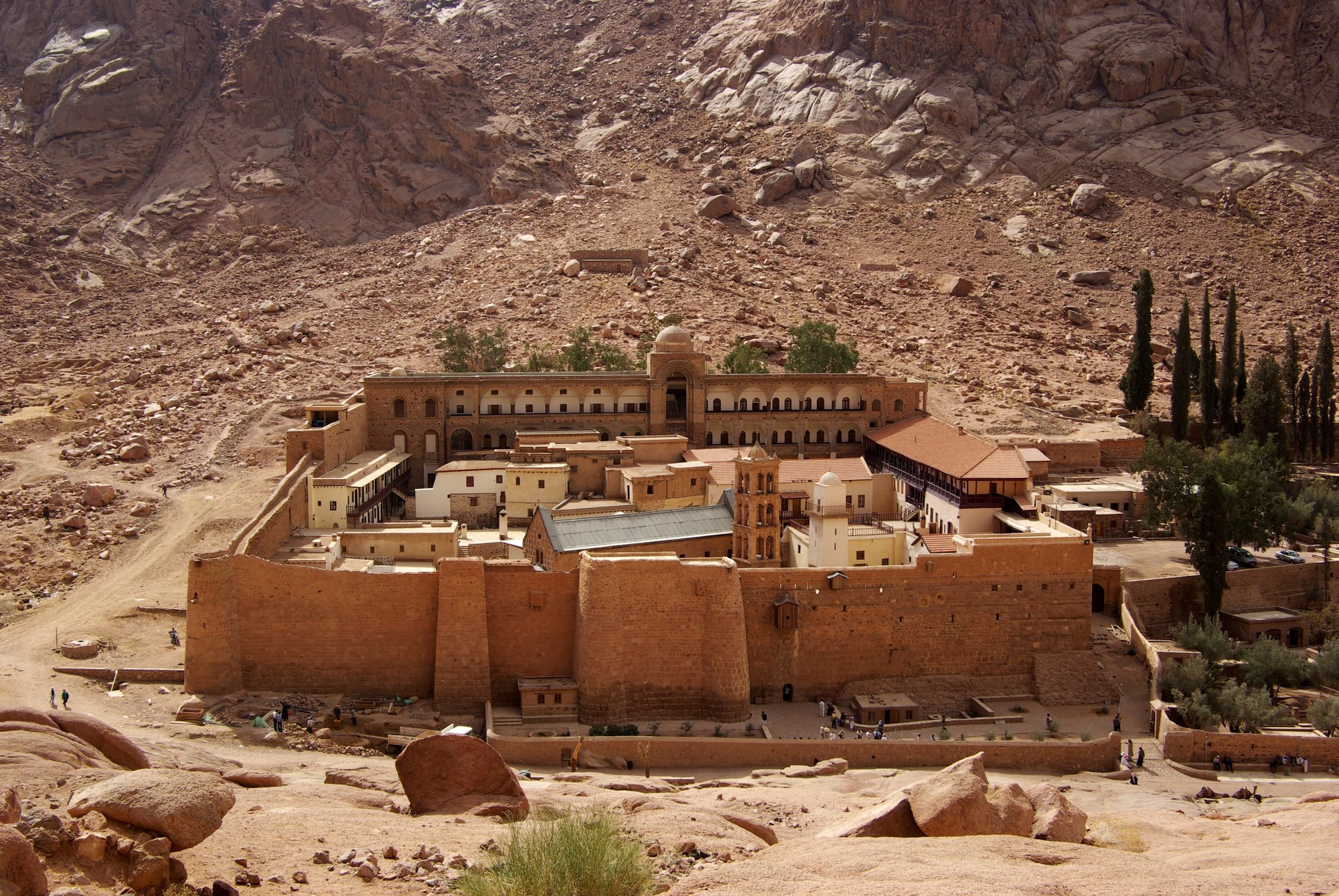
The fortified stone walls and bell tower of a monastery at the foot of bare, reddish granite mountains

Egypt

The Red Sea & Sinai

Saint Catherine's Monastery at the foot of Mount Sinai in the mountains of South Sinai. (Berthold Werner / Wikimedia Commons · CC BY-SA 3.0)

Egypt's eastern edge — the Sinai Peninsula between the Gulfs of Suez and Aqaba, the canal city of Suez, and the long Red Sea coast of the Eastern Desert down to the Sudanese border. Bare mountains, Bedouin country and coral reefs, now home to Egypt's biggest beach resorts, while North Sinai remains off-limits after years of insurgency.

Explore The Red Sea & Sinai

History

Sinai has been a land bridge and a borderland since the pharaohs sent expeditions to mine turquoise and copper at Wadi Maghara and Serabit el-Khadim, where a temple to Hathor still stands. The Bible places the Exodus and the giving of the Ten Commandments in its mountains, and in the 6th century the Byzantine emperor Justinian built the fortified monastery at the foot of the peak identified as Mount Sinai. On the Red Sea coast, Ptolemaic and Roman ports such as Berenice and Myos Hormos, near today's Quseir, traded with India and Arabia, supplied across the desert from the Nile, while Roman quarries such as Mons Claudianus worked the Eastern Desert's granite and porphyry.

Suez was the port for the Red Sea trade and the Hajj crossing, and in 1869 the Suez Canal made it a gateway of world shipping. Modern Sinai was then defined by war. Israel occupied the peninsula in 1967, the canal was closed until 1975, and in October 1973 Egyptian forces crossed the canal, a date still celebrated. Under the 1979 peace treaty, Israel withdrew from Sinai by 1982, and Taba followed after international arbitration in 1989.

Tourism grew from the 1980s, turning Hurghada and Sharm El Sheikh from fishing and military posts into resort cities. Bombings struck Taba, Sharm and Dahab between 2004 and 2006, and in 2015 a Russian airliner leaving Sharm was brought down by a bomb. From 2011 an insurgency spread in North Sinai, where the army fought Islamist militants, including an Islamic State affiliate, until the government declared an end to terrorism there in 2023. Sharm hosted the COP27 climate summit in 2022.

Culture & Customs

Sinai's original people are Bedouin tribes, each with its own territory: the Muzeina along the Gulf of Aqaba around Dahab and Nuweiba, the Jebeliya around St Catherine, traditionally linked to the monastery, and others across the centre and north. Their customs of hospitality, tribal law and tea around the fire continue, and many now run desert camps, guide treks and drive jeeps, though they also complain of being left out of the tourist economy. In the south of the Eastern Desert, the Ababda and Bishari keep their own nomadic culture.

St Catherine's Monastery is a living Greek Orthodox community that has been in continuous use for around 1,500 years. The Monastery of St Anthony in the Red Sea mountains is honoured as one of the first Christian monasteries, linked to the founder of monasticism.

The resort towns have a younger, more mixed culture of hotel staff from the Nile Valley, divers and foreign residents, with dress codes much looser than elsewhere in Egypt. Suez has an older working-class port identity and a tradition of simsimiyya music.

Daily Life

The region is thinly populated compared with the Nile Valley. Suez, with several hundred thousand people, is the largest city; Hurghada has grown into a large resort city; and Sharm El Sheikh, Dahab and Marsa Alam are much smaller, with most residents migrants from elsewhere in Egypt. El Arish is the main town of North Sinai.

Tourism is the main employer along the coast and in South Sinai, with diving, hotels, safaris and construction. Oil and gas from the Gulf of Suez, refineries at Suez and the port and industrial zone at Ain Sokhna matter too. The resorts are vulnerable to shocks, and the aftermath of the 2015 air crash emptied Sharm for years.

Life in North Sinai has been shaped by conflict, curfews and military operations, and much of the border town of Rafah was cleared for a buffer zone. The war in Gaza since 2023 has made the Rafah crossing a focus of aid and diplomacy.

In the far south of the Red Sea coast, Egypt administers the Hala'ib Triangle, which Sudan also claims.

Food

Bedouin cooking is the region's own. Bread is baked on a domed metal sheet or buried in embers in the sand. Goat and lamb, rice, lentils and dates are staples, and tea is brewed strong and sweet with wild herbs such as sage or mint gathered in the mountains.

On the coast the catch is Red Sea fish: grouper, snapper and parrotfish grilled whole, fried calamari and shrimp, and fish soups cooked with tomato and cumin, served in the fish restaurants of Hurghada's harbour, Quseir and Suez.

In the south, the Ababda and Bishari brew jebena, coffee roasted over coals, pounded with ginger and poured from a clay pot. The resorts serve international buffets, but Egyptian dishes such as koshari, fiteer and grilled kofta are easily found in the towns where staff live.

Attractions & Natural Wonders

The mountains of South Sinai centre on Mount Sinai, climbed by night on the camel path or the Steps of Repentance to watch the sunrise, and St Catherine's Monastery below it, with its Byzantine church, library and the bush identified as the Burning Bush. Surrounding peaks and wadis offer Bedouin-guided treks, and the temple of Serabit el-Khadim lies further west.

Sinai's coasts hold its best-known reefs. Ras Mohammed National Park guards the southern tip; Sharm El Sheikh has Naama Bay and the Strait of Tiran's reefs, with the Second World War wreck of the Thistlegorm near Ras Mohammed. Dahab has the Blue Hole, Nuweiba and Taba face the mountains of Saudi Arabia, and the Coloured Canyon lies inland.

On the mainland, Hurghada has boat trips to the Giftun Islands and neighbouring El Gouna has lagoons. Safaga and Quseir, with its old fort, lie south, and Marsa Alam and the Red Sea reefs beyond include Elphinstone and Wadi el-Gemal National Park, whose seagrass beds feed dugongs and green turtles. The monasteries of St Anthony and St Paul sit in the mountains above the Gulf of Suez. At the north end of the gulf, Suez has Port Tawfiq, where ships enter the canal, and the resorts of Ain Sokhna nearby.

Cities in The Red Sea & Sinai

Planning basics

Budget

The resorts are priced for package holidays: all-inclusive hotels in Sharm El Sheikh, Hurghada and Marsa Alam can be good value when booked with flights, but prices are often quoted in dollars or euros. Dahab is the budget exception, with cheap camps and guesthouses. Diving, boat trips and desert excursions are the main extra costs.

Daily Budget Midrange
USD 95–230 (resort hotel, restaurant meals, two dives or a boat trip, a St Catherine excursion)
Daily Budget Shoestring
USD 30–50 (Dahab camp or guesthouse, local restaurants, shared taxis, snorkelling from shore)

Compare dive centres on safety and equipment, not just price, and carry cash for Bedouin camps and park entry fees.

Safety

South Sinai's resorts and the Red Sea coast are heavily secured, and Sharm, Dahab, Hurghada and Marsa Alam receive millions of visitors. North Sinai is different: an insurgency by Islamist militants, some linked to the Islamic State, was fought there from 2011, and although the government declared an end to terrorism there in 2023, the area remains off-limits to visitors. The far south near the Sudanese border is also restricted. At sea, currents, boat traffic and occasional shark incidents are the main risks.

Stay out of North Sinai, use reputable dive and boat operators, never touch the coral or feed fish, and follow beach closures. Check current official travel advice before travelling.

Climate

Hot and very dry, with sunshine almost every day and a steady north wind that makes the coast feel cooler than the Nile Valley and draws kitesurfers and windsurfers. The sea stays warm enough for swimming all year. The mountains around St Catherine are much cooler, with freezing winter nights and occasional snow on the peaks.

Summer
hot, about 33–38°C on the coast, with sea temperatures near 28°C
Winter
mild and sunny, about 20–24°C by day on the coast; near or below freezing at night in the high mountains

Transportation

Sharm El Sheikh, Hurghada and Marsa Alam have international airports with many direct flights from Europe. Long-distance buses link the resorts with Cairo in roughly six to eight hours, crossing or tunnelling under the Suez Canal for Sinai. Within South Sinai, buses and taxis link Sharm, Dahab, Nuweiba and St Catherine, which is about two and a half hours from Sharm. Roads pass frequent checkpoints.

Carry a passport for the checkpoints, and note that the free Sinai-only entry stamp does not cover St Catherine or travel beyond the Aqaba coast resorts.

Best Time to Visit

The coast works all year. March to May and October to November have the best balance of warm sea and moderate heat, and these are the best months for hiking in the Sinai mountains. Summer is hot but good for diving, while winter brings European holidaymakers seeking sun, though the wind and cold nights can surprise.