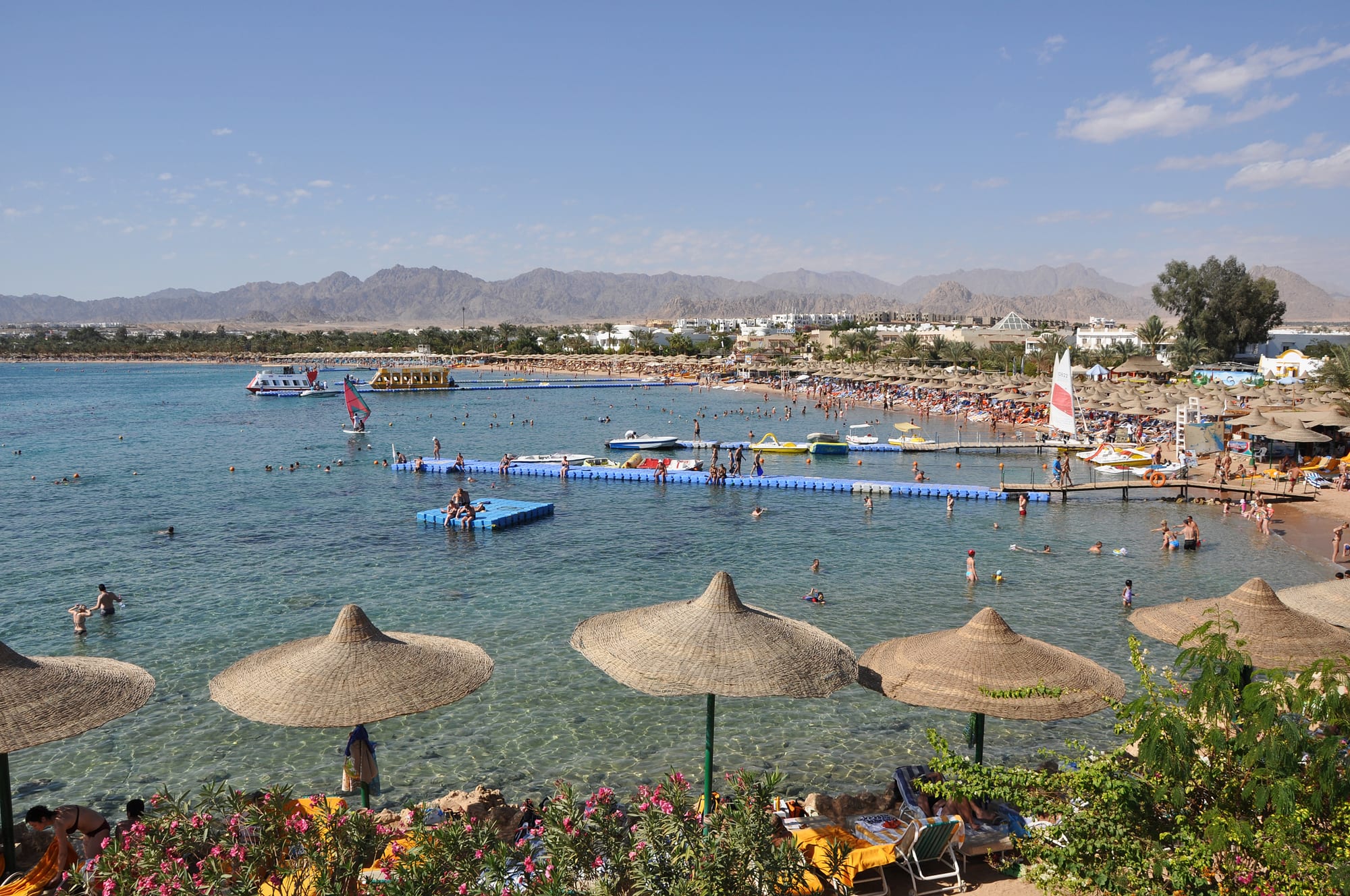
A curving bay of clear turquoise water lined with thatched parasols and hotels, with bare brown mountains behind

The Red Sea & Sinai, Egypt

Sharm El Sheikh

Naama Bay, the older hotel and nightlife strip of Sharm El Sheikh, with the Sinai mountains behind. (Marc Ryckaert / Wikimedia Commons · CC BY 3.0)

A major Red Sea resort, spread along the bays at the southern tip of the Sinai Peninsula where the Gulfs of Aqaba and Suez meet. A small fishing anchorage and military post until the 1980s, it grew into a city of hotel bays, dive boats and conference halls, with the reefs of Ras Mohammed and the Strait of Tiran a short boat ride offshore.

Neighbourhoods

  • Naama Bay
    • First-time visitors
    • Nightlife
    • Beaches

    The bay that made the resort's name, developed from the 1980s around a sheltered beach and a pedestrian promenade of cafés, bars, shops and hotels. It is the densest and busiest part of Sharm, and the easiest place to stay without a car.

    Open in Maps
  • Hadaba and Ras Um Sid
    • Beaches
    • Diving
    • Quiet and residential

    The raised plateau south of Naama Bay, ending at the headland and lighthouse of Ras Um Sid, where a reef wall runs close to shore. Hotels sit above low cliffs with stepped access to the water, and the streets behind them hold apartment blocks and small restaurants.

    Open in Maps
  • Old Market
    • Markets
    • Best for food
    • Local life

    The older town centre inland from the port, built around a bazaar street of spice and souvenir stalls, shisha cafés and fish restaurants. Prices are lower than in the hotel bays and much of the custom is local.

    Open in Maps
  • Sharks Bay and Nabq
    • Beaches
    • Families
    • Diving

    The stretch running north-east past the airport towards the Nabq protected area, where large all-inclusive resorts line a coast of shallow bays and fringing reef. It is spread out and quiet, and a taxi is needed for anywhere else.

    Open in Maps
  • Sharm El Maya
    • Harbour
    • Boat trips

    The old bay by the port, with the fishing and dive-boat harbour, the marina and a curve of sheltered beach. Most boat trips to Ras Mohammed and Tiran leave from here.

    Open in Maps

Things to do

Reefs and the sea

  • Ras Mohammed National Parkpark

    A national park at the tip of Sinai, a short drive south of the town, where coral walls drop into deep water at the meeting of the two gulfs.

    Open in Maps
  • Strait of Tiranattraction

    The narrow channel into the Gulf of Aqaba, north-east of the town, where four reefs rise mid-channel and carry some of the area's strongest currents and best-known dive sites.

    Open in Maps
  • Tiran Islandattraction

    An uninhabited island in the strait, transferred to Saudi sovereignty under a 2016 agreement, that forms the backdrop to most Tiran boat trips.

    Open in Maps
  • SS Thistlegormattraction

    A British merchant ship sunk in the Red Sea in 1941, still loaded with wartime motorcycles, trucks and rifles, and now a well-known wreck dive.

    Open in Maps
  • Nabq Protected Areapark

    A coastal reserve north of the airport with mangrove stands, sand flats and Bedouin settlements along the Gulf of Aqaba shore.

    Open in Maps

In town

  • Naama Baybeach

    The resort's original hotel bay, with a sheltered swimming beach and a pedestrian promenade of cafés, bars and shops behind it.

    Open in Maps
  • Sharm El Sheikh International Airporttransit hub

    The resort's airport, set between the hotel bays, which handles the charter and scheduled traffic that the town depends on.

    Open in Maps

Short trips

  • Saint Catherine's Monasterylandmark

    A fortified Greek Orthodox monastery in the mountains, inscribed as a UNESCO World Heritage Site in 2002, reached in roughly two and a half hours by road.

    Open in Maps
  • Mount Sinaitrail

    The 2,285 m peak traditionally identified with the giving of the Ten Commandments, climbed by night from the monastery for the sunrise.

    Open in Maps
  • Dahabneighborhood

    A smaller and far more relaxed coastal town about 80 km north-east up the Gulf of Aqaba, known for shore diving and Bedouin camps.

    Open in Maps
  • Coloured Canyontrail

    A narrow gorge in the mountains near Nuweiba, its walls banded in red, yellow and purple, walked on desert day trips.

    Open in Maps

Eat and drink

Long-standing places and food districts in Sharm El Sheikh. Hours, ratings and directions come from your maps app, always current.

Sharm classics

  • Old Market fish restaurantsneighborhood

    Red Sea grouper, snapper, calamari and shrimp, chosen from ice and grilled or fried, served with salads, tahina and baladi bread along the bazaar street.

    Open in Maps
  • Egyptian kitchens behind the baysneighborhood

    Koshari, ful and ta'meya, grilled kofta and shawarma in the plain workers' cafés of Hadaba and the residential streets, where most of the town's staff eat.

    Open in Maps

Cafés and markets

  • Naama Bay promenade cafésneighborhood

    Shisha, mint tea and thick Turkish-style coffee at pavement tables, alongside the international menus and beach bars of the resort strip.

    Open in Maps
  • Old Market bazaarmarket

    Spices, dried hibiscus for karkadeh, dates, nuts and sweets sold beside souvenir stalls in the town's oldest shopping street.

    Open in Maps

Experience Sharm El Sheikh

History

For most of its history the site was an anchorage rather than a town: a sheltered bay on an otherwise waterless stretch of coast, used by Bedouin of the Muzeina and by fishermen working the reefs. Its modern story is military. Egypt fortified the position to control shipping through the Strait of Tiran into the Gulf of Aqaba, and that control was one of the triggers of the 1967 war, after which Israel held the whole peninsula and began building the first small hotels and dive operations at what it called Ofira.

Egypt recovered Sharm El Sheikh under the 1979 peace treaty, with the withdrawal from Sinai completed in 1982, and set about turning it into a resort. Through the 1980s and 1990s Naama Bay filled with hotels, the airport was expanded, and international chains spread along the bays towards Nabq. Diving drove the growth: Ras Mohammed was protected as a national park in 1983, and the reefs at its tip and in the strait became some of the most visited in the world.

The town's later history has swung between prominence and crisis. It became a standing venue for international summits and Middle East peace talks, which gave it the nickname City of Peace, and hosted the COP27 climate conference in 2022. It was also struck by bombings in 2005, and the 2015 destruction of a Russian airliner shortly after take-off led to suspended flights that emptied the hotels for years. Each time, visitors have eventually returned to the reefs.

Culture & Customs

Sharm is not an old Egyptian town and does not behave like one. Almost everyone living here has come from somewhere else — from the Nile Valley and the Delta for hotel, construction and transport work, from Europe and Russia as dive instructors, guides and long-stay residents — and the local culture is the workplace culture of tourism, with Arabic, English and Russian all in daily use and signs in several alphabets.

Around and behind it are the Bedouin of South Sinai, whose tribal territories predate the resort by centuries. They run desert camps, guide treks and drive the jeeps on the quad and safari trips, and Bedouin tea brewed with wild herbs, served seated on cushions in a wool tent, is one of the few pieces of local tradition that visitors meet directly. Complaints that the tribes were left out of the tourist economy are long-standing.

Manners follow the resort rather than the country: swimwear on the beach, late dinners and open nightlife along the Naama Bay promenade. A short walk inland the norms are Egyptian again, with modest dress, the call to prayer from the Old Market mosque, and the rhythm of Ramadan, when the town's workers fast through hot days and the cafés fill after sunset. Diving gives the place a further culture of its own: early mornings, boat routines and reef etiquette that insists nothing is touched or taken.

Daily Life

Roughly 75,000 people live in Sharm El Sheikh, a number that rises and falls with the tourist season and with the fortunes of the airport. Almost all of them work directly or indirectly in tourism: hotels, restaurants, dive centres, boat crews, taxis, shops and the construction sites that keep extending the resort along the coast. Staff housing and the ordinary shops, bakeries and clinics are concentrated in Hadaba and the inland districts behind the Old Market, well away from the seafront that visitors see.

Everything here has to be brought in or made. Fresh water comes from desalination, food and building materials arrive by road from the Nile Valley, and power and waste are constant pressures on a settlement of this size in a desert. Water use, coastal building and the damage that anchors, sunscreen and careless divers do to the reefs are recurring local arguments, since the reefs are the town's entire livelihood.

The working day starts early, because dive boats and desert trips leave at dawn, and pauses in the heat of the afternoon before the promenades come alive in the evening. The town's exposure to outside shocks is its defining feature: after the 2015 air disaster, and again during the disruption to regional aviation that followed the war beginning in February 2026, hotels stood half empty and workers went home to their villages until flights returned.

Food

Sharm's everyday cooking is Red Sea seafood. Grouper, snapper, sea bream, calamari and shrimp are grilled over charcoal or fried and served whole with tahina, baba ghanoush, rocket salad, pickles and flat baladi bread — the standard table of the Old Market fish restaurants, where the catch is usually picked from ice at the front. Sayadeya, fish baked or stewed with spiced rice, onions and tomato, is the local one-dish version.

Behind the beachfront the food is plain Egyptian, because that is what the workforce eats: koshari, the bowl of rice, macaroni, lentils, chickpeas, fried onions and spiced tomato sauce; ful medames, slow-cooked fava beans scooped up with bread at breakfast; ta'meya, the Egyptian falafel made from fava rather than chickpea; and grilled kofta, shawarma and roast chicken from street grills. Fiteer, a layered flaky pastry served sweet or savoury, is a common late-night order.

Bedouin cooking appears mostly on desert trips: bread baked on a domed metal sheet or buried in embers, goat or chicken cooked slowly over coals, rice, and strong sweet tea flavoured with sage or wild mint. Drinks elsewhere run from karkadeh, the tart hibiscus infusion drunk hot or iced, and fresh mango, guava and sugarcane juice, to the imported wines, spirits and Egyptian beer served in the hotels and along the promenade.

Planning tools

Budget

Sharm is built around package holidays, and an all-inclusive hotel booked with flights is usually the cheapest way to stay. Prices are often quoted in dollars or euros. Diving, boat trips to Ras Mohammed or Tiran, desert excursions and the long taxi rides between bays are the main extra costs, and food and drink outside the hotels are far cheaper in the Old Market than on the resort strips.

Daily Budget Midrange
USD 95–230 (resort hotel, restaurant meals, two dives or a boat trip, a St Catherine excursion)
Daily Budget Shoestring
USD 35–60 (budget hotel or hostel away from the beach, Egyptian cafés, shared minibuses, shore snorkelling)

Agree taxi fares before setting off, carry cash for national park entry fees and Bedouin camps, and compare dive centres on safety and equipment rather than price.

Best Time to Visit

The coast works all year. March to May and October to November give the best balance of warm sea and moderate heat. Summer is very hot on land but good underwater, and winter brings sunshine, cooler evenings and a north wind that can chill a boat deck. The war that began in February 2026 has disrupted aviation and tourism across the region.

Suggested Number of Days

Three or four days suit a first stay on the bays and reefs. Divers and anyone adding the Sinai mountains or a neighbouring coastal town need six to eight. Distances between the bays, and the early starts that boat and desert trips require, stretch the total.

First Visit
3–4 days
With Surroundings
6–8 days

Transportation

The resort runs for tens of kilometres along the coast, and almost all movement between the bays is by taxi, hotel shuttle or the shared blue minibuses that work the main road. Boats leave from the harbour at Sharm El Maya for the reefs. Buses link the town with Dahab, Nuweiba, St Catherine and Cairo, and roads out of the resort pass frequent checkpoints.

Taxis are not metered, so settle the price first; carry a passport for road checkpoints outside the resort.

Airport & Station Connections

Sharm El Sheikh International Airport sits among the hotel bays about ten kilometres from Naama Bay and takes direct charter and scheduled flights from Europe as well as domestic services from Cairo. Buses from Cairo take roughly seven to eight hours, tunnelling under the Suez Canal, and about two and a half hours reach St Catherine. Aviation across the region has been disrupted by the war that began in February 2026, so flights are less predictable than before.

Walkability

Individual districts walk well — the Naama Bay promenade, the Old Market street and the seafront paths inside each hotel area — but the resort as a whole does not. The bays are separated by kilometres of desert road with little shade and few pavements, so walking between them is unpleasant and in summer unwise.

Safety

South Sinai's resorts are heavily secured and Sharm receives millions of visitors a year. Bombings struck the town in 2005 and other Sinai resorts between 2004 and 2006, and in 2015 a Russian airliner leaving Sharm was brought down by a bomb; security at the airport and on the approach roads has been tight since. North Sinai remains off-limits to visitors. The everyday risks are sea-related — currents, boat traffic and occasional shark incidents — along with heat, sunburn and persistent sales pressure on the promenades.

Stay out of North Sinai, use reputable dive and boat operators, never touch the coral or feed fish, and follow beach closures. Check current official travel advice before travelling.

Climate

Hot desert beside a warm sea, with sunshine almost every day, negligible rain and a steady north wind that takes the edge off the heat. Sea temperatures stay swimmable all year, and the mountains inland are much cooler than the coast.

Summer
hot, about 33–38°C by day, with sea temperatures near 28°C and warm nights
Winter
mild and sunny, about 20–24°C by day, cooler and breezy after dark

Local Customs

Dress codes in the resort are much looser than elsewhere in Egypt: swimwear is normal on hotel beaches, but modest clothing covering shoulders and knees is expected in the Old Market, in the town's residential streets and at the mosque. Alcohol is served in hotels, bars and licensed restaurants but not in the plain local cafés. During Ramadan many Egyptians fast by day and eating or drinking in the street is best avoided; resort restaurants continue as usual.

Small tips are expected for most services; ask before photographing people, and do not photograph the airport, checkpoints or military installations.

Common Payment Methods

The currency is the Egyptian pound, which has been devalued repeatedly, so check the rate rather than trusting an old figure. Hotels, dive centres and larger restaurants take cards and often quote in dollars or euros; the Old Market, taxis, minibuses and tips need cash in pounds. ATMs are common in Naama Bay, Hadaba and the Old Market.