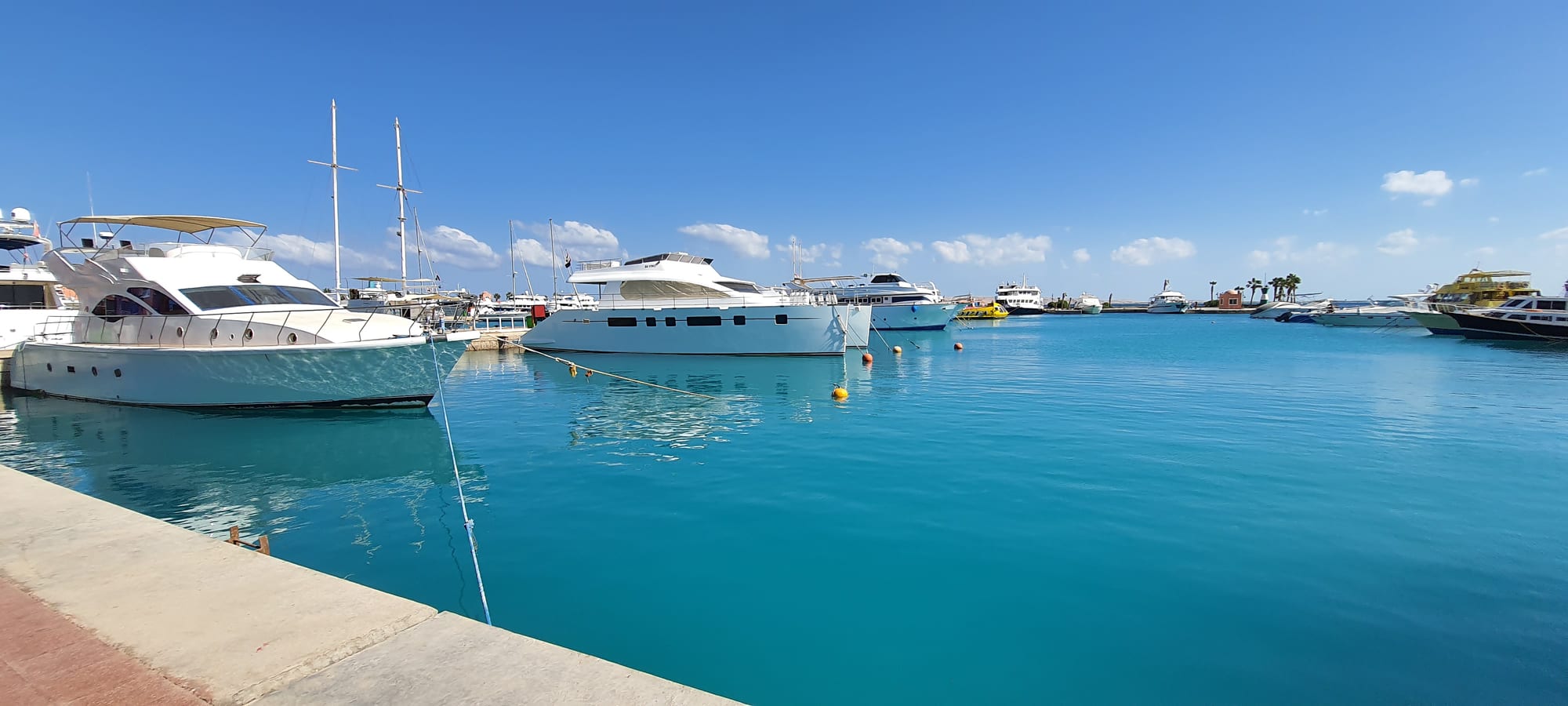
White motor yachts moored along a quay in bright turquoise water under a clear sky

The Red Sea & Sinai, Egypt

Hurghada

The marina at Hurghada, where dive boats and yachts moor along the quay. (1stTam3r / Wikimedia Commons · CC BY-SA 4.0)

The main resort city of Egypt's mainland Red Sea coast, strung for tens of kilometres along a desert shore facing reef islands. Founded as a small fishing and oil settlement early in the twentieth century, it grew from the 1980s into a city of hotels, dive boats and marinas, with an old inland quarter that still works to its own rhythm.

Neighbourhoods

  • El Dahar
    • Historic district
    • Markets
    • Local life

    The inland quarter set back from the sea at the city's northern end, with the bazaar, the mosque, public squares and the cheapest hotels and restaurants. It is where most residents live and shop, and the least resort-like district in Hurghada.

    Open in Maps
  • Sekalla and the marina
    • First-time visitors
    • Nightlife
    • Best for food

    The central strip along Sheraton Road, running down to the marina with its promenade of restaurants, cafés and moored dive boats. This is the busiest visitor district, dense with shops, bars and mid-range hotels within walking distance of one another.

    Open in Maps
  • Village Road and the southern hotel strip
    • Beaches
    • Families
    • Diving

    The long run of large beachfront resorts south of the centre, set on their own bays behind gates. Quiet and self-contained, with private beaches and house reefs, but a taxi ride from any shop or restaurant that is not a hotel's.

    Open in Maps
  • Sahl Hasheesh and Makadi Bay
    • Beaches
    • Quiet and residential

    Purpose-built resort bays south of the airport, each a separate development of hotels around a crescent of sand, roughly 25 to 30 km from the city centre. They have promenades and dive centres of their own and little else.

    Open in Maps
  • El Gouna
    • Watersports
    • Quiet and residential

    A privately developed resort town about 20 km north, built on islands and lagoons linked by bridges, with marinas and watersports centres. It functions as a separate place with its own centre rather than a suburb.

    Open in Maps

Things to do

Islands and the sea

  • Giftun Islandsattraction

    Two protected islands about 12 km offshore, with fringing reefs, sandbanks and day-trip beaches, reached by boats from the marina.

    Open in Maps
  • SS Carnaticattraction

    A British steamship wrecked in 1869 on a reef north of the city, one of several cargo ships lost there and now among the region's best-known wreck dives.

    Open in Maps
  • Shadwan Islandattraction

    A barren rocky island some 16 km long, the largest of the group at the mouth of the Gulf of Suez, with reefs and a lighthouse.

    Open in Maps
  • Sahl Hasheeshneighborhood

    A purpose-built resort bay about 25 km south of the centre, laid out around a crescent of sand with a promenade and house reefs.

    Open in Maps
  • Makadi Bayneighborhood

    Another self-contained resort bay further south, built on an empty shore and used mainly as a base for beach days and diving.

    Open in Maps

In the city

  • Hurghada Grand Aquariumattraction

    Egypt's largest aquarium, opened in 2015 in the Magawish area on the southern side of the city, with a shark tunnel, a rainforest section and an animal zoo.

    Open in Maps
  • Hurghada International Airporttransit hub

    Egypt's second-busiest airport, set inland a few kilometres south-west of El Dahar and handling most of the charter and scheduled traffic that brings visitors to the Red Sea coast.

    Open in Maps

Short trips

  • El Gounaneighborhood

    A resort town of lagoons, bridges and marinas about 20 km north, known for diving and watersports.

    Open in Maps
  • Mons Claudianuslandmark

    A Roman quarry of dark granodiorite with a fortified settlement in the Eastern Desert, which supplied columns for imperial buildings in Rome, among them the portico of the Pantheon, and is reached on a desert trip inland.

    Open in Maps
  • Safaganeighborhood

    A port and quieter resort town about 55 km south, known for its black sands, phosphate harbour and steady wind for watersports.

    Open in Maps
  • Mons Porphyriteslandmark

    The imperial Roman quarry in the mountains north-west of the city, the only known source of the purple porphyry used across the Roman Empire.

    Open in Maps

Eat and drink

Long-standing places and food districts in Hurghada. Hours, ratings and directions come from your maps app, always current.

Hurghada classics

  • El Dahar fish restaurantsneighborhood

    Red Sea grouper, snapper, calamari and shrimp grilled or fried to order and served with tahina, salads and baladi bread, in the plainer restaurants of the old quarter.

    Open in Maps
  • Sheraton Road kitchensneighborhood

    The central strip's mix of Egyptian grills, shawarma counters, pizza and international menus aimed at visitors, busiest in the evening.

    Open in Maps

Markets and cafés

  • El Dahar bazaarmarket

    Spices, dates, nuts, dried hibiscus and household goods sold beside souvenir stalls in the old quarter's shopping streets.

    Open in Maps
  • Marina promenade cafésneighborhood

    Shisha, mint tea and coffee at tables along the harbour front, alongside the bars and seafood restaurants facing the moored boats.

    Open in Maps

Experience Hurghada

History

Hurghada began early in the twentieth century as a small settlement where fishing families and Bedouin used a sheltered anchorage, and it grew first on oil rather than tourism: the fields discovered in the Gulf of Suez in the 1910s made it a company town of rigs, pipelines and workers' housing, with El Dahar as its inland centre. It remained obscure, hot and remote, several hundred kilometres from the Nile Valley across empty desert.

Diving changed it. The Red Sea reefs off the town drew scientific interest and then foreign divers, and the sheltered islands offshore gave boats an easy cruising ground. From the 1980s the Egyptian government promoted the coast for mass tourism, and international investment built hotels at an extraordinary pace: Hurghada spread south from El Dahar along the shore in a continuous line of resorts, with new bays such as Sahl Hasheesh and Makadi Bay developed from nothing, and El Gouna laid out on the lagoons to the north.

The city's population multiplied many times over within a generation, drawing workers from the Nile Valley and the Delta and residents from Europe and Russia. Growth has come with costs, and reef damage, unregulated building and water supply have all been long-running concerns. Like the rest of the coast, Hurghada has been shaken repeatedly by outside events — the aftermath of the 2015 air disaster on the Sinai side, the pandemic, and the regional disruption to aviation since the war that began in February 2026 — and each time has rebuilt its visitor numbers.

Culture & Customs

Hurghada has two cultures side by side. El Dahar is an Egyptian provincial town: families from Upper Egypt and the Delta, coffee houses full of men watching football, a weekly rhythm built around Friday prayers, and shopping in the bazaar. The seafront south of it is an international resort where Russian, German, Polish, Czech and English are heard as often as Arabic, menus are translated four ways, and the norms are those of a holiday rather than a country.

The original inhabitants of this coast are Bedouin of the Eastern Desert, and further south the Ababda, whose camps, camel herding and desert knowledge now support safari and trekking trips. Bedouin hospitality — tea brewed strong and sweet with wild herbs, bread baked on a domed metal sheet, guests seated on cushions — is the tradition most visitors encounter, though the tribes remain on the margins of the tourist economy.

Diving gives the city a further identity of its own: instructors and boat crews from a dozen countries, early-morning departures, and an etiquette that insists nothing on the reef is touched, fed or taken. Around them a long-established community of foreign residents has settled, running dive centres, restaurants and watersports schools, and giving Hurghada a more permanent international character than most Egyptian towns of its size.

Daily Life

Hurghada is the largest city of the Red Sea Governorate, whose population passed 400,000 in the early 2020s, and the great majority of its residents arrived within the past few decades from elsewhere in Egypt. Tourism employs most of them directly or indirectly — hotels, restaurants, dive centres, boat crews, taxis, shops and the constant construction that pushes the city further along the coast — while fishing, the Gulf of Suez oil industry and the port provide the rest. Residents live mainly in El Dahar and the inland districts behind the resorts, where the schools, clinics, markets and workshops are.

Everything the city consumes is imported across the desert or made on site: fresh water comes from desalination, vegetables and building materials arrive by road from the Nile Valley, and power and waste treatment struggle to keep pace with growth. The reefs that pay for it all are under pressure from anchors, sewage, landfill for new beaches and sheer numbers of swimmers, and marine protection rules on the islands are tightened periodically in response.

The working day begins before dawn for boat crews and runs late for restaurant and hotel staff, with a long pause through the hottest hours. Seasons matter more than months: the city fills with European visitors in winter and with Egyptian families in summer, and empties whenever flights are disrupted, as they were after the regional disruption to aviation that followed the war beginning in February 2026.

Food

Seafood is the city's own cooking. Grouper, snapper, sea bream, calamari and shrimp, bought from the harbour and grilled over charcoal or fried, come with tahina, baba ghanoush, rocket, pickles and flat baladi bread; sayadeya, fish baked with spiced rice, onions and tomato, is the local one-dish version, and fish soup flavoured with cumin and tomato is common in the old quarter.

Away from the seafront the food is standard Egyptian and cheap: koshari, the bowl of rice, macaroni, lentils, chickpeas, fried onions and spiced tomato sauce; ful medames, slow-cooked fava beans eaten at breakfast with bread; ta'meya, the Egyptian falafel made from fava beans rather than chickpeas; grilled kofta, shawarma and roast chicken; and fiteer, a layered flaky pastry served sweet or savoury. Sweets run to basbousa, konafa and syrup-soaked pastries, sold by weight in El Dahar's bakeries.

Drinks are tea, heavily sugared and often flavoured with mint, and thick coffee with cardamom, with karkadeh, the tart hibiscus infusion, drunk hot in winter and iced in summer, and fresh mango, guava and sugarcane juice from street stalls. Hotels and licensed restaurants serve Egyptian beer, local wine from the Mediterranean coast and imported spirits, and the bars along the marina stay open late.

Planning tools

Budget

Hurghada is one of the cheapest beach destinations on the Mediterranean or Red Sea when booked as a package with flights, and the wide choice of hotels keeps prices down. Independent travellers find good value in El Dahar. Diving, boat trips to the islands, kitesurfing tuition and desert excursions are the main extra costs, and hotel drinks cost far more than those in town.

Daily Budget Midrange
USD 95–230 (resort hotel, restaurant meals, two dives or a boat trip, a desert excursion)
Daily Budget Shoestring
USD 30–55 (simple hotel in El Dahar, local restaurants, shared minibuses, shore snorkelling)

Agree taxi fares before setting off, carry cash in pounds for El Dahar and island park fees, and compare dive centres on safety and equipment rather than price.

Best Time to Visit

The coast works all year. March to May and October to November have the best balance of warm sea and moderate heat. Summer is very hot on land though fine underwater, and winter is sunny and mild by day with a strong north wind that suits kitesurfers but makes boat decks cold. The war that began in February 2026 has disrupted aviation and tourism across the region.

Suggested Number of Days

Three or four days cover the city, a boat trip and some time on a reef. Divers, kitesurfers and anyone adding the desert or the coast further south want six to eight. The long distances between the hotel strips and the early starts for boats stretch the total.

First Visit
3–4 days
With Surroundings
6–8 days

Transportation

The built-up coast runs for more than 30 km, and movement between El Dahar, the centre and the southern resorts is by taxi, hotel shuttle or the shared minibuses that work the main road for a few pounds a ride. Boats to the islands and reefs leave from the marina and the harbour. Long-distance buses connect the city with Cairo, Luxor and the coast south, and roads out of town pass checkpoints.

Taxis are not metered, so agree the fare first; the shared minibuses are cheap but stop constantly and are simplest along the main coast road.

Airport & Station Connections

Hurghada International Airport lies a few kilometres south of the centre and takes direct charter and scheduled flights from across Europe as well as domestic services from Cairo. Buses reach Cairo in roughly six hours and Luxor in four to five, and a ferry has at times crossed the Gulf of Suez. Aviation across the region has been disrupted by the war that began in February 2026, so flights are less predictable than before.

Walkability

El Dahar and the Sekalla–marina strip are both walkable in themselves, and the marina promenade is pleasant on foot. The city as a whole is not: several kilometres of busy road separate the districts, pavements are patchy, and the southern resorts are isolated by design, so almost every journey between areas needs a taxi or minibus.

Safety

Hurghada is heavily secured and receives millions of visitors a year, and serious crime against them is rare. The everyday problems are traffic on the main coast road, persistent sales pressure from shops and excursion touts, heat and sunburn. At sea the risks are currents, boat traffic and occasional shark incidents, and beaches are sometimes closed as a precaution. North Sinai, across the gulf, remains off-limits to visitors.

Stay out of North Sinai, use reputable dive and boat operators, never touch the coral or feed fish, and follow beach closures. Check current official travel advice before travelling.

Climate

Hot desert beside a warm sea, with sunshine almost every day, almost no rain and a persistent north wind that cools the shore and drives the kitesurfing. Sea temperatures allow swimming all year, and humidity is lower than on Egypt's Mediterranean coast.

Summer
hot, often above 33°C by day, with sea temperatures near 28°C
Winter
mild and sunny, about 20–24°C by day, noticeably cooler and windy after dark

Local Customs

Resort dress codes are relaxed — swimwear is normal on hotel beaches — but El Dahar is an ordinary Egyptian district where covered shoulders and knees are expected, more so for women. Alcohol is served in hotels, bars and licensed restaurants, not in local cafés. During Ramadan many residents fast by day, so eating, drinking or smoking in the street is best avoided, while hotel restaurants carry on as usual.

Small tips are expected for most services; ask before photographing people, bargain politely in the bazaar, and do not photograph the airport, port or checkpoints.

Common Payment Methods

The currency is the Egyptian pound, devalued repeatedly in recent years, so check the rate rather than trusting an old figure. Hotels, dive centres and larger restaurants take cards and often quote in euros or dollars; the bazaar, taxis, minibuses and tips need cash in pounds. ATMs are common in El Dahar, along Sheraton Road and at the marina.