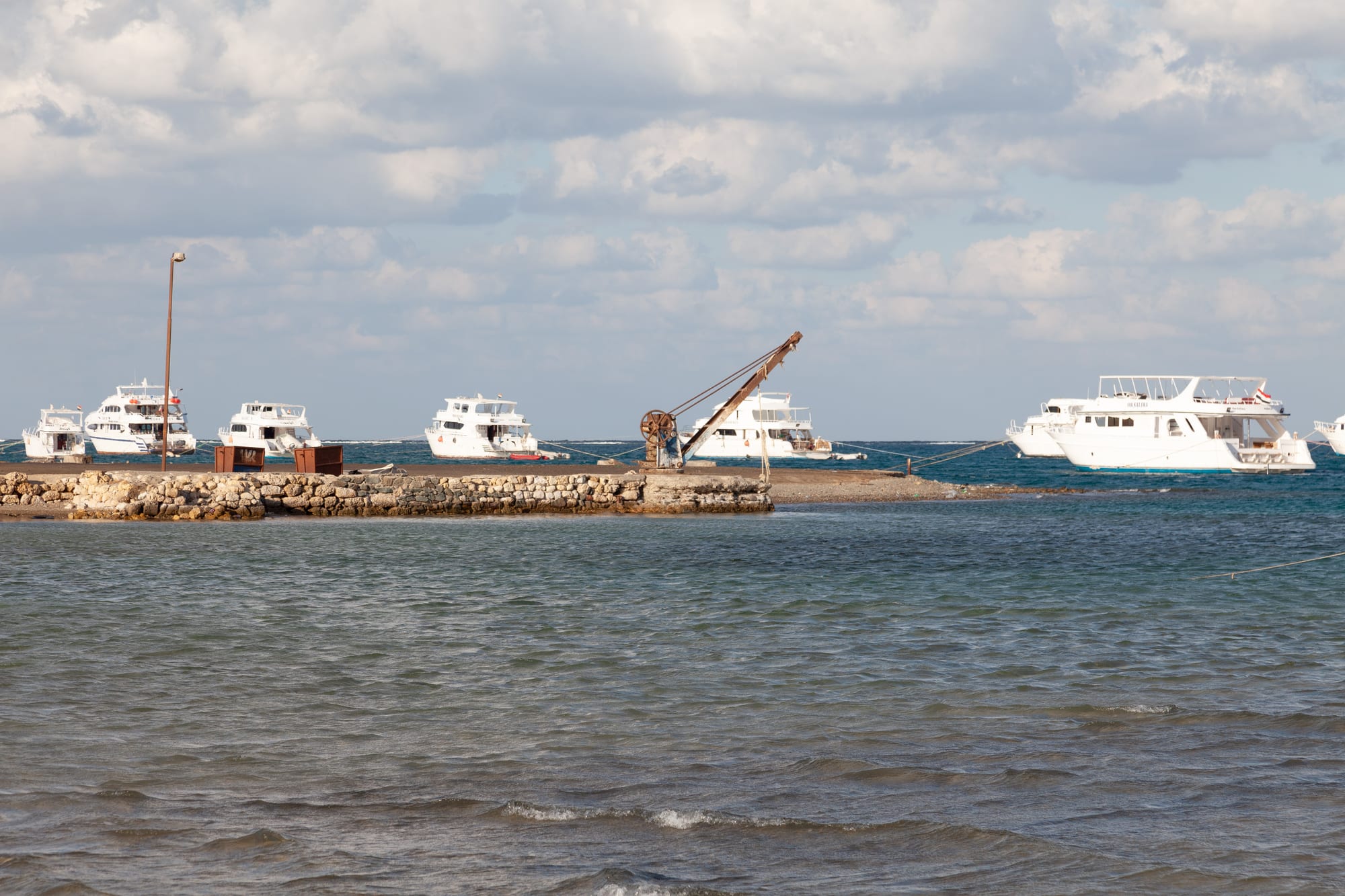
White dive and fishing boats moored behind a low stone breakwater on a windy stretch of Red Sea coast

The Red Sea & Sinai, Egypt

Marsa Alam

Boats moored on the coast at Marsa Alam on Egypt's southern Red Sea shore. (Roland Unger / Wikimedia Commons · CC BY-SA 4.0)

A small town and a scattered line of resorts on the southern Red Sea coast of Egypt, several hundred kilometres below Hurghada where the Eastern Desert mountains come down to the sea. Long a fishing and mining settlement, it was opened to tourism by an airport in 2003 and is known for quiet reefs, seagrass bays and a desert hinterland.

Neighbourhoods

  • Marsa Alam town
    • Local life
    • Markets
    • Best for food

    The small working settlement at the harbour, with a mosque, shops, cheap restaurants, the bus stop and the road junction inland towards Edfu. Few visitors stay here, but it is where residents shop and where the coast's plainest and cheapest food is found.

    Open in Maps
  • Port Ghalib
    • First-time visitors
    • Marina
    • Close to the airport

    A purpose-built marina town beside the airport, about 65 km north of the town, with a promenade of shops and restaurants around a sheltered basin, hotels behind it and dive boats on the quay. It is the nearest thing on this coast to a centre.

    Open in Maps
  • The northern bays
    • Beaches
    • Diving
    • Quiet and residential

    The string of resort bays running north past Abu Dabbab and Marsa Mubarak towards Port Ghalib, each a hotel or two on its own beach with a house reef and seagrass offshore. Self-contained and widely spaced, with desert in between.

    Open in Maps
  • The southern coast
    • Diving
    • Quiet and residential
    • Nature

    The stretch running south past Wadi El Gemal towards Hamata, thinly built with small eco-lodges and dive camps, mangrove-lined lagoons and Ababda Bedouin settlements. The most remote part of the coast and the least developed.

    Open in Maps

Things to do

Reefs and the sea

  • Elphinstone Reefattraction

    A standalone reef about 30 km north of the town, rising from open water with steep walls and soft corals, dived from day boats and exposed to strong currents.

    Open in Maps
  • Samadai Reef (Dolphin House)attraction

    A horseshoe-shaped reef about 3 km offshore and some 30 km south-east of the town, reached on day trips, where a pod of around 150 spinner dolphins regularly comes in.

    Open in Maps
  • Abu Dabbabbeach

    A bay and reef group about 30 km north of the town, also called Marsa Murena and one of the best-known beaches on this coast, known for sea turtles, with dugongs and dolphins often seen.

    Open in Maps
  • Marsa Mubarakbeach

    A bay, also called Marsa Mares, a few kilometres south of Port Ghalib beside Fayrouz Beach, one of the bays at the northern end of the resort coast, close to the airport.

    Open in Maps

Desert and nature

  • Wadi El Gemal National Parkpark

    A large protected area of desert mountains, wadis, mangrove lagoons and islands south of the town, whose seagrass beds feed dugongs and green turtles.

    Open in Maps
  • Mons Smaragdus emerald mineslandmark

    The emerald workings in the mountains inland, the oldest known in the world and in Roman times the only emerald mines in the empire, with ruins of miners' settlements and temples in the valleys.

    Open in Maps

In town and short trips

  • Marsa Alam International Airporttransit hub

    The airport that opened this coast to tourism in 2003, set a few kilometres inland from Port Ghalib and handling charter and scheduled flights from Europe.

    Open in Maps
  • Port Ghalibattraction

    A marina development around a sheltered basin, with a promenade of shops, restaurants and moored dive boats.

    Open in Maps
  • Berenicelandmark

    The ruins of a Ptolemaic and Roman harbour far down the coast, founded in 275 BC by Ptolemy II and named after his mother, and long a gateway for trade with Arabia, India and East Africa.

    Open in Maps

Eat and drink

Long-standing places and food districts in Marsa Alam. Hours, ratings and directions come from your maps app, always current.

Marsa Alam classics

  • Harbour fish restaurantsneighborhood

    Red Sea fish and calamari fried or grilled and served with rice, tahina, salad and baladi bread in the plain restaurants of the town beside the fishing harbour.

    Open in Maps
  • Port Ghalib marina restaurantsneighborhood

    The promenade's mix of seafood, Egyptian grills and international menus, the widest choice on a coast where most people eat in their hotel.

    Open in Maps

Cafés and markets

  • Marsa Alam town cafés and shopsmarket

    Small grocers, bakeries and juice stalls supplying the coast, with tea and shisha at pavement tables where drivers, fishermen and hotel staff gather.

    Open in Maps
  • Bedouin tea and breadneighborhood

    On desert trips, Ababda and Bedouin hosts bake bread on a domed metal sheet or in embers and brew tea strong and sweet with wild herbs.

    Open in Maps

Experience Marsa Alam

History

This coast has been worked far longer than it has been visited. The Eastern Desert behind Marsa Alam holds gold workings dating back to pharaonic times, and in the Ptolemaic and Roman periods the mountains inland were the empire's only known source of emeralds, mined in valleys that the Romans called Mons Smaragdus, where the ruins of miners' settlements and small temples survive. Down the coast, the port of Berenice, founded in 275 BC, shipped elephants, spices and Indian Ocean trade goods to the Nile by desert road.

For centuries this was a watering place and anchorage on the route between the desert mines, the Nile Valley and the sea crossing to Arabia. The people of the surrounding desert are the Ababda, one of the Beja peoples, whose camel herding and knowledge of the wadis long made the interior passable. Into the twentieth century the settlement lived on fishing and mining traffic, and remained one of the most isolated places in Egypt, hundreds of kilometres from any city.

Tourism arrived late and quickly. Divers had long reached the southern reefs by liveaboard, but the town was a long drive from anywhere until an airport opened inland in 2003, after which resorts were built along the bays and the marina town of Port Ghalib rose beside the runway. Wadi El Gemal was declared a national park in 2003, and the coast has since marketed itself on quiet reefs and wildlife rather than nightlife, though building has spread and the pressure on the reefs has grown with it.

Culture & Customs

The desert people give Marsa Alam a character unlike the resorts further north. The Ababda, and the Bishari further south, are Beja peoples of the Eastern Desert, traditionally camel herders and guides, with their own language alongside Arabic, their own poetry and music, and a coffee ritual — jebena, beans roasted over coals, pounded with ginger and poured in a thin stream from a clay pot — that is offered to guests as a matter of course. Many now work in the parks, lodges and safari businesses, or keep herds inland while a relative works on the coast.

The resort population is Egyptian, drawn from the Nile Valley towns a few hours inland and from Cairo, and the visitor population is heavily European, with German, Italian, Czech, Polish and Russian common on the promenades. Because hotels here are widely separated, the culture of the coast is quieter and more domestic than in Hurghada: diving, early nights and hotel terraces rather than bars and clubs.

Conservation has become part of the local identity. Dugongs, turtles, spinner dolphins, mangroves and seagrass meadows are the coast's selling point, and protected-area rules govern where boats may moor, how close swimmers may come to resting dolphins at Samadai and the other offshore reefs, and what may be taken from the reef. Guides and dive centres enforce these more visibly than elsewhere in Egypt, and nothing on the reef is touched, fed or collected.

Daily Life

Marsa Alam is small: the town and the long stretch of coast administered with it count only about 11,500 residents, many of them workers who have come from the Nile Valley for hotel, construction and transport jobs and who live in staff housing or in the town rather than by the sea. Fishing continues from the harbour, mining and quarrying still employ people inland, and the airport, the port and the resorts provide almost everything else.

Supply is the defining problem of daily life. Fresh water is desalinated or trucked, food and materials come by road from Edfu and the Nile or from Hurghada, and electricity and medical care are thinner than anywhere further north, so serious illness means a journey. Roads are long and empty, mobile signal fails in the wadis, and hotel staff often work long rotations before travelling home inland.

The Ababda live between two worlds, with herds and family in the desert and wage work on the coast, and their settlements south towards Wadi El Gemal and Hamata have schools and clinics of their own. Development is the recurring argument here: new resorts and roads bring jobs but eat into grazing land, mangroves and reef, and the region has swung between construction booms and the empty seasons that follow disruptions to flights, most recently with the effects of the war that began in February 2026.

Food

Fish is the local food. Grouper, snapper, emperor and calamari come from the harbour, fried or grilled over charcoal and served with rice, tahina, salad, pickles and baladi bread; sayadeya, fish baked with spiced rice, onions and tomato, is the standard one-dish meal, and fish soup with cumin and tomato is common in the town's restaurants.

Inland cooking is Ababda and Bedouin: bread baked on a domed metal sheet or buried in embers, goat or chicken cooked slowly over coals, rice, lentils and dates, with tea brewed strong and sweet and flavoured with wild herbs. Jebena, the ginger-spiced coffee poured from a clay pot, is the drink of the desert and is offered on every trip inland.

The workforce's own food is plain Egyptian and easily found in the town: koshari, the bowl of rice, macaroni, lentils, chickpeas, fried onions and spiced tomato sauce; ful medames, slow-cooked fava beans eaten at breakfast with bread; ta'meya, the fava-bean falafel; grilled kofta, shawarma and roast chicken. Sweets are syrup-heavy — basbousa, konafa and dates — and the usual drinks are heavily sugared tea, cardamom coffee, karkadeh, the tart hibiscus infusion, and mango and guava juice, with the hotels and marina serving Egyptian beer, local wine and imported spirits.

Planning tools

Budget

Almost everyone here stays in an all-inclusive resort booked with flights, which is comfortably the cheapest way to visit; there is little independent accommodation and few places to spend money outside the hotels. Diving, boat trips to the offshore reefs, protected-area fees and desert excursions are the real extra costs, along with taxis on a coast where distances are long.

Daily Budget Midrange
USD 95–230 (resort hotel, restaurant meals, two dives or a boat trip, a desert or Wadi El Gemal excursion)
Daily Budget Shoestring
USD 35–60 (simple hotel or dive camp, local restaurants in town, shore snorkelling, shared transport)

Carry cash in pounds for park and marine-reserve fees, taxis and tips, since card acceptance thins out quickly away from the hotels and the marina.

Best Time to Visit

The coast works all year and is warmer in winter than Hurghada or Sinai. March to May and October to November are the most comfortable. Summer is very hot on land but excellent underwater, and winter is sunny and mild by day with a cool north wind. The war that began in February 2026 has disrupted aviation and tourism across the region.

Suggested Number of Days

Four or five days suit a first stay on the reefs and bays. Divers, and anyone adding the national park, the desert or the coast further south, want a week to ten days. The long drives between bays and the early starts for boats make short stays feel rushed.

First Visit
4–5 days
With Surroundings
7–10 days

Transportation

There is no public transport along the coast to speak of: the resorts are strung over more than 100 km of desert road, and movement between them is by hotel shuttle, taxi or organised excursion. Boats to the offshore reefs leave from Port Ghalib and the harbour. Long-distance buses run north to Hurghada and inland to Edfu and the Nile Valley, and the road passes checkpoints.

Taxis are not metered, so agree the fare first, and expect a long journey for anything beyond the next bay; hiring a car is rare and fuel stops are widely spaced.

Airport & Station Connections

Marsa Alam International Airport, inland from Port Ghalib and about 65 km north of the town, takes charter and scheduled flights from Europe and domestic services from Cairo; transfers to the southern hotels can take two hours or more. Buses reach Hurghada in roughly four hours and the Nile at Edfu, inland across the desert, in three to four. Aviation across the region has been disrupted by the war that began in February 2026, so flights are less predictable than before.

Walkability

Marsa Alam is not a place for walking. Port Ghalib's marina promenade and the small town centre are pleasant on foot, but the resorts are isolated bays separated by kilometres of desert highway with no pavements or shade. Almost every journey beyond a hotel's own beach needs a vehicle.

Safety

The coast is quiet, heavily policed and among the least troubled parts of Egypt for visitors, with resorts set apart from any town. The far south towards the Sudanese border is restricted, and North Sinai, far to the north, remains off-limits. The practical risks are in the water and the desert: currents on the offshore reefs, boat traffic, occasional shark incidents, and heat, sun and dehydration on excursions. Medical facilities are limited and serious cases are moved to Hurghada or Cairo.

Stay out of North Sinai, use reputable dive and boat operators, never touch the coral or feed fish, and follow beach closures. Check current official travel advice before travelling.

Climate

Hot desert beside a warm sea, with sunshine almost every day and virtually no rain, although rare storms can send flash floods down the wadis. Being further south, it is hotter in summer and milder in winter than the rest of Egypt's Red Sea coast, and a north wind blows most afternoons.

Summer
very hot, often above 35°C by day, with sea temperatures near 29°C
Winter
warm and sunny, about 23–26°C by day, cooler at night and in the desert

Local Customs

Resort dress codes are relaxed and swimwear is normal on hotel beaches, but the town and the Ababda and Bedouin settlements are conservative, and covered shoulders and knees are expected there. Alcohol is served in hotels and licensed restaurants only. During Ramadan many residents fast by day, so eating, drinking or smoking in the street is best avoided, while hotel restaurants carry on as usual.

Small tips are expected for most services; ask before photographing people, especially Bedouin families, and do not photograph the airport, port or checkpoints.

Common Payment Methods

The currency is the Egyptian pound, devalued repeatedly in recent years, so check the rate rather than trusting an old figure. Hotels, dive centres and the marina take cards and often quote in euros; the town, taxis, park fees and tips need cash in pounds. ATMs are concentrated at Port Ghalib and in the town, and can run empty, so it is worth carrying a reserve.