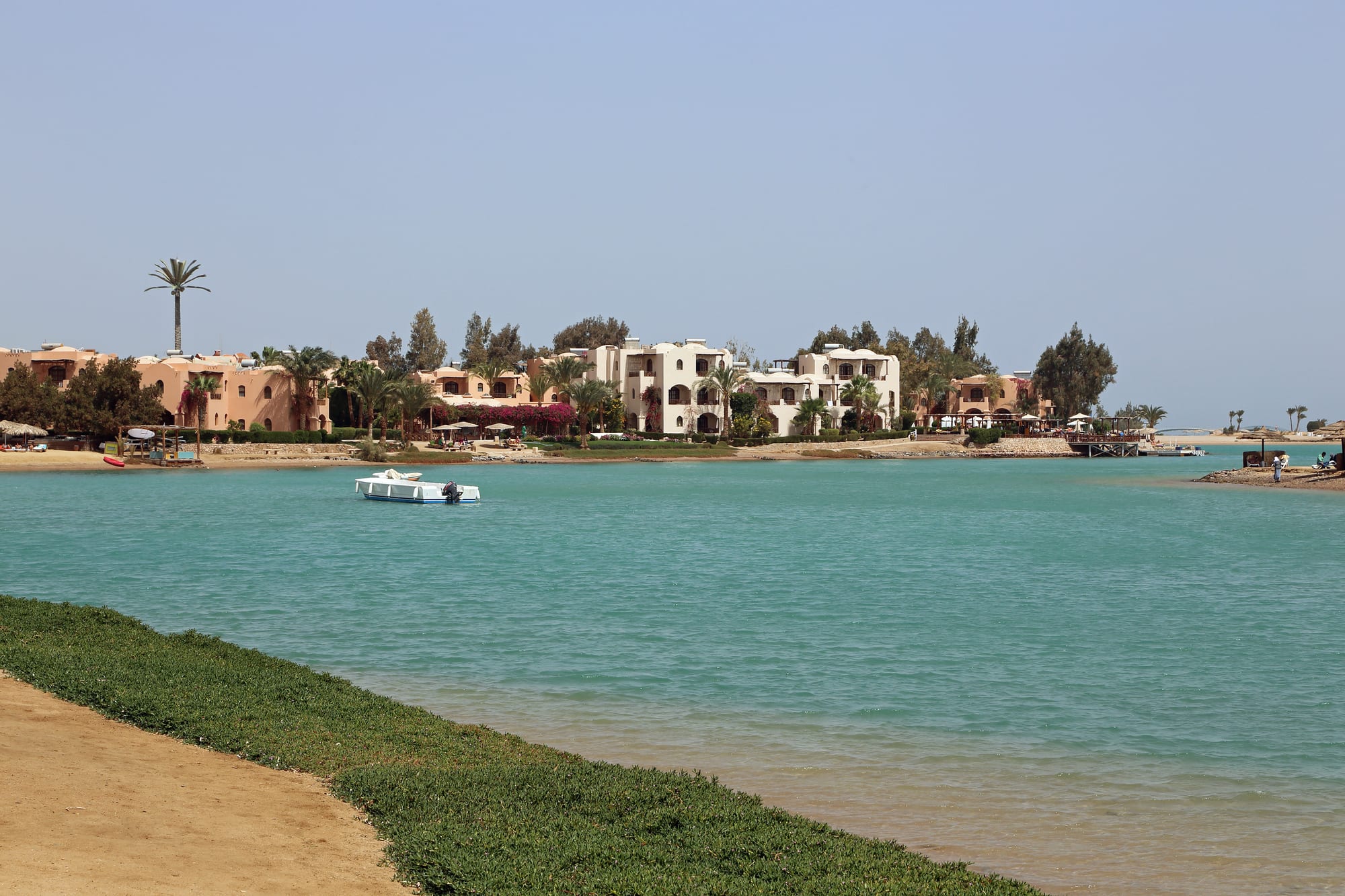
Sand-coloured low-rise buildings and palms along the far shore of a turquoise lagoon, with a small white boat on the water

The Red Sea & Sinai, Egypt

El Gouna

Low-rise buildings and palms along one of El Gouna's lagoons on the Red Sea coast. (Marc Ryckaert / Wikimedia Commons · CC BY-SA 4.0)

A purpose-built resort town on Egypt's Red Sea coast about 20 kilometres north of Hurghada, created in 1990 by Samih Sawiris's company Orascom Development on a stretch of desert shore cut into islands and lagoons. Low sand-coloured buildings, marinas, a golf course and shallow water have made it a base for diving, kitesurfing and long off-season stays.

Neighbourhoods

  • Downtown
    • First-time visitors
    • Best for food
    • Nightlife

    The town's centre, built around a square of arcaded shops, restaurants and cafés in the same sand-coloured style as the rest of the resort. It holds most of the everyday shops and the bars that stay busy after dark, and is small enough to cross on foot.

    Open in Maps
  • The marinas
    • Waterfront
    • Boats and diving
    • Bars

    The yacht harbours on the southern side of the town, lined with quayside restaurants, dive and boat operators and apartments overlooking the moorings. Boats for reef trips and fishing leave from here, and the promenades are the main evening walk.

    Open in Maps
  • The lagoon islands
    • Quiet and residential
    • Swimming

    Housing laid out on artificial islands and low ridges between the water channels, reached by causeways or by the small water taxis that work the lagoons. It is residential and quiet, with private jetties and shallow, sheltered water rather than shops.

    Open in Maps
  • The northern beaches
    • Beaches
    • Kitesurfing
    • Water sports

    The open coast at the north end of the town, where steady wind and flat shallow water have made the resort a centre for kitesurfing. Beach clubs, kite schools and a long sand strip face the Red Sea and the mountains behind Hurghada.

    Open in Maps

Things to do

Waterfront and water sports

  • Abu Tig Marinaattraction

    The best known of the town's three marinas, with berths for large boats, quayside restaurants and the departure point for most reef and fishing trips.

    Open in Maps
  • The lagoonsattraction

    A network of dredged saltwater channels and artificial islands that gives most of the town water frontage, crossed by bridges and small ferries.

    Open in Maps
  • Kitesurfing beachesbeach

    Flat, shallow water and a dependable north wind on the open coast north of town, used by kite schools through most of the year.

    Open in Maps
  • Red Sea reefs offshoreattraction

    Coral reefs and wrecks within a short boat ride, dived and snorkelled from the marinas; the same waters serve Hurghada to the south.

    Open in Maps

Short trips from the town

  • Hurghadaneighborhood

    The much larger resort city down the coast, with the international airport, a working fishing harbour, markets and the mainland's biggest choice of boat trips.

    Open in Maps
  • Giftun Islandsattraction

    Two islands off Hurghada, the larger of them protected, with beaches and reef diving, reached on day boats from the harbours along this coast.

    Open in Maps
  • Eastern Desert mountainsattraction

    The bare granite ranges inland from the coast, visited on desert excursions to Bedouin camps and old quarry country.

    Open in Maps

Seasonal events

  • El Gouna Film FestivalOctober

    An international film festival founded in 2017 and held in the town, screening Arab and international features and documentaries.

  • Kitesurfing seasonspring to autumn

    The windiest months bring competitions and clinics to the beaches north of the town, along with most of the kiting crowd.

  • European winter seasonDecember to February

    Mild, sunny weather fills the hotels and marinas with visitors from Europe, and the restaurants and bars are at their busiest.

Eat and drink

Long-standing places and food districts in El Gouna. Hours, ratings and directions come from your maps app, always current.

Food districts

  • Downtown restaurantsneighborhood

    The arcaded square and the lanes around it hold the widest choice in town, from Egyptian grills and seafood to pizza, sushi and shawarma counters.

    Open in Maps
  • Abu Tig Marina quaysideneighborhood

    Tables along the harbour wall, mostly seafood, Italian and international menus, with the evening crowd walking between them.

    Open in Maps
  • Hurghada's fish market and harbour restaurantsneighborhood

    Down the coast, the simplest Red Sea eating: fish and prawns bought by weight and grilled or fried to order, in a working port rather than a resort.

    Open in Maps

Egyptian classics nearby

  • Koshari and ful countersrestaurant

    Cheap Egyptian staples — koshari, ful medames and ta'meya — sold at small counters used mostly by the people who work in the resort.

    Open in Maps

Experience El Gouna

History

El Gouna is one of the youngest towns in Egypt. The site was empty desert and salt flats between the Red Sea and the Eastern Desert mountains until the company Orascom Development, run by Samih Sawiris, began building a holiday town there, and the resort was founded in 1990. Rather than a single hotel strip, the plan cut channels into the flat shore so that seawater filled a series of lagoons, leaving islands linked by bridges, and set low sand-coloured buildings with domes, arches and wind towers along the water in a style borrowed loosely from Nubian and Mediterranean building.

The resort grew steadily through the 1990s and 2000s as hotels, marinas, a golf course and housing were added, and it became a town with its own schools, clinics, staff housing and, between 2012 and 2022, a satellite campus of the Technical University of Berlin. Abu Tig Marina opened as its yacht harbour and two more marinas followed; the resort has its own small airport, while almost all arrivals use Hurghada's airport instead.

Tourism on this coast has had hard years — the fall in visitors after the 2011 revolution, the loss of the Russian and later other charter markets, and the pandemic — and El Gouna, with a large share of privately owned second homes and long-stay residents, came through them better than the big package resorts. From 2017 the El Gouna Film Festival brought an international audience each autumn, and the town has since built a reputation for water sports, particularly kitesurfing, and for remote workers wintering on the Red Sea.

Culture & Customs

The town has no old culture of its own: everyone who lives here came from somewhere else. The permanent population is largely Egyptians from Cairo, the Delta and Upper Egypt who work in hotels, restaurants, construction and boats, alongside a settled foreign community of Germans, Russians, Italians, Britons and others who own or rent property, and a floating crowd of divers, kitesurfers and seasonal staff. English is used constantly, German and Russian are common, and Egyptian Arabic is the language of the back streets and staff quarters.

What passes for local tradition is built around the water and the wind. Diving and kitesurfing set the rhythm of the day for many residents, the marinas fill in the evening, and sporting events draw regular crowds. The El Gouna Film Festival, held each October since 2017, gives the town an annual week of screenings and industry talk that is unusual for a resort of this size, and the El Gouna International, a men's and women's squash tournament played here each April, reflects Egypt's strength in that sport.

Social rules are looser than anywhere else on the coast except the Sinai camps — alcohol is served openly, swimwear is normal by the water — but this is still Egypt, and the staff who serve visitors live by ordinary Egyptian norms. Visitors who dress reasonably away from the beach, greet people with as-salamu alaykum and tip small amounts often are treated accordingly.

Daily Life

El Gouna's resident population is small — a couple of thousand villas and apartments and the staff who serve them — with many times that number passing through in the high season. Nearly all work is tourism or property: hotels, restaurants, dive and kite centres, boat crews, gardeners and maintenance teams, estate agents and the building trade, plus the schools, clinic and services that keep a self-contained town running. Staff housing and a workers' district sit inland from the water, away from the visitors' side of town.

Life here is quieter and more ordered than in an Egyptian town of comparable size. There is little through traffic, the streets are swept, water and power are managed by the developer, and the whole place is designed to be crossed by bicycle or shuttle bus. Food shopping and banking are Downtown, and a short drive brings the bigger supermarkets, hospitals and markets of Hurghada.

The pressures are those of a manufactured town on a desert coast: everything depends on the visitor season and on flights from Europe, water has to be produced and treated, the lagoons need constant management to stay clean, and building has continued along the shore on both sides. Longer-stay foreign residents have grown in number since remote work became common, which has pushed up rents and changed the mix of people in the town outside the summer months.

Food

Food in El Gouna is international before it is Egyptian: Italian, Levantine, Asian, seafood and grill menus fill the Downtown square and the marina quays, and most kitchens are aimed at visitors. Red Sea fish is the thing worth ordering — grouper, snapper, sea bream and calamari, grilled whole with lemon, cumin and garlic, or fried, with tahina, salads and warm flatbread alongside. Prawns cooked in tomato and chilli are a standard of the coast.

Egyptian staples are easy to find if sought out, mostly where the staff eat: koshari, the bowl of rice, macaroni, lentils, chickpeas, fried onions and spiced tomato sauce that is the national cheap meal; ful medames, slow-cooked fava beans eaten for breakfast with bread and oil; ta'meya, the Egyptian falafel made from fava beans rather than chickpeas; and shawarma and kofta from grills along the back streets. Fiteer, a layered pastry served sweet or savoury, turns up in the bakeries.

Drinking follows the resort's own rules. Egypt's own beer and wine are sold openly in the hotels and bars, which is not true of most towns on the mainland, and the cafés serve strong sweet tea, mint tea, Turkish-style coffee and fresh mango, guava and sugarcane juice. Karkadeh, chilled hibiscus, is the common non-alcoholic drink in the heat, and dates and syrup-soaked pastries such as basbousa and konafa appear wherever Egyptian sweets are sold.

Planning tools

Budget

El Gouna is one of the more expensive places on the Egyptian coast. It was built as a resort and prices in the marinas and Downtown are set for foreign visitors and well-off Egyptians rather than for local wages. Accommodation, diving and kitesurfing are the main costs; eating where the staff eat, and using the shared buses rather than taxis, brings the daily figure down sharply.

Daily Budget Midrange
USD 110–240 (resort hotel, restaurant meals, two dives or a boat trip, some water sports)
Daily Budget Shoestring
USD 45–75 (simple room or shared flat, local food, shuttle buses, shore snorkelling)

Prices are often quoted in euros or dollars in the marinas but bills are settled in pounds; carry cash for buses, taxis and the smaller cafés.

Best Time to Visit

The coast works all year. March to May and October to November give warm sea and moderate heat, and are the most comfortable months for walking around the town. Summer is hot but the sea breeze takes the edge off it, and the water is warm for diving. Winter is mild and sunny by day, cooler after dark, and busy with European visitors.

Suggested Number of Days

Two or three days are enough for a first visit. Allow four to six to include diving courses, kitesurfing lessons or trips down the coast. Many visitors come for a week or more and treat the resort as a base rather than a stop.

First Visit
2–3 days
With Surroundings
4–6 days

Transportation

The town is small and mostly flat, and getting about is done on foot, by bicycle, by the tuk-tuks and shuttle buses that circulate between the marinas, Downtown and the hotels, and by small boats across the lagoons. Taxis and ride-hailing link the resort with Hurghada. There is no need for a hire car unless the plan includes long drives along the coast.

Agree the fare before getting into a tuk-tuk or taxi, and check when the last shuttle bus of the night runs if staying away from the centre.

Airport & Station Connections

Hurghada International Airport, about 25 kilometres away, is the way in for almost everyone, with charter and scheduled flights from Europe and domestic flights from Cairo; the transfer takes roughly 30 to 45 minutes. Long-distance buses run from Cairo to Hurghada in around six hours, crossing the Eastern Desert. Aviation across the region has been disrupted by the war that began in February 2026, so flights to the resorts are less predictable than before.

Walkability

Downtown and each marina are pleasant to walk, with shaded arcades, pavements and little traffic, but the districts are separated by water and stretches of desert road, so most trips between them use a bus, tuk-tuk or bicycle. Shade is limited in the middle of the day from May to September.

Safety

The resort is enclosed, patrolled and generally very safe, and serious crime against visitors is rare. The practical risks are on and in the water: currents and boat traffic outside the lagoons, sunburn and dehydration, and coral cuts. Road traffic on the coastal highway is fast, and the region's wider situation affects flights rather than the town itself.

Stay out of North Sinai, use reputable dive and boat operators, never touch the coral or feed fish, and follow beach closures. Check current official travel advice before travelling.

Climate

Hot desert climate on the sea, with sunshine almost every day, very little rain and a steady north wind that makes the air feel cooler than the figures suggest and keeps the kitesurfers busy. The sea is warm enough for swimming all year.

Summer
hot, usually about 33–38°C by day, with sea temperatures near 28°C and a strong afternoon breeze
Winter
mild and sunny, about 20–24°C by day and cooler at night, with sea temperatures around 22°C

Local Customs

Dress codes inside the resort are far looser than in the rest of Egypt: swimwear is normal on the beaches and around the marinas, though covering shoulders and knees is polite in shops and in the workers' districts. Alcohol is served openly in hotels, bars and restaurants here, which is not the case in most Egyptian towns. Most residents are Egyptians from the Nile Valley working in tourism, and Ramadan changes their working hours even though the resort keeps running.

Small tips are expected for almost every service; ask before photographing staff or local families, and keep beachwear for the beach.

Common Payment Methods

The currency is the Egyptian pound. Cards are accepted in hotels, restaurants and larger shops, and ATMs are easy to find in Downtown and at the marinas, but cash is needed for buses, tuk-tuks, small cafés and tips. Prices are sometimes advertised in euros or dollars.