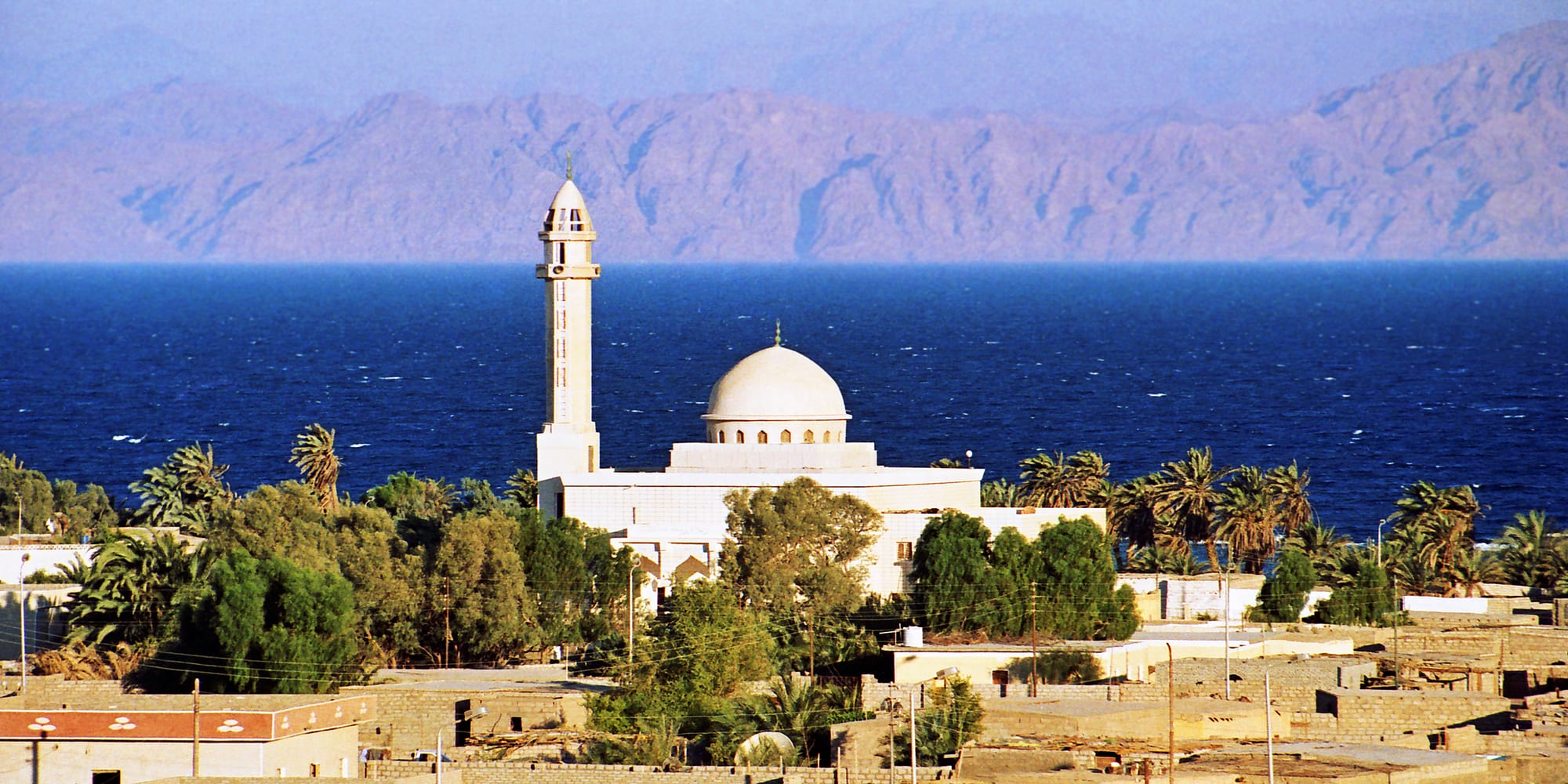
A white mosque with a dome and slender minaret among palms in a low-rise town, with deep blue sea and high mountains behind

The Red Sea & Sinai, Egypt

Dahab

Dahab on the Gulf of Aqaba, with the mountains of Saudi Arabia across the water. (Dr. Ondřej Havelka (cestovatel) / Wikimedia Commons · CC BY-SA 4.0)

A small town on the Gulf of Aqaba coast of South Sinai, between bare mountains and a reef that begins a few metres from the shore. Once a Bedouin fishing settlement, it grew from the 1980s into a low-rise resort of camps, guesthouses and dive centres, far quieter and cheaper than the large hotel bays further south.

Neighbourhoods

  • Masbat and the Lighthouse
    • First-time visitors
    • Best for food
    • Diving

    The centre of visitor life: a pedestrian seafront promenade of restaurants, cafés, dive centres and small hotels running north from the bridge, with cushioned terraces facing the water and the reef entry points a few steps away.

    Open in Maps
  • Assalah
    • Local life
    • Quiet and residential

    The largely Bedouin quarter behind and north of the promenade, where much of the town's population lives. Plain streets of low houses, small shops and workshops, with cheap guesthouses and camps among them.

    Open in Maps
  • Mashraba
    • Beaches
    • Quiet and residential
    • Budget stays

    The stretch south of the bridge, with beach camps, guesthouses and small hotels along a quieter seafront. It has its own row of restaurants and shops and is a short walk from the centre.

    Open in Maps
  • The Lagoon and Dahab City
    • Watersports
    • Families

    The shallow flat-water lagoon at the southern end of town, used for windsurfing and kitesurfing, with larger hotels beside it. Dahab City, known in Arabic as Medina, the administrative quarter inland, holds the bus station, banks and government offices.

    Open in Maps

Things to do

Reefs and the sea

  • Blue Holeattraction

    A submarine sinkhole about 10 km north of town, roughly 100 m deep, famous for shallow snorkelling above its rim and notorious for the deaths of divers who have attempted its deep arch.

    Open in Maps
  • Dahab lagoonbeach

    The shallow, flat lagoon at the south end of town, sheltered by a sandspit and used for windsurfing, kitesurfing and beginner lessons.

    Open in Maps

Desert and mountains

  • Ras Abu Galumpark

    A stretch of mountain and coast north of the Blue Hole, reached on foot, by camel or by boat, with Bedouin camps, empty beaches and reef close to shore.

    Open in Maps
  • Coloured Canyontrail

    A narrow sandstone gorge in the mountains inland, banded red, yellow and purple, about 90 km north near Nuweiba and walked on desert excursions from the coast.

    Open in Maps
  • Nuweibaneighborhood

    A quiet coastal town about 65 km north, with beach camps, a ferry port for Aqaba in Jordan and views across the gulf to Saudi Arabia.

    Open in Maps

Short trips

  • Saint Catherine's Monasterylandmark

    A fortified Greek Orthodox monastery in the high mountains, built between 548 and 565 and inscribed as a UNESCO World Heritage Site in 2002, reached by road across the mountains inland.

    Open in Maps
  • Mount Sinaitrail

    The 2,285 m peak traditionally identified with the giving of the Ten Commandments, climbed by night for the sunrise on the camel path or the Steps of Repentance.

    Open in Maps
  • Ras Mohammed National Parkpark

    A national park at the southern tip of the peninsula, protected since 1983, where reef walls drop into deep water at the meeting of the two gulfs.

    Open in Maps
  • Sharm El Sheikhneighborhood

    The large resort city about 80 km south by road, with the nearest international airport and the reefs of Ras Mohammed and Tiran.

    Open in Maps

Eat and drink

Long-standing places and food districts in Dahab. Hours, ratings and directions come from your maps app, always current.

Dahab classics

  • Masbat seafront restaurantsneighborhood

    Grilled Red Sea fish, calamari, shrimp and mezze served at low cushioned tables along the water, alongside the pizza, curries and breakfasts that long-staying divers have made standard here.

    Open in Maps
  • Assalah Bedouin kitchensneighborhood

    Plain, cheap Egyptian and Bedouin food inland from the promenade — ful, ta'meya, koshari, grilled chicken and chicken or goat with rice — where residents rather than visitors eat.

    Open in Maps

Cafés and markets

  • Mashraba beach cafésneighborhood

    Mint tea, shisha, juices and coffee at open-air terraces on the quieter southern seafront, popular in the long afternoon gap between dives.

    Open in Maps
  • Dahab's shops and stallsmarket

    Small grocers, bakeries and fruit and vegetable stalls supplying the town, together with the souvenir, spice and Bedouin craft shops along the promenade.

    Open in Maps

Experience Dahab

History

Dahab — the name means gold in Arabic — was for centuries a Bedouin settlement of the Muzeina tribe, whose families fished the gulf, kept goats and grew date palms in the oasis behind the shore. The reef offshore made for good fishing and terrible harbours, and the town remained tiny and almost unreachable except by boat or desert track, with the mountains of Saudi Arabia visible across the water.

Its modern history begins with the 1967 war, after which Israel held Sinai until the withdrawal completed in 1982 under the peace treaty of 1979. During those years the bay became known to travellers as a cheap and beautiful stop on the overland route, and a reputation for palm-frond huts, hashish and long stays attached itself to the place and lasted for decades. After Egypt's return, the government developed the coast, laid a road from Sharm El Sheikh, and built the lagoon-side hotels and the administrative quarter of Dahab City.

Diving turned the village into a town. Shore-entry sites — the reef along the promenade, the Canyon, the Blue Hole up the coast — made it a place where people came to train cheaply and stay, and freediving later added to that. Growth brought hotels, apartment blocks and a population many times the original. The bombings of April 2006 and the later collapses in tourism hurt the town badly, but its long-stay visitors, divers and climbers have kept returning, and Dahab has stayed low-rise and small where the rest of the coast built upward.

Culture & Customs

The town has an unusual mix for Egypt. The Muzeina Bedouin are the original inhabitants and still own much of the land and many of the camps; Egyptians from the Nile Valley and the Delta run most of the restaurants, hotels and shops; and a resident foreign community of dive and freedive instructors, yoga teachers and long-stayers gives the promenade its distinctly unhurried, international character. Arabic, English and Russian are all heard daily.

Bedouin customs remain visible. Hospitality is a duty — tea brewed strong and sweet with wild sage or mint, offered to any guest — and tribal law still settles many local disputes. Camel handling, goat herding and desert knowledge underpin the trekking and camp business, and women's craftwork, beadwork and embroidery are sold along the seafront. The tribes' complaint that they take too small a share of the tourist economy is long-standing here as elsewhere in Sinai.

Daily manners are more relaxed than in most of Egypt, with beachwear on the promenade and mixed evening crowds in the cafés, yet Dahab is still a religiously observant small town: the mosque's call to prayer sets the day, Ramadan changes the hours of everything, and modest dress inland is simply good manners. The diving culture adds its own rules — nothing on the reef is touched, fed or taken — and the pace of life, built around morning dives, an afternoon pause and long evenings at low tables by the water, is what most visitors remember.

Daily Life

Dahab remains a small town, its permanent population swelled by seasonal workers and long-staying visitors. Most people live in Assalah and in the inland streets of Dahab City rather than on the seafront, and almost every household depends on tourism: dive centres, camps and hotels, restaurants, pick-up taxis, desert guiding and the building trade. Fishing, once the whole economy, now supplies mainly the local restaurants.

The town is supplied from outside. Water comes from desalination and tankers, food and materials by road from Sharm El Sheikh and the Nile Valley, and electricity through a single line down the coast, so shortages and cuts are part of ordinary life. Building has spread up the wadis behind the town, and the flash floods that occasionally pour down them are a real hazard. Reef damage from snorkellers, boats and construction is a constant argument in a place whose entire livelihood sits a few metres offshore.

The day starts early, with dive boats and jeeps leaving at first light, pauses through the heat of the afternoon, and comes alive again after sunset, when the promenade fills and the tables by the water stay busy late. The town empties whenever the region's tourism falters — after the 2006 bombings, after the loss of a Russian airliner over Sinai in 2015, and again with the disruption to regional aviation following the war that began in February 2026.

Food

Eating in Dahab happens mostly at low tables on the seafront, and the food reflects who lives here. Red Sea fish — grouper, snapper, sea bream — comes grilled whole with tahina, baba ghanoush, rocket, pickles and baladi bread, with calamari and shrimp alongside; sayadeya, fish baked with spiced rice, onions and tomato, is the local one-dish version.

Bedouin cooking is the town's other tradition, met on desert trips and in the camps: bread baked on a domed metal sheet or buried in embers, goat or chicken cooked slowly over coals with rice, lentils, and strong sweet tea flavoured with sage, mint or other herbs gathered in the mountains. Dates from the oasis palms are a staple.

Plain Egyptian food fills the rest of the table and the cheaper streets inland: koshari, the bowl of rice, macaroni, lentils, chickpeas, fried onions and spiced tomato sauce; ful medames, slow-cooked fava beans at breakfast; ta'meya, the Egyptian falafel made from fava rather than chickpea; shawarma and grilled kofta. Decades of long-staying travellers have also left their mark, and the promenade's menus carry pizza, pasta, curries and fruit-and-yoghurt breakfasts alongside karkadeh, the tart hibiscus infusion, and fresh mango and guava juice.

Planning tools

Budget

Dahab is the budget exception on this coast, with simple camps, guesthouses and cheap restaurants in place of all-inclusive resorts, and it is common to stay for weeks rather than days. Diving and freediving courses, desert trips and the long taxi ride from Sharm's airport are the main costs; much of the best snorkelling is free from the shore.

Daily Budget Midrange
USD 95–230 (hotel room, restaurant meals, two dives or a boat trip, a St Catherine excursion)
Daily Budget Shoestring
USD 25–45 (beach camp or guesthouse, local restaurants, shore snorkelling, shared taxis)

Carry enough cash for camps, Bedouin guides and protected-area fees, and choose dive centres on their safety record and equipment rather than price.

Best Time to Visit

The sea is swimmable all year. March to May and October to November are the most comfortable, and the best months for walking in the mountains. Summer is very hot on land but fine underwater; winter days are warm and sunny while nights are cold, and the mountains behind the town can freeze. The war that began in February 2026 has disrupted aviation and tourism across the region.

Suggested Number of Days

Three or four days are enough for the reefs in and beside the town. Divers, freedivers and anyone adding the mountains or the desert commonly stay a week or two, and Dahab's slow pace and cheap rooms tend to stretch any stay.

First Visit
3–4 days
With Surroundings
1–2 weeks

Transportation

The town is small enough to cross on foot, and pick-up taxis run along the main road and out to the northern dive sites for a few pounds. Buses link Dahab with Sharm El Sheikh, Nuweiba, St Catherine and Cairo, and jeeps and camels handle the desert and the trips north to Ras Abu Galum. Roads out of town pass military checkpoints.

Agree the fare with a pick-up driver before setting off, and carry a passport for the checkpoints on any road journey.

Airport & Station Connections

Most visitors fly into Sharm El Sheikh International Airport and continue about 80 km north by taxi or bus, roughly an hour and a half. Buses also run from Cairo in around nine hours, crossing under the Suez Canal, and from Nuweiba, whose ferry connects with Aqaba in Jordan. Aviation across the region has been disrupted by the war that began in February 2026, so flights are less predictable than before.

Walkability

Dahab is one of the easiest places in Egypt to get around on foot. The seafront promenade through Masbat and Mashraba is pedestrian, most restaurants, dive centres and rooms are along it, and the whole strip can be walked end to end in half an hour. Assalah and Dahab City are a little further inland, and the northern dive sites need transport.

Safety

The town is quiet and heavily policed, and visitors have long stayed here for months at a time; bombings struck Dahab in 2006 and other Sinai resorts between 2004 and 2006, and security on the roads has been tight since. North Sinai remains off-limits. The real dangers here are in the water: the Blue Hole is no more dangerous than other Red Sea sites, but the deep tunnel within it known as the Arch has caused many diving fatalities, and currents, boat traffic and sea urchins account for most ordinary injuries. Desert heat and dehydration are the other common problems.

Stay out of North Sinai, use reputable dive and boat operators, never touch the coral or feed fish, and follow beach closures. Check current official travel advice before travelling.

Climate

Hot desert beside a warm sea, with sunshine almost every day and virtually no rain, though rare flash floods can run down the wadis. A north wind blows most afternoons, feeding the lagoon's windsurfing, and nights are much cooler than days because the desert loses heat quickly.

Summer
very hot by day, regularly above 35°C, with sea temperatures near 28°C
Winter
warm and sunny by day, about 20–23°C, with cool nights and much colder temperatures in the mountains inland

Local Customs

Dahab is relaxed by Egyptian standards — swimwear is normal on the beach and along the promenade — but this remains a small Bedouin town, and covered shoulders and knees are appreciated in Assalah, in shops and away from the water. Alcohol is served in licensed restaurants and hotels, not in local cafés. During Ramadan many residents fast by day, so eating or drinking in the street is best avoided.

Small tips are expected for most services; ask before photographing people, particularly Bedouin women, and do not photograph checkpoints or military posts.

Common Payment Methods

The currency is the Egyptian pound, devalued repeatedly in recent years, so check the rate rather than trusting an old figure. Dive centres and larger hotels take cards, but camps, pick-up taxis, small restaurants and Bedouin guides work in cash. ATMs are in the centre and in Dahab City and can run empty at busy times, so it is worth carrying a reserve.