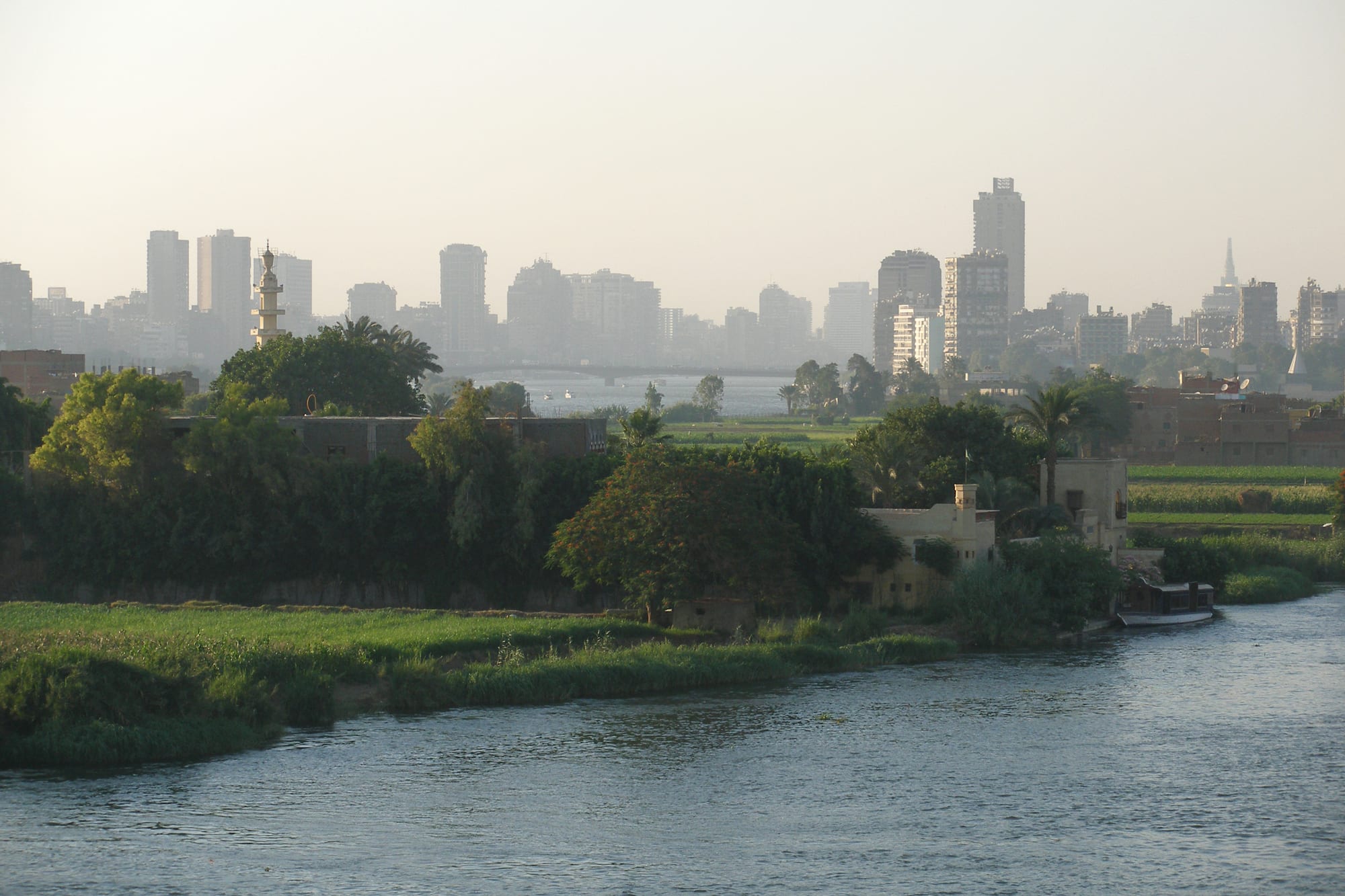
Green fields and palm trees on the bank of the Nile with a minaret and Cairo's hazy tower blocks behind

Egypt

Cairo, Giza & the Faiyum

The Nile in Cairo, with riverside fields in the foreground and the city's skyline beyond. (Vyacheslav Argenberg / Wikimedia Commons · CC BY 4.0)

The point where the Nile Valley opens into the Delta — Greater Cairo and Giza with their pyramid fields, the orchards of Qalyubia, the Faiyum oasis with its lake and desert reserves, and Beni Suef on the river to the south. Egypt's capital region, holding the Old Kingdom's royal cemeteries and a thousand years of Islamic Cairo.

Explore Cairo, Giza & the Faiyum

History

The region is where Egypt began as a single state. Memphis, founded around 3100 BC at the junction of the valley and the Delta, was the capital of the Old Kingdom, and its kings were buried on the desert edge to the west: Djoser's Step Pyramid at Saqqara, the first large stone building, then the pyramids of Meidum and Dahshur under Sneferu, and the great pyramids of Giza under Khufu, Khafre and Menkaure. The Faiyum rose in the Middle Kingdom, when the kings of the 12th Dynasty turned its lake into a vast water reservoir; the Ptolemies later drained its marshes for farming, and Roman-era Faiyum gave the world its painted mummy portraits.

Cairo itself grew in stages. The Romans held a fortress called Babylon beside the river, where Christian churches clustered. The Arab general Amr ibn al-As founded Fustat beside it in 641, the Tulunids added a new quarter in the 9th century, and in 969 the Fatimids built a walled palace city named al-Qahira, "the Victorious". Saladin began the Citadel in the 1170s, and under the Mamluks from 1250 to 1517 Cairo became the largest city west of China, filling with mosques, schools and caravanserais.

After the Ottoman conquest of 1517 the city declined in status but kept growing. In the 19th century Khedive Ismail laid out a new downtown on European lines, and in the 20th century Cairo spread over both banks and deep into the desert. Tahrir Square was the centre of the protests of 2011 and of the mass demonstrations of 2013 that preceded the military's removal of President Mohamed Morsi.

Culture & Customs

Egyptians often call Cairo simply Masr, the same word as the country, and Cairenes see their city as the centre of the Arab world's film, music, publishing and religious scholarship. Al-Azhar, founded under the Fatimids, remains one of Sunni Islam's leading institutions. The Cairene accent is the standard of Egyptian Arabic heard across the region on screen, while the Faiyum and Beni Suef speak with rural Middle Egyptian accents.

Religious life is visible everywhere. Moulids, the festivals of saints' birthdays, fill the squares around the mosques of Al-Hussein and Sayyida Zeinab with Sufi chanting, swings and sweet stalls. Coptic Christians worship in the ancient churches of Old Cairo and in the Cave Church carved into the Mokattam cliffs, above the neighbourhood of the Zabbaleen, the mostly Christian community that has long collected and recycled much of the city's rubbish. Sufi whirling, the tanoura, is performed at Sufi festivals and staged as a folk dance.

Crafts survive in the old city: brass and copper lanterns, inlaid woodwork, the tentmakers' appliqué of the Street of the Tentmakers, and perfume and spice shops around Khan el-Khalili. In the Faiyum, the village of Tunis is known for its pottery. Football divides the capital between Al Ahly and Zamalek, whose derby is the biggest fixture in Egyptian sport.

Daily Life

Greater Cairo, spread across the Cairo, Giza and Qalyubia governorates, has well over 20 million people, and the Faiyum and Beni Suef governorates each have a few million more, most of them farmers on irrigated land. The capital's districts differ sharply: the island of Zamalek and leafy Maadi, the dense old quarters of Islamic Cairo, huge informal neighbourhoods on former farmland, and gated desert suburbs such as New Cairo and Sheikh Zayed, with the New Administrative Capital rising further east.

The economy is government, services, trade, construction and tourism, with industry in Shubra El Kheima and Helwan and in the new desert cities. In the Faiyum and Beni Suef, people grow cotton, wheat, vegetables and fruit, and many young people commute or migrate to Cairo for work.

The day starts early and ends very late. Traffic jams build from morning to night, microbuses and the metro carry millions, and shops and cafés stay busy until after midnight, especially in summer when the evenings are cooler. Rising prices after repeated devaluations of the pound, housing costs and the demolition of old neighbourhoods for new roads are the everyday concerns.

Food

Cairo eats on the street and late at night. Beyond the national breakfast of beans and ta'meya, the city's own favourites include hawawshi, flatbread stuffed with spiced minced meat and baked until crisp; feteer meshaltet, a flaky, many-layered pastry eaten with honey, cheese or molasses; and mombar, sausage casings stuffed with spiced rice and fried. Kebab and kofta houses cluster around Al-Hussein and in the old city.

Sweets are a Cairene passion. Roz bel laban, rice pudding, and mahallabiya, a milk pudding, are sold in small bowls in every district, and in Ramadan the sweet shops pile up kunafa and qatayef, small pancakes folded around nuts or cream. Sobia, a sweet, milky coconut drink, and tamarind and liquorice juices are sold from street stalls during the fast.

In the Faiyum, fish from Lake Qarun appears in local restaurants, and the basin's orchards and fields supply the capital with vegetables, fruit and olives. The ahwa, the coffee house, is where men drink tea and Turkish coffee and smoke shisha — the El Fishawy café in the Khan el-Khalili is the best known.

Attractions & Natural Wonders

The Giza plateau holds the pyramids of Khufu, Khafre and Menkaure, the Sphinx and fields of officials' tombs, with the Grand Egyptian Museum on the approach road. Downtown, the older Egyptian Museum on Tahrir Square still holds a large collection, and the National Museum of Egyptian Civilization at Fustat now houses the royal mummies.

Islamic Cairo is best walked: Al-Muizz Street from Bab al-Futuh to Bab Zuweila, the Fatimid mosque of Al-Azhar, the Mamluk complexes of Qalawun and Sultan Hassan, the vast courtyard of the Ibn Tulun mosque, and the Citadel with the domed mosque of Muhammad Ali. The Khan el-Khalili bazaar and the City of the Dead, where people live among the Mamluk tombs, lie close by. Coptic Cairo, inside the walls of Roman Babylon, holds the Hanging Church, the Coptic Museum and the Ben Ezra Synagogue.

South of Giza, Saqqara has the Step Pyramid of Djoser, the pyramid of Unas with its carved texts and the Serapeum's bull tombs; Memphis, at Mit Rahina, keeps a colossal statue of Ramesses II and an alabaster sphinx; and Dahshur has Sneferu's Bent and Red Pyramids. North of the city in Qalyubia, the Delta Barrage at El Qanater El Khayreya is a riverside park where the Nile divides.

The Faiyum centres on Lake Qarun and the old pyramid sites of Hawara and Lahun. To the south-west, Wadi El Rayan has linked desert lakes and small waterfalls, and the nearby Wadi Al-Hitan, a UNESCO World Heritage Site, preserves fossil whale skeletons in the sand. In Beni Suef, the collapsed Meidum pyramid stands alone on the desert edge.

Cities in Cairo, Giza & the Faiyum

Planning basics

Budget

Cairo covers every budget, from cheap downtown hostels and street food to Nile-view hotels in Zamalek and Garden City. The biggest costs are site tickets — Giza, Saqqara and the Grand Egyptian Museum each charge foreigners far more than locals — plus drivers for day trips. The Faiyum and Beni Suef are cheaper but have few hotels, so most visits are day trips from Cairo with a hired car.

Daily Budget Midrange
USD 75–150 (mid-range hotel, restaurant meals, a driver or guide for Saqqara and Dahshur, museum tickets)
Daily Budget Shoestring
USD 25–45 (downtown hostel, street food, metro and ride-hailing, one major site)

Group Saqqara, Dahshur and Memphis into one day with a hired driver, and carry small notes for tips and toilets.

Safety

Cairo and Giza are heavily policed and serious crime against visitors is uncommon. The daily problems are touts, camel and horse operators and fake guides at Giza, overcharging, harassment of women in crowded places, and the traffic itself. Police checkpoints are common on the roads into the Faiyum and Beni Suef, and passports may be checked.

Buy tickets only at official counters, agree prices before any ride at Giza, dress modestly away from hotels, and cross roads with local pedestrians. Check current official travel advice before travelling.

Climate

Hot desert, with almost no rain. Cairo is a little cooler than Upper Egypt but humid and hazy in summer, when air pollution and traffic fumes add to the heat. The Faiyum is slightly greener and more humid around its lake. The khamsin can bring dusty, hot winds in spring.

Summer
hot, around 33–36°C by day in Cairo, hotter in the open desert at Saqqara and Wadi El Rayan
Winter
mild and sunny, around 18–22°C by day, cool nights and the occasional shower

Transportation

Cairo International Airport is the country's main gateway. Inside the city the metro is cheap and avoids the traffic, and ride-hailing apps are widely used; journeys by road can take an hour or more at peak times. Giza is 30–60 minutes from downtown depending on traffic. The Faiyum is about two hours by road, and Beni Suef lies on the main Nile Valley railway south.

Use ride-hailing apps rather than street taxis to avoid haggling, and start day trips to Saqqara or the Faiyum early to beat the traffic.

Best Time to Visit

October to April, when the pyramid fields and desert reserves are comfortable to walk. December and January are the busiest months at Giza. Summer sightseeing is best done early in the morning. During Ramadan, Islamic Cairo comes alive after sunset, with lanterns and late-night crowds around Al-Hussein and Al-Azhar.