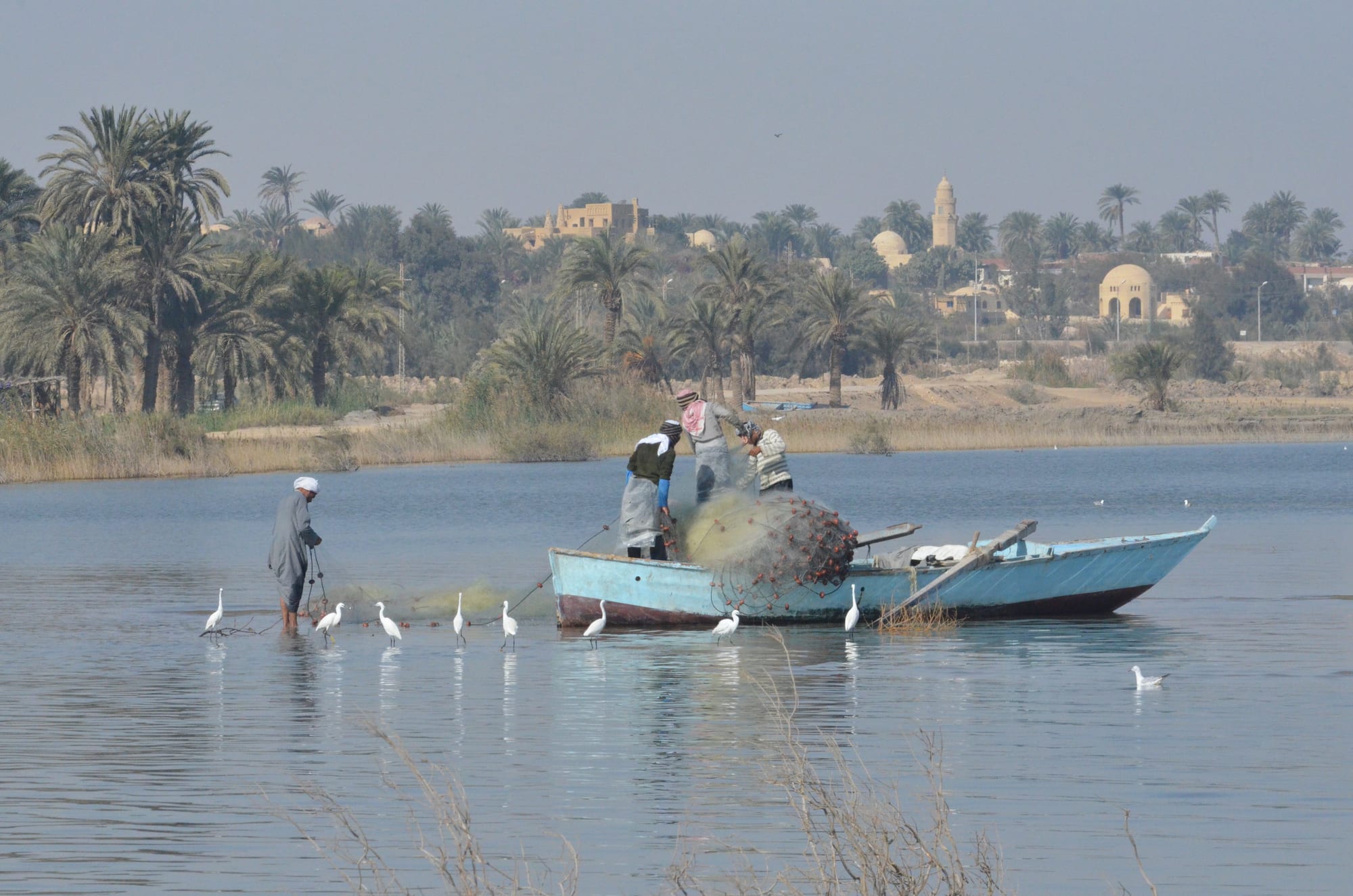
A wooden fishing boat in the shallows of Lake Qarun with egrets standing in the water and a palm-fringed village behind

Cairo, Giza & the Faiyum, Egypt

Tunis Village

Fishermen working the shallows of Lake Qarun below Tunis village in the Faiyum. (Hatem Moushir / Wikimedia Commons · CC BY-SA 3.0)

A small village on a ridge above the southern shore of Lake Qarun in the Faiyum, known across Egypt for its pottery. Workshops and kilns stand among mud-brick houses, olive trees and guesthouses looking north over the water and south towards the desert, and weekend visitors come from Cairo for the ceramics, the quiet and the lake air.

Neighbourhoods

  • The pottery street
    • First-time visitors
    • Crafts and shopping

    The lane through the middle of the village, lined with family workshops, showrooms and kilns. Finished bowls and plates are set out on shelves and walls, and most workshops are happy for visitors to watch the wheel and the glazing.

    Open in Maps
  • The ridge and the guesthouses
    • Views
    • Quiet and residential

    The higher ground at the edge of the village, where mud-brick lodges and guesthouses are built with domed rooms, terraces and gardens facing the lake. Evenings here are silent apart from dogs and the call to prayer from the village mosque.

    Open in Maps
  • The lake shore below
    • Birdwatching
    • Fish restaurants

    A strip of reeds, fishing landings and open ground between the ridge and the water, where boats are pulled up on the sand, egrets work the shallows and a few simple places grill the day's catch.

    Open in Maps
  • The desert edge
    • Walks and viewpoints
    • Desert trips

    South and west of the houses the cultivated land stops abruptly and open desert begins, with tracks running towards the dunes, the fossil country and the lakes of Wadi El Rayan. Sunset walks up onto the sand are the usual evening outing.

    Open in Maps

Things to do

In the village

  • Pottery workshopsattraction

    Family studios throw, glaze and fire earthenware in the village, selling directly from their showrooms; several teach short classes at the wheel.

    Open in Maps
  • Lake Qarunattraction

    The salt lake below the village, a shrunken remnant of the ancient Lake Moeris, fished from small wooden boats and busy with herons, egrets and wintering waterbirds.

    Open in Maps

Around the lake and the desert

  • Qasr Qarunlandmark

    A Ptolemaic temple of the crocodile god Sobek standing alone in the sand at the western end of the lake, beside the remains of the Greco-Roman town of Dionysias.

    Open in Maps
  • Wadi El Rayanpark

    A protected area of two desert lakes linked by low waterfalls, with dunes, springs and dorcas gazelle, reached on the tracks running south-west from the village.

    Open in Maps
  • Wadi Al-Hitanattraction

    The Valley of the Whales, a UNESCO World Heritage Site inscribed in 2005, where fossil skeletons of early whales lie in the desert along a marked trail walked with a guide.

    Open in Maps
  • Medinet Madilandmark

    A Middle Kingdom temple in the desert south-east of the lake, approached by a long paved processional way and later enlarged by the Ptolemies.

    Open in Maps

Short trips

  • Faiyumneighborhood

    The provincial town at the centre of the oasis, with its canal, waterwheels and market, about an hour away by road around the lake.

    Open in Maps
  • Karanislandmark

    A Greco-Roman farming town at Kom Aushim in the north-eastern corner of the oasis, with stone temples, houses and granaries excavated from the sand.

    Open in Maps

Seasonal events

  • The pottery festivalautumn

    The village's ceramics festival brings potters from across Egypt and beyond to exhibit and sell in the streets, with music, food stalls and workshops over several days.

  • Ramadanthe month of Ramadan

    Days are quiet and work slows; the village gathers for the fast-breaking meal at sunset and the lanes stay busy late into the night.

  • Winter birdwatchingautumn to early spring

    Flamingos, waders and ducks wintering away from Europe and Asia gather on Lake Qarun and the reserve lakes, and birdwatchers come with them.

  • The olive and citrus harvestsautumn and early winter

    Olives are picked and pressed and citrus comes in from the oasis orchards, bringing extra work and fresh oil, fruit and pickles to village tables.

Eat and drink

Long-standing places and food districts in Tunis Village. Hours, ratings and directions come from your maps app, always current.

Village tables

  • Guesthouse kitchensrestaurant

    Most lodges cook for their guests, serving oasis vegetables, stuffed vine leaves, duck or chicken with rice, and bread from a clay oven at a shared table.

    Open in Maps
  • Fish from Lake Qarunrestaurant

    Bolti and other lake fish are grilled or fried whole and served with rice, tahini and salad at simple places along the shore below the village.

    Open in Maps
  • Village bakeries and tea stallscafe

    Flat baladi bread, ta'meya in the morning and very sweet tea are sold from small shops on the main lane, where men sit out in the shade.

    Open in Maps

Experience Tunis Village

History

Tunis is a young village in a very old landscape. The ridge above the southern shore of Lake Qarun has been the edge of the cultivated Faiyum since antiquity, with the Ptolemaic temple of Qasr Qarun at the far end of the lake and Greco-Roman farming towns buried in the sand around the basin. Until the middle of the 20th century the shore here held no more than a scatter of farming and fishing households on poor land between the water and the desert, without the orchards and canals that made the centre of the oasis prosperous.

Its reputation was made by pottery. The village itself is new, created in the 1960s by the poet Sayed Hegab and the writer Abdou Gobeir; in the 1980s Hegab's wife, the Swiss potter Evelyne Porret, built a house and studio from mud brick and opened a pottery school for local children, teaching the wheel, glazing and firing. Pupils grew up to open their own workshops, their children learned in turn, and ceramics became the village's main trade, with a recognisable style of simple earthenware forms in blue, green and earth glazes.

Artists, writers and architects from Cairo followed, drawn by the quiet and the view, and built or restored houses in mud brick with domed and vaulted rooms in the traditional manner. Guesthouses and small lodges opened for weekend visitors, and an annual ceramics festival began to draw potters from elsewhere in Egypt and abroad. The village today lives from that combination — clay, farming, fishing and visitors — and remains small, with new building restricted by the desert on one side and the lake on the other.

Culture & Customs

The village is unusual in Egypt: a farming community whose best-known occupation is a craft learned within living memory, and one that women and men both practise. Workshops are family businesses, often run by the children or grandchildren of the first pupils, and the trade is taught at home rather than in a college. Styles are recognisable between families, and pieces are usually signed or stamped.

Alongside that sits ordinary rural Faiyumi life. Households keep goats, poultry and a few fields; fishing families work the lake from small wooden boats; and the rhythm of the week turns on Friday prayers at the village mosque. Hospitality is strong and slightly formal — tea is offered before business, and refusing it outright is awkward — and news travels through the lanes quickly. Dress is conservative, and visitors who cover their shoulders and knees are treated more warmly than those who do not.

The relationship with Cairo is close. Weekend visitors, artists and returning residents bring money, ideas and the occasional friction over land prices and new building. The ceramics festival is the village's public face, turning the lanes into a market and a meeting place for potters from across the country. Away from it the pace is slow: long afternoons, early nights, and the desert beginning a few hundred metres from the last house.

Daily Life

A few thousand people live in Tunis and the settlements immediately around it, and the population rises at weekends and in the winter season when the guesthouses fill. Work divides between the potteries, farming on the narrow strip of cultivated land, fishing on Lake Qarun, and hospitality — cooking, cleaning, driving and guiding for the lodges. Many families do two or three of these at once, and children help in the workshops after school.

The day begins early, with bread baked at home, animals fed and boats out on the lake before the heat. Workshops throw in the morning, glaze in the afternoon and fire in batches when a kiln is full. The village shop, the bakery and the tea stalls on the main lane are the places where people meet; the nearest bank, hospital and secondary schools are in the oasis town about an hour away, so a trip into town is a planned event rather than a casual one.

The concerns here are those of a small rural place with an unusual economy: the price of clay, gas and glaze materials; whether the winter visitor season holds up; the falling level and rising salinity of the lake and what that does to the fish; water for the fields; and the steady sale of village land to outsiders building second homes on the ridge.

Food

Cooking in Tunis is Faiyumi country food, plain and seasonal. Fish from Lake Qarun is the local speciality — bolti, the Nile tilapia, and other freshwater fish grilled over charcoal or fried whole and eaten with rice, tahini, bread and a sharp salad of tomato, cucumber and lime. Duck and chicken are the meats for a celebration or a guest, often roasted with rice, and hamam mahshi, pigeon stuffed with rice or cracked green wheat, is the dish of a real occasion.

Everyday meals are built on bread, pulses and vegetables from the oasis: ful medames, fava beans stewed overnight with oil and cumin; ta'meya, the Egyptian falafel of crushed fava beans; lentil soup; molokhia, the green jute-leaf soup, served with rice; and mahshi, courgettes, peppers, cabbage leaves and vine leaves stuffed with rice and herbs. Feteer meshaltet, the flaky layered pastry, comes from village ovens and is eaten with honey, cream or salty cheese.

The oasis supplies the rest. Olives are cured and pressed for oil, citrus and figs come from the orchards, dates and prickly pears are sold in season, and mish, a sharp cheese aged in brine, and fresh white cheese turn up at every breakfast with eggs and tomato. Tea is drunk very sweet all day, hibiscus tea hot in winter and cold in summer, and guesthouses will usually put on a fresh juice from whatever fruit the market had that morning.

Planning tools

Budget

Staying in the village is cheap by Cairo standards. Mud-brick guesthouses and eco-lodges charge modest rates that usually include breakfast, and many also cook dinner. The variable costs are transport — a car and driver for the desert reserves and the ancient sites, since there is almost no public transport out here — and pottery, which is sold cheaply by the piece but adds up.

Daily Budget Midrange
USD 70–130 (mud-brick lodge with meals, a hired car and driver for the desert and the ancient sites, pottery and site tickets)
Daily Budget Shoestring
USD 20–40 (simple guesthouse room, village meals and market food, shared microbuses to the town)

Bring enough cash for the whole stay, agree a full day rate with a driver before setting out, and ask guesthouses in advance if dinner is needed.

Best Time to Visit

October to April. Winter days are mild and clear, the lake is full of migrating birds and the desert is comfortable to walk. Weekends bring visitors from Cairo, so midweek is quieter. Spring can be dusty when the khamsin blows. Summer is very hot in the open desert, though the ridge catches a breeze off the lake in the evening.

Suggested Number of Days

One night suits the village itself, and two or three days in all are enough to take in the lake and the wider oasis at an easy pace. Most of the extra time goes on travel between places rather than at them.

First Visit
1–2 days
With Surroundings
2–3 days

Transportation

There is no scheduled transport worth relying on. Microbuses and shared taxis run between the oasis town and the villages on the lake road, but they are infrequent this far round. Guesthouses arrange cars and drivers, and most visitors arrive by hired car from Cairo or the town and use it for the whole stay. The village itself is covered on foot, and tracks into the desert need a four-wheel-drive vehicle.

Arrange the return journey and any desert trip in advance through a guesthouse, as taxis do not wait in the village.

Airport & Station Connections

The village is about an hour from the oasis town by the road around the southern shore of Lake Qarun, and about two and a half to three hours from Cairo or Giza by car on the desert highway. Buses and microbuses from Cairo reach the town, from where a taxi or a guesthouse car covers the last stretch.

Walkability

The village is small enough to cross on foot in twenty minutes, and walking is how the workshops, the ridge and the lake shore are seen. Lanes are unpaved, sandy and steep in places. Everything beyond the village — the temples, the reserves, the town — needs a vehicle, and the lake road has no pavement and little light after dark.

Safety

The village is quiet and welcoming and crime against visitors is very rare. The practical risks are the desert rather than the people: heat, dehydration, soft sand and losing the track away from the surfaced roads, as well as fast traffic and poor lighting on the lake road at night. The lake is salty and polluted in places, and swimming is not a local habit.

Buy tickets only at official counters, agree prices before any ride at Giza, dress modestly away from hotels, and cross roads with local pedestrians. Check current official travel advice before travelling.

Climate

Hot desert, softened slightly by the lake below and the trees around the houses. The ridge is breezy, nights cool quickly in winter, and spring winds carry dust off the desert to the south.

Summer
very hot — days around 35–38°C in the open, with warm evenings and a breeze off the lake
Winter
mild and clear — days around 19–22°C, with cold nights on the ridge and in the desert

Local Customs

This is a conservative farming village, and visitors are guests in it: modest dress covering shoulders and knees is expected, greetings are exchanged before any question, and tea will be offered in workshops and houses. Photographing pots and streets is fine; photographing people, especially women, needs permission first. Alcohol is not part of village life, though some guesthouses serve it to guests.

Buy directly from the workshops rather than bargaining hard, and during Ramadan avoid eating, drinking or smoking in the lanes during daylight.

Common Payment Methods

The currency is the Egyptian pound, and the village runs almost entirely on cash. There is no reliable cash machine here, and few workshops or guesthouses take cards, so money is drawn in the oasis town or in Cairo before arriving. Small notes are useful for tea, tips and single pieces of pottery.