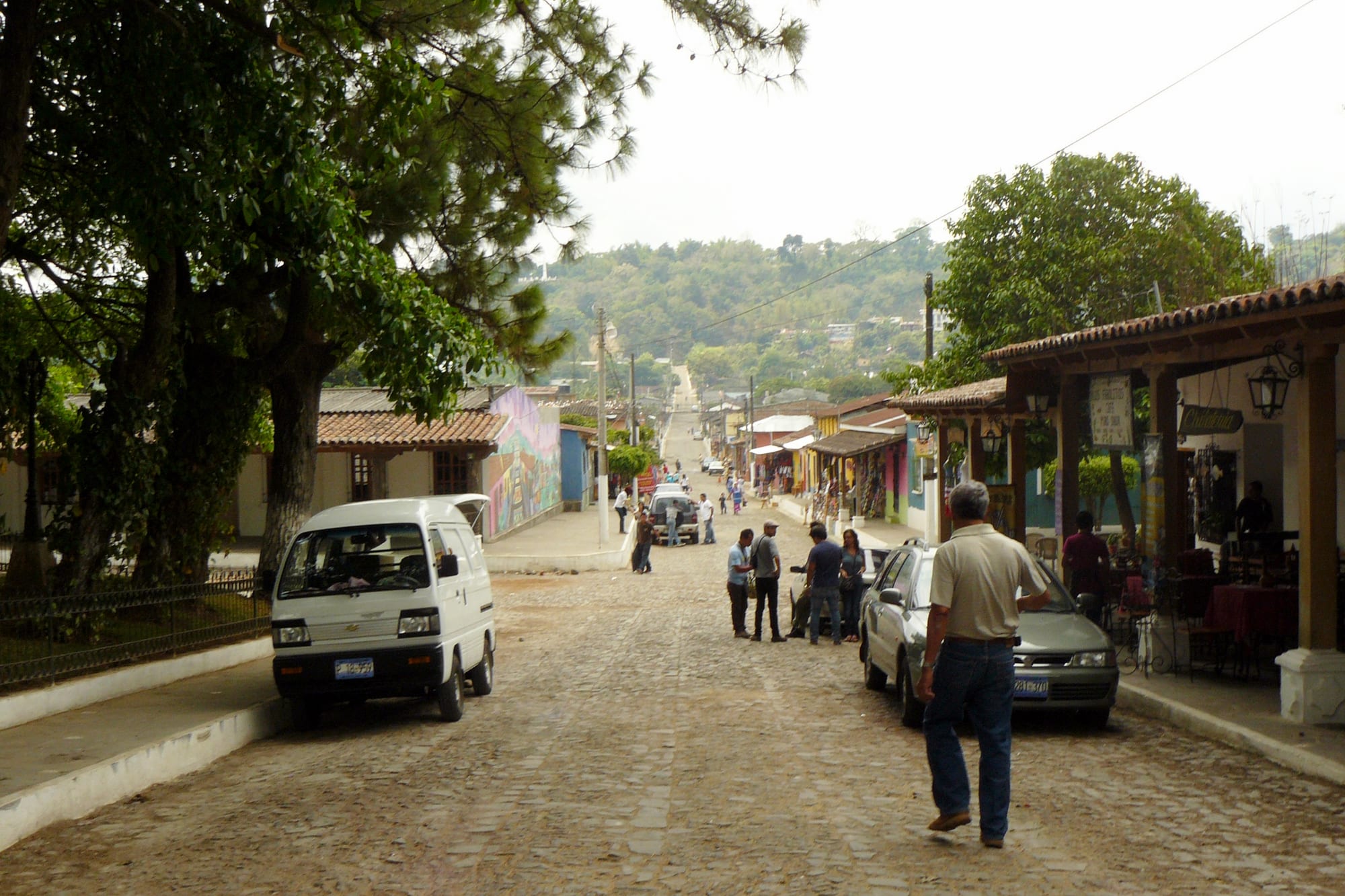
A cobbled street in Juayúa with tiled-roof arcades, a painted mural wall and green hills rising beyond

El Salvador

Juayúa

A cobbled street in Juayúa, with the coffee hills beyond. (Erickssonr / Wikimedia Commons · CC BY-SA 3.0)

A small Pipil-founded town at about 1,040 metres in the Apaneca-Ilamatepec range of western El Salvador, the country's main coffee region. Coffee made it prosperous in the 19th century; today it is a stop on the Ruta de las Flores, known for its Black Christ church, street murals, weekend food fair and waterfall walks through the coffee farms.

Neighbourhoods

  • The central plaza
    • First-time visitors
    • Best for food
    • Weekend fair

    The square in front of the white church of Santa Lucía, where the food fair sets up every weekend. The market and its comedores stand next to the church, and cafés and restaurants line the streets around it.

    Open in Maps
  • The mural streets
    • Street art
    • Walking

    The cobbled streets of the centre, where the walls of cafés, restaurants and shops are covered in murals by local artists, from surrealist works to realistic portraits, many of them of flowers.

    Open in Maps

Things to do

In town

  • Church of Santa Lucía (Cristo Negro)landmark

    The white parish church on the main square, inaugurated in 1957 — the third on the site — housing a Black Christ, a sister image to the one at Esquipulas in Guatemala.

    Open in Maps
  • Murals of Juayúaattraction

    Walls, posts and signs across the centre painted by local artists, many with flowers in a nod to the Ruta de las Flores.

    Open in Maps
  • Municipal marketmarket

    The market beside the church, surrounded by comedores serving cheap local meals.

    Open in Maps

Waterfalls and coffee country

  • Los Chorros de la Caleratrail

    Waterfalls and swimming holes just outside town, reached by a popular walk through coffee farms.

    Open in Maps
  • Seven Waterfalls hiketrail

    A hike of several hours past a series of waterfalls in the hills around the town, usually including Los Chorros de la Calera.

    Open in Maps

Short trips on the Ruta de las Flores

  • Apanecaattraction

    A small highland town on the Ruta de las Flores, whose name means 'river of the wind' in Nahuatl.

    Open in Maps
  • Concepción de Atacoattraction

    A Pipil-founded town in the Apaneca range, its Nawat name meaning 'high place of springs', and a town popular with local and international visitors.

    Open in Maps
  • Nahuizalcoattraction

    A town with strong Indigenous customs, famous for its wicker and tule crafts and for a night market whose streets are lit by candles.

    Open in Maps

Seasonal events

  • Fiestas del Cristo Negrothe first half of January

    The patron-saint festivities in honour of the Black Christ, with fairs, the election of a festival queen and a funfair; as at Esquipulas, many pilgrims come to give thanks, and the main day is 15 January.

Eat and drink

Long-standing places and food districts in Juayúa. Hours, ratings and directions come from your maps app, always current.

Juayúa classics

  • Feria Gastronómicamarket

    The food fair held every weekend since 1997 in the central square, where local restaurants serve chicken soup, pupusas, yuca with pork, tamales, seafood and dishes from abroad.

    Open in Maps
  • Comedores by the marketneighborhood

    Cheap eateries in and around the market next to the church, serving everyday Salvadoran meals.

    Open in Maps
  • Cafés of the centreneighborhood

    Cafés in the painted streets around the square, serving coffee from the surrounding hills and desserts.

    Open in Maps

Experience Juayúa

History

Juayúa began as a Pipil town before the Spanish conquest. By 1550 it had an estimated 300 inhabitants, and by 1577 it was a town where Franciscan friars based in Sonsonate taught the faith. Towards the end of the 16th century the friars set up an image like the Black Christ of Esquipulas and built the first chapel of what became the church of Santa Lucía. In 1770 the archbishop of Guatemala, Pedro Cortés y Larraz, recorded the town as part of the parish of Apaneca, with 526 people.

Coffee changed everything. Some families began to grow it around 1838 or 1839, and by the second half of the 19th century the crop had made Juayúa a prosperous and picturesque town; by 1890 it had 3,980 inhabitants and drinking water piped from the Cerro Los Naranjos. The church was rebuilt more than once: the first, of adobe, fell in an earthquake, and the second, a neoclassical wooden building, burned down.

In the 20th century the town was caught up in the peasant uprising of 1932, whose crushing in La Matanza killed an estimated 10,000 to 40,000 people, mostly Pipil peasants. The present church was built between 1953 and 1956 and inaugurated in January 1957. Small coffee growers, struggling alone with debts, pests and prices, later formed the San José La Majada cooperative, still one of the strongest in the sector. Since 1996 Juayúa has been part of the tourist route first called the Ruta del Café and later the Ruta de las Flores, and since 1997 it has held its weekend food fair.

Culture & Customs

Faith and the Black Christ are at the centre of Juayúa's identity. The image in the church of Santa Lucía is a sister to the revered Christ of Esquipulas in Guatemala, and the patron-saint festivities from 1 to 15 January draw people of faith who come, as at Esquipulas, to give thanks for the past year. The festivities bring commercial fairs, the election of a festival queen and a funfair, with the main day on 15 January. Inside the church, the high altar is clad in marble and the stained glass and images were brought from Europe.

The town has also made itself a gallery. The walls of its cafés, restaurants and shops are covered in murals by local artists, ranging from surrealism to realistic portraits; along the streets, walls, posts and signs are painted with flowers in a nod to the Ruta de las Flores. The weekend food fair turns the square into the town's social centre.

Local legend adds a touch of mystery: it is said that at midnight the Princess of Juayúa appears among the shadows of La Calera, near the waterfalls.

Daily Life

The district had about 24,300 inhabitants at the 2024 census, spread over about 103 square kilometres. The town stands at about 1,040 metres in the Apaneca-Ilamatepec range, the country's largest coffee-producing region, and coffee remains the main economic activity, with farms covering the surrounding hills, among them the Larín finca, and a coffee museum nearby.

Tourism has become the second pillar. Visitors from El Salvador and abroad come for the scenery, the events and the town's place on the Ruta de las Flores, and weekends are busiest, when the food fair fills the central square and the town's restaurants set out their tables. The countryside around holds rivers, waterfalls and lagoons — among them the Laguna Verde and the Laguna de las Ranas — that are used for ecotourism.

During the week the town is quieter, centred on the market beside the church, the comedores around it and the coffee work in the hills.

Food

Juayúa is best known for its Feria Gastronómica, held every weekend since 1997 in the town centre. Local restaurants set up in the square to serve traditional dishes — chicken soup, pupusas, yuca with pork, tamales and seafood — alongside dishes from other countries, and visitors come from across El Salvador and abroad to eat there.

Through the week, the comedores in and around the market next to the church serve cheap, everyday Salvadoran food, including pupusas, thick corn or rice tortillas stuffed with cheese, refried beans, chicharrón or loroco flower buds and served with curtido, a tangy cabbage slaw, and tomato salsa. Panes rellenos, warm stuffed sandwiches, are another typical Salvadoran dish.

Coffee is the local drink. It is grown on the farms of the Apaneca-Ilamatepec range around the town, the country's main coffee region, and served in the cafés of the centre, which are also known for their desserts. Horchata made with rice milk and morro seeds, and tamarind juice, are popular cold drinks across the country.

Planning tools

Budget

Juayúa is inexpensive. Buses, comedor meals and pupusas cost very little; guesthouses, guided waterfall hikes and the restaurants of the weekend fair are the main costs.

Daily Budget Midrange
USD 70–130 (guesthouse or small hotel, restaurant meals, a guided waterfall hike, shuttles)
Daily Budget Shoestring
USD 30–50 (hostel or guesthouse, comedor meals and the food fair, local buses)

Come at a weekend for the food fair, and carry small notes for buses and stalls.

Best Time to Visit

November to April, the dry season, is best for the waterfall walks and clear views. The wet season from May to October is green, with heavy afternoon rain. The food fair runs every weekend all year, and the Black Christ festivities fill the first half of January.

Suggested Number of Days

A weekend covers the town and its food fair. Allowing three or four days makes room for the waterfalls and the other towns of the Ruta de las Flores, for which Juayúa is a convenient base.

First Visit
1–2 days
With Surroundings
3–4 days

Transportation

The town is small enough to cover on foot. Buses run along the Ruta de las Flores between Ahuachapán and Sonsonate, stopping at Juayúa, and link it with the neighbouring towns; tourist shuttles and hire cars are the easier options for touring the route.

Take the waterfall walks with a guide, and avoid driving between towns at night.

Airport & Station Connections

Juayúa is about 80 km from San Salvador. Bus 249 runs from Sonsonate in about 45 minutes, bus 238 runs directly from Santa Ana's main terminal several times a day, and bus 23 runs the length of the Ruta de las Flores from Ahuachapán to Sonsonate. Tourist shuttles are the more comfortable alternative to the buses.

Walkability

The centre is compact and easy to walk, on cobbled and sometimes uneven streets. Los Chorros de la Calera is just outside town on foot; longer waterfall walks cross hilly, muddy ground in the rains.

Safety

El Salvador was for years one of the most violent countries in the world, dominated by the MS-13 and Barrio 18 gangs. Since a "state of exception" declared in March 2022 and extended 55 times by September 2026, which suspended some civil liberties and led to more than 90,000 arrests, homicide rates have fallen dramatically, and tourist areas are much safer than a decade ago. Juayúa is a small town; at the crowded weekend fair, ordinary care with belongings is sensible.

Walk to the waterfalls with a guide or a group rather than alone, watch belongings in the weekend crowds, and do not photograph police or military. Check current official travel advice before travelling.

Climate

At about 1,040 metres the town is cooler than the coast and the lowlands, with a dry season from about November to April and a wet season from May to October.

Summer
the wet months bring heavy afternoon rain; El Salvador's mountain areas are the coolest in the country, with annual averages of about 12 to 23 °C
Winter
dry and sunny from November to April; El Salvador's mountain areas, cooler than the coast and lowlands, have annual averages of about 12 to 23 °C

Local Customs

A small, devout town: the Black Christ draws pilgrims, and visitors are expected to dress neatly and be quiet in the church. Greetings matter, and weekends are lively with visitors at the food fair.

Say 'buenos días' on entering shops, ask before photographing people and pilgrims, never photograph police or soldiers, and leave a small tip in sit-down restaurants.

Common Payment Methods

The currency is the US dollar. Bitcoin was made legal tender in 2021 but lost that status in February 2025, and acceptance is limited. Some restaurants and guesthouses take cards, but cash in small notes is needed for buses, the market, comedores and food-fair stalls.