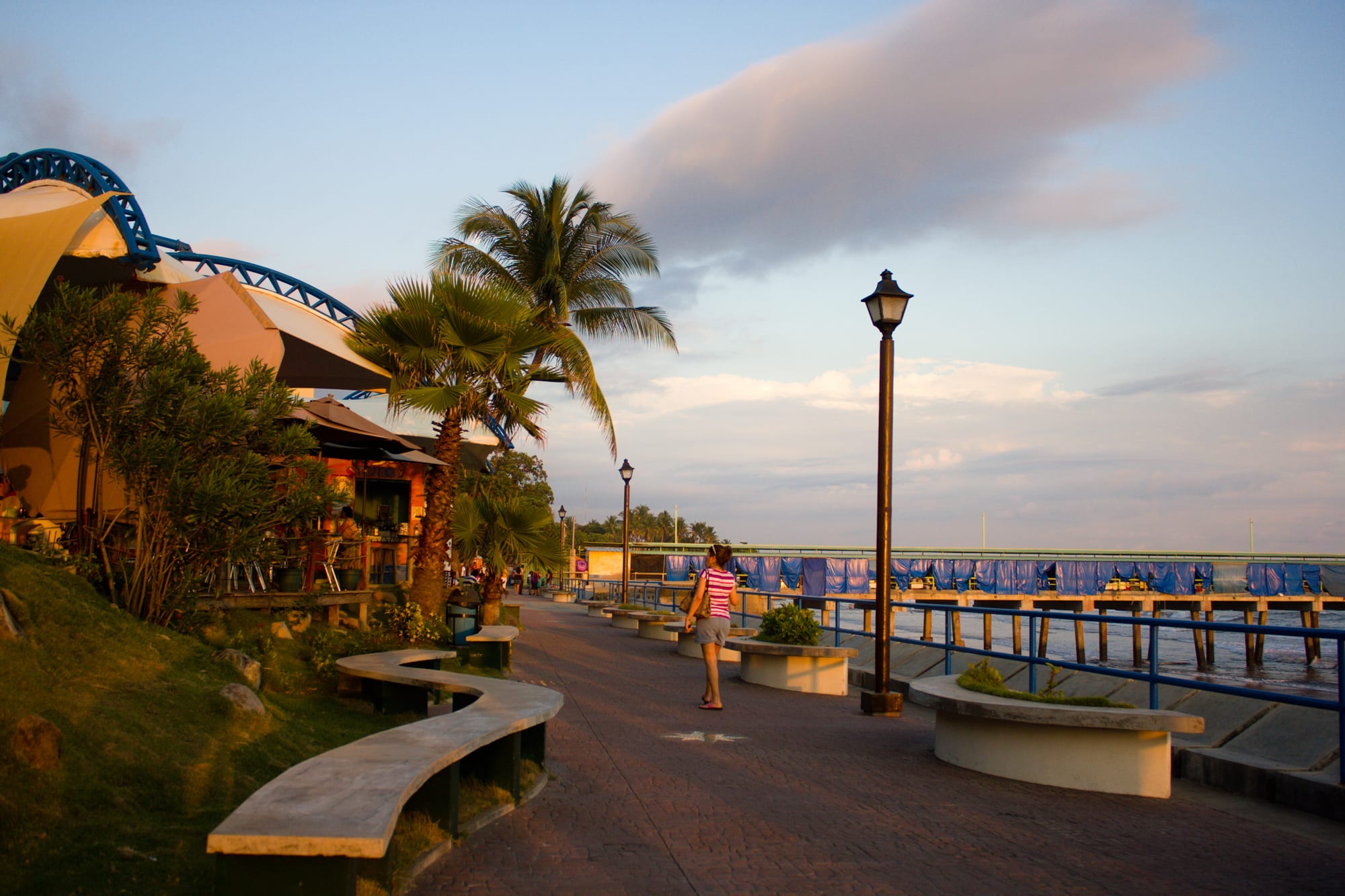
A paved seafront promenade with palm trees, benches and lamp posts beside the long pier at La Libertad in evening light

El Salvador

La Libertad

The malecón at La Libertad, with the fishing pier beyond. (Ayaita / Wikimedia Commons · CC BY-SA 3.0)

A Pacific port town, known simply as El Puerto, at the heart of El Salvador's surf coast. Founded as the country's first port in the 19th century, it now lives from fishing, tourism and the waves of Punta Roca, one of the best right-hand point breaks in Central America, with the surf beaches of El Sunzal, El Tunco and El Zonte along the coast.

Neighbourhoods

  • The port and the malecón
    • First-time visitors
    • Best for food
    • Beaches

    The town's seafront, where the pier, the seafood stalls and the tourist complex of boardwalk, restaurants and amphitheatre face the beach. Punta Roca breaks off the point at one end, and the Sunset Park fairground stands beside the promenade.

    Open in Maps
  • El Sunzal and El Tunco
    • Surfing
    • Nightlife

    Surf beaches along the coast near the port. El Sunzal is an easy point break popular with learners and crowded at weekends, and neighbouring El Tunco has most of the bars frequented by travellers and local surfers.

    Open in Maps
  • El Zonte
    • Surfing
    • Quiet beaches

    A surf town further west along the coast, described as a world surfing mecca, whose beach became known as Bitcoin Beach as one of the first places in the country to accept bitcoin.

    Open in Maps

Things to do

The waterfront

  • La Libertad pierlandmark

    The working fishing pier, successor to an iron pier of 1869, where a crane lowers the boats into the sea and fishermen sell the day's catch.

    Open in Maps
  • Malecón tourist complexattraction

    The seafront complex completed in 2010, with a boardwalk, restaurants and an amphitheatre, and small seafood and craft stalls at the old wharf.

    Open in Maps
  • Sunset Parkattraction

    An amusement park on the seafront, opened in August 2022 as part of the government's Surf City programme of viewpoints, piers and recreational areas along the coast.

    Open in Maps

Surf and beaches

  • Punta Rocabeach

    The town's famous right-hand point break, with fast, hollow waves that often run for 90–180 metres and a rocky, difficult entry; it hosts regional and international championships.

    Open in Maps
  • El Sunzalbeach

    A surf beach with an easy point break suited to beginners, crowded at weekends; the International Surfing Association's world games were held on its waves in 2023 and 2025.

    Open in Maps
  • Playa San Diegobeach

    A beach east of town with surf for beginners, without the rocks and crowds of El Sunzal.

    Open in Maps
  • Playa El Obispobeach

    One of the beaches within the municipality.

    Open in Maps
  • El Zontebeach

    A surf beach and village west of the port, one of the first places in the country to accept bitcoin.

    Open in Maps

Nature

  • Walter Thilo Deininger National Parkpark

    A forest park off the coastal highway near Playa San Diego, east of town towards the airport, with canopy walks and guided tours; the Deiningers were the first German immigrants to settle in the department.

    Open in Maps

Seasonal events

  • Fiestas patronalesDecember

    The town's patron-saint festival in honour of the Immaculate Conception.

Eat and drink

Long-standing places and food districts in La Libertad. Hours, ratings and directions come from your maps app, always current.

La Libertad classics

  • Fish stalls on the piermarket

    Fishermen sell their catch at the pier — snapper, tuna and rays, squid, shrimp, lobster, blue crabs known as jaibas, clams and scallops.

    Open in Maps
  • Seafood restaurants on the malecónneighborhood

    Restaurants along the seafront serving shrimp cocktails and creamy seafood stews with views of the ocean and the sunset.

    Open in Maps
  • Bars of El Tunconeighborhood

    The neighbouring beach town where most of the bars frequented by travellers and surfers are found.

    Open in Maps

Experience La Libertad

History

Before it was a port, the area was known as Tepehua, from a Nahuatl expression meaning "mountain of the oak trees", and in 1770 it was recorded as the hacienda Tepeahua, one of the largest estates in the parish of San Jacinto. On 24 February 1824 the Congress of the Federal Republic of Central America authorised the name Puerto de La Libertad — the Port of Freedom — and in 1831 the national assembly opened the Pacific coast to commercial trade. The first steamship arrived in 1857.

La Libertad was the first port built in El Salvador. It became a village in 1858, was placed in the new department of La Libertad in 1865, and in 1869, when it had just 266 inhabitants, opened an iron pier; until then cargo had been landed from barges held by mooring lines. A telegraph line to San Salvador followed in 1870. The town was made a villa in 1874 and a city in 1957, but newer ports at Acajutla and La Unión eventually took its trade.

The original pier deteriorated and was replaced by a modern structure; partly damaged in the earthquakes of 2001, it was repaired and given a major renovation in 2003. In the 1970s, when only a few local surfers rode Punta Roca, it was discovered by internationally known surfers such as Gerry Lopez; the civil war of the 1980s made the point dangerous to reach. A seafront tourist complex was built between 2006 and 2010, and in 2022 the Sunset Park fairground opened on the waterfront as part of the government's Surf City programme.

Culture & Customs

La Libertad is described as El Salvador's surf capital, with surf shops, board rentals and repair shops, and Punta Roca hosts regional and international championships. Its main break runs for about 800 metres from La Punta to the town, in three sections: the fast, hollow wave at the top of the point, a middle section in front of the cemetery, and La Paz, a gentler inside cove in front of the restaurants, good for longboarding. In 2026 Punta Roca was on the World Surf League's Championship Tour, and the International Surfing Association held its world games on the waves of La Bocana and El Sunzal in 2023 and 2025.

Local surfers have shaped that culture. Boards were scarce during the war, and young locals got them from travellers who left them behind in exchange for guidance and a place to stay; the surfer known as Yepi was among the first of his generation to popularise the sport among Salvadorans, and others now run surf tours.

The town keeps a port's working character beside the surf scene. The fishing pier and its fish stalls are the centre of daily life, and the patron-saint festival in December honours the Immaculate Conception. Further west, El Zonte became known as Bitcoin Beach, one of the first places in the country to accept bitcoin and an inspiration for its adoption as legal tender from 2021 until 2025.

Daily Life

The municipality had about 45,000 inhabitants at the 2024 census, spread over 162 square kilometres of coast and hills. People in the San Salvador metropolitan area call the town simply El Puerto. Beaches within the municipality include Las Flores, San Diego, El Obispo, La Paz and El Majahual, and El Palmarcito lies 15 km to the west.

The local economy is based on agriculture and services, and above all on fishing and tourism. Boats are lowered into the sea by a crane at the end of the pier, and their catch is sold there the same day. The malecón's restaurants, the amphitheatre and the craft and seafood stalls at the old wharf draw day-trippers, and the surf beaches along the coast draw visiting surfers.

Weekends are busiest, when the surf breaks are crowded and parties are held at the pavilion near the beach. The Surf City programme has brought new public works to the coast, with viewpoints, piers, urban infrastructure and recreational areas among its aims.

Food

Seafood is what La Libertad is known for. At the pier fishermen sell snapper, tuna and rays, squid, shrimp and lobster, jaibas (blue crabs), clams and scallops, and the stalls at the old wharf and the restaurants on the malecón cook them. The town is known for shrimp cocktails, cocteles de camarón, and for mariscada de crema, a creamy seafood stew, while fish is grilled over a hardwood fire on the beaches nearby. Sopa de pescado, a fish or seafood soup, is eaten across the country, above all on Good Friday.

Away from the sea, the town eats the national staples: pupusas — thick corn or rice tortillas stuffed with cheese, beans, chicharrón or loroco flower buds and served with curtido, a tangy cabbage slaw — in simple pupuserías, and beans, rice, fried plantain, crema and queso fresco in comedores. Horchata made with rice milk and morro seeds, tamarind drinks and cold beer are the usual accompaniments, and the beach towns have bars and cafés catering to travellers.

Planning tools

Budget

La Libertad itself is inexpensive, with cheap buses, seafood from the pier and simple eateries. Surf-town guesthouses, board hire, lessons and shuttles are the main costs, and prices rise in the more international beach towns along the coast.

Daily Budget Midrange
USD 70–140 (beachfront hotel, restaurant meals, board hire or a surf lesson, shuttles)
Daily Budget Shoestring
USD 30–50 (guesthouse or hostel, comedor and seafood meals, local buses)

Surfboards travel free on local buses along the coast.

Best Time to Visit

November to April is dry and sunny on the coast; from May to October afternoon and evening downpours are usual. The breaks can be crowded at weekends.

Suggested Number of Days

Two or three days suit a beach stay; surfers often stay a week or longer and move between the breaks along the coast. The number grows with the swell and the time spent learning to surf.

First Visit
2–3 days
With Surroundings
4–7 days

Transportation

The town itself is walkable, and local buses run along the coastal highway to the neighbouring beaches, with surfboards carried at no extra cost. Taxis and tourist shuttles link the surf towns and the airport.

Avoid driving between towns at night.

Airport & Station Connections

The CA-4 road runs down from San Salvador to the port, and local bus 102 links the capital's centre with the town. The coastal highway CA-2 runs east to El Salvador International Airport and west to Sonsonate and Ahuachapán; most visitors arriving by air come by taxi or shuttle.

Walkability

The centre, the pier and the malecón are close together and easy on foot. The other beaches are spread along the highway and are reached by bus, taxi or shuttle.

Safety

El Salvador was for years one of the most violent countries in the world, dominated by the MS-13 and Barrio 18 gangs. Since a "state of exception" declared in March 2022 and extended 55 times by September 2026, which suspended some civil liberties and led to more than 90,000 arrests, homicide rates have fallen dramatically, and tourist areas are much safer than a decade ago. In La Libertad, ordinary theft and the sea itself are the main risks: the rocks at Punta Roca have caused injuries.

Leave valuables out of sight on the beach, take local advice on currents and rocks before surfing or swimming, and do not photograph police or military. Check current official travel advice before travelling.

Climate

Hot all year on the Pacific lowlands, with a dry season from about November to April and a wet season from May to October, when heavy afternoon rain is the norm.

Summer
hot and humid in the wet season from May to October, with afternoon storms; across the Pacific lowlands annual averages range from 25 to 29 °C
Winter
dry, hot and hazy from November to April; inland in San Salvador, average highs reach about 32 °C in April and May

Local Customs

Beachwear belongs on the beach and in the surf towns; in the port town and in churches people dress more modestly. Surf etiquette matters at crowded breaks: wait one's turn, and do not drop in on others.

Greet people with a 'buenos días', ask before photographing fishermen and their catch, never photograph police or soldiers, and leave a small tip in sit-down restaurants.

Common Payment Methods

The currency is the US dollar. Bitcoin was made legal tender in 2021 but lost that status in February 2025, and acceptance is limited even in the beach towns where it first caught on. Cards work in larger hotels and restaurants; cash in small notes is needed for buses, the pier and small eateries.