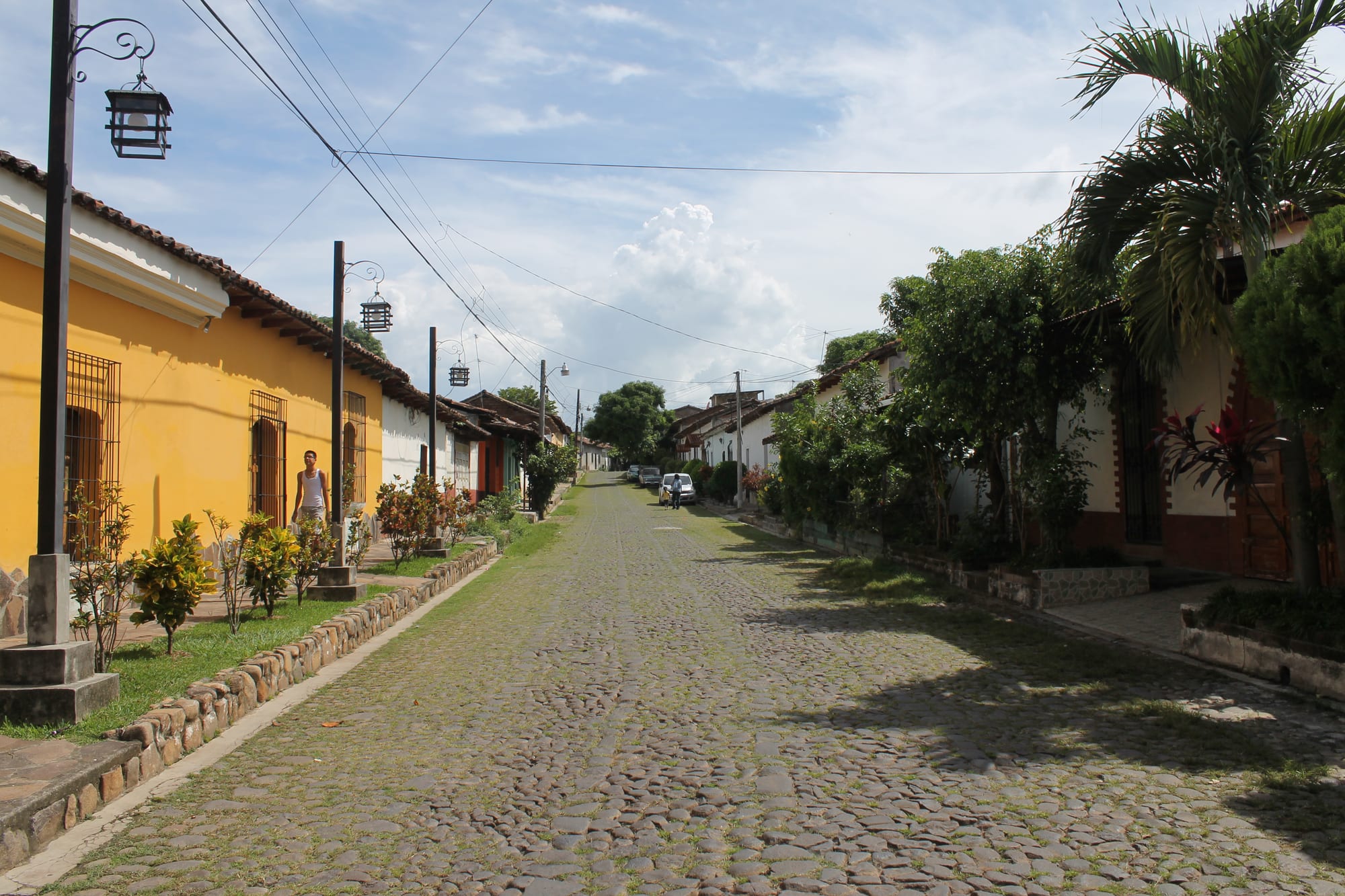
A cobbled street lined with low tiled-roof houses, iron lamp posts and gardens under a blue sky with white clouds

El Salvador

Suchitoto

A cobbled street in Suchitoto, leading down towards the lake. (ElmerGuevara / Wikimedia Commons · CC BY-SA 3.0)

A small colonial town of cobbled streets and adobe houses in Cuscatlán, above the Cerrón Grande reservoir known locally as Lake Suchitlán. Rich on indigo in colonial times and badly emptied by the civil war, it has rebuilt itself since 1992 around heritage, the arts and tourism, with the white church of Santa Lucía at its centre.

Neighbourhoods

  • The historic centre
    • First-time visitors
    • Historic district
    • Cafés

    The cobbled grid around the main square and the church of Santa Lucía, with adobe and neoclassical houses built around inner courtyards. Hostels, restaurants and cafés have opened in the old houses, and the municipal market is a minute from the square.

    Open in Maps
  • Down to the lake
    • Nature
    • Boat trips

    The road that drops downhill from the town to the shore of Lake Suchitlán and Puerto San Juan, the lakeside complex with boat landings, places to eat and views across the water. The walk back up is steep and hot.

    Open in Maps

Things to do

In town

  • Church of Santa Lucíalandmark

    The white parish church begun in 1853, mixing neoclassical design with traditional building methods, with porcelain plates set into its domes; a National Monument since 1978.

    Open in Maps
  • Casa Museo de Alejandro Cottomuseum

    The restored family house of the filmmaker Alejandro Cotto, founder of the town's arts festival, now a house museum.

    Open in Maps
  • Teatro de las Ruinasattraction

    The theatre that hosts the February arts festival, with orchestras, opera, dance, theatre and poetry from Salvadoran and international artists.

    Open in Maps
  • Municipal marketmarket

    The town market a minute from the main square, with simple canteen meals on its top floor and the bus stop to San Salvador beside it.

    Open in Maps

The lake and the hills

  • Lake Suchitlánpark

    The Cerrón Grande reservoir, the largest body of fresh water in the country, formed when the Lempa River was dammed in the 1970s; boat tours leave from Puerto San Juan below the town.

    Open in Maps
  • Puerto San Juanattraction

    The lakeside complex closest to the town, with boat landings, places to eat and somewhere to rest by the water.

    Open in Maps
  • Los Tercios waterfalltrail

    A waterfall reached by a short trail off the road south of town, with a viewpoint over the lake nearby.

    Open in Maps

Short trips from the town

  • Ciudad Viejaattraction

    The archaeological remains of the second site of the town of San Salvador, founded in 1528 and abandoned for today's capital in 1545, about 12 km from Suchitoto, where the grid of streets leading from the main square can still be traced.

    Open in Maps

Seasonal events

  • Festival Permanente de Arte y CulturaFebruary

    An arts festival founded by Alejandro Cotto in 1991, held at the Teatro de las Ruinas with music, opera, dance, theatre and poetry.

  • Festival del MaízAugust

    A festival in tribute to maize, the sacred grain.

  • Feriado del AñilNovember

    A celebration of indigo, the dye that made the town's fortune in colonial times.

  • Fiestas patronalesDecember

    The patron-saint festivities in honour of Santa Lucía.

Eat and drink

Long-standing places and food districts in Suchitoto. Hours, ratings and directions come from your maps app, always current.

Suchitoto classics

  • Municipal market canteensmarket

    Cheap canteen-style meals served on the top floor of the market near the main square.

    Open in Maps
  • Cafés of the historic centreneighborhood

    Cafés in old courtyard houses and gardens around the centre, some with views over the lake.

    Open in Maps
  • Puerto San Juanneighborhood

    The lakeside complex below the town, with places to eat by the boat landings.

    Open in Maps

Experience Suchitoto

History

The land around Suchitoto was densely settled by Nahua people before the Spanish arrived. In April 1528 Diego de Alvarado re-founded the town of San Salvador about 12 km away, in the Bermuda valley; it had a hard existence, besieged by the native people, and from around 1539 its settlers began moving to the Valle de las Hamacas, the site of today's capital, a move made official in 1545. The ruins, known as Ciudad Vieja, lie within Suchitoto's territory. By 1550 Suchitoto itself had about 600 inhabitants and was the seat of a large parish.

From the 17th century the town became one of the most important centres of indigo production in the region. It was made a villa in 1836 and a city in 1858, and through the 19th century indigo and early coffee paid for its neoclassical and adobe houses arranged around courtyards, and for the church of Santa Lucía, begun in 1853.

The 20th century brought two blows. In the 1970s the Cerrón Grande dam flooded the valley below the town to create the reservoir now called Lake Suchitlán, displacing around 12,000 people and drowning whole cantons, including El Tablón and San Juan. Then the civil war of the 1980s emptied the town: the municipality's population fell from 34,101 in 1971 to 13,850 by 1992. After the peace accords residents began to return, and the town rebuilt itself around heritage conservation, culture and tourism. In the municipal reform approved in 2023, it became a district of the new municipality of Cuscatlán Norte.

Culture & Customs

Suchitoto has made culture its calling card. The filmmaker Alejandro Cotto founded its arts festival in 1991, held every February in the Teatro de las Ruinas with orchestras, opera, dance, theatre and poetry from Salvadoran and international artists; his restored family home is now a house museum. As tourism has grown, many arts and cultural spaces have opened, offering young people in the community new opportunities.

The church of Santa Lucía, with porcelain plates set into its domes and a clock in the middle of its pediment, is the town's symbol and one of the first churches built in El Salvador after independence; it was declared a National Monument in 1978. The patron-saint festivities in honour of Santa Lucía fill December, and the year also brings a maize festival in August, a celebration of indigo in November and a festival on the Guazapa hill in January.

The town's name is usually explained as Nahuat for "bird and flower", and it keeps a strong sense of place, from its cobbled streets and colonial façades to the memory of the war years, when most of its people left.

Daily Life

The district had about 22,700 inhabitants at the 2024 census, spread over 329 square kilometres of hills, forest and lakeshore divided into 28 cantons. At the 2007 census most people lived in the rural communities rather than in the small town itself, which stands at about 390 metres above sea level. Since the municipal reform it is governed as a district of Cuscatlán Norte.

Tourism now shapes the town's economy, bringing hostels, restaurants and cafés into the old houses of the centre, and the lake supports boat tours from Puerto San Juan. The surrounding countryside is a patchwork of natural areas — the Guazapa and Tecomatepe hills, part of the Cinquera forest and the lakeshore — and farmland.

Life centres on the main square, the church and the municipal market, where buses leave for San Salvador. The reservoir that gives the town its views is also a problem: the Cerrón Grande is among the most polluted bodies of fresh water in Central America.

Food

Suchitoto eats the national staples. Pupusas — thick corn or rice tortillas stuffed with cheese, refried beans, chicharrón or loroco flower buds, griddled and served with curtido, a tangy cabbage slaw, and tomato salsa — are made in pupuserías around the town. In comedores and at the market, canteen-style meals of beans, rice, eggs, fried plantain, crema and queso fresco, and tamales are the everyday lunch; the top floor of the municipal market is the place for cheap, filling plates.

Maize, the base of the tortilla and the pupusa, has its own festival in August. The cafés that have opened in the colonial houses of the centre serve coffee from the country's highlands and horchata, made here as across El Salvador from rice milk, morro seeds, sesame and spices; some have gardens with views of the lake. Chan and tamarind drinks are other traditional refreshments, and Tic Tack, a sugar-cane spirit, is the national liquor.

Planning tools

Budget

Suchitoto is inexpensive. Buses from San Salvador, market meals and pupusas cost very little; guesthouses in restored colonial houses, café meals and boat trips on the lake are the main costs.

Daily Budget Midrange
USD 70–130 (guesthouse in a colonial house, restaurant meals, a boat trip, taxis or a shuttle)
Daily Budget Shoestring
USD 30–50 (hostel or guesthouse, market and comedor meals, buses)

Carry small notes; there is a small entry charge at the lake and at Los Tercios.

Best Time to Visit

November to April, the dry season, brings sunny weather, though the air turns hot and hazy. The wet months from May to October are green, with afternoon downpours. February brings the arts festival.

Suggested Number of Days

A night or two suits most visits. The number grows with the surroundings — the lake, the waterfall and the ruins of the old capital nearby — or with a festival weekend.

First Visit
1–2 days
With Surroundings
2–3 days

Transportation

Everything in town can be reached on foot. Small red enclosed taxis run between the centre and the lake. Buses run to San Salvador and to San Martín on the Pan-American Highway.

Take a taxi back up from the lake on hot afternoons.

Airport & Station Connections

Buses 129 and 140 run from San Salvador's Terminal Plaza Amanecer, near the eastern terminal, and frequent buses link Suchitoto with San Martín on the Pan-American Highway, where eastbound buses from the capital stop. Buses back to San Salvador leave from beside the municipal market. Many visitors arrive by tourist shuttle or hire car.

Walkability

A small, walkable town, though the cobbles are uneven and the streets steep. The walk down to the lake and the waterfall is easy; the climb back is hard work in the heat.

Safety

El Salvador was for years one of the most violent countries in the world, dominated by the MS-13 and Barrio 18 gangs. Since a "state of exception" declared in March 2022 and extended 55 times by September 2026, which suspended some civil liberties and led to more than 90,000 arrests, homicide rates have fallen dramatically, and tourist areas are much safer than a decade ago. Suchitoto is a quiet town; ordinary theft is the main concern, and walks outside town are best done with company.

The tourism office has advised visiting Los Tercios with the tourism police; carry water against the heat, and do not photograph police or military. Check current official travel advice before travelling.

Climate

Hot for most of the year, at an altitude of under 400 metres, with a dry season from about November to April and a wet season from May to October.

Summer
the wet months from May to October bring heavy afternoon rain; across El Salvador's interior lowlands below 800 metres average temperatures run from about 22 to 28 °C
Winter
dry, sunny and very hot late in the season, when highs across the country can pass 32 °C in April

Local Customs

A small, Catholic town where people greet each other in the street and neat dress is expected in the church.

Say 'buenos días' on entering shops, ask before photographing people, never photograph police or soldiers, and leave a small tip in sit-down restaurants.

Common Payment Methods

The currency is the US dollar. Bitcoin was made legal tender in 2021 but lost that status in February 2025, and acceptance is limited. Cards work in some guesthouses and restaurants, but cash is needed for buses, the market, taxis and boat trips, and it is wise to arrive with enough of it.