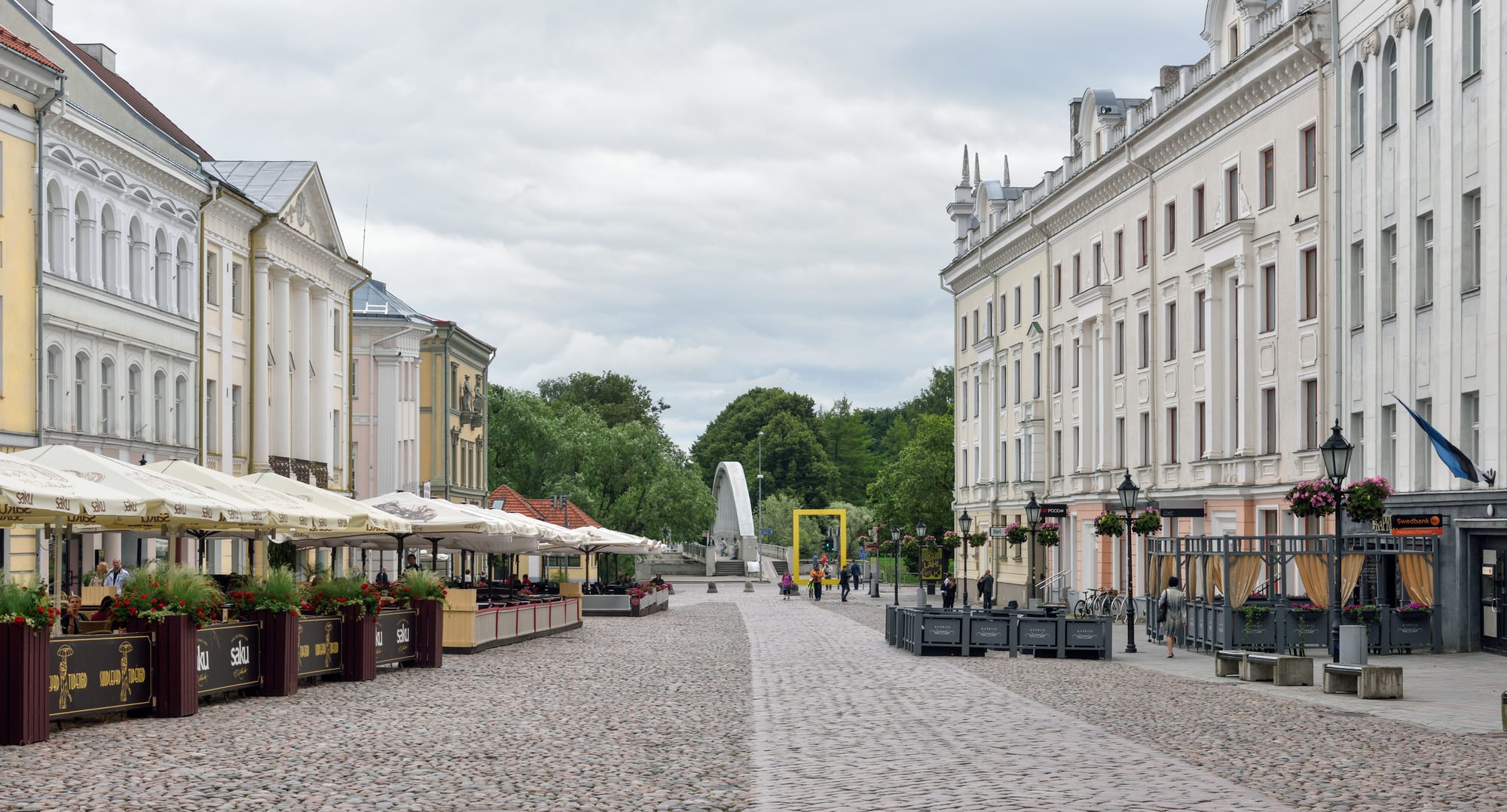
Cobbled Town Hall Square in Tartu lined with pale classical facades and café umbrellas, leading to a white arched footbridge

Tartu, Pärnu & Southern Estonia, Estonia

Tartu

Town Hall Square in Tartu, looking towards the Arch Bridge over the Emajõgi. (Cayambe / Wikimedia Commons · CC BY-SA 4.0)

Estonia's second city, on the Emajõgi river in the south-east of the country, a Hanseatic town that grew around a hilltop fort and became the home of the nation's oldest university in 1632. Rebuilt in classical style after the great fire of 1775 and scarred by the Second World War, it is now a green, student-filled city and was European Capital of Culture in 2024.

Neighbourhoods

  • Old town and Town Hall Square
    • First-time visitors
    • Historic district
    • Cafés and bars

    The compact centre between the river and Toome Hill, rebuilt in Late Baroque and Neoclassical style after the fire of 1775. The pink town hall, the university main building, St John's Church and most museums, cafés and student bars are a few minutes' walk apart.

    Open in Maps
  • Toomemägi
    • Parks and views
    • History

    The wooded hill above the old town where Tartu began as a hill fort and later held the bishop's castle. Today it is a park of paths, bridges and monuments around the cathedral ruins, the old observatory and the Supreme Court.

    Open in Maps
  • Supilinn
    • Wooden houses
    • Quiet and residential

    Soup Town, a small district just north of the centre on the bank of the Emajõgi, whose streets are named after soup ingredients. A former slum of one- and two-storey wooden houses, it is being steadily renovated into a sought-after neighbourhood.

    Open in Maps
  • Tähtvere
    • Quiet and residential

    A residential district where a row of functionalist houses was designed in the 1930s, when Estonia was first independent, and one of the quieter parts of the city.

    Open in Maps
  • Annelinn
    • Local life
    • Soviet-era architecture

    The largest neighbourhood, on the left bank of the Emajõgi, planned between 1969 and 1973 as estates of five- and nine-storey Soviet apartment blocks. More than a quarter of the city's people live here, and it shows everyday Tartu away from the old town.

    Open in Maps

Things to do

Famous landmarks

  • Tartu Town Halllandmark

    The seat of the city government, built between 1782 and 1789 at the head of Town Hall Square, the classic view of the city.

    Open in Maps
  • Kissing Studentslandmark

    The fountain in front of the town hall, with Mati Karmin's 1998 sculpture of a kissing couple, one of the best-known symbols of the student city.

    Open in Maps
  • Main building of the University of Tartulandmark

    Johann Wilhelm Krause's columned main building of 1804–1809, one of the finest examples of classical architecture in Estonia, with a large assembly hall and attic lock-up rooms where 19th-century students were detained as punishment.

    Open in Maps
  • St John's Churchlandmark

    A Brick Gothic Lutheran church known for its many terracotta figures, largely rebuilt after both the Great Northern War and the Second World War.

    Open in Maps
  • Tartu Cathedrallandmark

    The imposing ruin of the medieval cathedral on Toome Hill; about a third has been restored and houses the university museum, and its towers serve as viewing platforms.

    Open in Maps
  • Barclay de Tolly Monumentlandmark

    An 1849 monument to the Baltic-German field marshal Michael Andreas Barclay de Tolly, one of the best-known of the city's many sculptures.

    Open in Maps

Museums

  • Estonian National Museummuseum

    Founded in 1909 and since 2016 housed in a long modern building on the old runway of the Soviet Raadi airfield, it covers the life and traditions of the Estonian people, other Finno-Ugric peoples and the country's minorities.

    Open in Maps
  • AHHAA Science Centremuseum

    The largest science centre in the Baltic states, full of interactive exhibits, in its own building in the city centre since 2011.

    Open in Maps
  • University of Tartu Old Observatorymuseum

    An observatory active from 1810 to 1964 and now a museum; as the first measuring point of the Struve Geodetic Arc it is part of a UNESCO World Heritage Site.

    Open in Maps
  • Tartu Art Museummuseum

    The largest art museum in southern Estonia, founded in 1940 by members of the Pallas art school and housed in the visibly leaning house on Town Hall Square.

    Open in Maps
  • Estonian Sports and Olympic Museummuseum

    The largest sports museum in the Baltic states, founded in 1963 and modernised in 2020, on Rüütli Street in the old town.

    Open in Maps
  • Tartu Toy Museummuseum

    The biggest toy museum in the Baltic states, in one of the city's oldest wooden buildings, with thousands of toys, Estonian film puppets and a children's theatre house.

    Open in Maps

Parks and the river

  • University of Tartu Botanical Gardenpark

    A university garden founded in 1803 and moved in 1806 to a former bastion on Lai Street on the northern edge of the old town.

    Open in Maps
  • Raadi Manor Parkpark

    The park of the former Liphart family manor on the northern edge of the city, beside the Estonian National Museum, on ground that later became a secret Soviet bomber base.

    Open in Maps

Music, theatre and nights out

  • Vanemuineattraction

    The first Estonian-language theatre, which grew from the Vanemuine Society of 1865 and now stages drama, opera, ballet and concerts with its own orchestra.

    Open in Maps
  • Aparaaditehasattraction

    A former Soviet-era factory complex on Kastani Street that has worked since 2013 as a creative quarter with its own cultural programme.

    Open in Maps

Seasonal events

  • Tartu Ski Marathonthird Sunday of February

    A long-distance cross-country ski race, part of Worldloppet, run over 63 km from Otepää to Elva.

  • Tartu Student Daysspring and autumn

    Student festivities that take over the city, with a night song festival in spring and Walpurgis Night celebrations.

  • Tartu Hanseatic Dayssummer

    A festival held since 1995 to celebrate the city's Hanseatic past, with a Hanseatic market of crafts and farm food, workshops, concerts and performances.

  • TartuffAugust

    A romance film festival held since 2006, the largest open-air film festival in the Baltics, with free screenings on a big screen in Town Hall Square.

Eat and drink

Long-standing places and food districts in Tartu. Hours, ratings and directions come from your maps app, always current.

Tartu classics

  • Café Wernercafe

    One of the oldest cafés in Estonia, near the university main building, where Johann Werner opened a Viennese confectioner's in 1895; for generations a meeting place of professors, writers and students.

    Open in Maps
  • Gunpowder Cellarrestaurant

    A beer restaurant in an 18th-century gunpowder store dug into Toome Hill, listed by Guinness for the highest pub ceiling in the world, at 11 metres, and a popular student meeting place with live music.

    Open in Maps

Markets and food districts

  • Tartu Market Hallmarket

    A neoclassical indoor market opened in 1938 beside the Emajõgi, with a meat hall and a smaller fish hall.

    Open in Maps
  • Old town cafés and barsneighborhood

    The streets around Town Hall Square and the university hold most of the city's cafés, pubs and student bars.

    Open in Maps

Experience Tartu

History

Archaeologists have found a permanent settlement on the site from as early as the fifth century AD, and by the seventh century local people had built a wooden fort on the east side of Toome Hill. Around 1030 Yaroslav the Wise, Grand Prince of Kiev, captured the area and built his own fort, Yuryev, which was burned in 1061. In 1224 German crusaders took the hill fort for the last time, and as Dorpat the town became the capital of a semi-independent bishopric, joined the Hanseatic League in the 1280s and became an important trading city.

The Livonian War began here in 1558, when Ivan the Terrible's army forced the town to surrender. Polish-Lithuanian and Swedish rule followed, and in 1632 King Gustavus Adolphus of Sweden founded the university. Russia took the town in 1704 and in 1708 blew up its fortifications and deported its citizens; after the great fire of 1775 the centre was rebuilt in Late Baroque and Neoclassical style. In the 19th century Tartu became the heart of the Estonian national awakening: the first song festival was held here in 1869 and the Vanemuine theatre opened in 1870.

The Treaty of Tartu, signed on 2 February 1920, ended the War of Independence. The Second World War left much of the centre in ruins, including the old stone bridge, and the Soviet authorities closed the city to foreigners because of the bomber base at Raadi; the population almost doubled to more than 100,000. Since 1991 the old town has been renovated, St John's Church restored, and the Estonian National Museum given a new building on the old airfield in 2016.

Culture & Customs

Tartu is often called the intellectual capital of Estonia, and half-jokingly the Athens of the Emajõgi. The University of Tartu, the oldest and largest in the country, shapes the city's character, and the town is also home to the Estonian University of Life Sciences, the Supreme Court, the Ministry of Education and Research and the Estonian National Museum. Its scholarly names include the embryologist Karl Ernst von Baer and the semiotician Juri Lotman, whose Tartu School remains influential.

Vanemuine, the oldest Estonian-language theatre, keeps a respected ballet company, and the city gave its name to a school of composition. Student life sets the calendar, with festivities each spring and autumn, a night song festival and Walpurgis Night; the custom of walking over the top of the Arch Bridge is said to make a true Tartu student. In summer the Hanseatic Days recall the medieval trading town and Tartuff fills Town Hall Square with free films. The year as European Capital of Culture in 2024 brought new attention to the city's arts scene.

Sport is a large part of local life. Tartu hosts Rally Estonia, the biggest motorsport event in the Baltic states and a round of the World Rally Championship since 2020, and supports a professional basketball club, a top-flight football club and a volleyball team. The Tartu Ski Marathon, part of Worldloppet, runs through the hills to the south each February.

Daily Life

About 97,000 people lived in Tartu in 2025, making it Estonia's second city and the largest urban centre in the south. Students and researchers set much of its rhythm: the university and its clinic are among the largest employers, and the city has a high share of researchers, doctors and other skilled professionals.

Beyond the university, the economy mixes traditional industry with technology. Food processing has long been important, with the brewer A. Le Coq, Tartu Mill and Salvest, and a major printing house is based here. Since the start of the century many ICT and other high-tech companies have set up in the city. The Soviet-era estates of Annelinn house the largest share of residents, while Supilinn's wooden houses are being renovated into a sought-after neighbourhood.

Daily life is unhurried and outdoor-minded in the warm months, when cyclists fill the cycle paths, students gather in Pirogov Park and the riverbanks fill up on long evenings. Winters are dark and cold, and life moves indoors, to the theatres, cafés, saunas and shopping centres. Friday afternoon buses and trains to Tallinn fill with students going home for the weekend during term.

Food

Tartu eats the food of southern Estonia, where several of the country's staples originate. Kama, a dish of milled and roasted pea, barley, rye and oat flour soaked in milk or buttermilk, kohupiim, a fresh quark, and sõir, a cooked mixture of milk, cottage cheese and eggs, all originate in the south. Black rye bread, leib, accompanies almost every savoury meal, and mulgikapsad, sauerkraut with pork and pearl barley, is counted among Estonia's national foods.

The neoclassical market hall by the river, opened in 1938, has meat and fish halls. Herring is a staple of the Estonian cold table, and kiluvõileib, an open sandwich of spiced salted sprats with boiled egg, is a classic appetiser. For something sweet, kringel, a cardamom-scented yeast bread, and curd buns are eaten with coffee, a tradition kept alive at Café Werner, one of the country's oldest cafés, close to the university.

Beer is the usual drink with food, and A. Le Coq, one of the most recognised brands in Estonia, brews in the city. The Gunpowder Cellar on Toome Hill pours beer under the highest pub ceiling in the world, and the bars around Town Hall Square and the old town fill with students most evenings of term.

Planning tools

Budget

Tartu costs noticeably less than Tallinn, with student-priced cafés and good-value hotels. Prices rise for big events such as the Hanseatic Days and student festivals, and the museums charge admission, but walking the old town, Toome Hill and the riverbanks costs nothing.

Daily Budget Midrange
USD 100–180 (mid-range hotel, restaurant dinners, museum tickets, taxis)
Daily Budget Shoestring
USD 50–80 (hostel or guesthouse, café lunches, buses and city bikes)

The city bike scheme and the walkable centre keep transport costs low; book rooms early for festival weekends.

Best Time to Visit

May to September for long light evenings, café terraces, open-air film in August and the summer festivals. Term time, in spring and autumn, brings the student celebrations and a busier nightlife. Winters are cold and dark but the museums stay open, and February brings the ski marathon to the hills south of the city.

Suggested Number of Days

Two days cover the old town and the main museums at an easy pace. Allow three or four to add the countryside and lakes of southern Estonia, which are best reached by car.

First Visit
2 days
With Surroundings
3–4 days

Transportation

The centre is small enough to walk. Cycling is fast and easy, with a network of cycle paths and a large city bike scheme, many of the bikes electric, unlocked with an app or a bus card. Fourteen city bus lines and two night lines cover the rest, and tickets can be paid by tapping a contactless card on board. Taxis are usually ordered by app.

Tap a contactless card on each boarding; regular riding converts automatically into a day ticket.

Airport & Station Connections

Most visitors fly into Tallinn, about 185 km to the north-west, and continue by bus or train; Elron trains take about two hours and buses run directly from Tallinn Airport. Small Tartu Airport, about 11 km south-south-west of the city, has a few flights to Helsinki. Trains also run south to Valga for connections to Riga, and long-distance buses use the bus station beside the Tasku shopping centre.

Walkability

Very walkable. All the central sights are close together; the railway station is about 20 minutes' walk from the old town, and the Estonian National Museum about half an hour on a walkway along Roosi Street. Toome Hill has some steep paths, and pavements can be icy in winter.

Safety

Estonia is a safe country with low levels of violent crime. Tartu is calm, and the main risks are ordinary ones: late-night crowds around the student bars, icy pavements in winter and thin ice on the river.

Keep off river ice, watch footing on frozen pavements, and keep an eye on belongings in busy bars. Check current official travel advice before travelling.

Climate

A humid continental climate, milder than its latitude suggests because of the Baltic Sea and Atlantic air, but with hot spells in summer and cold snaps in winter, when the temperature can occasionally fall below −30°C.

Summer
June–August; inland Estonia averages about 18°C in July, the warmest month, with long light evenings
Winter
December–February; inland Estonia averages about −5°C in February, the coldest month, and snow is usual

Local Customs

Tartu is proudly a university town, and many traditions belong to the students, from spring and autumn festivities to the custom of walking over the top of the Arch Bridge. Tipping became common only after independence and is not always expected; about 10 per cent in restaurants is usual. English is widely understood.

Drinking alcohol in public places is restricted; Pirogov Park behind the town hall is a designated picnic area where light alcohol is allowed in the warmer months.

Common Payment Methods

The currency is the euro. Cards and contactless payment are accepted almost everywhere, including on city buses, and cash is rarely needed; a few coins can help with parking machines.