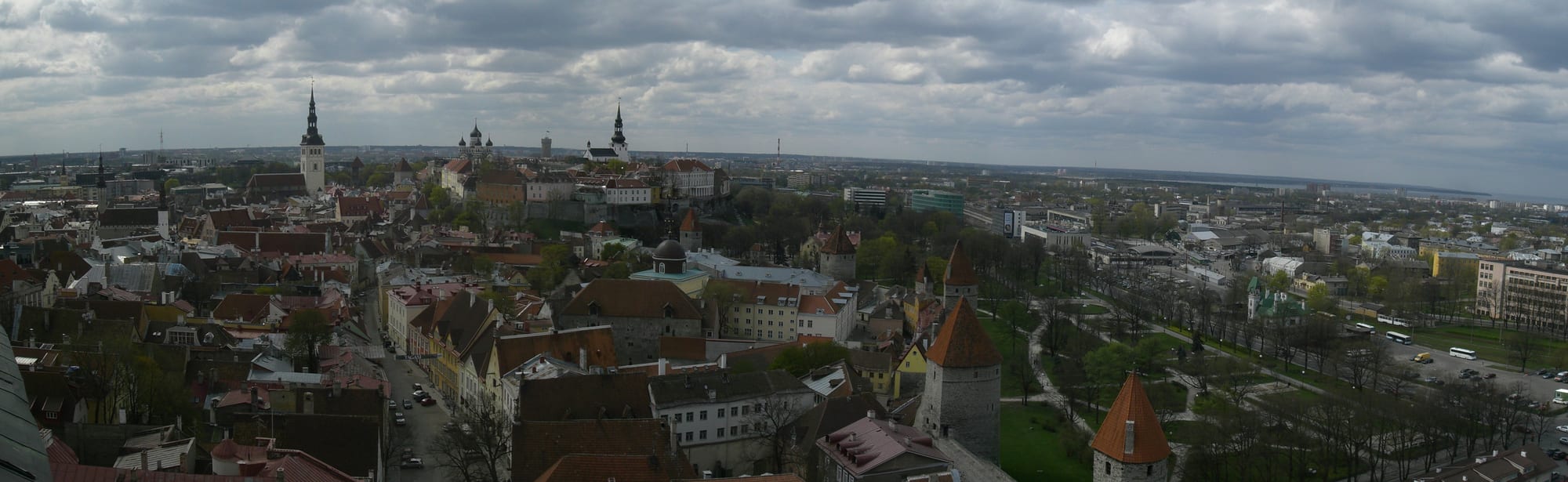
A dense cluster of medieval red-tiled roofs, church spires, and stone towers seen from above under a bright sky

Estonia

The medieval Old Town of Tallinn, a UNESCO World Heritage Site and one of the best-preserved in Northern Europe. (Chmee2 / Wikimedia Commons · CC BY-SA 3.0)

The northernmost Baltic state — flat, forested, and dotted with islands and bogs — with a medieval Hanseatic capital, a Finnic language, and a reputation as one of the world's most digital societies.

Explore Estonia

History

Estonians, a Finnic people, were among the last pagans in Europe when Danish and German crusaders conquered the country in the thirteenth century. For the next 700 years Estonia was ruled by others — Denmark, the Livonian Order, Sweden, and, from 1710, the Russian Empire — while a German-speaking nobility owned the land and towns like Tallinn and Tartu thrived as Hanseatic trading centres and, later, seats of Baltic-German culture and a Swedish-founded university.

A national awakening in the nineteenth century produced an Estonian-language press, choirs, and the great song festivals. Estonia seized independence in 1918 amid the collapse of the Russian Empire and won a war to keep it, enjoying two decades as a democracy and then an authoritarian republic.

The 1939 Molotov-Ribbentrop Pact assigned Estonia to the Soviet sphere; it was occupied by the USSR in 1940, by Nazi Germany from 1941, and by the Soviets again from 1944, with mass deportations to Siberia and an armed "Forest Brothers" resistance. Non-violent mass protest — the "Singing Revolution" and the 1989 "Baltic Way" human chain — helped restore independence in 1991. Estonia joined NATO and the EU in 2004.

  • Estonia: The Northern Crossroads — A Finno-Ugric people on the Baltic shore — seven centuries under German, Swedish and Russian masters, two decades of freedom between the wars, a Soviet half-century, and a revolution set to song

Culture & Customs

Estonians have a reputation, which they cheerfully accept, for reserve, dry understatement, and comfort with silence. Nature is close to a national religion: most people can name birds and berries, forest and bog walks are a normal weekend, and a large share of the population has access to a summer cottage.

Song is the deep cultural thread. The national song and dance celebration, held every five years and involving tens of thousands of singers before audiences of tens of thousands, is on UNESCO's list and is bound up with the independence story. Sauna, a shared Finnic tradition, is a weekly ritual and a place for quiet, honest conversation.

Estonia's other modern identity is digital: online voting, e-residency, near-total digital government, and a startup culture (Skype was built here) that Estonians mention with pride. Religious observance is among the lowest in the world.

  • Estonia: Song, Sauna and the Quiet Forest — One of the least religious countries in Europe, where reserve hides a generous welcome, shoes come off at the door, the forest is treated with respect and the whole nation still gathers to sing

Daily Life

About a third of Estonia's nearly 1.4 million people live in Tallinn, the capital on the Gulf of Finland; Tartu, the university city in the south, is the intellectual centre; and Narva, on the Russian border, is overwhelmingly Russian-speaking. The rest of the country is small towns, farmland, forest, and islands, with a low and ageing population density.

The economy is open and tech-heavy, closely tied to the Nordic countries and the EU, with electronics, wood products, IT services, and logistics prominent. Living standards have risen fast since the 1990s, though wages still trail Western Europe and energy costs and regional security are current concerns given the border with Russia.

Daily life is quiet and orderly: the commute, the sauna, the summer cottage, and long light evenings in June balanced against dark, indoor winters.

  • Estonia: A Digital Life, Lived Quietly — Taxes filed in minutes, an ID card that replaces most of the paperwork, and a population that still disappears at weekends to a lake, a forest, or a wooden sauna

Food

Estonian cooking is northern and seasonal, built on rye bread, pork, potatoes, dairy, fish, and what the forest provides. Black rye bread is eaten at every meal; sült (jellied pork), blood sausage (verivorst, a Christmas dish), mulgipuder (mashed potato and barley), and pork with sauerkraut are the traditional mainstays.

Baltic herring and sprats, smoked and salted, appear on the kiluvõileib open sandwich; lake and sea fish, crayfish in late summer, and elk and wild boar feature seasonally. Forest foods — chanterelles, ceps, lingonberries, bilberries — are gathered and preserved by many households.

Kama, a roasted grain-and-pulse flour mixed with buttermilk, is a distinctive snack; kohuke, a glazed curd bar, is a much-loved everyday sweet. Craft beer, Vana Tallinn rum liqueur, and, increasingly, gin and cider are the drinks.

  • Estonia: Food and the National Dish — A humble barley-and-potato porridge elevated to national symbol, a roasted-grain mix eaten mainly in Estonia and Finland, and a Baltic sprat sandwich once built to a record-breaking length

Attractions & Natural Wonders

Tallinn's walled Old Town, a UNESCO World Heritage Site, is the headline: cobbled lanes, Hanseatic merchant houses, Gothic churches, the Town Hall Square, and the hilltop Toompea with its Orthodox cathedral and viewing terraces. Beyond the walls, the Seaplane Harbour maritime museum, the Kadriorg palace and park, and the KUMU art museum round out the city.

Lahemaa National Park, an hour east, packs bogs, forest, boulder-strewn coast, restored manor houses, and fishing villages into an easy day or two. The university town of Tartu, a 2024 European Capital of Culture, has a lively student scene and good museums. Pärnu, in the southwest on the Gulf of Riga, is the summer beach resort.

The islands are the quiet counterpoint: Saaremaa, the largest, with its bishop's castle at Kuressaare, juniper heath, windmills, and a meteorite crater lake at Kaali; and smaller Hiiumaa and Muhu, reached by car ferry, where the pace slows right down. The bogs — Soomaa, where spring floods spread over the grasslands and forests, and raised bogs crossed by boardwalks — are a landscape found in few other places.

Planning basics

Budget

Estonia is mid-range for the EU — cheaper than the Nordic countries just across the water, pricier than it was before the euro. Tallinn's Old Town is the most expensive spot; Tartu, the islands, and the countryside cost less. Card and phone payment is near-universal.

Daily Budget Midrange
EUR 100–180 (mid-range hotel, restaurants, a rental car, day trips)
Daily Budget Shoestring
EUR 45–75 (hostel or guesthouse, supermarket and café food, buses)

Visa Requirements

Estonia is in the EU, the Schengen Area, and the eurozone. Citizens of the EU, the UK, the US, Canada, Australia, and many other countries need no visa for stays of up to 90 days in any 180-day period. The EU's ETIAS travel authorisation, which visa-exempt visitors will have to obtain before travelling, is scheduled to come into force in 2027, a year after the Entry/Exit System.

Typical Stay
90 days in any 180-day period, visa-free, for most Western passports

Safety

Estonia is a safe country with low levels of violent crime. Petty theft occurs in Tallinn's Old Town and on the Helsinki ferries; winter driving on snow and ice, and thin lake or sea ice, are the main seasonal hazards.

Watch belongings in the Old Town crowds and on ferries, and use winter tyres in the cold season.

Climate

Cool temperate, moderated by the Baltic. Summers are short, mild, and bright, with very long days around midsummer; winters are long, cold, dark, and often snowy, with the sea sometimes freezing near the coast. Spring and autumn are brief and changeable.

Summer
June–August, generally 17–23°C, near-midnight-sun daylight in June
Winter
December–February, averaging roughly -1 to -5°C, often snowy, short days

Transportation

Tallinn Airport is the main gateway, with ferries to Helsinki (roughly two to three and a half hours) and Stockholm. Intercity buses are the backbone of domestic travel, frequent and cheap; trains (Elron) serve Tartu, Narva, and other lines. A rental car suits Lahemaa and the islands, which are reached by regular car ferries.

The Tallinn–Helsinki ferry makes a day trip between the two capitals easy.

Best Time to Visit

May to September for mild weather, the "white nights" of June, and the islands and national parks at their best. Midsummer (Jaanipäev, 23–24 June) is one of the most widely celebrated holidays. Winter offers a snowy Old Town, Christmas markets, and bog-walking on snowshoes, if you don't mind the cold and dark.

Currency

Estonia uses the euro, adopted in 2011. It is close to a cashless society; cards and contactless work everywhere, and some places no longer take cash.

Symbol
€
Currency Code
EUR — euro

Language

Estonian is the official language, a Finnic language closely related to Finnish and unrelated to Russian, Latvian, or Lithuanian. English is very widely spoken, especially by younger people and in Tallinn and Tartu. Russian is the first language of about a quarter of the population, concentrated in the northeast and parts of Tallinn.

English
Widely spoken, especially by younger people
Russian
Spoken by a large minority, mainly in the northeast
Official Language
Estonian