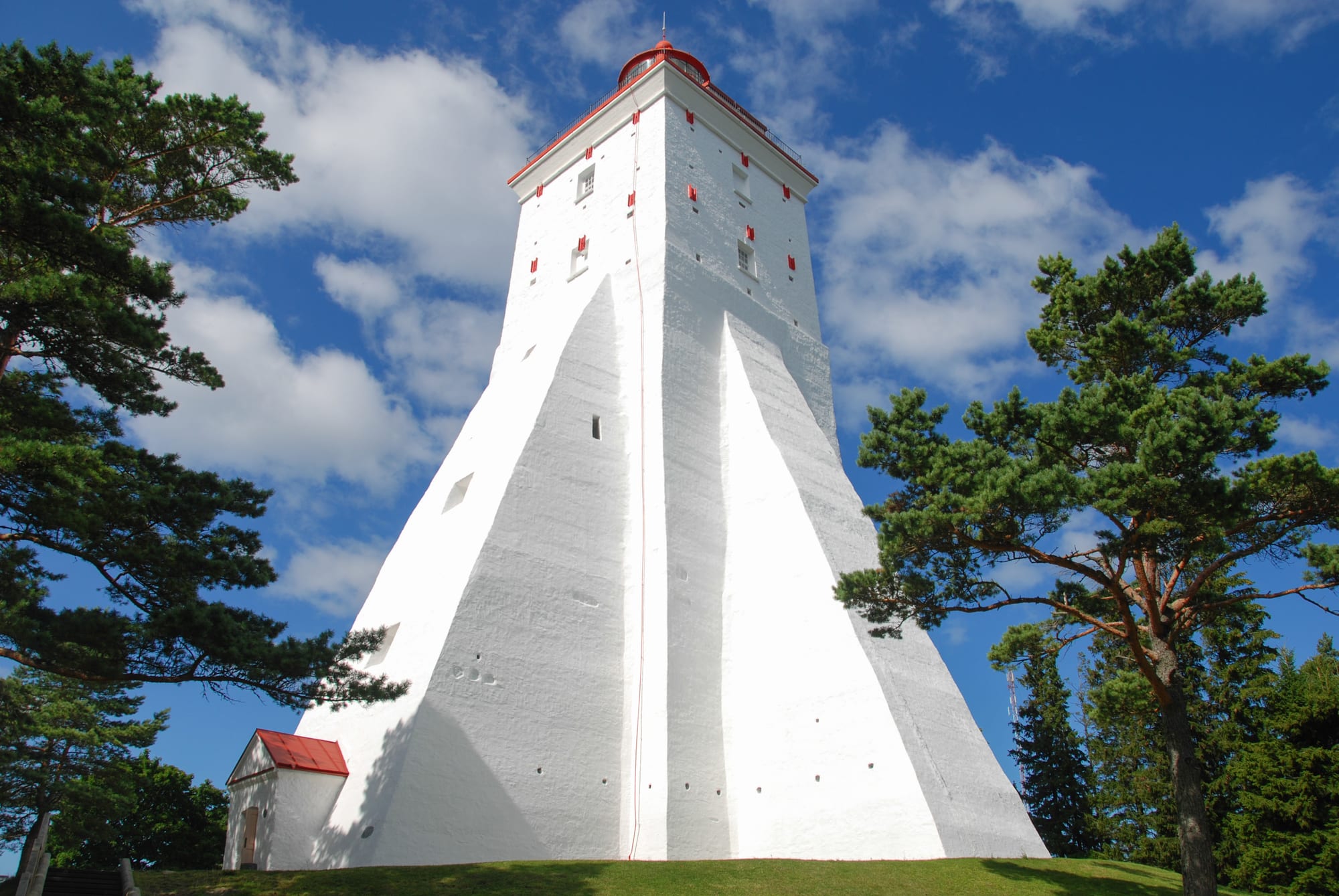
The massive white tapering stone tower of Kõpu lighthouse with red window frames, framed by pine trees under a blue sky

Tallinn & Northern Estonia, Estonia

Hiiumaa

Kõpu lighthouse on Hiiumaa, in continuous use since its completion in 1531. (Abrget47j / Wikimedia Commons · CC BY-SA 3.0 ee)

Estonia's second-largest island, 22 kilometres off the west coast, low and limestone-based, covered in pine and deciduous forest, dunes and mires. Once home to Swedish-speaking farmers and closed to most outsiders in Soviet times, it is now a quiet place of lighthouses, manor parks, small harbours and one small town, Kärdla, reached by ferry or a short flight.

Neighbourhoods

  • Kärdla
    • First-time visitors
    • Beaches
    • Close to public transport

    The island's only town and the capital of Hiiu County, a small place by the sea on the north-east coast with the tourist information office, shops and bicycle hire. The airport is a short drive east, and a cycle path runs west towards Kõrgessaare.

    Open in Maps
  • Käina and Kassari
    • Quiet and residential
    • Nature

    The small borough of Käina sits on the shallow Käina Bay, which separates it from the island of Kassari to the south. Kassari, home to about 300 people in four villages, has the Orjaku yacht harbour, a museum dedicated to the writer Aino Kallas and Oskar Kallas, and the narrow, stony spit of Sääretirp.

    Open in Maps
  • Kõpu Peninsula
    • Lighthouses
    • Wild coast

    A peninsula about 21 kilometres long reaching west into the Baltic, with the island's highest hill, the Kõpu and Ristna lighthouses, scattered villages, a nature reserve and long sandy beaches.

    Open in Maps
  • Tahkuna Peninsula
    • Nature
    • Military history

    The northern tip of the island, with five villages, Lehtma harbour, the iron Tahkuna lighthouse, a stone labyrinth, old-growth forest protected in a nature reserve and the ruins of Soviet border posts along the coast.

    Open in Maps

Things to do

Lighthouses

  • Kõpu Lighthouselandmark

    A massive buttressed stone tower on the island's highest hill, in continuous use since its completion in 1531 and one of the oldest lighthouses in the world, built to warn ships off the Hiiu Shoal.

    Open in Maps
  • Tahkuna Lighthouselandmark

    A cast-iron tower begun in 1873, made in Paris and shipped to the island in parts, at the northern tip of Tahkuna, where Soviet troops surrendered to German forces in 1941.

    Open in Maps

Manors, churches and memorials

  • Suuremõisa Park and manorpark

    The largest park on the island, laid out from 1755 by Countess Ebba Margareta Stenbock around her Baroque manor house, with ponds, terraces and some of the tallest trees of their kind in Estonia.

    Open in Maps
  • Pühalepa churchlandmark

    In the village of Pühalepa, the island's oldest surviving stone church, a medieval fortress-church altered in later centuries.

    Open in Maps
  • Hill of Crosseslandmark

    A wooded hillside near Kärdla where the first cross is said to have been raised in 1781 by Swedes expelled from the island; visitors still add crosses in their memory.

    Open in Maps

Nature and the coast

  • Tahkuna Nature Reservepark

    Almost 1,900 hectares of forest left largely untouched by people, with Estonia's largest single habitat of yew, dune forests, mires and a forest trail.

    Open in Maps
  • Käina Baypark

    A very shallow, almost enclosed bay between Hiiumaa and Kassari, about a metre deep at most and linked to the open sea by three small channels.

    Open in Maps
  • Heltermaatransit hub

    The ferry port on the east coast where boats from Rohuküla on the mainland arrive, about 25 kilometres by road from Kärdla.

    Open in Maps

Short trips across the island

  • Ristna Lighthouselandmark

    A smaller iron lighthouse of 1874 at the westernmost point of the Kõpu Peninsula, damaged by German warships in 1915 and strengthened with a concrete belt in 1920.

    Open in Maps

Eat and drink

Long-standing places and food districts in Hiiumaa. Hours, ratings and directions come from your maps app, always current.

Where to eat

  • Pub at Orjaku Portrestaurant

    A cosy harbour pub on Kassari popular with locals, serving fish dishes and pancakes.

    Open in Maps
  • Kärdla's cafésneighborhood

    The island's only town has the widest choice of cafés and places to eat.

    Open in Maps

Experience Hiiumaa

History

Hiiumaa rose out of the Baltic about 8,500 years ago as the land lifted after the retreat of the ice, and the first seal hunters camped on the Kõpu Peninsula around 5500 BC, on shores now far from the sea. The island first appears in writing as Dageida in 1228, when German crusaders conquered it with the rest of Estonia, and in 1254 it was divided between the Bishopric of Ösel-Wiek and the Livonian Order. Around the beginning of the 16th century Tallinn's merchants, eager to make the dangerous shoals off Kõpu safer for Hanseatic shipping, built the stone tower that became the Kõpu lighthouse.

Under the Swedish name Dagö the island belonged to Sweden from 1563 to 1721 and then passed to the Russian Empire. It had a large Swedish-speaking population, but in 1781 about a thousand Swedish peasants were ordered off the island to settle in Ukraine; only about half reached the end of the winter journey to what became Gammalsvenskby, and the Hill of Crosses near Kärdla grew from the cross they raised as they left. Countess Ebba Margareta Stenbock built the manor at Suuremõisa in the 18th century, and in the 19th century iron lighthouses ordered from Paris went up at Tahkuna and Ristna.

German forces took the island in 1917 in Operation Albion, and it joined independent Estonia in 1918. Soviet occupation in 1940 was followed by German occupation in 1941 and Soviet rule again from 1944, and the surrounding waters were heavily mined. From 1944 to 1991 Hiiumaa was closed to foreigners and to most mainland Estonians, and the ruined forts and towers of the Soviet border guard still stand on the northern coast.

Culture & Customs

Hiiumaa people are known for their humour, much of it aimed at themselves and at their neighbours on Saaremaa, with whom there is a long, friendly rivalry. Many speak their own Hiiu dialect alongside standard Estonian, and the island is part of the B7 network of the larger Baltic islands. Life is close to nature: forests of pine and deciduous trees cover much of the island, and its fauna includes elk, red and roe deer, wild boar, lynx and, again in recent years, wolves and bears.

Memory of the Swedish past runs through the landscape, from the Swedish name Dagö to the Hill of Crosses, where visitors still leave crosses in memory of the exiles of 1781, whose descendants were allowed to leave Soviet Russia for Sweden in 1929. In 1944 nearly all of Estonia's remaining Swedes were evacuated or fled to Sweden.

Literature has a home on Kassari, where a museum remembers the writer Aino Kallas and Oskar Kallas. The lighthouses are the island's emblems: Kõpu, Tahkuna and Ristna each mark a different headland, and Kõpu, in use since 1531, is one of the best-known symbols of the island.

Daily Life

Hiiu County, made up of Hiiumaa and the small islands around it, is the smallest of Estonia's fifteen counties in both area and population. Kärdla, the only town, has a little over 3,000 inhabitants, and the rest of the island lives in the small boroughs of Käina and Kõrgessaare and in scattered villages — Suuremõisa, with about 300 people, is the largest village in the municipality, and Kassari has about 300 in four villages.

The economy rests on tourism, livestock, farming, fishing and fish processing. Tourism is mostly seasonal, and the trend has been towards smaller farms and more tourism; the island council has also agreed to the construction of a wind farm. A bridge to the mainland is occasionally proposed, but for now daily life is set by the ferry timetable, with car space hard to find on summer weekends.

The year swings between a busy summer, when holiday homes fill and the beaches of Tahkuna and Kõpu draw visitors, and a long, quiet winter. In hard winters the sea freezes and a 26.5-kilometre ice road, the longest in Europe, may be opened from Rohuküla, letting cars cross the frozen Baltic.

Food

The island eats from the sea and the farm. Smoked cooked plaice is a traditional summertime delicacy. Baltic herring (räim), the national fish, and sprats (kilu) appear on the cold table with pickles, sausages, potato salad and rosolje, a salad of beetroot, potatoes and herring, and spiced salted sprats on an open sandwich with a slice of boiled egg — kiluvõileib — are a classic appetiser.

Inland, the staples are the Estonian ones: black rye bread with almost every savoury meal, pork, potatoes, barley and dairy from the island's livestock. Pancakes (pannkook) are a favourite, served in harbour pubs such as the one at Orjaku on Kassari, which also serves fish. At Christmas blood sausage (verivorst), jellied pork (sült) and sauerkraut with roast potatoes come to the table.

Places to eat are few outside Kärdla, which has the widest choice, and tourism — and with it much of the restaurant trade — is mostly seasonal. Beer is the usual drink with food.

Planning tools

Budget

Everyday costs on Hiiumaa are lower than in Tallinn, but beds are few and fill in July, and the ferry fare for a car adds to the bill. Buses are sparse and do not reach the lighthouses, so most visitors bring a car or hire bicycles, and a hire car from the mainland is the main extra cost.

Daily Budget Midrange
USD 130–230 (guesthouse or farm stay, restaurant meals, lighthouse tickets, a hire car on the ferry)
Daily Budget Shoestring
USD 55–90 (guesthouse or campsite, café meals, bus and ferry, bicycle hire)

Book accommodation and car space on the ferry ahead for summer weekends, when the boats fill up.

Best Time to Visit

May to September, with July and August best for the beaches of the Tahkuna and Kõpu peninsulas. The island tends to have more sunny days and fewer rainy ones than the mainland, but the shores are windy even in summer. In hard winters an ice road may open across the frozen sea.

Suggested Number of Days

Two or three days are enough to circle the island by car and see its lighthouses and harbours. Four or five allow a slower pace, time on the beaches and forest trails, or a crossing to Saaremaa. Without a car, more time is needed.

First Visit
2–3 days
With Surroundings
4–5 days

Transportation

A car is the practical way to get around, since bus connections are poor and none goes directly to the lighthouses; only Kõpu can be reached from a bus route along the main road. Bicycles can be hired in Kärdla, and a good cycle path runs west from the town towards Kõrgessaare. Roads are quiet, but elk and deer cross at dusk.

Ask hosts about lifts or tours to the lighthouses if travelling without a car.

Airport & Station Connections

Most visitors arrive on the ferry from Rohuküla on the mainland to Heltermaa, a crossing of 28 kilometres with up to ten departures a day; Heltermaa is about 25 kilometres by road from Kärdla. About two buses a day run from Tallinn to Kärdla, using the ferry. Kärdla Airport, 13 kilometres east of the town, has regular flights to Tallinn, and a smaller ferry links Sõru with Triigi on Saaremaa.

Walkability

Kärdla is small enough to get around on foot. Elsewhere distances between villages, harbours and lighthouses are long and walking is a matter of forest trails and beaches rather than getting around.

Safety

Estonia is a safe country with low levels of violent crime. On Hiiumaa the hazards are natural: ticks carrying encephalitis and Lyme disease in the forests, elk on rural roads at dusk, wind and rocky shallows at sea, and thin ice in winter. The derelict Soviet military buildings on the northern coast can be unstable.

Check for ticks after forest walks, never drive or walk on sea ice except on an officially opened ice road, and take care inside ruined military buildings. Check current official travel advice before travelling.

Climate

A climate shaped by the surrounding sea, with more sunny days and fewer rainy ones than on the mainland, and winds that can be strong near the shore even in summer. In hard winters the sea between the island and the mainland freezes.

Summer
mild — on Estonia's Baltic islands, July, the warmest month, averages about 18°C; it can be windy by the sea
Winter
cold — on Estonia's Baltic islands, February averages about −1.4°C, milder than inland, with short days

Local Customs

Islanders are known for their sense of humour, above all jokes at their own expense and at that of their neighbours on Saaremaa, with whom there is a friendly rivalry. Many speak the local Hiiu dialect as well as standard Estonian. Tipping of about 10 per cent is usual in restaurants. Life is quiet and close to nature, and summer is when the island is at its liveliest.

Leave gates and farmland as found, keep to marked trails in nature reserves, and remember that many places open only in summer.

Common Payment Methods

The currency is the euro. Cards are accepted in most places, though some parking machines and rural farms may want cash.