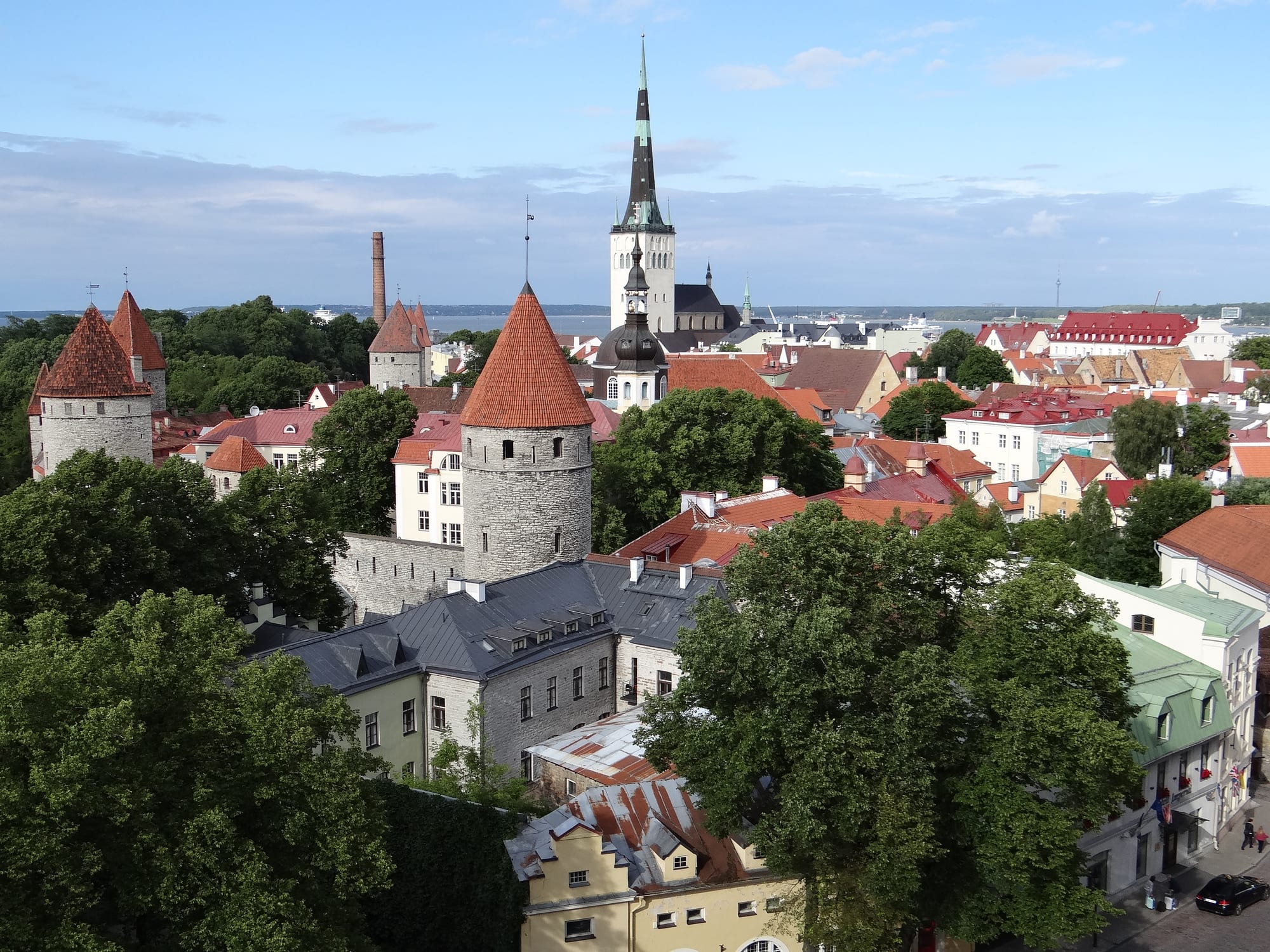
Red-roofed stone towers of Tallinn's town wall and the tall green spire of St Olaf's church, with the sea beyond

Tallinn & Northern Estonia, Estonia

Tallinn

The lower Old Town and St Olaf's church seen from the Patkul viewing platform on Toompea. (Adam Jones / Wikimedia Commons · CC BY-SA 2.0)

Estonia's capital, on a bay of the Gulf of Finland, grew from a Danish-conquered hill fort into Reval, the northernmost town of the Hanseatic League. Its walled Old Town, a UNESCO World Heritage Site, survives almost whole beneath the hill of Toompea, while wooden suburbs, converted factory quarters and Soviet-era housing districts spread around a busy ferry port and a technology economy.

Neighbourhoods

  • Old Town and Toompea
    • First-time visitors
    • Historic district

    The walled medieval town, laid out in the 13th century and mostly built between the 13th and 16th centuries, with the Town Hall Square at its heart. Above it rises Toompea, the limestone hill of the castle, the parliament and the Orthodox cathedral, with viewing platforms over the red roofs of the lower town.

    Open in Maps
  • Kalamaja and Telliskivi
    • Best for food
    • Cafés and creative life

    Tallinn's old fishing harbour just north-west of the Old Town, and one of the best-preserved areas of wooden houses in the country, built for factory workers after the railway arrived in 1870. Telliskivi Creative City, on a former railway factory site, and the seafront museums lie at its edges.

    Open in Maps
  • City Centre and Rotermanni
    • Close to public transport
    • Shopping

    The modern centre between the Old Town walls, Viru Square and the port, where shopping centres and office towers stand beside the Rotermanni Quarter, a former industrial area rebuilt with flats, shops and a public square. It lies between the Old Town and the port.

    Open in Maps
  • Kadriorg
    • Museums
    • Parks
    • Quiet and residential

    A green subdistrict about 2 kilometres east of the centre, named after the Baroque palace Peter the Great built for Catherine I. Its park holds several museums and the president's official residence, and its streets of old villas make it one of the wealthiest neighbourhoods in Estonia. Trams and buses link it to the centre.

    Open in Maps
  • Pirita
    • Beaches
    • Quiet and residential

    A spacious district of private houses along the bay north-east of the centre, with Tallinn's largest beach, a yachting harbour built for the sailing events of the 1980 Olympics, and the ruins of a medieval convent.

    Open in Maps

Things to do

Old Town landmarks

  • Tallinn Town Halllandmark

    The Gothic town hall on the south side of the old market square, the oldest in the Baltic Sea region and Scandinavia, crowned by the Old Thomas weather vane, in place since 1530.

    Open in Maps
  • Town Hall Pharmacylandmark

    Across the square from the town hall, one of the oldest continuously running pharmacies in Europe, in business in the same house since the early 15th century.

    Open in Maps
  • St Olaf's Churchlandmark

    The tallest church building in Estonia, its spire rising almost 124 metres, with an observation platform in the tower 60 metres above the ground.

    Open in Maps
  • St Nicholas' Churchmuseum

    A 13th-century church badly damaged in the Second World War and restored as the Niguliste Museum of church art, which is also used as a concert hall.

    Open in Maps
  • Alexander Nevsky Cathedrallandmark

    The onion-domed Orthodox cathedral on Toompea, built in 1894–1900 when Estonia was part of the Russian Empire, and the city's largest cupola church.

    Open in Maps
  • Kiek in de Köklandmark

    An artillery tower of 1475 on the town wall, 38 metres high with walls 4 metres thick, named in Low German for the view its guards had into nearby kitchens.

    Open in Maps
  • Fat Margaret and the Maritime Museummuseum

    The largest part of the town fortifications, a tower 25 metres across, built in 1511–1530 at the end of Pikk Street to guard the harbour, now home to the Estonian Maritime Museum.

    Open in Maps

Museums

  • Kumu Art Museummuseum

    The branch of the Art Museum of Estonia that houses its main offices, in Kadriorg, showing Estonian art from the 18th century onwards, including socialist realism and nonconformist art from the occupation years.

    Open in Maps
  • Kadriorg Palacemuseum

    Peter the Great's Baroque palace of 1718–1725, now the Kadriorg Art Museum, with foreign art from the 16th to the 20th centuries.

    Open in Maps
  • Seaplane Harbourmuseum

    A maritime museum opened in 2012 in a former seaplane hangar in the area of Peter the Great's Naval Fortress, part of the Estonian Maritime Museum.

    Open in Maps
  • Vabamu Museum of Occupations and Freedommuseum

    A museum of the years 1940–1991, when Estonia was occupied by the Soviet Union, then Nazi Germany, then the Soviet Union again, and of the restoration of independence.

    Open in Maps
  • Estonian Open Air Museummuseum

    At Rocca al Mare, about 8 kilometres west of the centre, a reconstructed rural and fishing village of farmyards, mills, a church, a tavern and net sheds gathered from across Estonia.

    Open in Maps

The seafront and the parks

  • Kadriorg Parkpark

    The palace park of about 70 hectares, begun for Peter the Great in 1718, with the Swan Pond, formal gardens, a Japanese garden and several museums.

    Open in Maps
  • Patarei Sea Fortresslandmark

    A tsarist sea fortress of 1830–1837 on the shore of Kalamaja, used as a prison from 1919 to 2005 and for Estonians one of the main symbols of Soviet and Nazi terror.

    Open in Maps
  • Noblessnerneighborhood

    A former submarine shipyard harbour redeveloped since 2013 with a marina, a seafront promenade, an art centre, a craft brewery, cafés and restaurants.

    Open in Maps
  • Tallinn Song Festival Groundslandmark

    The open-air arena and arched stage where the national song festival is held, every five years.

    Open in Maps
  • Pirita Conventlandmark

    The ruins of a Bridgettine convent that functioned from 1407 to 1575, once the largest church building in medieval Estonia.

    Open in Maps
  • Tallinn TV Towerviewpoint

    A 313-metre tower near Pirita, about 6 kilometres from the centre, built for the 1980 Olympic regatta, with an observation deck 170 metres up.

    Open in Maps

Creative quarters

  • Telliskivi Creative Cityneighborhood

    Ten former railway factory buildings turned into studios, shops, theatres, galleries, restaurants and the Fotografiska photography centre, with a weekly flea market.

    Open in Maps
  • Rotermanni Quarterneighborhood

    A 19th-century industrial area between the Old Town and the port, rebuilt with flats, shops and restaurants around Rotermanni Square.

    Open in Maps

Short trips from the city

  • Jägala Waterfallpark

    The largest natural waterfall in Estonia, about 50 metres wide and 8 metres high, which freezes over in winter.

    Open in Maps
  • Lahemaa National Parkpark

    About 70 kilometres east, the first national park of the former Soviet Union and the largest park in Estonia, protecting the forests, bogs and coast of the north.

    Open in Maps

Seasonal events

  • Tallinn Music Weekspring

    A showcase of new music from across Europe, held since 2009, with concerts across the city and a gathering of music-industry professionals.

  • Tallinn Old Town Daysearly summer

    A week of concerts, exhibitions, theatre and fairs in the streets of the Old Town, held since 1982.

  • Estonian Song FestivalJune or July, every five years

    One of the largest choral events in the world, held since 1869 and on UNESCO's list of intangible heritage, staged at the Song Festival Grounds.

  • Tallinn Black Nights Film FestivalNovember

    One of the largest film festivals in Northern Europe, held since 1997 and known locally as PÖFF.

  • Tallinn Christmas MarketAdvent to early January

    Wooden stalls of handicrafts, mulled wine and souvenirs around a Christmas tree on Town Hall Square.

Eat and drink

Long-standing places and food districts in Tallinn. Hours, ratings and directions come from your maps app, always current.

Tallinn classics

  • Maiasmokkcafe

    The oldest working café in Estonia, dating in its present form from 1864, with a small museum of marzipan on the premises.

    Open in Maps
  • Põhjala Breweryrestaurant

    The largest craft brewery in the Baltic states, known for porters, barrel-aged beers and ingredients from Estonia's forests.

    Open in Maps

Food districts and markets

  • The market by the Baltic Stationmarket

    A market hall beside the main railway station, between the Old Town and Kalamaja, with stalls of local produce and food.

    Open in Maps
  • Kalamaja and Telliskivineighborhood

    Cafés, bakeries and restaurants among the old railway workshops and wooden houses north-west of the Old Town.

    Open in Maps
  • Old Town restaurantsneighborhood

    Cellar restaurants, cafés and bars in the medieval houses around Town Hall Square and along Pikk and Vene streets, the busiest and priciest place to eat in the city.

    Open in Maps

Experience Tallinn

History

The hill of Toompea held an Estonian stronghold before King Valdemar II of Denmark took it in 1219 and built a castle in its place; the city's Estonian name is widely read as Taani-linna, "Danish castle". For most of the next seven centuries the rest of the world knew the town as Reval. It received Lübeck town rights in 1248, joined the Hanseatic League in 1285 as its northernmost member, and passed from Denmark to the Teutonic Order in 1346. A merchant town of about 8,000 people grew up below the hill, enclosed by walls and 66 defensive towers, and its trade between Russia and the west paid for the guild halls, churches and town hall that still stand.

Swedish rule followed in 1561 and Russian rule in 1710. Under the tsars Peter the Great built the palace at Kadriorg, a sea fortress went up on the shore, and the railway from St Petersburg arrived in 1870, bringing factories and workers' suburbs such as Kalamaja. Estonian independence was proclaimed in the city on 24 February 1918, and the name Tallinn replaced Reval in international use.

The Soviet Union occupied the country in 1940, Nazi Germany from 1941 and the Soviets again from September 1944. A Soviet air raid on 9–10 March 1944 started fires that killed 757 people and left 20,000 without shelter. In the following decades whole new districts — Mustamäe, Väike-Õismäe and above all Lasnamäe — were built for workers arriving from elsewhere in the Soviet Union, and in 1980 Pirita hosted the Olympic sailing events. Tallinn became the capital of an independent country again on 20 August 1991; the Old Town was added to the UNESCO World Heritage List in 1997.

Culture & Customs

The Old Town is the city's stage. Tallinn Old Town Days fills its streets with concerts, theatre and fairs every early summer, and the Christmas market takes over Town Hall Square in winter. Music runs deep: the national song festival, held since 1869 and staged in Tallinn since 1928, brings choirs of many thousands to the Song Festival Grounds every five years, and the grounds were the setting of the mass singing that helped end Soviet rule. Tallinn Music Week each spring showcases new bands from across Europe, and the Black Nights Film Festival, held since 1997, is one of the largest in Northern Europe.

The city lives in two languages. Around a third of its residents are first- or second-generation migrants from Russia and the former Soviet Union, most of them now Estonian citizens, and districts such as Lasnamäe remain largely Russian-speaking. The Orthodox cathedral on Toompea and the Lutheran spires of the lower town reflect that long mixture, though Estonia is one of the least religious countries in the world.

Tallinn is also proud of its modern side: Skype and Bolt began here, and old factory quarters such as Telliskivi, Rotermanni and Noblessner have become galleries, studios and restaurants. Manners are reserved and understated, and comfort with silence is part of the national character.

Daily Life

About 453,000 people lived in the city at the start of 2026, roughly a third of Estonia's population, and around 646,000 in the wider metropolitan area. Lasnamäe, a district of Soviet-era apartment blocks on the limestone plateau to the east, has been the most populous district since the 1980s. Kalamaja's wooden houses, built for factory workers, make it one of the best-preserved wooden districts in Estonia, while Pirita is a district of private houses and Kadriorg is one of the wealthiest neighbourhoods in the country.

The economy runs on services, technology, government and the port, whose ferries carry heavy traffic to Helsinki. The city is home to eu-LISA, the EU agency that runs large-scale IT systems, and to many start-ups, while the Rail Baltica line is planned to link it with Warsaw through Latvia and Lithuania. Since January 2013 registered residents have ridden the buses, trams and trolleybuses free, the first such scheme in a European capital.

Daily rhythms follow the light. Summer evenings stretch late, and Midsummer Eve is marked with bonfires, music and dancing. Winter days are short and dark, life moves indoors to cafés, saunas and concert halls, and the city's beaches at Pirita, Stroomi and Kakumäe stand empty until the warmth returns.

Food

Tallinn eats like the rest of Estonia, but with more choice. Black rye bread accompanies almost every savoury meal, and a traditional meal opens with a cold table of pickles, meats, sausages, potato salad and rosolje — a salad of beetroot, potatoes and herring. The Baltic herring (räim) and the sprat (kilu) are national fish; spiced salted sprats on an open sandwich with a slice of boiled egg, kiluvõileib, are a distinctively Estonian appetiser. At Christmas, blood sausage (verivorst), jellied pork (sült), roast pork and sauerkraut appear on tables across the city.

Sweet things have a long history here. Maiasmokk, the oldest working café in Estonia, has served cakes since 1864 and keeps a small museum of marzipan. Kama — a flour of roasted peas, barley, rye and oats soaked in milk or buttermilk and eaten uncooked — and pancakes (pannkook) are everyday favourites, and kali, a drink similar to kvass, survives beside modern soft drinks.

Beer is the usual drink with food. Põhjala, founded in the city and now the largest craft brewery in the Baltic states, makes porters and barrel-aged beers, and Vana Tallinn, a liqueur made since 1960 with Jamaican rum, herbs and spices, is the city's best-known bottle. The Old Town has the most restaurants, but Kalamaja, Telliskivi and the market by the Baltic Station are where many residents eat.

Planning tools

Budget

Tallinn is the most expensive place in Estonia, and the Old Town is the most expensive part of it, with restaurant and hotel prices that climb in summer and over the Christmas market. Kalamaja, the city centre beyond the walls and the market halls cost noticeably less. Public transport is cheap, and the city is compact enough to cover much of it on foot.

Daily Budget Midrange
USD 130–230 (mid-range hotel, restaurant dinners, museum tickets, a day trip to Lahemaa)
Daily Budget Shoestring
USD 55–90 (hostel bed, market and café lunches, trams and buses)

Walking the Old Town lanes, the Toompea viewing platforms, Kadriorg Park and the seafront promenades cost nothing; set weekday lunches in cafés are the cheapest good meals.

Best Time to Visit

May to September, when days are long and mild, café terraces open and the beaches at Pirita fill. In June the nights barely grow dark, and Midsummer Eve is marked with bonfires, music and dancing. Winter is dark and cold, but the Old Town under snow, the Christmas market and the Black Nights Film Festival draw visitors from November to January.

Suggested Number of Days

Two or three days cover the Old Town and the main districts around it at an easy pace. Four or five allow time for the countryside and coast east of the city, or for a ferry crossing. Short winter days mean a little more time is useful between November and February.

First Visit
2–3 days
With Surroundings
4–5 days

Transportation

The city runs bus, tram and trolleybus routes to every district; the tram network is the only one in Estonia. Since 2013 travel has been free within the city limits for registered residents, while visitors pay a fare. Bolt, the ride-hailing company founded in Tallinn, and taxis are widely used, and a car is only needed for the countryside.

Trams run from the city centre to Kadriorg and towards Kalamaja and Kopli; the airport is linked to the centre by tram as well as bus.

Airport & Station Connections

Lennart Meri Tallinn Airport is about 5 kilometres south-east of the centre, beside Lake Ülemiste, and is linked to the city by tram and bus in a short ride. Ferries connect the port, a short walk from the Old Town, with Helsinki, Mariehamn and Stockholm. Trains to Tartu, Narva and other Estonian towns leave from the Baltic Station.

Walkability

The Old Town is small and best seen on foot, though its cobbles are uneven and the lanes up to Toompea are steep. Kalamaja, the Rotermanni Quarter and the ferry port are each a short walk from the walls, and Kadriorg is a longer walk or a short tram ride. In winter the cobbles and pavements are often icy.

Safety

Estonia is a safe country with low levels of violent crime. Pickpockets work the Old Town and the passenger port area, and some clubs and bars are known for overcharging tourists who come in for a drink. In winter, slippery cobbles and pavements are the main hazard.

Watch belongings in the Old Town and around the port, check prices before ordering in unfamiliar bars and clubs, and take care on icy streets in winter. Check current official travel advice before travelling.

Climate

A humid continental climate of warm, rainy summers and cold, snowy winters. Summers are the sunniest season, with very long days; winters hover close to freezing, with snow, cloud and little sunshine. Spring is slow to warm, and snow can fall as late as April and as early as October.

Summer
mild — daytime highs from June to August are usually around 19–22°C, and July averages 17.6°C over day and night
Winter
cold and grey — February, the coldest month, averages −3.6°C, and cold spells push temperatures below −18°C on about six days a year

Local Customs

Tipping became common only after independence was restored and is not always expected; about 10 per cent is usual in restaurants, and taxi drivers often keep the change. Estonians are known for reserve and comfort with silence, so quiet conversation and personal space are the norm. In 2011 46.7 per cent of the city's residents had Russian as their first language, and both languages are heard on the streets; English is widely spoken.

Keep voices down in churches, ask before photographing people, and do not drink and drive — the legal limit is very close to zero.

Common Payment Methods

The currency is the euro. Cards and contactless payment are accepted almost everywhere, and some places no longer take cash at all. ATMs are easy to find in the centre.