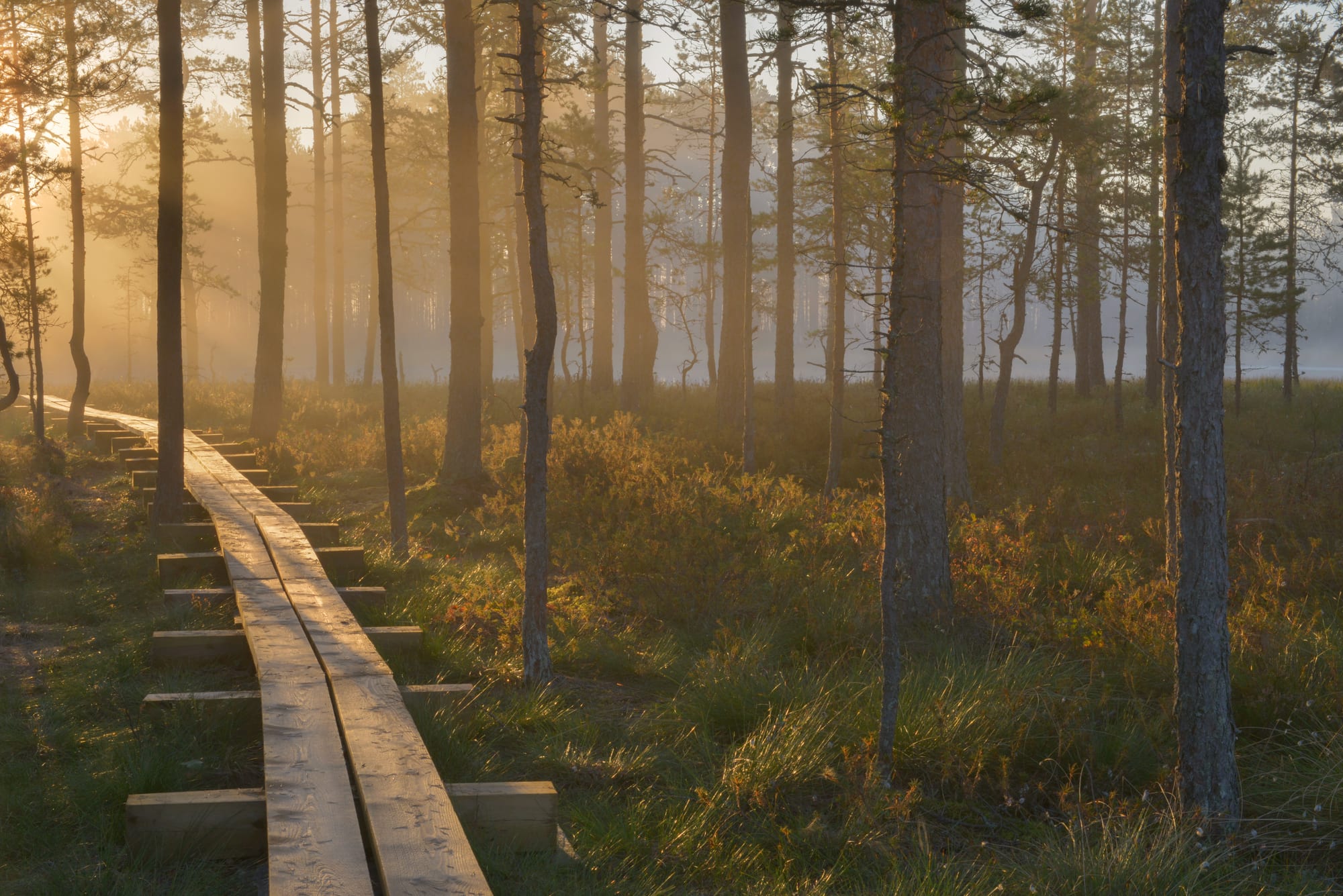
A narrow wooden boardwalk curving through scattered pine trees in a misty bog, lit gold by low morning sun

Estonia

Tallinn & Northern Estonia

Sunrise on the boardwalk through Viru bog in Lahemaa National Park, an hour's drive east of Tallinn. (Abrget47j / Wikimedia Commons · CC BY-SA 3.0)

Estonia's northern half, from the island of Hiiumaa and the old bishops' resort of Haapsalu in the west, through Tallinn — home to a third of the country — and the manors, bogs and boulder-strewn coast of Lahemaa, to the oil-shale towns and the Russian-speaking border city of Narva in the east, with the farmland of Rapla, Järva and Jõgeva counties reaching south to Lake Peipus.

Explore Tallinn & Northern Estonia

History

Tallinn began as the Estonian hill fort of Lindanise on Toompea, taken by Valdemar II of Denmark in June 1219 — the battle in which, by Danish legend, the Dannebrog fell from the sky — and the city's Estonian name is usually read as Taani linn, "Danish castle". Under Lübeck law from 1248, and as a Hanseatic port, German-speaking Reval grew rich on the trade between Novgorod and the west. The Estonians' last great rising, the St George's Night revolt of 1343, began in the villages of Harju; once it was crushed, Denmark sold the north to the Teutonic Order in 1346. Haapsalu, meanwhile, was the seat of the bishops of Ösel-Wiek, who ruled the west coast and the islands from its castle.

Sweden took the north in 1561 and held it until the Great Northern War. That war opened at Narva, where Charles XII routed a much larger Russian army in a snowstorm in November 1700; Peter the Great returned to storm the town in 1704, and plague-stricken Tallinn surrendered in 1710. On Hiiumaa, about a thousand Swedish-speaking peasants were ordered off the island in 1781 to settle in Ukraine. The railway from St Petersburg arrived in the 19th century, and the Kreenholm cotton mill at Narva, founded in 1857, became one of the largest in the world.

Independence was proclaimed in Tallinn on 24 February 1918. In 1944 Soviet bombers burned part of the capital and the fighting on the Narva front levelled baroque Narva, which was rebuilt as an industrial town and resettled largely from Russia. Oil-shale mines and power stations spread across Ida-Viru, and Sillamäe, which processed uranium, and the submarine base of Paldiski became closed towns. In September 1988 some 300,000 people sang banned national songs at the Tallinn Song Festival Grounds, the high point of the Singing Revolution.

Culture & Customs

Tallinn is where Estonia's two language communities live side by side. About four in ten of the city's residents are Russian-speakers, many of them in the Soviet-built district of Lasnamäe, and in Narva the figure is above nine in ten; the move of all schooling into Estonian is keenly argued over in the north-east. The capital's calendar runs from Tallinn Music Week in spring and the Old Town Days to the Black Nights Film Festival in November and the Christmas market on Town Hall Square; the city's Brotherhood of Blackheads set up a Christmas tree in its guild house in 1441.

The west coast and its islands were home for seven centuries to the Coastal Swedes, farmers and fishermen of Vormsi, Noarootsi and Hiiumaa, nearly all of whom fled to Sweden in 1944. Haapsalu is known for its fine knitted lace shawls, and for the White Lady, the ghost of a walled-up girl said to appear in the cathedral window at the August full moon. Hiiumaa's islanders are credited with the driest humour in the country.

On the Peipus shore around Mustvee live Russian Old Believers, whose ancestors fled religious persecution in the late 1600s; their prayer houses still stand in Mustvee. Inland, the farm museum at Vargamäe in Järva county is the setting of Tammsaare's Truth and Justice, the national novel, and Palamuse's old parish school that of Oskar Luts's Spring. Rakvere, where the composer Arvo Pärt grew up, is watched over by its giant bronze aurochs.

Daily Life

Most Estonians live in these eight counties, and the imbalance within them is stark. Tallinn has about 455,000 residents and Harju county around 640,000; Narva has fallen from 83,000 people in 1992 to about 53,000, and Kohtla-Järve has shrunk too. The county towns are small: Haapsalu has under 10,000 people and Jõgeva about 5,000.

Tallinn earns its living from technology and services: Skype was written here, Bolt and a string of later start-ups are based here, the ferry port is busy with Helsinki traffic, and Rail Baltica will link the city with Warsaw. Registered residents have ridden the city's buses and trams free since 2013. Old factory quarters — Telliskivi, the Noblessner submarine yard, Rotermann — have become offices, bars and flats, while the wooden houses of Kalamaja have gone from cheap to coveted within a generation.

Ida-Viru tells the opposite story. Its oil shale long generated most of Estonia's electricity, but the mines and power stations are shedding jobs under European climate policy, unemployment is high, and since the crossing closed to traffic in 2024 the border trade that sustained Narva has all but ceased. The inland counties live from dairy farming, grain and forestry, and their small towns are ageing. Hiiumaa combines small industry with fishing and a summer influx of visitors. Across the region the week bends towards the country cottage, the sauna and, in late summer, the forest for berries and mushrooms.

Food

Tallinn's edible emblem is the sprat. Tallinna kilud, Baltic sprats cured in a spiced brine and packed in round tins with the Old Town skyline on the lid, go onto kiluvõileib, buttered black bread with a slice of boiled egg. The city also claims marzipan, sold as a remedy at the Town Hall Pharmacy, which has traded on the same corner since at least 1422; the Maiasmokk café, open since 1864, still paints marzipan figures by hand. The Michelin Guide's arrival in Estonia in 2022 confirmed Tallinn's restaurants as the country's most ambitious, and the Baltic Station market beside Telliskivi is the place to see the raw materials. Põhjala, founded in 2011 and now brewing at Noblessner, leads Estonian craft beer; Saku, south of the city, has brewed lager since 1820.

The edges of the region eat from their waters. Along Lake Peipus the Old Believer villages are known for fish and onions, and Hiiumaa and the Haapsalu coast smoke their catch of Baltic fish.

Inland, Rakvere has Estonia's largest meat plant, Järva county is dairy land, and Põltsamaa's factory made fruit and berry wines from the 1920s until 2023.

Attractions & Natural Wonders

Within Tallinn's walls the Gothic Town Hall of 1404 faces the pharmacy across its square, St Olaf's spire rises 124 metres, St Nicholas's church holds Bernt Notke's Danse Macabre, and the cannon tower Kiek in de Kök opens onto tunnels under the bastions. Outside them are Kalamaja's wooden streets and the Seaplane Harbour's concrete hangars, the Patarei sea fortress, Kadriorg palace and the Kumu art museum, the Song Festival Grounds, the ruined Pirita convent, the 314-metre TV Tower and the farmsteads of the Open Air Museum. West of the city the limestone coast breaks into cliffs at Türisalu and Paldiski, and the Arvo Pärt Centre stands among pines at Laulasmaa.

East along the coast come the Jägala waterfall and Lahemaa National Park: the Viru bog boardwalk, the manors of Palmse, Sagadi and Vihula, the captains' village of Käsmu with its field of glacial boulders, the net sheds of Altja and an abandoned Soviet submarine station at Hara. Rakvere's castle ruin and bronze aurochs crown the hill above the town. Beyond, the coastal cliff rises high at Ontika, where the Valaste fall drops 30 metres, and the road continues past the Orthodox convent of Kuremäe and Stalin-era Sillamäe to Narva, where Hermann Castle and the Russian fortress of Ivangorod face each other across the river, and to the long pine-backed beach of Narva-Jõesuu.

Haapsalu has its bishop's castle, a wooden promenade and assembly hall on the bay, and a 216-metre covered railway platform, with bird towers on Matsalu Bay to the south. From nearby Rohuküla the ferry crosses to Hiiumaa: the stout Kõpu lighthouse, the iron towers of Tahkuna and Ristna, the gravel spit of Sääretirp on Kassari, Suuremõisa manor and the Hill of Crosses, where visitors still leave crosses.

Cities in Tallinn & Northern Estonia

Planning basics

Budget

Tallinn's Old Town is the most expensive square kilometre in Estonia, with restaurant and hotel prices close to Nordic levels from June to August and on Christmas-market weekends; a few streets away in Kalamaja or around the Baltic Station market the same meal costs a third less. Rakvere, Narva, Haapsalu and the inland county towns are markedly cheaper than the capital. Hiiumaa has few beds, which fill in July, and Lahemaa's manor hotels charge for their setting.

Daily Budget Midrange
USD 130–230 (mid-range hotel in Tallinn, restaurant dinners, museum tickets, a hire car for Lahemaa or the islands)
Daily Budget Shoestring
USD 55–90 (hostel or guesthouse, market and café lunches, city transport and intercity buses)

Eat the weekday set lunch (päevapraad) that most Tallinn cafés offer for a few euros, and book Hiiumaa accommodation and the car ferry ahead in July.

Safety

The region is safe. Tallinn's Old Town has pickpockets in summer, a few bars that overcharge lone visitors, and icy cobbles and falling roof snow in winter. Narva and the north-east are calm, but the river is the external frontier of the EU and NATO: the border strip and its installations are not to be photographed or approached. Ticks carrying encephalitis and Lyme disease are common in the forests and on the islands, elk cross rural roads at dusk, and bog pools are deep, so walkers keep to the boardwalks.

Agree prices before ordering in Old Town bars, consider the tick-borne encephalitis vaccine before long forest trips, and never walk or drive on sea ice outside an officially opened ice road. Check current official travel advice before travelling.

Climate

The Gulf of Finland keeps the north coast milder in winter and cooler in spring than the interior, and Hiiumaa is the most maritime corner of all, with late, mild autumns. Inland it is colder: Jõgeva holds the national record of −43.5°C, set in January 1940, and snow lies for three to four months. Tallinn has more than 18 hours of daylight at midsummer and barely six in December, and in hard winters the sea freezes between the mainland and the islands.

Summer
June–August, 16–22°C on the coast and a little warmer inland; long white nights and sea temperatures of 16–19°C
Winter
December–March, −2 to −7°C with colder snaps inland; snow, icy pavements and short, dim days

Transportation

Tallinn's airport is four kilometres from the centre, and the ferry harbour is a short walk from the Old Town. Trains run east to Rakvere and Narva, south-east through Tapa and Jõgeva to Tartu, south to Rapla and Türi, and west to Keila and Paldiski. Haapsalu has had no passenger trains since 1995 and is reached by bus. Lahemaa has only a thin bus service, so a car, a bicycle or a day tour is the practical choice. The Hiiumaa ferry sails from Rohuküla, near Haapsalu, to Heltermaa in 75 minutes, and small planes fly from Tallinn to Kärdla.

The border bridge at Narva has been open only to pedestrians since early 2024 and crossing rules change at short notice, so check the current position before planning any onward travel to Russia.

Best Time to Visit

May to September. June has the white nights, though the capital empties for Midsummer on 23–24 June, which Estonians spend around bonfires in the countryside. July and August are the months for Hiiumaa, Haapsalu's promenade and the beaches of Narva-Jõesuu; Haapsalu's White Lady festival falls at the August full moon. September and October bring migrating cranes and geese to the bays of the west coast and red-gold colour to the bogs. November's Black Nights Film Festival and the Christmas market on Town Hall Square are the reasons to come in the dark months.