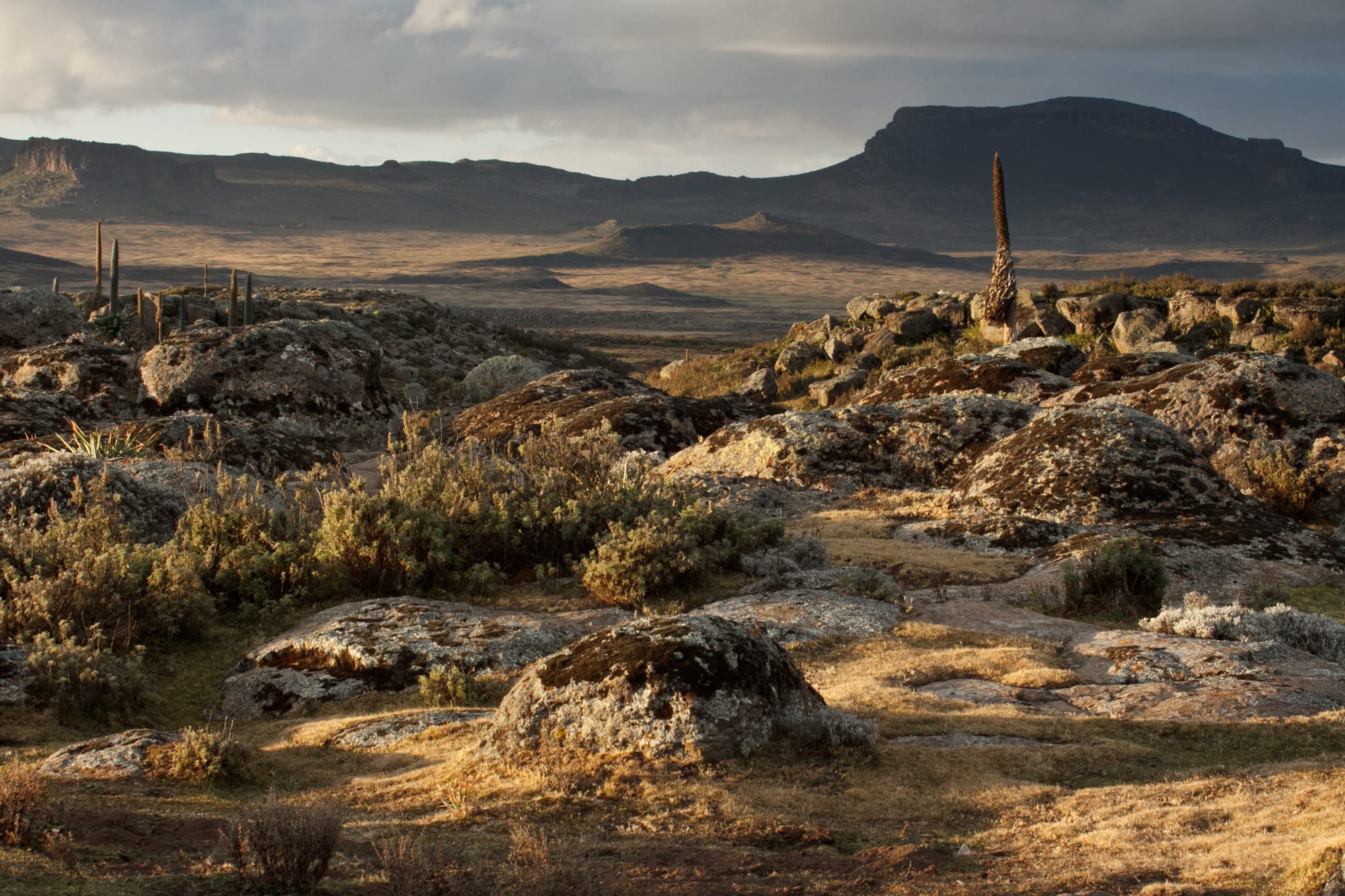
Rocky Afro-alpine moorland with tall giant lobelia stalks and low shrubs, under flat-topped hills in low evening light

Addis Ababa, Oromia, Harar & the East, Ethiopia

Goba

Afro-alpine moorland and giant lobelia in Bale Mountains National Park, the range that rises behind Goba. (Indrik myneur / Wikimedia Commons · CC BY 2.0)

A highland town in the Bale zone of south-eastern Oromia, at about 2,700 metres on the northern edge of the Bale Mountains. Goba is an administrative and market centre for a farming district of barley and wheat, and the usual base for the national park behind it, whose moorlands hold the Ethiopian wolf and the mountain nyala.

Neighbourhoods

  • The town centre
    • First-time visitors
    • Markets
    • Cafés

    A few main streets of single-storey shops, small hotels, bars and coffee houses around the bus stand and the market. Everything practical in Goba — guides, supplies, transport for the park — is arranged within a couple of blocks.

    Open in Maps
  • The market quarter
    • Markets
    • Local life

    The open ground where farmers from the surrounding highlands bring barley, wheat, potatoes, honey and livestock on market days. It is the busiest place in town and the clearest view of the district's farming economy.

    Open in Maps
  • The Robe road
    • Quiet and residential
    • Transport

    The strip running north towards Robe, the larger neighbouring town about 15 kilometres away, with newer houses, compounds and the offices that serve the zone. Buses and shared minibuses use this road constantly.

    Open in Maps

Things to do

The Bale Mountains

  • Sanetti Plateauviewpoint

    A moorland plateau above 4,000 metres crossed by the road south from Goba, scattered with tarns, giant lobelia and rock fields, and the best place to see Ethiopian wolves hunting rats.

    Open in Maps
  • Tullu Dimtuviewpoint

    At 4,377 metres the highest point in the Bale range and the fourth highest summit in Ethiopia, reached by a rough gravel road off the plateau road.

    Open in Maps
  • Dinshoattraction

    The village north-west of Goba, with the national park headquarters a few kilometres outside it, where guides and scouts are hired and mountain nyala and Menelik's bushbuck are among the animals of the surrounding grassland.

    Open in Maps

Around the town

  • Goba marketmarket

    The Wednesday market, when highland farmers sell grain, potatoes, honey, butter and livestock, with spices and cloth traded alongside.

    Open in Maps
  • Robeattraction

    The neighbouring town about 15 kilometres by road to the north, larger and busier than Goba, sharing Robe Airport with it and holding its main market on Thursdays.

    Open in Maps

Short trips from the town

  • Bale Mountains National Parkpark

    A park of about 2,150 square kilometres of woodland, Afro-alpine moorland and cloud forest, protecting the Ethiopian wolf and the mountain nyala, an antelope found nowhere else, and inscribed as a World Heritage site in 2023.

    Open in Maps
  • Harenna Forestpark

    Moss-hung cloud forest on the southern slope below the plateau, where wild coffee grows under the canopy and lions and colobus monkeys are recorded.

    Open in Maps
  • Sof Omar Cavesattraction

    The longest cave in Ethiopia, cut through limestone by the Weyb River in the lowlands east of the range, with high pillared chambers and a shrine used by local people near the village entrance.

    Open in Maps
  • Web valleytrail

    A broad grassland valley north-west of the plateau within the national park, one of the more reliable places to see Ethiopian wolves.

    Open in Maps

Seasonal events

  • Irreechalate September or early October

    The Oromo thanksgiving for the end of the rains, marked across Oromia with processions carrying fresh grass and flowers to water.

  • Market daysweekly, all year

    The regular market draws farmers from the surrounding highlands and is the town's main social event as well as its trade.

  • Eid al-Fitrvaries with the Islamic calendar

    The end of Ramadan, widely observed by the town's Muslim community and across the surrounding highlands, with prayers, visiting and shared meals.

Eat and drink

Long-standing places and food districts in Goba. Hours, ratings and directions come from your maps app, always current.

Goba classics

  • Highland eating housesrestaurant

    Small kitchens around the centre serving injera with shiro, lentils and greens, tibs of goat or beef, and lamb soup, with barley bread from the surrounding farms.

    Open in Maps
  • Coffee housescafe

    Counters serving macchiato and the full jebena coffee ceremony, and in Oromo households chuko, roasted barley flour worked with spiced butter.

    Open in Maps

Markets

  • Goba marketmarket

    Honey from the forest hives, butter, potatoes, barley and wheat from the highland fields, and bundles of herbs and spices.

    Open in Maps

Experience Goba

History

Goba is a comparatively young town. The Bale highlands were settled by Oromo pastoralists and farmers, and the area was brought under imperial rule during the southern expansion of the Ethiopian empire in the late 19th century. The advance of Ras Darge Sahle Selassie into southern Arsi and Bale led to a camp at Goba in 1900, on a site that held a medieval Christian rock church or monastery, and the town grew from that camp into the administrative centre of the Bale highlands.

The mountains kept the town at the edge of national events for much of the 20th century. The Bale revolt of the 1960s, a rural uprising against imperial land and tax policy in these highlands, ran from 1963 until 1970, and rebels attacked the town twice between November 1965 and March 1966. The Derg years that followed brought land reform, resettlement schemes and villagisation to the district. Bale Mountains National Park was established to protect the Afro-alpine moorland and the mountain nyala, and the road south from Goba across the Sanetti Plateau, among the highest in Africa, opened the range to vehicles.

Goba was the capital of the former Bale Province until the province was abolished under the constitution of 1995, and it has continued since then as an administrative centre in the Oromia region, with government offices, a hospital, colleges and the trade of a productive farming district. The national park was inscribed on the World Heritage list in 2023, and tourism to it has become a steady part of the local economy, though the town remains far smaller and quieter than Robe, its neighbour a short way down the road, which has taken most of the area's commercial growth.

Culture & Customs

Goba is an Oromo town, and Afaan Oromo, written in the Latin alphabet, is the language of the street, the market and the schools. The Arsi Oromo of these highlands keep the memory of the Gadaa system, the age-grade institution that organised Oromo society into generations holding authority in turn; it is on UNESCO's intangible heritage list and remains a source of identity and ceremony even where it no longer governs daily affairs. Irreecha, the thanksgiving at the end of the rains, is the great annual celebration.

Islam is strong across the Bale highlands, and the calendar of Ramadan and Eid sets the shape of the year for many families, although the 2007 census recorded an Orthodox Christian majority within Goba itself, with a large Muslim minority and a smaller Protestant one; mosques, churches and meeting halls stand within a few streets of each other. Hospitality follows the same forms found across Ethiopia: guests are received with coffee roasted, ground and brewed in front of them, and the third round is expected.

Horses matter here more than in most of the country. The Bale horse is a local breed, and riding is both transport and sport in the highlands, with horses hired out to trekkers in the national park. Honey from forest hives, woven baskets and the long woollen or cotton wraps worn against the cold are the everyday crafts of the district, and singing and dancing at weddings and at Irreecha are the main public performances.

Daily Life

Goba had about 32,000 residents at the 2007 national census, a small town by Ethiopian standards, and it works as an administrative and service centre rather than a commercial one. Government offices, a hospital, colleges and schools employ a sizeable share of the working population, and the surrounding countryside supplies the rest of the economy: barley, wheat, pulses, potatoes, cattle and sheep, with honey collected from forest hives on the southern slopes.

Housing is low, built of stone, timber and corrugated iron, laid out along a few paved roads with unpaved lanes running off them. Robe, about 15 kilometres away, has grown faster, taking the zone's larger market and many of its newer businesses, and the two towns work as a pair, with minibuses running between them all day.

The day begins early and cold, with wood smoke over the roofs and buses leaving at first light. Trade peaks in the late morning, and the afternoon is slower, given over to coffee and, for some, to khat. Electricity and water supply interruptions, the state of the mountain roads in the rains, and the pressure of farming and grazing on the edges of the national park are the recurring local concerns, as is the insecurity that has affected parts of Oromia in recent years.

Food

The food of the Bale highlands is grain and dairy country cooking. Barley is the staple crop at this altitude, eaten as a thick porridge or as dense flatbread, and wheat and pulses follow. Injera made from teff or from barley and wheat flour is served with shiro, the chickpea purée, with misir lentils, with cooked greens and, on days of celebration, with meat stewed in berbere or sautéed as tibs.

Oromo dishes appear alongside the national ones. Chuko, or michirra, mixes roasted and ground barley with spiced butter and is eaten with the fingers or with milk; ittoo, a meat stew, and qincee, a coarse grain porridge, belong to the same tradition. Butter, sour milk and fresh cheese are plentiful in a district that keeps a great many cattle, and the honey gathered in the Harenna forest below the mountains is sold in combs in the market.

Coffee is drunk constantly, and the forest on the southern side of the range is one of the places where Arabica grows wild beneath the canopy. Macchiato is served in the town's cafés, the jebena ceremony at home, and tea is taken sweet and heavily spiced. Tella, the home-brewed barley beer, is made in the countryside, and bottled lagers are sold in the town's bars.

Planning tools

Budget

The town itself is cheap: simple hotels, local eating houses and bus fares cost very little. The national park is what raises the total, through entry fees, the compulsory scout or guide, and a hired vehicle, since the plateau road and the tracks into the park are long and rough.

Daily Budget Midrange
USD 70–150 (better hotel or lodge, a hired vehicle with driver, park fees, guide and scout)
Daily Budget Shoestring
USD 20–40 (basic hotel, local eateries, buses and shared minibuses)

Bring enough cash in birr for the whole stay, agree vehicle and guide rates before setting out, and expect to share the cost of a vehicle with others heading into the park.

Best Time to Visit

November to February is the driest and clearest period, with firm tracks and long views from the plateau, although nights on the high ground fall below freezing. The main rains run from about June to October, when the roads turn to mud and the moorland is often in cloud.

Suggested Number of Days

A night or two is enough for the town and a single trip onto the high ground. Three or four days allows the forest on the far side of the range, a walk or ride at altitude, and the lowland caves, all of which need long drives on rough roads.

First Visit
1–2 days
With Surroundings
3–4 days

Transportation

The centre is walked. Shared minibuses run constantly to Robe and less often to other towns of the zone, and buses leave early in the morning for Addis Ababa and Shashamane. Getting into the national park means a hired vehicle with a driver, arranged in Goba, Robe or at the park headquarters, or hiring horses and a guide for the walking routes.

Long-distance buses fill and depart at dawn, and drivers avoid the mountain roads after dark, so plan arrivals and departures for the morning.

Airport & Station Connections

Most visitors drive from Addis Ababa, about 450 kilometres by way of Shashamane or Adama on a mix of good and rough road, taking a long day by bus. Robe Airport, shared by Goba with neighbouring Robe about 15 kilometres away, has scheduled Ethiopian Airlines flights to Addis Ababa and Arba Minch, and the park headquarters near Dinsho lies on the approach road from the north-west.

Walkability

Goba is small enough to cross on foot in twenty minutes, on unpaved side streets that are muddy in the rains. The altitude of about 2,700 metres makes walking harder than the gradients suggest, and the effect is stronger again on the plateau above 4,000 metres, where visitors should allow time to acclimatise.

Safety

Goba and the park road are generally quiet, and crime against visitors is uncommon in a town this size. Parts of Oromia have seen an armed insurgency, and roads in the region can close without warning, so the overland route needs checking before travel. The greater practical risks are altitude, cold nights and rough mountain tracks.

Check current advisories closely and route around conflict-affected regions, travel the Danakil and remote parks only with a licensed operator and escort, and avoid political demonstrations. Check current official travel advice before travelling.

Climate

A cool highland climate at about 2,700 metres, with mild days, cold nights and a long rainy season. The mountains behind the town are colder again, with frost and occasional hail on the plateau on clear nights.

Summer
the rains, roughly June to October — cloudy and wet, days around 15–20°C
Winter
the dry season, November to February — sunny days around 18–22°C and nights near or below freezing

Local Customs

This is Oromo country, and Afaan Oromo is the everyday language, with Amharic used in offices and by travellers. The 2007 census recorded an Orthodox Christian majority in the town with a large Muslim minority and a smaller Protestant one, and the surrounding highlands are strongly Muslim, so modest dress is normal and alcohol is sold but not drunk openly by many. Greetings are lengthy and hospitality is taken seriously; coffee is offered to any visitor.

Ask before photographing people or livestock, take a scout's instructions seriously inside the national park, and carry warm clothing for the plateau even on a hot day in town.

Common Payment Methods

The currency is the Ethiopian birr and everything here is paid in cash. Bank branches and ATMs exist in Goba and in Robe but can be out of service or out of notes, and park fees, guides and vehicles are all settled in cash, so it is usual to arrive with enough for the whole stay.