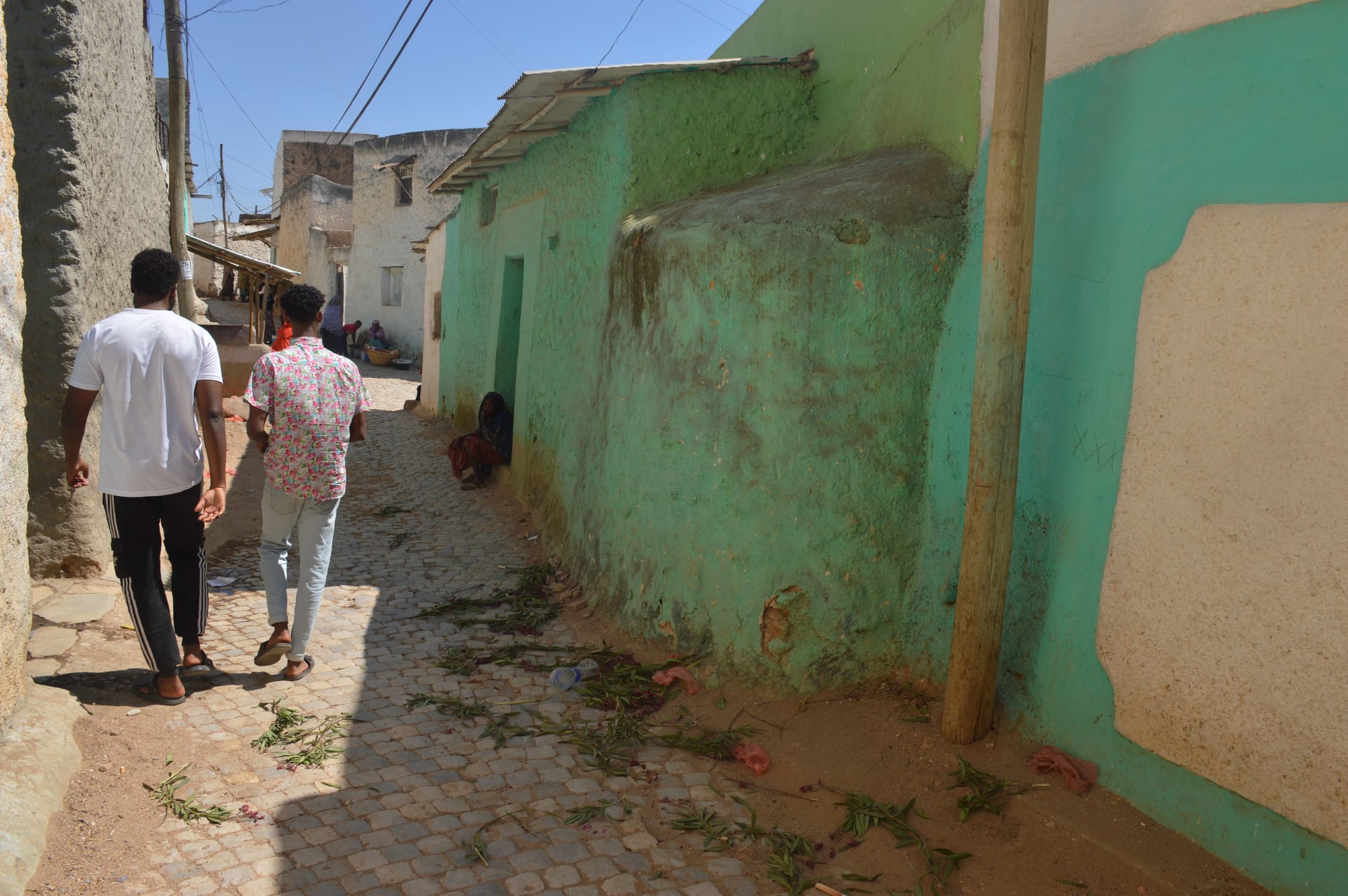
A narrow cobbled lane in Harar's walled old town between green and white painted house walls, with people walking away from the camera

Addis Ababa, Oromia, Harar & the East, Ethiopia

Harar

A lane inside Jugol, the walled old city of Harar. (Bikoadem / Wikimedia Commons · CC BY-SA 4.0)

A walled Muslim city on a ridge in eastern Ethiopia, capital of the Harari people and their language. Its old town, Jugol, is a UNESCO World Heritage Site of narrow lanes, mosques, shrines and painted houses, entered through five historic gates. Harar was an independent emirate until 1887, traded coffee and khat, and feeds wild hyenas outside its walls at night.

Neighbourhoods

  • Jugol, the walled city
    • First-time visitors
    • Historic district
    • Walking

    The old town inside the 16th-century wall, a dense knot of lanes barely wide enough for two people, with lime-washed and brightly painted houses, dozens of small mosques and saints' shrines, and shops that open straight onto the alley.

    Open in Maps
  • Feres Magala
    • Central
    • Cafés
    • Markets

    The horse market square at the heart of Jugol, where the main lanes meet. The Medhane Alem church and the Rimbaud House stand within a few steps of it, and it is the usual starting point for walking the old city.

    Open in Maps
  • Shoa Gate and the market
    • Markets
    • Local life

    The western gate and the busiest of the city's markets, spilling out beyond the wall with grain, vegetables, spices, basketry and the afternoon khat trade. Minibuses for Dire Dawa leave from nearby.

    Open in Maps
  • The new town
    • Hotels
    • Quiet and residential

    The grid of wider streets outside the wall to the west, built up during the 20th century, holding most of the hotels, government offices, the university and the brewery. Distances are longer and the traffic is heavier than inside Jugol.

    Open in Maps

Things to do

The walled city

  • Harar Jugolneighborhood

    The walled historic town, inscribed by UNESCO in 2006; the listing counts 82 mosques, three of them dating from the 10th century, and 102 shrines inside a wall pierced by five historic gates.

    Open in Maps
  • Jami Mosquelandmark

    The 16th-century grand mosque near Feres Magala, the main Friday mosque of the old city, with white minarets rising above the surrounding roofs.

    Open in Maps
  • Harar's city gateslandmark

    Five historic gates pierce the wall — among them Shoa, Buda, Erer and Sanga — each giving onto a different road and a different quarter of the town.

    Open in Maps

Museums and houses

  • Rimbaud Housemuseum

    An ornate timber merchant's house of the Indian-influenced type, now a museum and cultural centre devoted to the French poet Arthur Rimbaud, who traded in Harar in the 1880s.

    Open in Maps
  • Sherif Harar City Museummuseum

    A private collection of Harari manuscripts, coins, jewellery, weapons, textiles and household objects, gathered by Abdulahi Ali Sherif.

    Open in Maps
  • Harari cultural housesattraction

    Traditional gey gar interiors, arranged around a raised platform with recessed niches and walls hung with baskets and imported plates, shown to visitors in several restored family houses in Jugol.

    Open in Maps
  • Ras Makonnen's houselandmark

    The residence associated with Ras Makonnen, appointed governor of Harar by Menelik II in 1887 and father of Haile Selassie.

    Open in Maps

Markets and evenings

  • The hyena feedingattraction

    Wild spotted hyenas are called in by name and fed meat by hand outside the walls after dark, a practice Harar has become widely known for.

    Open in Maps
  • Shoa Gate marketmarket

    The main produce and spice market beside the western gate, where khat is traded in the afternoon and basket-weaving is sold.

    Open in Maps
  • Harar Breweryattraction

    The brewery on the edge of town, making the Harar Beer pale lager and Hakim Stout, state-owned until Heineken bought it in 2011.

    Open in Maps

Short trips from the city

  • Babille Elephant Sanctuarypark

    A protected area in the dry country east of Harar, holding a small isolated population of elephants in dry acacia bush.

    Open in Maps
  • Valley of Marvelsviewpoint

    A stretch of desert east of the city, near Babille, where wind and water have left balanced rocks and tall stone pillars beside the road.

    Open in Maps
  • Dire Dawaattraction

    The railway city on the plain about 50 kilometres north-west, the usual air gateway to Harar, with a French-planned quarter and a large market.

    Open in Maps

Seasonal events

  • Eid al-Fitrvaries with the Islamic calendar

    The end of Ramadan, marked with morning prayers, new clothes, family visits and communal meals through the lanes of the old city.

  • Mawlidvaries with the Islamic calendar

    The Prophet's birthday, marked in Harar with chanting, shrine visits and gatherings that draw pilgrims from across the region.

  • Ashuravaries with the Islamic calendar

    Observed in the old city with communal meals and prayers, part of a dense local calendar of saints' days and religious anniversaries.

  • Shuwalidafter Ramadan, varying with the Islamic calendar

    The three-day Harari festival celebrating the end of a further six days of fasting that Harari Muslims keep after Ramadan, to make up for any lapses during it.

Eat and drink

Long-standing places and food districts in Harar. Hours, ratings and directions come from your maps app, always current.

Harar classics

  • Harar coffeecafe

    The highland Arabica grown in the hills around the city, sold as Harar or Harrar and known for a dry, winey, fruity character; it is roasted and brewed in the clay jebena wherever visitors are received.

    Open in Maps
  • Hulbat fatira and Harari home cookingrestaurant

    Small eating houses in and around the old city serving Harari dishes — fatira with honey and fenugreek at breakfast, hulbat fenugreek paste, and stews eaten with injera or rice.

    Open in Maps

Markets and streets

  • Shoa Gate marketmarket

    Spices, grain, coffee, bananas from the lowlands and bundles of khat, traded from the pavement and the lanes just inside the wall.

    Open in Maps
  • Feres Magala cafésneighborhood

    Macchiato, tea with spices and fresh fruit juices at counters around the old horse market square.

    Open in Maps

Experience Harar

History

Harar's own tradition dates its founding to the 10th century, and by the 13th it was a centre of Islamic learning on the trade road between the Ethiopian highlands and the Red Sea port of Zeila. The Sultanate of Adal moved its seat here in the 16th century, and from Harar Imam Ahmad ibn Ibrahim al-Ghazi launched the wars of the 1520s and 1530s against the Christian empire. After his death his successor, Emir Nur ibn Mujahid, built the wall that still defines the old town, raised against Oromo expansion across the surrounding plateau.

For three centuries afterwards Harar was an independent emirate, minting its own coinage and closed to outsiders — the British explorer Richard Burton entered in disguise in 1855 and wrote about it as a forbidden city. Egypt occupied Harar from 1875 to 1885. Two years later the armies of Menelik II defeated the emir at the battle of Chelenqo and annexed the city to Ethiopia, and Ras Makonnen governed it from 1887; the city's principal mosque was pulled down in that period and an Orthodox church built in its place. Arthur Rimbaud, who had given up poetry, lived and traded here between 1880 and 1891.

The railway from Djibouti bypassed Harar for the easier gradients of the plain in 1902, and the new town of Dire Dawa took much of its trade. Harar remained a regional capital, was briefly occupied by Italy in the 1930s, and later became the seat of the Harari Region. UNESCO inscribed Jugol as a World Heritage Site in 2006, and the walled city has been the focus of restoration and tourism since.

Culture & Customs

Harar is the home of the Harari, a small urban people whose language, Harari, is Semitic and closely related to the Gurage languages; they call the walled city Gey, "the city", and themselves Gey Usu, "people of the city". Afaan Oromo, Amharic and Somali are all heard in the streets as well, and the surrounding countryside is Oromo.

The city's identity is bound to Islam. Jugol holds a very large number of mosques and saints' shrines for its size — the UNESCO listing counts 82 mosques, three of them from the 10th century, and 102 shrines — and the religious year of Mawlid, Ashura and the Harari festival of Shuwalid is observed with shrine visits, chanting and communal meals. The Harari house, the gey gar, is a cultural form in itself: a single high room with a raised platform in tiers for seating by rank, recessed niches in red-washed walls, and displays of woven baskets and imported porcelain plates that a bride brings to the marriage. Harari women's dress, embroidered and brightly coloured, and the basket-weaving of the city are both well known in Ethiopia.

Then there are the hyenas. Spotted hyenas enter the town at night through holes in the wall, and for generations men have fed them meat by hand outside the gates, calling individual animals by name. The practice is explained locally as keeping peace with the animals, and it has become the thing outsiders most associate with Harar.

Daily Life

Harar is a small city — 99,368 people at the 2007 census — and the capital of Harari, the smallest of Ethiopia's regions in both area and population. Its population is mixed: Oromo, Amhara and Somali residents outnumber the Harari in their own city. Most people live outside the wall in the newer quarters, while Jugol holds shops, workshops, guesthouses and the families who have stayed.

The economy rests on trade, administration, the university and two crops from the hills around the city. Harar coffee has been exported for centuries and carries the city's name on sacks worldwide. Khat, a leaf chewed as a mild stimulant, has become the larger earner, travelling by truck and plane to Djibouti, Somaliland and the Gulf within hours of picking; its trade shapes the working day, with markets busy in the morning and much of the town settling down to chew after lunch.

The rhythm is otherwise unhurried. Prayer calls mark the hours from the many mosques, women sell vegetables and bread in the lanes, and evening brings families out to the square. Water supply, unemployment among young people and the pressure of khat cultivation on food farming are the recurring local concerns, as is the wear on the old houses of Jugol, which are expensive to maintain in traditional materials.

Food

Harari cooking is distinct from highland Ethiopian food, carrying the spices and habits of the Red Sea trade. Fatira, a folded pancake of layered dough cooked with egg and eaten with honey, is the celebrated breakfast, often with hulbat, a whipped fenugreek paste that also accompanies meat. Rice and pasta appear more often than in the highlands, and camel meat is eaten here as in the Somali lowlands.

Injera with wat is still everyday food, and the fasting platters of the Orthodox minority are sold beside the Muslim kitchens. Local specialities include stews thickened with fenugreek or flavoured with the dried chillies of the surrounding farms, roasted goat, and sambusa, the fried triangular pastries sold from baskets in the afternoon. Bananas, papaya and mangoes come up from the lowlands cheaply.

Drink means coffee above all. Harar's beans are among the oldest known in cultivation, and the coffee ceremony here is often made with the husks as well as the beans — a light infusion called hoja or qishr, spiced with cinnamon and ginger, is a Harari habit shared with Yemen across the sea. Harar beer is brewed on the edge of town, and fruit juices layered in glasses are sold in the new town's cafés.

Planning tools

Budget

Harar is inexpensive. Hotels are modest and mostly in the new town, meals in local eating houses cost very little, and shared minibuses from Dire Dawa are cheap. The additional costs are the flight or long bus ride from Addis Ababa, a guide for the lanes of Jugol, museum entry and the evening hyena feeding.

Daily Budget Midrange
USD 70–150 (better hotel, a car with a driver from Dire Dawa, guide, museum entry)
Daily Budget Shoestring
USD 20–40 (basic hotel, local eateries, minibuses)

Carry cash in birr from Dire Dawa or Addis Ababa; cards are of little use here, and agreeing a guide's fee in advance avoids argument later.

Best Time to Visit

October to February is the most comfortable period, dry and clear on the ridge. The main rains fall between June and September, and a shorter wet spell comes in March and April, when the lanes turn slippery. The Islamic festivals that fill the old city move through the year with the lunar calendar.

Suggested Number of Days

One full day is enough to walk the walled city and stay for the evening feeding; a second allows the museums, the markets and an unhurried look at the quarters away from the main lanes. Add a day for the country east of the city or a slower return to the lowlands.

First Visit
1–2 days
With Surroundings
2–3 days

Transportation

Jugol is walked; nothing else works inside the wall. Three-wheeled bajaj taxis serve the new town and the road out to the bus station, and shared minibuses run the hour or so down to Dire Dawa through the hills. Vehicles can be hired with a driver for the sanctuary and the desert east of town.

Agree the bajaj fare before setting off, and arrange transport back from the hyena feeding site in advance, as it is outside the wall and unlit.

Airport & Station Connections

Most visitors fly to Dire Dawa, about 50 kilometres away, and continue by minibus or hired car in roughly an hour over the escarpment. Buses from Addis Ababa take a long day on the eastern highway. The railway to Djibouti passes through the Dire Dawa area rather than Harar itself.

Walkability

The old city is very walkable and can only be seen on foot, though the lanes are steep, uneven and cobbled, and they branch so often that visitors lose their bearings quickly — many take a local guide for the first circuit. The new town is flatter but spread out, and traffic is heavier there.

Safety

Harar and the road to Dire Dawa are generally manageable, with petty theft in the markets and around the gates the main risk. The old city is busy and watched by its residents, but the lanes are dark at night. Parts of Oromia beyond the city have seen an armed insurgency, and roads can close without warning, so overland routes need checking before travel.

Check current advisories closely and route around conflict-affected regions, travel the Danakil and remote parks only with a licensed operator and escort, and avoid political demonstrations. Check current official travel advice before travelling.

Climate

Harar sits on a ridge at about 1,885 metres, between the cool highlands and the hot plain around Dire Dawa, so it is warm by day and pleasant at night for most of the year. Rain comes in two spells, a short one in spring and the main rains in summer.

Summer
warm and showery, roughly 20–28°C by day, with the main rains from June to September
Winter
dry and sunny, around 22–27°C by day with mild nights

Local Customs

This is a conservative Muslim city and dress is modest: covered shoulders and knees, and a head covering for women entering a mosque or shrine. Most mosques and shrines are not open to non-Muslims, and permission should be asked before entering a courtyard or photographing inside a house. Afternoons are quiet as men gather to chew khat, a legal stimulant leaf grown in the surrounding hills.

Ask before photographing people, particularly women and khat sellers, remove shoes when invited into a Harari house, and accept the coffee offered.

Common Payment Methods

The currency is the Ethiopian birr, and almost everything here is paid for in cash. A few hotels and bank branches in the new town have card machines and ATMs, but they are unreliable, so it is usual to arrive with enough notes for the stay.