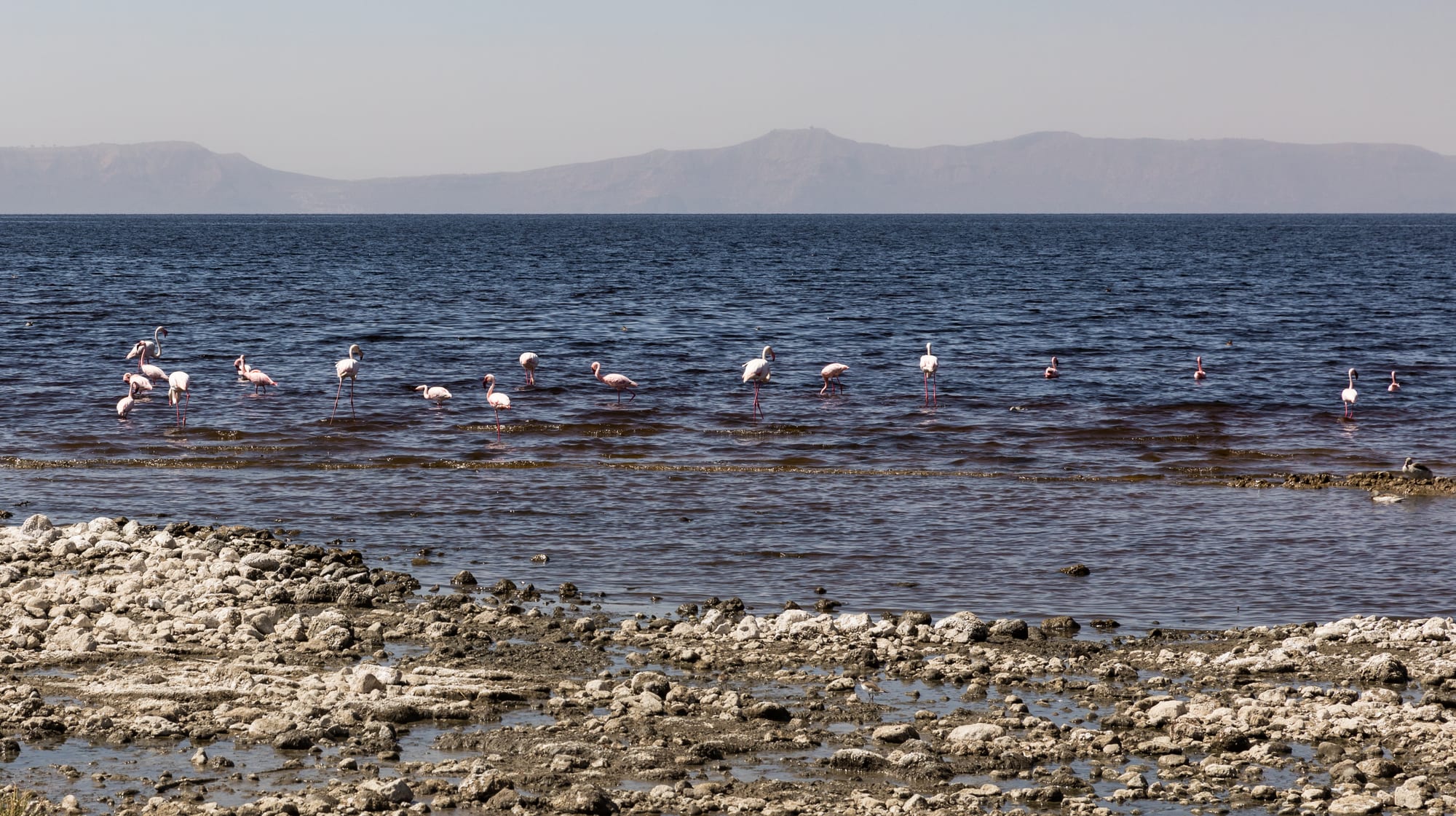
Flamingos wading in the blue water of Lake Shalla, with a stony white shore in front and hazy hills beyond

Ethiopia

Addis Ababa, Oromia, Harar & the East

Flamingos on Lake Shalla in Abijatta-Shalla National Park, one of the Rift Valley lakes of Oromia. (Ninaras / Wikimedia Commons · CC BY 4.0)

The centre and east of Ethiopia, from the capital Addis Ababa across Oromia, the country's largest and most populous region, to the walled Muslim city of Harar, the railway town of Dire Dawa and the arid Somali lowlands around Jijiga — a band that runs from the Bale Mountains and the Rift Valley lakes to the borders of Somalia and Djibouti.

Explore Addis Ababa, Oromia, Harar & the East

History

The oldest traces here are prehistoric: the Melka Kunture sites on the Awash River south of Addis Ababa hold stone tools and hominin remains going back well over a million years. For much of the Middle Ages the east belonged to Muslim states rather than the Christian highland empire. The Sultanate of Adal, trading through the port of Zeila, moved its seat to Harar in the 16th century, and from there Imam Ahmad ibn Ibrahim al-Ghazi, known to Christians as Gragn, invaded the highlands in the 1520s and 1530s, until Portuguese help turned the war. His successor, Emir Nur, built Harar's wall.

In the same century Oromo groups, organised under the age-grade system called Gadaa, spread north and east across the central highlands and much of what is now Oromia. Harar stayed a walled city-state under its emirs, then under Egyptian occupation from 1875 to 1885, before Menelik II took it in 1887. Menelik, expanding his kingdom southwards, also founded Addis Ababa in 1886 on the site chosen by Empress Taytu, and the railway to Djibouti, begun in the late 1890s, created Dire Dawa as a new town where the line reached the lowlands.

The Somali-inhabited Ogaden was fought over in the 1977–78 Ogaden War with Somalia. Under the 1995 federal constitution Oromia, Harari, the Somali Region and the two city administrations of Addis Ababa and Dire Dawa became separate units. Oromo protests from 2014 helped bring Abiy Ahmed, an Oromo, to power in 2018, but western and southern Oromia have since seen fighting between federal forces and the Oromo Liberation Army, and the Oromia–Somali boundary saw deadly clashes in 2017–18.

Culture & Customs

The Oromo are Ethiopia's largest people, and Afaan Oromo, written in the Latin alphabet since the 1990s, is the language of Oromia. Their Gadaa system, which organises society into generation groups that rotate authority, is on UNESCO's intangible heritage list, and its values of assembly and balance are a strong part of Oromo identity. Irreecha, the thanksgiving that marks the end of the rains, brings very large crowds carrying fresh grass and flowers to the lake Hora Arsadi at Bishoftu and, in recent years, to Addis Ababa. Oromia is religiously mixed: Muslim in much of the east and south, Orthodox in the centre, Protestant in the west.

Harar has its own language, Harari, and a strongly Muslim urban culture, with dozens of mosques and saints' shrines, the gey gar houses with their raised platforms and walls hung with baskets and plates, and fine basket-weaving. The city is also known for feeding wild hyenas at night, a practice that began as a way of keeping peace with the animals.

The Somali Region is almost entirely Muslim and Somali-speaking, organised by clan and pastoral life, with poetry held in high esteem. Addis Ababa gathers all of these and more: an Amharic-speaking city of Orthodox churches, mosques and the Merkato, Africa's great open-air market, with a strong live music scene of jazz and traditional azmari singers.

Daily Life

Addis Ababa has several million people — UN projections put the metropolitan area above five million in 2022 — and is growing fast, with new apartment blocks, the light railway, road corridors cut through old neighbourhoods and large redevelopment projects along its rivers. It is the country's economic centre and, as the seat of the African Union and the UN Economic Commission for Africa, a diplomatic city too. Adama, an hour or so to the south-east, is a growing industrial and conference town of several hundred thousand people.

Rural Oromia grows much of Ethiopia's teff, wheat, barley and coffee, and the lakes district has large flower and horticulture farms. In the east, khat grown in the hills around Harar is a major cash crop. Dire Dawa, with a few hundred thousand people, lives on trade and the railway; Jijiga has grown quickly as the Somali Region's capital.

In the east, afternoons are shaped by khat: shops quieten after lunch as men gather to chew. Across the region, recurring drought in the lowlands, insecurity in parts of Oromia and the high cost of living are the main concerns.

Food

The capital eats from every corner of the country: kitfo, the spiced raw or lightly warmed minced beef of the Gurage people, is served with crumbly ayib cheese and gomen greens in specialist houses, while Addis Ababa's tej bets pour honey wine in glass flasks. Oromo cooking adds chuko, whole grain seasoned with butter and spices.

Harar is famous for its coffee, a highland Arabica with a fruity, winey flavour sold as Harar or Harrar, and the city brews Harar beer; Bedele beer comes from western Oromia and Ambo mineral water from the springs west of the capital.

In the Somali Region the food is pastoral: camel and goat meat, camel milk, rice and pasta — a legacy of Italian influence across the Somali world — and canjeero, a thin fermented pancake eaten at breakfast. Across the lakes district, fried and grilled fish from Ziway and the other lakes is the roadside meal, and in every town the coffee ceremony, with popcorn and incense, frames the afternoon.

Attractions & Natural Wonders

Addis Ababa's sights begin with the National Museum and its casts and fossils of Lucy, the Holy Trinity Cathedral where Haile Selassie is buried, the Ethnological Museum at Addis Ababa University, the Red Terror Martyrs' Memorial Museum and the vast Merkato. The Entoto hills above the city hold churches of Menelik's time and forest walks, and the crater lakes of Bishoftu lie an hour to the south-east. Beyond Bishoftu, Adama is the gateway to Awash National Park, with the Fantale volcano and the Awash gorge.

South of the capital the Rift Valley lakes follow the main road: Ziway with its island monasteries, Langano, where swimming is possible, and Abijatta-Shalla National Park, where flamingos crowd the soda lake of Abijata beside the crater lake of Shalla and its hot springs. Further south-east, the Bale Mountains National Park climbs through juniper and hagenia woodland to the Sanetti Plateau and down into the Harenna Forest; the Sof Omar caves, a limestone cave system cut by the Weyb River, lie in the lowlands east of the range.

In the east, Harar Jugol is the centre of attention: five historic gates, the Arthur Rimbaud House, named after the French poet who traded here in the 1880s, and the evening hyena feeding outside the walls. Dire Dawa's old quarter and railway station and its market sit below, and beyond the Marda Pass Jijiga opens onto the Somali lowlands.

Cities in Addis Ababa, Oromia, Harar & the East

Planning basics

Budget

Addis Ababa has the widest range of prices in Ethiopia, from cheap guesthouses and street food to international hotels and restaurants priced in hard currency. Outside the capital costs fall: Adama, Harar and Dire Dawa have modest hotels and cheap local food, and bus fares are low. The Bale Mountains add park fees, a compulsory scout or guide and, for most visitors, a hired vehicle.

Daily Budget Midrange
USD 60–120 roughly USD 70–150 (mid-range hotels, domestic flights, a car and driver for Bale or the lakes)
Daily Budget Shoestring
USD 20–40 roughly USD 25–45 (basic hotels, local eateries, minibuses and long-distance buses)

Prices in birr change quickly after the 2024 devaluation, so confirm hotel and guide rates in writing before arriving; carry cash for Bale and the Somali Region.

Safety

Addis Ababa and the Harar–Dire Dawa area are generally manageable, with pickpocketing, bag snatching and scams the main problems in the capital. Parts of Oromia, particularly in the west and south, have seen an armed insurgency, and roads can close without warning. Parts of the Somali Region near the Somalia border carry a risk of cross-border attacks and are covered by government advice against travel.

Check current advisories closely and route around conflict-affected regions. Travel outside the main towns with a reputable local operator, avoid driving after dark, and keep phones and bags close in Addis Ababa. Check current official travel advice before travelling.

Climate

Altitude decides everything. Addis Ababa, at about 2,350 metres, is mild all year, with the main rains from June to September. The Bale plateau is far colder, with frost on clear nights. The Rift Valley floor is warmer and drier, and Dire Dawa and the Somali lowlands are hot for most of the year, with short, unreliable rains; Harar, on a ridge at about 1,900 metres, sits between the two.

Summer
rainy and cool in Addis Ababa, around 15–22°C; hot in Dire Dawa and the Somali lowlands, often above 35°C before the rains
Winter
dry and sunny in the highlands, 20–25°C by day with cold nights; frost on the Bale plateau

Transportation

Addis Ababa's Bole airport is the hub, with domestic flights to Dire Dawa, Jijiga and the Bale area. A main road runs east to Adama, and the electric railway to Djibouti passes Adama and Dire Dawa. Harar is a short drive from Dire Dawa; buses cover the whole route from the capital in a long day. The Rift Valley lakes lie along the main road south, and Bale is several hours' drive from Addis Ababa on a mix of good and rough road.

Fly to Dire Dawa to save a long day on the road to Harar; hire a vehicle with a driver for Bale and the lakes.

Best Time to Visit

October to February is the best period for most of the region: dry roads, clear views on the Bale plateau and green country just after the rains. Addis Ababa's Meskel bonfire in late September and Timkat in January are the big Orthodox festivals, and Irreecha, the Oromo thanksgiving, falls in late September or early October. Dire Dawa and the Somali lowlands are least punishing from November to February.