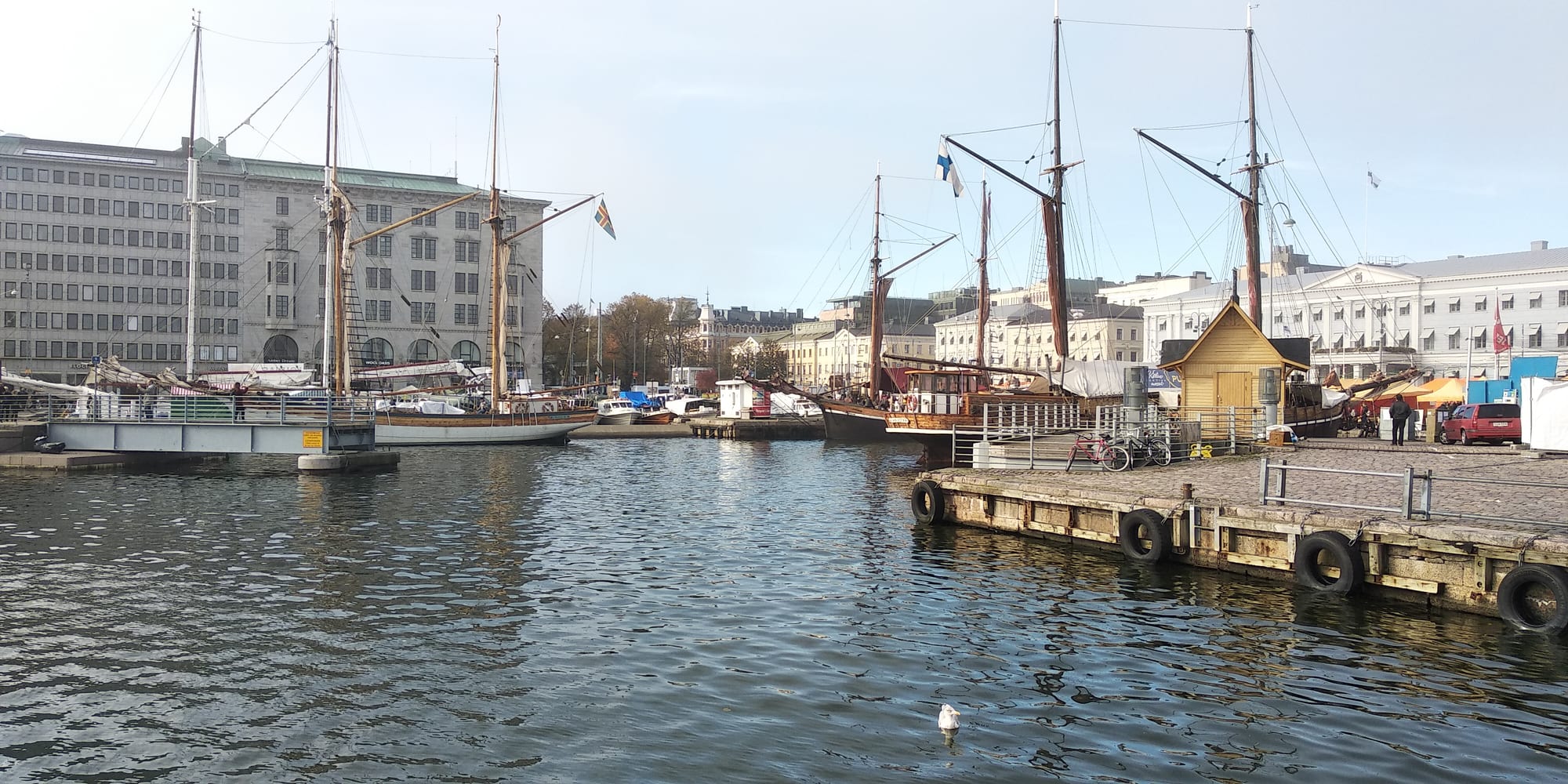
Tall-masted wooden sailing ships moored in Helsinki's harbour by the Market Square, with stone buildings behind

Helsinki & Southern Finland, Finland

Helsinki

The South Harbour beside Helsinki's Market Square. (Denis Koshelev / Wikimedia Commons · CC BY-SA 4.0)

Finland's capital and largest city, on a peninsula in the Gulf of Finland — a Swedish trading town of 1550 that Russia made the capital in 1812 and rebuilt in white neoclassical stone. Today it is a bilingual, design-minded city of trams, harbour markets and island ferries, with the Suomenlinna sea fortress offshore.

Neighbourhoods

  • Kruununhaka
    • First-time visitors
    • Historic district

    The district the town moved to in 1640, around Senate Square, which with its surroundings forms the oldest part of central Helsinki. The cathedral, the Government Palace and many university buildings are here, and its quieter streets are known for vintage shops.

    Open in Maps
  • Kamppi
    • Close to public transport
    • Shopping

    A busy part of the city centre, with the Kamppi Center shopping centre and metro station, the Tennispalatsi and the Kamppi Chapel on Narinkka Square. Much of its heart stayed undeveloped until 2002.

    Open in Maps
  • Punavuori
    • Best for food
    • Nightlife
    • Shopping

    A former working-class district with a seedy 19th-century reputation, now known for small shops, bars, nightclubs and restaurants along streets such as Uudenmaankatu and Iso Roobertinkatu. Old Helsinki slang calls it Rööperi.

    Open in Maps
  • Kallio
    • Nightlife
    • Students and artists
    • Local life

    The old workers' district across the Pitkäsilta bridge, about a kilometre north of the centre and one of the most densely populated places in Finland. Small flats, many bars and a bohemian, liberal reputation make it popular with students and artists.

    Open in Maps
  • Töölö
    • Quiet and residential
    • Museums

    The western side of the peninsula, made up of Etu-Töölö, with Parliament House, and Taka-Töölö to the north. The Olympic Stadium, the rock church and Sibelius Park are here among streets of apartment blocks.

    Open in Maps
  • Katajanokka
    • Architecture
    • Waterfront

    A headland made into an island by a 19th-century canal, just east of the Market Square. Once Finland's largest import harbour, it is now a distinguished residential area with the Uspenski Cathedral, a ferry terminal and a building by Alvar Aalto.

    Open in Maps
  • Eira and Kaivopuisto
    • Quiet and residential
    • Parks

    South of the centre, Eira has some of the city's most sought-after old Jugend-style apartments, embassies and upmarket restaurants. Beside it, Kaivopuisto is one of Helsinki's oldest parks, running down to the sea.

    Open in Maps

Things to do

Famous landmarks

  • Senate Squarelandmark

    Carl Ludvig Engel's neoclassical square, framed by the cathedral, the Government Palace, the university's main building and the Sederholm House of 1757, the oldest building in central Helsinki.

    Open in Maps
  • Helsinki Cathedrallandmark

    The white, green-domed Lutheran cathedral above Senate Square, built from 1830 to 1852 and known as St Nicholas's Church until independence in 1917.

    Open in Maps
  • Uspenski Cathedrallandmark

    The main cathedral of the Orthodox Church of Finland on Katajanokka, the largest Orthodox church in Northern Europe.

    Open in Maps
  • Temppeliaukio Churchlandmark

    A Lutheran church built directly into solid rock in Töölö, designed by the brothers Timo and Tuomo Suomalainen and opened in 1969.

    Open in Maps
  • Kamppi Chapellandmark

    The 'Chapel of Silence' on Narinkka Square, meant as a quiet place in one of the busiest parts of the city.

    Open in Maps
  • Helsinki Central Library Oodilandmark

    The public library opened in December 2018 opposite Parliament, with spaces for games, recording, film and concerts as well as books; it had more than 2.7 million visits in 2025.

    Open in Maps

Museums

  • Ateneummuseum

    Part of the Finnish National Gallery beside the Central Station square, holding the largest collections of classical art in Finland.

    Open in Maps
  • Kiasmamuseum

    The National Gallery's museum of contemporary art on Mannerheimintie, in a building designed by Steven Holl.

    Open in Maps
  • Amos Rexmuseum

    A privately funded contemporary art museum opened in 2018 under the Lasipalatsi building on Mannerheimintie.

    Open in Maps
  • Architecture & Design Museummuseum

    Founded in 1873 as the Museum of Applied Arts, with a permanent exhibition on Finnish design from 1870 to the present in a former school building of 1895.

    Open in Maps

Parks, islands and the sea

  • Suomenlinnalandmark

    The sea fortress Sweden began in 1748 on a group of islands about four kilometres south-east of the centre, surrendered to Russia in 1808 and renamed in 1918; a year-round ferry runs from the Market Square.

    Open in Maps
  • Esplanadipark

    The tree-lined park boulevard between Erottaja and the Market Square, with a statue of the national poet J. L. Runeberg at its centre and the Kappeli restaurant at its eastern end.

    Open in Maps
  • Kaivopuistopark

    One of the oldest and best-known parks in central Helsinki, on the southern shore, where crowds picnic on 1 May.

    Open in Maps
  • Seurasaaripark

    An island in the city with old, mainly wooden buildings brought from elsewhere in Finland, red squirrels and hares, and a large bonfire at Midsummer.

    Open in Maps
  • Sibelius Monumentattraction

    Eila Hiltunen's memorial to the composer in Sibelius Park, Töölö — an abstract cluster of 569 welded steel pipes that visitors can stand inside.

    Open in Maps
  • Allas Sea Poolattraction

    A marine spa beside the Market Square, opened in 2016, with a warm pool, a seawater pool and a children's pool built on top of the sea, as well as a sauna and a café.

    Open in Maps

Markets

  • Market Squaremarket

    Kauppatori, the harbour square at the end of Esplanadi, with food and souvenir stalls and outdoor cafés from spring to autumn — and seagulls that snatch snacks from unwary hands.

    Open in Maps

Sport and nights out

  • Helsinki Olympic Stadiumattraction

    The stadium in Töölö, about 2.3 kilometres from the centre, the main venue of the 1952 Olympics and home of the national football team; it reopened in 2020 after renovation.

    Open in Maps
  • Linnanmäkiattraction

    Finland's oldest and most popular amusement park, opened in 1950 and run by a non-profit foundation that raises money for child welfare.

    Open in Maps

Short trips from the city

  • Nuuksio National Parkpark

    Forest and lakes less than 30 kilometres from downtown, with eight marked trails and the Siberian flying squirrel as its emblem, reached by bus from Espoo.

    Open in Maps
  • Porvooattraction

    Finland's second-oldest town, with its wooden old town and riverside storehouses, reached by bus or by a summer ferry from Helsinki.

    Open in Maps
  • Tallinnattraction

    Estonia's capital, 80 kilometres south across the Gulf of Finland and reached by ferry, with a medieval old town.

    Open in Maps

Seasonal events

  • Lux Helsinkiearly January

    A free light-art event run by the city since 2009, with works by Finnish and international artists in the dark midwinter streets.

  • Vappu30 April–1 May

    Finland's biggest carnival-style festival, rich in student traditions: the Havis Amanda statue is capped on the evening of 30 April, and picnics fill Kaivopuisto the next day.

  • Helsinki DayJune

    The city's birthday, marked with entertainment events and an open-air concert.

  • Flow FestivalAugust

    An urban music and arts festival at the former Suvilahti power plant, with artists from indie rock and soul to jazz, folk and club music.

  • Helsinki FestivalAugust

    Finland's largest multi-arts festival, with theatre, music, dance, circus and the Night of the Arts, when performers take over parks and streets.

  • Baltic Herring MarketOctober

    An old fair, said to date from 1743, when archipelago people sell fish and island products from their boats in the South Harbour.

Eat and drink

Long-standing places and food districts in Helsinki. Hours, ratings and directions come from your maps app, always current.

Helsinki classics

  • Café Ekbergcafe

    The oldest café still operating in Finland, founded in 1852 and on Bulevardi since 1915, whose range has included Napoleon cake and Runeberg tortes since the 19th century.

    Open in Maps
  • Kappelirestaurant

    A restaurant at the eastern end of Esplanadi, opened in 1867 and a favourite of poets, writers and artists around 1900.

    Open in Maps

Market halls and food districts

  • Old Market Hallmarket

    Helsinki's oldest market hall, on the Eteläranta waterfront beside the Market Square, in business since 1889.

    Open in Maps
  • Hakaniemi market hallmarket

    A market hall of 1914 on Hakaniemi square in Kallio, renovated from 2018 to 2023.

    Open in Maps
  • Kallio's barsneighborhood

    Many bars, in the old working-class district north of the Pitkäsilta bridge.

    Open in Maps

Experience Helsinki

History

King Gustav I of Sweden founded Helsingfors on 12 June 1550 as a trading town to rival Reval, today's Tallinn, across the gulf. For a long time it stayed small, troubled by poverty, war and disease. In 1640 Count Per Brahe moved the town to the Vironniemi peninsula by the sea — today's Kruununhaka, where Senate Square stands. The wooden town burned repeatedly, and the plague of 1710 killed most of its people. From 1748 Sweden built the Sveaborg fortress on the islands offshore, but in the Finnish War of 1808 it surrendered to Russia after a two-month siege, and about a quarter of the town was destroyed by fire that year.

Russia turned the town into a capital. Emperor Alexander I moved Finland's capital here from Turku on 8 April 1812, to bring it closer to St Petersburg and reduce Swedish influence, and Carl Ludvig Engel designed a new neoclassical centre around Senate Square. After the great fire of Turku in 1827 the country's only university moved here too. Industry and railways followed, and by the 1910s the population passed 100,000, with Finnish- and Swedish-speakers in roughly equal numbers at the start of the century.

After independence and the civil war of 1918, the city prepared for the 1940 Olympics, which the war cancelled. The Games came in 1952 instead, a landmark for a country recovering from the Winter and Continuation Wars. Between 1944 and 1969 the population nearly doubled, and the metro opened in 1982. Helsinki hosted the first CSCE summit in 1975, the Eurovision Song Contest in 2007 and was World Design Capital in 2012; new towers in Kalasatama include Majakka, completed in 2019 and the first skyscraper in Finland.

Culture & Customs

Helsinki is a bilingual city — Helsingfors in Swedish — with Finnish- and Swedish-language schools, theatres and parishes; of its 21 Lutheran congregations, three are Swedish-speaking. The city also has its own old slang, stadin slangi, Finnish laced with Swedish, German and Russian loanwords, and about a fifth of its residents have a foreign background, twice the national average.

Architecture and design are central to the city's image. Engel's empire-style centre, the National Romantic and Art Nouveau buildings of the early 1900s, the functionalist Olympic venues and recent landmarks such as Oodi and Amos Rex sit within a short walk of each other. The World Design Capital jury in 2012 pointed to Nokia, Kone and Marimekko and to the annual Helsinki Design Week. The Ateneum, Kiasma and the Helsinki Festival keep a busy arts calendar, and Flow brings international music to an old power station every August.

The year has clear peaks. On the evening of 30 April students cap the Havis Amanda statue, and on 1 May Vappu picnics fill Kaivopuisto; at Midsummer the city empties to the cottages while a great bonfire burns on Seurasaari. The October herring market keeps a fair said to date from 1743. Residents are reserved and direct, value quiet on trams and in shared spaces, and treat the sauna, public or private, as an everyday habit.

Daily Life

About 694,000 people live in the city of Helsinki, about 1.3 million in the capital region with Espoo, Vantaa and Kauniainen, and about 1.6 million in the wider metropolitan area — roughly a quarter of Finland's population. Women make up 53 per cent of residents, above the national average, and about 20.8 per cent of people have a foreign background, twice the national figure.

The metropolitan area holds roughly 700,000 jobs and generates about a third of Finland's GDP; 83 of the 100 largest Finnish companies have their headquarters there, and the University of Helsinki and Aalto University are its major research universities. The Port of Helsinki became the world's busiest passenger port in 2017, counting ferry and cruise passengers together. Inner districts such as Kallio, one of the most densely populated places in the country, are full of small flats popular with students and young people; families spread into the suburbs and new towers in the east.

Restaurants serve weekday lunch sets from late morning, and evenings go to sport, sauna or the supermarket. People get around by tram, bicycle and metro, swim at city beaches in summer and at winter-swimming spots in the cold months, and leave for cottages on summer weekends. Scarce and costly housing has pushed many commuters out to towns such as Lahti, Hämeenlinna and Porvoo.

Food

The Baltic sets much of the table. Silakka, Baltic herring, is smoked or pickled, and archipelago people sell fish from their boats at the October herring market, held at the South Harbour since 1820. Lohikeitto, salmon soup, is one of the most popular salmon dishes in Finland, the Old Market Hall by the harbour has traded since 1889, and in August many Swedish-speaking Finns hold crayfish parties. Some of the Market Square's outdoor cafés sell lihapiirakka, meat pastries.

Finnish staples appear everywhere: dark rye bread, unsweetened and even bitter, Karelian pies with a thin rye crust and a rice filling, and new potatoes at Midsummer. Café culture is strong in a country that drinks a great deal of coffee, with korvapuusti cinnamon buns and pulla sweet bread at every counter. Café Ekberg, the oldest café still operating in Finland, has baked Runeberg tortes since the 19th century, eaten nationwide on the poet's day, 5 February.

The confectioner Fazer, founded by the Helsinki-born baker Karl Fazer, makes Fazer Blue, a milk chocolate. Fine dining leans on local seafood and other local produce, while the weekday lunch set, lounas, is the cheapest way to eat out. Lonkero, originally a gin and grapefruit long drink, is a national speciality.

Planning tools

Budget

Helsinki is expensive for hotels, taxis and eating out. The weekday lunch menu is the cheapest way to eat well, supermarkets are good, and many sights — the churches, Oodi, the parks and the market — cost nothing.

Daily Budget Midrange
USD 180–340 (central hotel, restaurant dinners, museum tickets, a day trip by ferry or bus)
Daily Budget Shoestring
USD 80–130 (hostel or budget hotel, lunch buffets, supermarket dinners, HSL day tickets)

Eat the main meal at lunchtime, when menus (lounas) are cheapest; the HSL day ticket covers trams, the metro and the Suomenlinna ferry.

Best Time to Visit

June to August, when the city lives outdoors, the island ferries run often and the evenings stay light. May and September are quieter and still pleasant. Winter is dark and grey, with snow that comes and goes, but brings Lux Helsinki in January and quiet museums.

Suggested Number of Days

Two to three days cover the compact centre, the museums and the nearest islands. Allow four to six to add the forests and lakes to the west, an old wooden town along the coast or the ferry to Estonia; long summer days fit more in than short winter ones.

First Visit
2–3 days
With Surroundings
4–6 days

Transportation

HSL runs a dense network of trams, commuter trains, the metro, buses, ferries and city bikes across Helsinki, Espoo and Vantaa. The tram system dates from 1891 and covers the inner city well; the metro, opened in 1982, runs east–west. Ferries go to Suomenlinna all year. Few visitors need a car.

Buy tickets in the HSL app or by contactless card on trams and buses; cash is not accepted on board.

Airport & Station Connections

Helsinki Airport, Finnair's hub, is in neighbouring Vantaa, about 17 kilometres north of the centre and linked to it by commuter train. VR trains run from the Central Station to the rest of Finland, and ferries link the South and West Harbours with Tallinn in 1½ to 3½ hours depending on the ferry, as well as with Stockholm and Mariehamn. The land border with Russia is closed.

Walkability

The centre is compact and flat enough to cross on foot: Kamppi, Esplanadi, Senate Square, the Market Square and Katajanokka sit close together, and Kallio and Töölö are a short walk or tram ride away. The shoreline paths of Kaivopuisto and the southern parks are the pleasant routes. Pavements turn icy and slushy in the freeze-thaw months.

Safety

Finland is consistently rated one of the safest countries in the world, with very low crime. In Helsinki there is some pickpocketing in crowded places, crime in the centre concentrates around the Central Station and the Kamppi shopping centre, and bicycles are prone to theft. Kaisaniemi park behind the station is best avoided at night. Thin sea ice and cold water are the natural hazards.

Keep valuables close in crowds and on ferries, lock bicycles securely, stay off sea ice unless locals are clearly using it, and wear grip soles in winter. Check current official travel advice before travelling.

Climate

The Baltic Sea and the North Atlantic Current keep winters milder than the latitude suggests. Summers are short and mild with very long days; winters are dark, damp and grey, with snow that comes and goes.

Summer
mild — some July and August afternoons reach around 26°C or more, and the record is 33.2°C, set in July 2019
Winter
cold and dark — January and February average about −4°C, and temperatures below −20°C occur only a few times a year

Local Customs

Helsinki is officially bilingual, so street signs give Finnish and Swedish names, and English is spoken almost everywhere. Service is included in prices and tipping is not expected. People are reserved, punctual and comfortable with silence; queues are respected.

Sauna is traditionally taken naked and followed by a plunge into the sea or the snow; ask before photographing people, and keep voices low on public transport.

Common Payment Methods

The currency is the euro. Cards and mobile payment are accepted almost everywhere, including market stalls and transport, and some places no longer take cash at all. ATMs are easy to find, but most visitors need little or no cash.