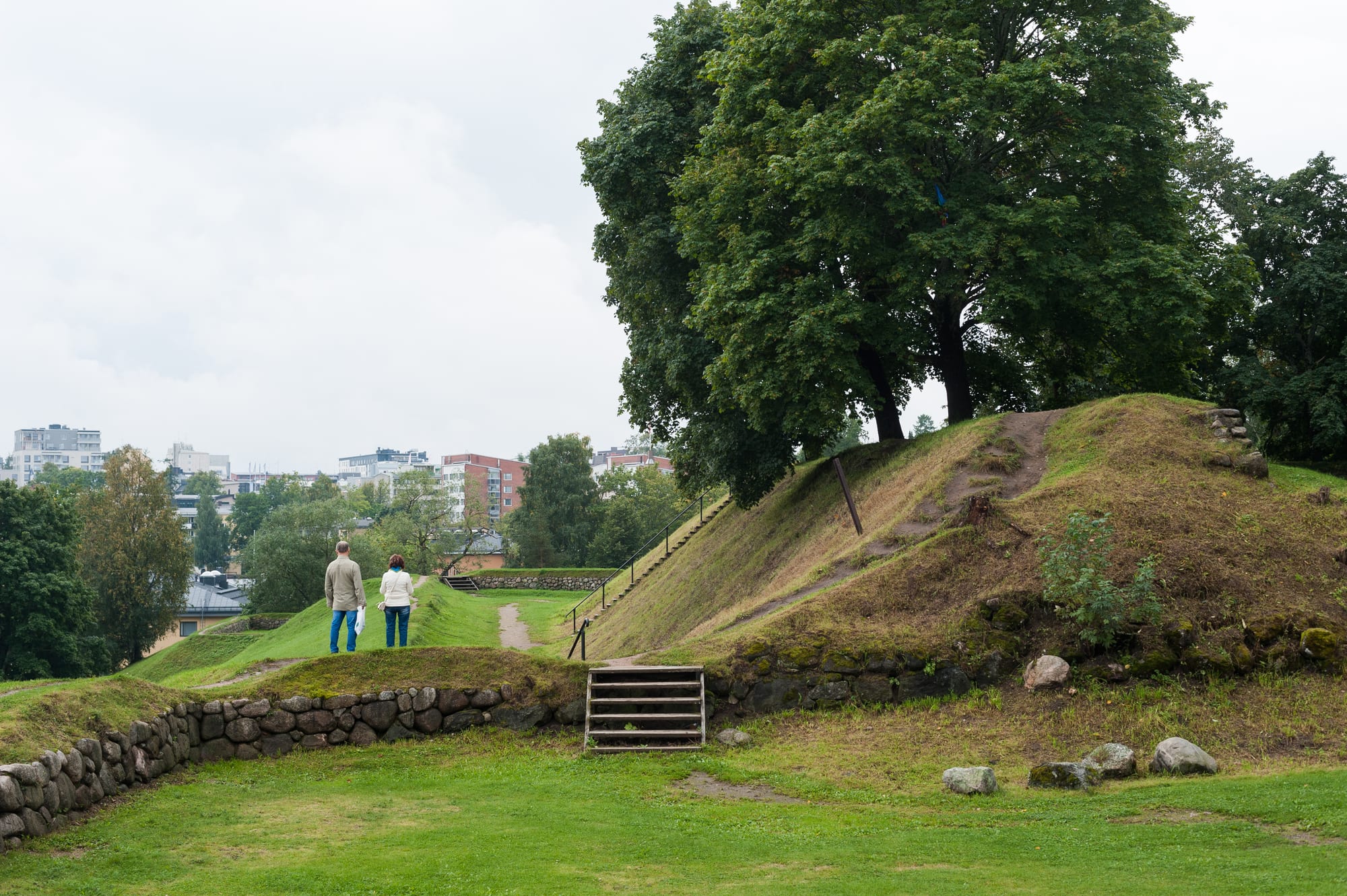
Grassy earth ramparts and stone walls of Lappeenranta's fortress under large trees, with city apartment blocks behind

Helsinki & Southern Finland, Finland

Lappeenranta

The grass-covered ramparts of the fortress in Lappeenranta, with the modern city beyond. (Tuomas Vitikainen / Wikimedia Commons · CC BY-SA 4.0)

The regional capital of South Karelia, on the southern shore of Lake Saimaa about 30 kilometres from the Russian border — a tar-trading town chartered in 1649 that changed hands between Sweden and Russia and grew around an 18th-century fortress. Today it is a university city and summer lake resort, with the Russian border crossings closed since late 2023.

Neighbourhoods

  • The fortress (Linnoitus)
    • Historic district
    • Museums
    • Cafés

    The original town on a headland jutting into Lake Saimaa, fortified by Sweden from the 1720s. Its old buildings hold artists' workshops, the Museum of South Karelia, the South Karelia Art Museum, cafés and Finland's oldest Orthodox church.

    Open in Maps
  • The harbour
    • Waterfront
    • Summer evenings
    • Families

    The lakeside below the fortress, with terraces, boats, parks and Myllysaari beach close by; each summer artists build a giant sandcastle at its northern end.

    Open in Maps
  • The city centre
    • First-time visitors
    • Shopping
    • Close to public transport

    The modern centre south of the harbour, around the Market Square, with shops, restaurants and the wooden St Mary's Church of Lappee.

    Open in Maps
  • Skinnarila
    • Students
    • Quiet and residential

    The campus district shared by LUT University and LAB University of Applied Sciences, with around 8,000 students, served by city buses from the centre.

    Open in Maps

Things to do

Fortress and history

  • Lappeenranta Fortresslandmark

    Earthwork ramparts and stone buildings built mostly between 1722 and 1728, when Lappeenranta stood on the new Swedish–Russian border, and later strengthened; today a quarter of museums, workshops and cafés.

    Open in Maps
  • Orthodox Church of the Intercession of the Theotokoslandmark

    The church of the local Orthodox parish inside the fortress, completed in 1785 — the oldest Orthodox church in Finland.

    Open in Maps
  • St Mary's Church of Lappeelandmark

    A wooden Lutheran church of 1792–94 in the city centre, the only surviving 18th-century double-cross church in Finland, with a bell tower of 1856.

    Open in Maps
  • Museum of South Kareliamuseum

    A museum at the northern end of the fortress, in early-19th-century artillery storehouses, keeping the heritage of ceded Karelia, including a large scale model of Vyborg as it was in 1939.

    Open in Maps

Lake and harbour

  • Lake Saimaapark

    Finland's largest lake and the fourth-largest natural freshwater lake in Europe, home of the endangered Saimaa ringed seal; summer cruise boats sail from Lappeenranta's harbour.

    Open in Maps
  • Lappeenranta Sandcastleattraction

    A giant sandcastle built by artists every summer at the northern end of the harbour, the biggest in Finland.

    Open in Maps
  • Myllysaari beachbeach

    A beach near the harbour and the fortress, part of the summer waterfront scene.

    Open in Maps
  • Saimaa Canalattraction

    The canal of 1845–56 that connects Lake Saimaa at Lappeenranta with the Gulf of Finland near Vyborg, passing through Russian waters on the way.

    Open in Maps

Short trips from the city

  • Imatrankoskiattraction

    The Imatra Rapids on the Vuoksi in neighbouring Imatra, a tourist attraction since the late 1700s and a national landscape, dammed since 1929 but released for shows in summer.

    Open in Maps
  • Ylämaaattraction

    A rural district in the south of the city, known for spectrolite, a gemstone found while building the Second World War Salpa Line fortifications, with a gemstone museum and quarry tours.

    Open in Maps

Seasonal events

  • Night of the Fortressearly August

    A two-day cultural festival in the fortress and harbour area.

  • Lappeenranta Ballet Galalate August

    An annual ballet gala at the end of the summer season.

Eat and drink

Long-standing places and food districts in Lappeenranta. Hours, ratings and directions come from your maps app, always current.

Lappeenranta classics

  • Vety and atomi at the Market Squaremarket

    Kiosks on the Market Square and at the harbour sell the local meat pies: vety, 'hydrogen', with ham and boiled egg, and atomi, 'atom', with ham or egg but not both.

    Open in Maps
  • Majurskacafe

    A café inside the old fortress.

    Open in Maps
  • Wolkoffrestaurant

    A restaurant on Kauppakatu in the city centre.

    Open in Maps

Food districts

  • Harbour terracesneighborhood

    In summer the harbour's terraces and bars are where the city eats and drinks outdoors, looking out over the lake.

    Open in Maps

Experience Lappeenranta

History

People have lived around Kauskila, south of the present centre, for about 2,000 years, and in the Middle Ages it was one of the main Karelian settlements of the area. The town itself began as a market on a headland jutting into Lake Saimaa, called Lapvesi and later Lappee; its trade grew so important that the Governor-General Per Brahe the Younger asked for town privileges, and Queen Christina of Sweden chartered the town in 1649, when it was an important port for tar. Its Swedish name, Villmanstrand, contains the "wild man" who still appears on its coat of arms.

After the Treaty of Nystad in 1721 the town found itself on the new border with Russia. From 1721 to 1743 it was the capital of Kymmenegård and Nyslott County, and Sweden built its fortress, mostly between 1722 and 1728. In 1741 a Russian army defeated the Swedes at the Battle of Villmanstrand and pillaged and burned the town, and by the Treaty of Turku it passed to Russia as part of "Old Finland". The Orthodox church in the fortress dates from this Russian period, completed in 1785. In 1812 Alexander I joined Old Finland to the Grand Duchy of Finland, and in 1856 the Saimaa Canal opened, linking the lake with the Gulf of Finland near Vyborg.

The airport opened in 1918, making it the oldest still operating in Finland. After the Second World War Vyborg and the Karelian Isthmus went to the Soviet Union, leaving Lappeenranta a border city. It absorbed Lappee and Lauritsala in 1967, Nuijamaa in 1989, Joutseno in 2009 and Ylämaa in 2010. Russian visitors made it the second most visited Finnish city for Russian tourists, until the border crossings were closed in late 2023.

Culture & Customs

The city's identity is shaped by the lake and the border. Lake Saimaa makes it a summer city of terraces, beaches and boats, and the yearly sandcastle at the harbour — the biggest in Finland — has become a symbol of the season. The fortress quarter, with its museums, artists' workshops, Orthodox church and cafés, is the cultural heart, and hosts the two-day Night of the Fortress festival each August; the Lappeenranta Ballet Gala follows later that month, and the city holds an annual national singing contest.

Sport is strong for a city of its size. SaiPa plays in Finland's top ice hockey league, Veiterä have been Finnish bandy champions five times, and the city hosted the first Women's Bandy World Championship in 2004 and again in 2014. Basketball has a long local following, and the women's team Catz has won the national championship four times in a row.

The universities have given the city an international side: LUT University and LAB University of Applied Sciences together have about 13,000 students from 68 countries. Decades of Russian visitors left Cyrillic signs on some shops, and Russian is still the most common language after Finnish. Lappeenranta has also worked to brand itself as a green city, reaching the finals of WWF's Earth Hour City Challenge in 2014.

Daily Life

The city of Lappeenranta has about 73,200 inhabitants, the 13th largest municipality in Finland, and the sub-region about 88,100. About 87.9 per cent speak Finnish as their first language and 11.9 per cent another language, led by Russian, Chinese and English; in 2024 about 11 per cent of residents had a foreign background, the same as the national average.

The main employers include the city, LUT University, the regional health district, the armed forces — the Army Academy is here — and industry: Fazer, the forest company UPM-Kymmene, the limestone producer Nordkalk, the insulation maker Paroc, Metso Outotec and the railway company VR. Tourism and retail long relied on Russian shoppers, who made the city a rival to Helsinki for tax-free sales, until all the border crossings were closed in late 2023.

Residents live in the centre and in suburbs spread along the lakeshore, from Skinnarila's campus to Lauritsala, with villages in the merged rural districts. Summer evenings are spent at the harbour, Myllysaari beach and lakeside cottages; in winter the lake freezes and people skate, ski, sledge and ride snowmobiles.

Food

Lappeenranta's own speciality is the meat pie. Kiosks on the Market Square and at the harbour sell vety — "hydrogen" — a meat pie with ham, boiled egg and condiments, and atomi — "atom" — which has either ham or egg but not both. Ask for a "vetyatomi" and most grill kiosks in Finland will understand.

South Karelia shares the eastern Finnish taste for rye and pastries. Karelian pies, with a rye crust and rice filling topped with egg butter, are everyday food, alongside rye bread, potatoes, fish from Saimaa and forest berries and mushrooms. The confectioner Fazer is one of the city's major employers.

Cafés and restaurants cluster in the centre and the fortress, where historic houses hold small cafés, and in summer the harbour's terraces fill with people eating and drinking by the lake. The weekday lunch menu is how most residents eat out, and large hypermarkets on the edge of town supply everything else.

Planning tools

Budget

Lappeenranta has noticeably cheaper hotels and lunch menus than Helsinki. The fortress, harbour, beach and sandcastle area cost little or nothing to enjoy, and the market-square meat pies are among the cheapest meals in town. Lake cruises are the main extra.

Daily Budget Midrange
USD 150–280 (city hotel, restaurant dinners, museum tickets, a lake cruise)
Daily Budget Shoestring
USD 70–120 (guesthouse or budget hotel, lunch menus, market pies, Jouko city buses)

Eat the main meal at lunchtime, when menus are cheapest; a 24-hour Jouko bus ticket covers the city.

Best Time to Visit

June to August, when the harbour terraces open, the sandcastle stands, cruise boats run on Saimaa and Lappeenranta enjoys some of Finland's warmest summers; early August brings the Night of the Fortress. Winter brings snow, skating, skiing and snowmobiling on and around the lake.

Suggested Number of Days

One or two days cover the fortress, the harbour and the centre. Allow three or four to add a lake cruise, neighbouring Imatra and the rural south, or a stay in a lakeside cabin; summer suits a longer visit.

First Visit
1–2 days
With Surroundings
3–4 days

Transportation

Pink Jouko buses run 17 city lines and regional lines to Imatra and the surrounding villages; tickets can be bought by card on board, by mobile app or with a Waltti card. The fortress, harbour and centre are close enough to walk between, and a car helps for the lakeside countryside.

Use the Jouko route planner online for timetables and live bus positions.

Airport & Station Connections

Trains from Helsinki take about two hours to Lappeenranta's main station, and the city lies 215 kilometres from Helsinki by road. Lappeenranta Airport, Finland's oldest operating airport, is 2.5 kilometres south-west of the centre and mainly serves charter and low-cost flights. The land border with Russia, 30 kilometres away, is closed, and trains to St Petersburg have been suspended since 2022.

Walkability

The compact centre, the harbour and the fortress sit within easy walking distance of each other along the lakeshore, and the beach is close to the harbour. The campus and outer suburbs need a bus or bicycle. Pavements are icy in winter.

Safety

Finland is consistently rated one of the safest countries in the world, with very low crime. Lappeenranta is a quiet regional city; the main hazards are winter ice on pavements and on the lake, and cold water early in the summer.

Stay off lake ice unless locals are clearly using it, keep well away from the closed Russian border zone, and wear grip soles in winter. Check current official travel advice before travelling.

Climate

A humid continental climate with longer, warm summers — among the warmest in Finland, as the city is southern but inland — and often harsh winters. Warm days have become more frequent since 2000.

Summer
warm and usually long, though rarely hot — some of the warmest in Finland; days above 24°C, once rare, have become regular this century
Winter
often harsh, and colder than on the coast, where winter highs in Helsinki tend to sit between 0 and 5°C

Local Customs

Lappeenranta is a Finnish-speaking city, with Russian the most common other language and Cyrillic still seen on some shop signs from the years of heavy Russian tourism. English is widely spoken, especially around the universities. People are reserved and direct and value quiet.

Sauna is traditionally taken naked and followed by a plunge into the lake; ask before photographing people, and do not photograph military sites near the border.

Common Payment Methods

The currency is the euro. Cards and mobile payment are accepted almost everywhere, including on the city buses, and some places no longer take cash. ATMs are in the centre and at the shopping centres.