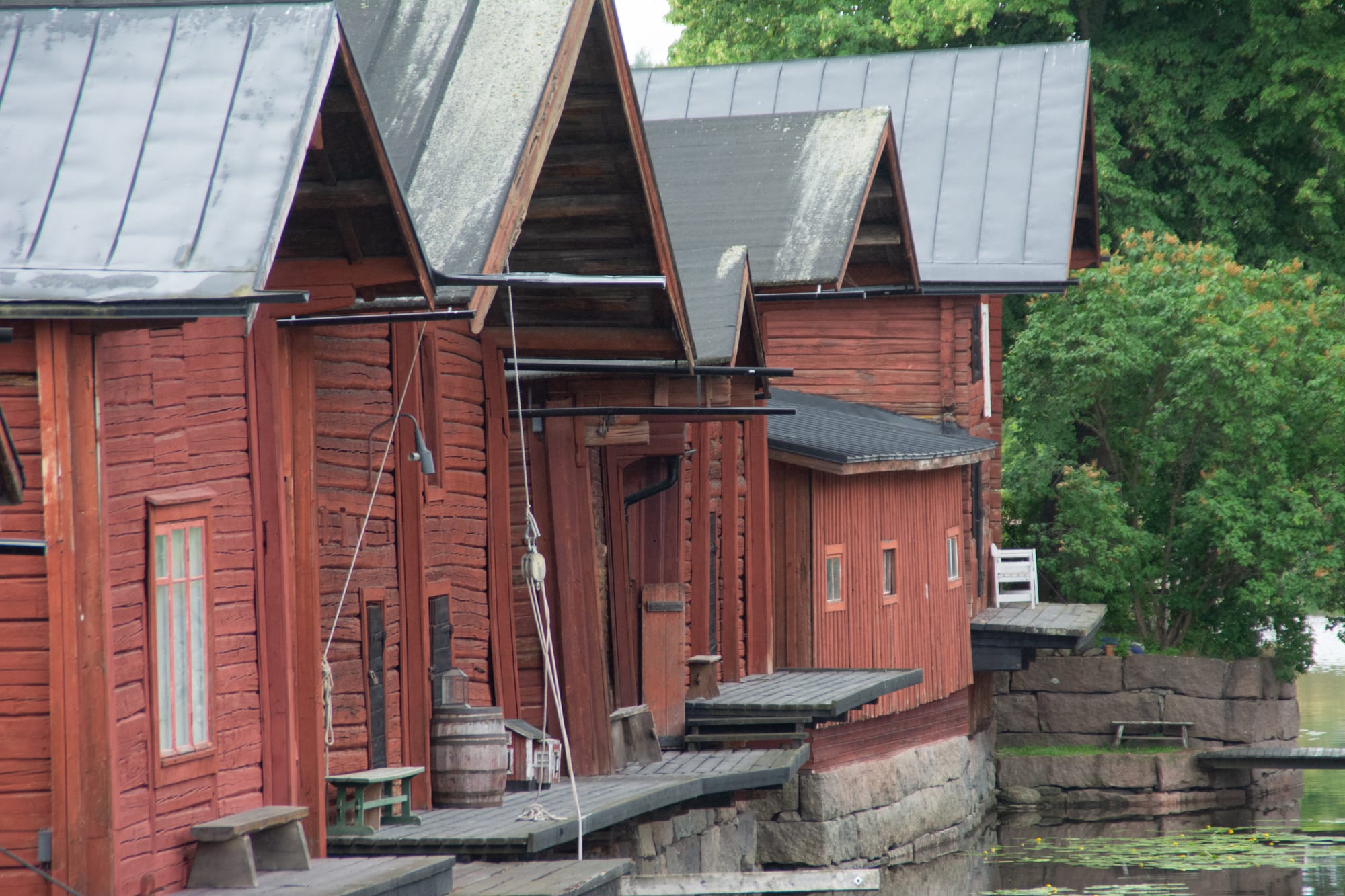
Red-painted wooden storehouses with grey metal roofs on stone foundations at the edge of the river in Porvoo

Helsinki & Southern Finland, Finland

Porvoo

The red wooden storehouses on the bank of the Porvoonjoki in Porvoo's old town. (Jae Lo Presti / Wikimedia Commons · CC BY-SA 4.0)

A bilingual town at the mouth of the Porvoonjoki river on the Gulf of Finland, about 50 kilometres east of central Helsinki — one of Finland's six medieval towns, where the Diet of 1809 made Finland a grand duchy. Its wooden old town, red riverside storehouses and hilltop cathedral draw day-trippers; the wider town lives from oil refining and commuting.

Neighbourhoods

  • Old Town (Vanha Porvoo)
    • First-time visitors
    • Historic district
    • Cafés

    A dense medieval street pattern of mainly wooden houses from the 17th and 18th centuries, climbing from the river to the cathedral. Pedestrian streets such as Jokikatu are lined with restaurants, coffeehouses and antique shops, and the whole quarter is compact enough to cross on foot.

    Open in Maps
  • The new town
    • Local life
    • Close to public transport

    When the town outgrew its medieval core, a grid-plan town was built beside it, its houses also of wood. Today this is the everyday part of the town.

    Open in Maps
  • The west bank
    • Riverside views
    • Arts

    Long left untouched, the western side of the river has been built up in recent decades, with new houses modelled on the old storehouses opposite, a vehicle bridge and a pedestrian bridge, and the Art Factory.

    Open in Maps

Things to do

The old town

  • Porvoo Cathedrallandmark

    The medieval stone and brick cathedral at the top of the old town, built in the 15th century on older foundations — seat of Finland's Swedish-speaking diocese. It has burned five times, most recently in 2006.

    Open in Maps
  • Porvoo Museummuseum

    A history museum founded in 1897, housed in the old Town Hall of 1764 in the heart of the old town.

    Open in Maps
  • Porvoo Hillfortviewpoint

    Linnamäki, the historic hill beside the old town, where Iso Linnamäki is known as the largest ancient hillfort in Finland, in use from the 8th to the 14th century.

    Open in Maps
  • Porvoonjoki by kayakattraction

    Kayaking and canoeing past the storehouses on the river that once carried the inland Tavastians' trade to the coast is a popular summer pastime.

    Open in Maps

Museums and the arts

  • Runeberg's Homemuseum

    The house where the national poet J. L. Runeberg lived from 1852 until his death in 1877, a museum since 1882 with the family's furniture, art and the descendants of Fredrika Runeberg's houseplants.

    Open in Maps
  • Art Factoryattraction

    Taidetehdas, on the west bank of the river, with a bistro.

    Open in Maps

Short trips from the town

  • Albert Edelfelt's studio museummuseum

    At Haikkoo on the edge of town, a museum devoted to the painter Albert Edelfelt, one of the leading figures of the Golden Age of Finnish art.

    Open in Maps
  • Pellinkiattraction

    A largely Swedish-speaking island community about 23 kilometres south of the town, reached by a free cable ferry, where Tove Jansson spent her summers and wrote Notes from an Island.

    Open in Maps
  • Söderskär Lighthouselandmark

    A granite-and-brick lighthouse of 1862 on an islet in the outer Porvoo archipelago, said to be Tove Jansson's model for the lighthouse island in Moominpappa at Sea.

    Open in Maps

Seasonal events

  • Runeberg Day5 February

    The national poet's birthday is marked at his home museum, with lilies of the valley, his favourite flower, and Runeberg tortes in the town's cafés.

  • Old Town Christmas marketDecember

    An annual Christmas market in the wooden old town; in December 2025 Radio Nostalgia voters chose Porvoo as the most beautiful Christmas town in Finland.

Eat and drink

Long-standing places and food districts in Porvoo. Hours, ratings and directions come from your maps app, always current.

Porvoo classics

  • Brunbergcafe

    A family-run confectioner founded in 1871, best known for its Pusu chocolate-coated foam kisses and its liquorice.

    Open in Maps
  • Runeberg tortes in the old town cafésneighborhood

    Porvoo is the exception to the January–February torte season: some of its cafés sell Runeberg tortes every day of the year.

    Open in Maps

Food streets

  • Jokikatuneighborhood

    The pedestrian street along the east bank of the river, lined with restaurants and coffeehouses in old wooden buildings.

    Open in Maps

Experience Porvoo

History

The Porvoonjoki was a trade route long before there was a town: inland Tavastians carried goods down the river to the coast, and merchants traded at Saksala, "the place of the Germans". Swedish colonists from Svealand settled the area in the 13th and 14th centuries, after the crusade against the Tavastians of 1249–1250, and the town took its Swedish name, Borgå — "castle river" — from a medieval fortress near the river. It received town rights around 1380, the third in Finland after Turku and Ulvila, though a founding date of 1347 is also claimed, which would make it the second oldest.

When Sweden lost Vyborg to Russia in 1721, the bishop's seat moved to Porvoo in 1723, and for a time it was the second largest town in Finland. A fire in 1760 burned about two-thirds of its buildings, but the town was rebuilt. In 1809, after Russia had conquered Finland, Tsar Alexander I summoned the four estates to Porvoo; the Diet of Porvoo, which met from March to July, made Finland an autonomous grand duchy.

In the 19th century a new grid plan threatened the old town, but popular resistance led by Count Louis Sparre saved it, and a new wooden town was built beside it instead. The cathedral gave its name to the Porvoo Communion of Anglican and Lutheran churches in 1992. The old town and the rural municipality merged in 1997, and in 2006 the cathedral's roof was destroyed by a fire started accidentally by a youth, though the interior largely survived.

Culture & Customs

Porvoo is a bilingual town with a strong Finland-Swedish identity: it is the seat of the Swedish-speaking Diocese of Borgå, and the Swedish People's Party came first in the town at the 2015 parliamentary election. About 27 per cent of residents speak Swedish as their first language, and the island community of Pellinki, within the municipality, is overwhelmingly Swedish-speaking.

The town's cultural memory centres on J. L. Runeberg, the national poet, who lived here from 1837 until his death in 1877; his home has been a museum since 1882, and his birthday on 5 February is still celebrated there with traditions going back to the 1870s, when firemen marched with torches to honour the bedridden poet. His wife, Fredrika Runeberg, a pioneer of Finnish historical fiction, wrote most of her work here. The painter Albert Edelfelt and the sculptor Ville Vallgren are among the town's notable figures, and Borgå Gymnasium holds Finland's oldest public library, founded in 1728.

Tove Jansson spent childhood and adult summers in the Pellinki islands, and the outer archipelago's Söderskär lighthouse is said to be the model for Moominpappa at Sea. Sport has its own local pride: Borgå Akilles play bandy in the top division and have twice been Finnish champions, and the footballer Sami Hyypiä comes from the town.

Daily Life

The city of Porvoo has about 51,900 inhabitants, the 19th largest municipality in Finland, and the wider sub-region about 60,000. About 63 per cent speak Finnish as their first language, 27 per cent Swedish and almost 10 per cent another language, most commonly Russian, Estonian, Ukrainian or Arabic; in 2024 about 9 per cent of residents had a foreign background.

Industry carries far more weight than the postcard image suggests. The oil company Neste was the largest employer in 2014, and the Port of Kilpilahti on the town's outskirts handles more cargo by tonnage than any other in Finland; the chemicals firm Borealis and the electrical maker Ensto are also major employers. Many residents commute to the Helsinki area, and the town is the largest municipality in Finland without a scheduled passenger railway.

Life outside the old town is that of a modern Finnish small town — suburbs of flats and houses around the centre, shopping in the new town, and villages along the river and among the islands. In summer the old town fills with day-trippers from Helsinki and boats tie up at the guest marina on the river.

Food

The town's best-known delicacy is the Runeberg torte, said to have been developed by a local pastry master and eaten by Runeberg for breakfast. It is a small torte of about 100 grams flavoured with almonds and arrack or rum, usually topped with raspberry jam inside a ring of icing. Elsewhere in Finland it is sold from January until Runeberg Day on 5 February, but some Porvoo cafés sell it all year.

Confectionery is a local speciality. Brunberg, a family firm founded in 1871, is known for its chocolate-covered foam kisses and its liquorice, and the Old Porvoo Ice Cream Factory is another local name. The town's traditional dishes come from the coast and the islands: grilled herring with onion rings and dill became Porvoo's second parish dish, after the Runeberg torte, in the 1980s, and Pellinki's fish soup and nettle soup were chosen as the main dishes of the Porvoo countryside.

Eating out centres on the old town, where Jokikatu and the lanes around it hold restaurants and coffeehouses in old wooden buildings. Across the water, the Art Factory has a bistro, and the new town has ordinary lunch restaurants and supermarkets.

Planning tools

Budget

Porvoo is a common day trip from Helsinki and cheaper than the capital for food and rooms, though the old town's cafés and restaurants are priced for visitors. The weekday lunch menu is the best value, and walking the old town, the riverbanks and the hillfort costs nothing.

Daily Budget Midrange
USD 160–300 (hotel or guesthouse, restaurant dinners, museum tickets, a boat trip)
Daily Budget Shoestring
USD 70–120 (bus from Helsinki or a guesthouse room, lunch menus, supermarket food)

Eat the main meal at lunchtime, when menus are cheapest; Runeberg tortes and Brunberg sweets make inexpensive treats.

Best Time to Visit

June to August for the riverside cafés, kayaking and the summer boat from Helsinki; the old town is busiest then. December brings the Christmas market and lit-up wooden streets, and early February brings Runeberg Day and the tortes.

Suggested Number of Days

Most people come for a single day from Helsinki. An overnight stay gives the old town in the quiet of the evening, and two or three days allow time for the archipelago and the countryside along the river.

First Visit
1 day
With Surroundings
2–3 days

Transportation

The old town is pedestrianised and compact, and everything central is within walking distance of the bus station and the river. Local buses serve the suburbs. The islands and the archipelago need a car, a bicycle or a boat. Porvoo has had no regular passenger trains since 1981.

Museum trains from Kerava run to Porvoo on some summer weekends — a slow, scenic alternative to the bus.

Airport & Station Connections

Buses leave Helsinki's Central Bus Station for Porvoo every 15–30 minutes In summer the ferry J. L. Runeberg sails from Helsinki's Market Square three to five times a week, taking about three and a half hours. Helsinki Airport is the nearest airport; there is none in Porvoo.

Walkability

Very walkable: the old town, the river, the cathedral and the new town's shops sit within a few hundred metres of each other. The old town's streets are steep and cobbled in places, which makes them hard going with pushchairs or wheels and slippery in winter.

Safety

Finland is consistently rated one of the safest countries in the world, with very low crime. Porvoo is a quiet small town; the practical hazards are uneven cobbles, icy slopes in winter and cold water for anyone paddling the river or the archipelago in spring.

Wear good shoes on the cobbles, stay off river and sea ice unless locals are clearly using it, and wear a life jacket when kayaking. Check current official travel advice before travelling.

Climate

A coastal climate, moderated by the Gulf of Finland, with short, mild, very light summers and long, dark winters in which snow comes and goes.

Summer
mild — in nearby Helsinki some July and August afternoons reach around 26°C or more
Winter
cold and dark — in nearby Helsinki January and February average about −4°C

Local Customs

Porvoo is officially bilingual: about 63 per cent of residents speak Finnish as their first language and 27 per cent Swedish, and signs give the Swedish name, Borgå, alongside the Finnish. English is widely spoken. Residents are reserved and value quiet.

The old houses are private homes, so keep voices down and do not walk into courtyards or photograph through windows. Dress quietly for services in the cathedral.

Common Payment Methods

The currency is the euro. Cards and mobile payment are accepted almost everywhere, including cafés and small shops, and some places no longer take cash. ATMs are in the new town centre.