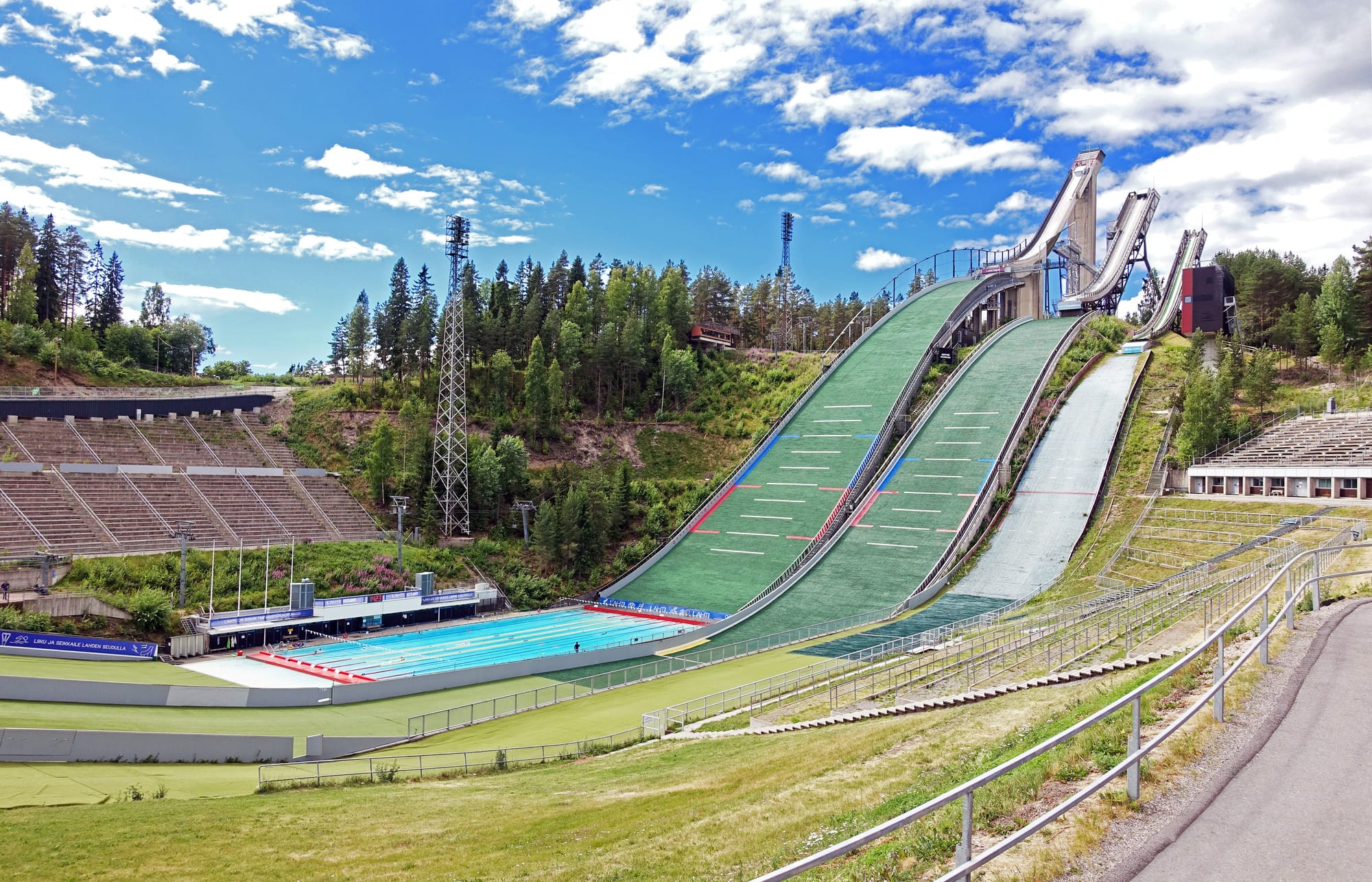
Three ski-jump towers with green summer landing slopes above an outdoor swimming pool and stands, with pine forest behind

Helsinki & Southern Finland, Finland

Lahti

The Salpausselkä ski jumps at the Lahti Sports Centre in summer. (Tiia Monto / Wikimedia Commons · CC BY-SA 4.0)

Finland's ninth-largest city, on a bay at the southern end of Lake Vesijärvi about 100 kilometres north-east of Helsinki — a railway-junction town of 1905 that grew on sawmills, furniture and engineering. It is known for its ski jumps on the Salpausselkä ridge, seven Nordic World Ski Championships, the timber Sibelius Hall and its record as a green city.

Neighbourhoods

  • Keski-Lahti (the centre)
    • First-time visitors
    • Close to public transport
    • Shopping

    The downtown grid laid out after the fire of 1877, circling the Market Square, which is also the hub of the city buses. Saarinen's town hall, Aalto's Church of the Cross, shopping centres and most restaurants are here.

    Open in Maps
  • Vesijärvi harbour
    • Waterfront
    • Concerts
    • Summer evenings

    The lakeside north of the centre, once a busy railway port, now a harbour area with outdoor cafés and bars, restaurant ships in summer, lake cruises and the timber Sibelius Hall. A public beach lies about a kilometre further north along the shore.

    Open in Maps
  • Salpausselkä and Radio Hill
    • Sport
    • Outdoor activities
    • Museums

    The forested ridge that cuts through the city from west to east, holding the sports centre with its ski jumps and ski museum, and Radio Hill with its two 150-metre masts and the radio and TV museum.

    Open in Maps
  • Nastola
    • Quiet and residential
    • Countryside

    A rural former municipality east of the city, merged with Lahti in 2016, with lakes, villages and Nastola Church of 1804, the oldest church within the city limits.

    Open in Maps

Things to do

Landmarks and architecture

  • Sibelius Halllandmark

    The concert and congress centre of 2000 on the Vesijärvi harbour, built of glulam timber by Kimmo Lintula and Hannu Tikka, known for its acoustics and home of the Lahti Symphony Orchestra.

    Open in Maps
  • Church of the Crosslandmark

    Ristinkirkko, the city's main church, a modernist building completed in 1978 and one of Alvar Aalto's last designs.

    Open in Maps
  • Lahti Town Halllandmark

    Eliel Saarinen's town hall, designed in 1911 and completed in 1912 in dark brick brought from Sweden.

    Open in Maps
  • Radio Hillviewpoint

    A ridge-top hill in the centre whose twin 150-metre radio masts of 1927–28, 316 metres apart, are the city's best-known landmark.

    Open in Maps

Museums

  • Lahti Ski Museummuseum

    A museum of skiing and other winter sports in the sports centre, beside the ski-jumping venue.

    Open in Maps
  • Radio and TV Museummuseum

    Mastola, the national museum of radio and television, in the 1935 station building on Radio Hill, where visitors can see old equipment and hear old programmes.

    Open in Maps

Sport, lake and parks

  • Salpausselkä ski jumpsattraction

    The ski-jumping venue of the Lahti Sports Centre, with hills from K116 down to K6, at the sports centre that hosts the Lahti Ski Games.

    Open in Maps
  • Lake Vesijärvipark

    A 111-square-kilometre lake restored after severe pollution in the 1960s, cruised in summer by a paddle steamer and by boats that continue to Lake Päijänne through the Vääksy canal.

    Open in Maps

Short trips from the city

  • Päijänne National Parkpark

    Fifty unbuilt islands and parts of inhabited islands in the southern part of Lake Päijänne, a national park since 1993.

    Open in Maps
  • Hollolaattraction

    The neighbouring municipality to the west, the old parish Lahti once belonged to, with the Messilä outdoor resort by Vesijärvi for skiing, hiking and golf.

    Open in Maps

Seasonal events

  • Lahti Ski Gameswinter

    A three-day international tournament of cross-country skiing, ski jumping and Nordic combined, held since 1923 in a stadium for close to 100,000 spectators.

  • Finlandia-hiihtoFebruary

    A long-distance cross-country ski race held since 1974, part of the Worldloppet series, and since 2001 run on a course from Lahti to Hollola and back.

Eat and drink

Long-standing places and food districts in Lahti. Hours, ratings and directions come from your maps app, always current.

Food districts

  • Market Squaremarket

    The large square at the heart of the 1878 town plan, where the city buses meet.

    Open in Maps
  • Vesijärvi harbourneighborhood

    In summer several restaurant ships moored at the passenger harbour work as open-air pubs, beside the harbour's cafés and bars.

    Open in Maps
  • Sibelius Hallrestaurant

    The concert hall has its own lunch restaurant.

    Open in Maps

Experience Lahti

History

Lahti — "bay" in Finnish — was first mentioned in 1445 as a village in the parish of Hollola, on the medieval trade road between Hämeenlinna and Vyborg. It took off with the railway from Riihimäki to St Petersburg in 1870 and the Vesijärvi canal in 1871, which made it a busy junction: for a long time the station at Vesijärvi harbour was the second busiest in Finland. Craftsmen, merchants and industrial workers joined the farming village. On 19 June 1877 almost the whole village burned, and the fire prompted the first plan for a town: Alexander II granted market-town rights in 1878, with an empire-style grid around a large market square that still shapes the centre.

The early town grew slowly in a recession, with only about 200 inhabitants at first, but full city rights followed in 1905, and within ten years Lahti had a hospital, a town hall by Eliel Saarinen and a centre of new brick houses. In the civil war of 1918 the German Brandenstein detachment took the town from the Reds. Its slaughterhouses earned it the nickname "the Chicago of Finland", and in the 1930s it was one of the fastest-growing cities in the country.

After the Second World War about 10,000 evacuees from the territories ceded to the Soviet Union settled here, and growth continued until 1975. The collapse of Soviet trade and the recession of the early 1990s hit its engineering and furniture industries hard. Lahti turned to environmental policy — it was European Green Capital in 2021 — merged with Nastola in 2016, and became a university city in 2018 through LUT University's campus.

Culture & Customs

Sport is Lahti's strongest identity. The first Lahti Ski Games were held in 1923, inspired by Norway's Holmenkollen, and the city is the only one to have hosted the FIS Nordic World Ski Championships seven times, most recently in 2017; it also hosted the World Games in 1997 and the Ironman 70.3 World Championship in 2023. The Pelicans play in Finland's top ice hockey league, and FC Lahti in the top football league.

Music is the other pillar. The Lahti Symphony Orchestra, founded in 1910, concentrates on the works of Jean Sibelius and runs the annual Sibelius Festival in the timber Sibelius Hall, which hosts about 800 events a year, from classical to rock and pop. The city also has an organ festival, a jazz festival on the Market Square, and was the home of the folk metal band Korpiklaani. Architecture enthusiasts come for Saarinen's town hall, Aalto's Church of the Cross and small structures by winners of the Spirit of Wood Architecture Award, including Kengo Kuma.

Lahti is the headquarters of the Salpausselkä UNESCO Global Geopark, recognised in 2022, and Lake Vesijärvi's water quality has much improved since restoration began in the 1970s. Locals have a reputation as quiet and down-to-earth, and summer life moves to the harbour and the beaches of Vesijärvi.

Daily Life

The city has about 121,800 inhabitants, the ninth largest municipality in Finland, and the Lahti region about 204,500. It is a Finnish-speaking city: about 88.5 per cent speak Finnish as their first language and 11 per cent another language, most often Russian, Arabic, Ukrainian or Estonian; in 2024 about 11 per cent of residents had a migrant background.

Machinery, furniture and other manufacturing remain important, though jobs in the region fell from about 90,000 in 1990 to under 70,000 in 1993, and the LUT University campus is a newer presence. Fast trains make Lahti a commuter town for Helsinki as well. People live in the apartment blocks of the centre and in suburbs and detached-house districts spread across the ridge and around the lakes, with Nastola's villages to the east.

The rhythm is that of Finnish provincial life: an early start, a hot lunch before noon, and evenings of sport, sauna or the lake. Winter brings skiing along the ridge; summer brings cruises, swimming at Ankkuri beach and evenings on the harbour's restaurant ships.

Food

Lahti eats like the rest of Finland: rye bread at every meal, potatoes, dairy, fish from the lakes and forest berries and mushrooms. Karelian pies, with a rye crust and rice filling topped with egg butter, and salmon soup, lohikeitto, are everyday dishes, and the cafés serve korvapuusti cinnamon buns and pulla sweet bread with filter coffee, in a country with the highest coffee consumption per head in the world.

The weekday lunch menu, lounas, is how most people eat out, and Sibelius Hall has its own lunch restaurant by the lake. In summer the harbour comes alive: several restaurant ships moor at the passenger harbour and work as open-air pubs, alongside lakeside cafés and bars.

The Häme countryside around the city has a tradition of sahti, a cloudy farmhouse beer brewed with juniper, and summer markets sell new potatoes, strawberries and peas by the litre. Crayfish parties in August and the autumn mushroom and lingonberry season follow the national calendar.

Planning tools

Budget

Lahti is noticeably cheaper than Helsinki for hotels and eating out, and many people visit on a day trip by train. The weekday lunch menu is the cheapest way to eat well, and the ridge trails, beaches and harbour cost nothing.

Daily Budget Midrange
USD 150–280 (city hotel, restaurant dinners, a concert or museum, a lake cruise)
Daily Budget Shoestring
USD 70–120 (budget hotel or guesthouse, lunch menus, supermarket food, city buses)

Eat the main meal at lunchtime, when menus are cheapest; the travel centre makes a day trip from Helsinki by train easy.

Best Time to Visit

June to August for the lake, the harbour terraces, cruises and swimming, when Lahti has some of Finland's hottest summer days. Winter, from January to March, is the season for skiing, the Ski Games and the Finlandia marathon. Sibelius Hall hosts about 800 events a year.

Suggested Number of Days

One or two days are enough for the centre, the ridge and the harbour. Allow three or four for the lakes, the national park and outdoor sport, and more in winter if skiing is the reason for coming.

First Visit
1–2 days
With Surroundings
3–4 days

Transportation

The regional authority LSL runs about 20 local bus lines, most crossing the centre via the Market Square, with buses every 10–20 minutes in the urban area. The travel centre at the railway station gathers local and long-distance buses and trains in one place. A car helps for the lakes and the countryside.

Local buses link the Market Square and the travel centre non-stop.

Airport & Station Connections

Long-distance and commuter trains from Helsinki run at least twice an hour in the daytime and take about an hour, and all eastern and north-eastern services from Helsinki call at Lahti. Helsinki Airport is 49–65 minutes away by train via Tikkurila. Lahti also sits where Highway 4 (Helsinki–Jyväskylä) meets Highway 12 (Tampere–Kouvola).

Walkability

The grid centre is compact and walkable, and the harbour and Sibelius Hall are a short walk north. The ski jumps and Radio Hill sit on the ridge just south and west of the centre, with some climbing. Trails along the ridge and the lakeshore suit walkers in summer and skiers in winter.

Safety

Finland is consistently rated one of the safest countries in the world, with very low crime. The central Keski-Lahti district has been recorded as the most dangerous district in Finland, with almost 80 homicide cases registered within 20 years. Winter ice and cold lake water are the natural hazards.

Take ordinary care in the centre late at night, stay off lake ice unless locals are clearly using it, and wear grip soles in winter. Check current official travel advice before travelling.

Climate

A humid continental climate, warmer in summer and colder in winter than the coast. Rain and snow are spread fairly evenly through the year, with spring the driest season and the most precipitation in the second half of the year. Winters are long and cold.

Summer
warm — with Kouvola, Lahti has had the most days of 25°C or more in Finland over the last two decades, and the heatwave of 2010 reached 35.0°C
Winter
long and cold — colder than the coast, where Helsinki averages about −4°C in January and February

Local Customs

Lahti is a monolingual Finnish-speaking city, though English is widely spoken. People are reserved, direct and value punctuality and quiet. Winter sport is a point of civic pride.

Sauna is traditionally taken naked and followed by a plunge into the lake; ask before photographing people, and keep voices low on buses.

Common Payment Methods

The currency is the euro. Cards and mobile payment are accepted almost everywhere, and some places no longer take cash. ATMs are in the centre and the shopping centres, but little cash is needed.