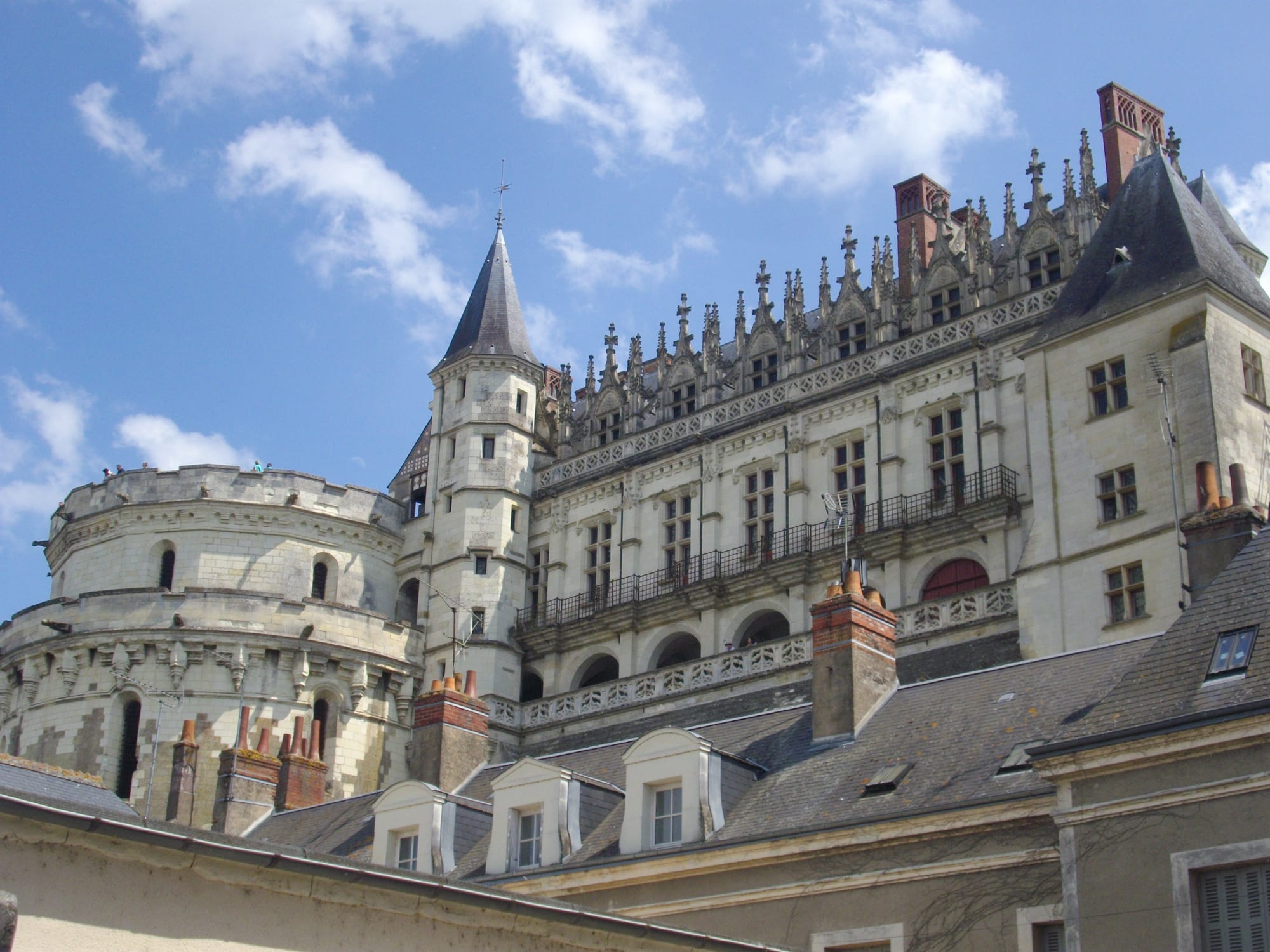
The pale stone royal château of Amboise with a round tower, Gothic dormers and pinnacles rising above slate town roofs under a blue sky

The Loire Valley & Atlantic Loire, France

Amboise

The royal château of Amboise seen from the Quai du Général de Gaulle. (Fab5669 / Wikimedia Commons · CC BY-SA 4.0)

A small market town on the south bank of the Loire, about 22 km east of Tours, dominated by the royal château where Charles VIII was born and died and where the young Francis I and Mary, Queen of Scots, grew up. Leonardo da Vinci spent his last three years at the nearby Clos Lucé, and tourism and light industry now sustain a town of about 13,000.

Neighbourhoods

  • The old town below the château
    • First-time visitors
    • Historic district
    • Best for food

    The narrow streets between the château rock and the Loire embankment, with timber-framed houses, the 15th-century clock tower over the old Amasse gate, the Max Ernst fountain by the market place and most of the town's shops and restaurants. The Clos Lucé is about 500 metres from the château.

    Open in Maps
  • Île d'Or
    • Riverside
    • Quiet
    • Views of the château

    The island in the Loire that the bridge crosses, also called the Île Saint-Jean, with a campsite and riverside paths. It gives the classic view back to the château across the water.

    Open in Maps
  • The north bank and the station
    • Close to public transport
    • Quiet and residential

    The quarter that grew across the river around the railway station, with houses and everyday shops. It is a short walk over the bridge and the island into the old town.

    Open in Maps

Things to do

Château, houses and old town

  • Château d'Amboiselandmark

    The royal château on its rock above the Loire, extensively rebuilt for Charles VIII and at its height under Francis I, whose chapel of Saint-Hubert holds a marble stone marking the reputed remains of Leonardo da Vinci.

    Open in Maps
  • Clos Lucémuseum

    The manor house of 1471 where Leonardo da Vinci lived from 1516 until his death in 1519, a museum of his life and work since the 19th century.

    Open in Maps
  • Tour de l'Horlogelandmark

    A 15th-century clock tower built on the old Amasse gate of the town, with a belfry added under Charles VIII, listed as a historic monument in 1933.

    Open in Maps
  • Church of Saint-Denislandmark

    A former collegiate church on the hillside, close to where the early town grew up beyond the marsh of the Amasse.

    Open in Maps
  • Musée Hôtel Morinmuseum

    A museum in an early 16th-century mansion in the town centre.

    Open in Maps
  • Châteliers oppidumlandmark

    The limestone plateau above the château, the site of a Gallic town of some 50 hectares, possibly Ambacia, chief town of the Turones, with an earthen rampart about 800 metres long.

    Open in Maps

Short trips from the town

  • Pagode de Chantelouplandmark

    A 44-metre Chinese-style pagoda of seven storeys, built in 1775 for the Duke of Choiseul, the main survivor of the vanished Château de Chanteloup south-west of the town.

    Open in Maps
  • Château de Chenonceaulandmark

    The château built across the river Cher, about 11 km south of Amboise, one of the best-known in the Loire Valley.

    Open in Maps
  • Château de Chaumontlandmark

    A castle above the Loire upstream at Chaumont-sur-Loire, destroyed on Louis XI's orders and rebuilt later in the 15th century.

    Open in Maps
  • Toursattraction

    The largest city of the region, about 22 km downstream, with its cathedral, old town around Place Plumereau and TGV connections.

    Open in Maps

Eat and drink

Long-standing places and food districts in Amboise. Hours, ratings and directions come from your maps app, always current.

Amboise classics

  • Restaurants of the old townneighborhood

    Restaurants and cafés in the streets below the château and along the embankment, serving Touraine food with local wine.

    Open in Maps
  • Touraine-Amboise wineneighborhood

    The town's own wine appellation, separate from the wider Touraine AOC since 1954, made in communes on both banks of the Loire around Amboise.

    Open in Maps

Experience Amboise

History

The limestone spur above the meeting of the Amasse and the Loire was a Gallic town, the oppidum of the Châteliers, which may have been Ambacia, chief town of the Turones; the later settlement grew up on the opposite slope around the church of Saint-Denis. Clovis is said to have met the Visigothic king on the island in the river in the early 6th century. Vikings destroyed the wooden bridges in 840, and around 878 the castle was refortified and the bridges rebuilt.

Confiscated by the crown in the 15th century, the château became a favourite royal residence. Louis XI lived here from 1461; his son Charles VIII was born here in 1470, rebuilt the château, bringing in Italian craftsmen after his Italian campaign, laid out the royal estate of Château-Gaillard and its gardens, and died here in 1498 after striking his head on a door lintel. Francis I, who had come to Amboise as a small child, invited Leonardo da Vinci in 1516 and installed him at the Clos Lucé, where he died on 2 May 1519. Mary, Queen of Scots, was raised at the court here from 1548. In 1560 the Protestant conspiracy of Amboise failed, and the peace of Amboise of 1563 granted Protestants freedom of conscience.

The château declined from the later 16th century. From 1848 to 1852 it held the Algerian resistance leader Abd al-Qadir and his household as captives. In June 1940 refugees streamed through the town, French engineers blew up part of the bridge, and the fighting damaged the château and the chapel of Saint-Hubert. In 1946 Amboise absorbed the neighbouring commune of Saint-Denis-Hors.

Culture & Customs

Leonardo da Vinci defines the town's image. The Clos Lucé tells the story of his last years, a stone in the château's chapel of Saint-Hubert marks his reputed remains, the local lycée bears his name and Amboise is twinned with Vinci, his birthplace in Tuscany. The 500th anniversary of his death in 2019 brought a year of events, and visitors to the Clos Lucé that year were estimated at 500,000.

The royal past is the other thread — the château where Charles VIII was born and died, the Renaissance court of Francis I, the childhood of Mary, Queen of Scots, and the drama of the 1560 conspiracy. The 19th century added the memory of Abd al-Qadir's captivity, and the 20th a fountain by the surrealist Max Ernst in front of the market place. Jacqueline Apollinaire, widow of the poet Guillaume Apollinaire, lived near the town for more than twenty years and died here in 1967.

Wine is part of local identity. Amboise lies within its own appellation, Touraine-Amboise, made by communes along both banks of the river and distinct from the wider Touraine appellation since 1954, and the town is home to the VinOpôle, which brings together wine businesses and culture of the Val de Loire.

Daily Life

The commune had 12,937 inhabitants in 2023 and lies within the wider urban area of Tours. The town spreads across both banks: the historic centre on the south bank below the château, the island in the middle of the river and the station quarter on the north bank.

Tourism is the most visible business, with the château, the Clos Lucé and the shops and restaurants of the old town busy from spring to autumn. The area is also the second industrial centre of Indre-et-Loire: the precision engineering firm Mecachrome had its headquarters here until 2021 and has employed more than 200 people, and an insurance-administration office of the AXA group employs over 250.

Living beside the Loire means living with its floods. Strong levees protect the town on all sides, the embankment promenade by the port stands well above the first houses, and the island in the river takes its old name from a priory battered by floodwater.

Food

Amboise eats from the Touraine table. Rillettes, pork seasoned and cooked slowly in its fat, then shredded and packed under fat to be spread on bread, are a speciality of nearby Tours. The local cheese is Sainte-Maure de Touraine, an unpasteurised goat's cheese shaped like a log, rolled in wood ash and pierced lengthways by a straw, made across Touraine.

The town's own wine is Touraine-Amboise, an appellation of communes on both banks of the Loire next to the town, and the wider Touraine vineyards include Vouvray, known for white wines rated among France's best, a short way downstream. Wine is drunk with lunch as a matter of course.

Restaurants and cafés crowd the streets below the château and the embankment facing the river, and the market place, with the Max Ernst fountain in front of it, sits at the heart of the old town. Visitors staying in town find the classics of Touraine — rillettes on bread, goat's cheese and a glass of the local appellation — on most of its menus, alongside the set lunches common across provincial France.

Planning tools

Budget

Amboise is moderately priced for the Loire, though rooms and restaurants in the old town are busiest and dearest in summer. Admissions to the château, the Clos Lucé and nearby châteaux are the main extra cost, and a car or bicycle is needed for most sights outside the town.

Daily Budget Midrange
USD 150–270 (guesthouse or hotel in town, restaurant dinners with Touraine-Amboise wine, two château entries, a hire car or bicycle)
Daily Budget Shoestring
USD 70–110 (campsite on the island or budget room, picnics and lunch menus, regional trains, a hired bicycle)

Walking the embankment, the island and the old streets costs nothing, and the views of the château from the bridge are free.

Best Time to Visit

May, June and September are the most comfortable months, with open gardens and fewer queues at the château and the Clos Lucé. July and August are hot and busy. In winter the town is quiet and some smaller sites shorten their hours.

Suggested Number of Days

The town itself needs a day or two. Allow three to five days to use it as a base for the surrounding châteaux and wine villages; a car or bicycle shortens the time needed.

First Visit
1–2 days
With Surroundings
3–5 days

Transportation

The town centre is walked. The railway line along the Loire links Amboise with Tours and Blois, but most nearby châteaux need a car, a bicycle or a seasonal shuttle. The Loire à Vélo cycle route passes through the town, and cycling between the châteaux is a popular way to travel.

Park on the edge of the old town; the streets below the château are narrow and busy in summer.

Airport & Station Connections

Amboise station, on the north bank of the Loire, has TER and Intercités trains on the line between Tours, Blois, Orléans and Paris-Austerlitz. Tours, about 22 km west, has TGVs from Paris and the nearest airport, Tours Val de Loire. Many visitors arrive by car or by bicycle along the river.

Walkability

Very walkable: the old town is small and flat along the river, with a short climb to the château and the Clos Lucé. The station is across the bridge and the island, a walk of some minutes. Pavements in the old streets are narrow and crowded at peak times.

Safety

France is a safe country overall, with violent crime against visitors uncommon. Amboise is a quiet town; the main risks are traffic in the narrow streets, pickpockets in the summer crowds near the château, and the river, which is dangerous for swimming.

Watch for cars in streets without pavements, keep bags closed in busy spots, and do not swim in the Loire, whose currents and shifting sandbanks make it dangerous. Check current official travel advice before travelling.

Climate

Temperate, with warm summers and cool, damp winters. The town's own weather station records an annual mean of 12.2°C and about 710 mm of rain; its record high is 41.4°C, in July 2019, and its record low −13.1°C, in February 2012.

Summer
warm, with occasional heatwaves; the town's record of 41.4°C was set in July 2019
Winter
cool and damp; the record low of −13.1°C came in February 2012

Local Customs

A 'bonjour' on entering a shop or restaurant is expected, and service is included in bills, so tipping is modest. Lunch is the main meal for many, and wine is part of it. Leonardo da Vinci is a point of local pride: Amboise is twinned with his home town, Vinci.

Keep voices down in the chapel of Saint-Hubert and the churches, and dress respectfully in them.

Common Payment Methods

The currency is the euro. Cards and contactless payment are accepted in almost all shops, restaurants and ticket offices; a little cash is useful at market stalls and small bakeries.