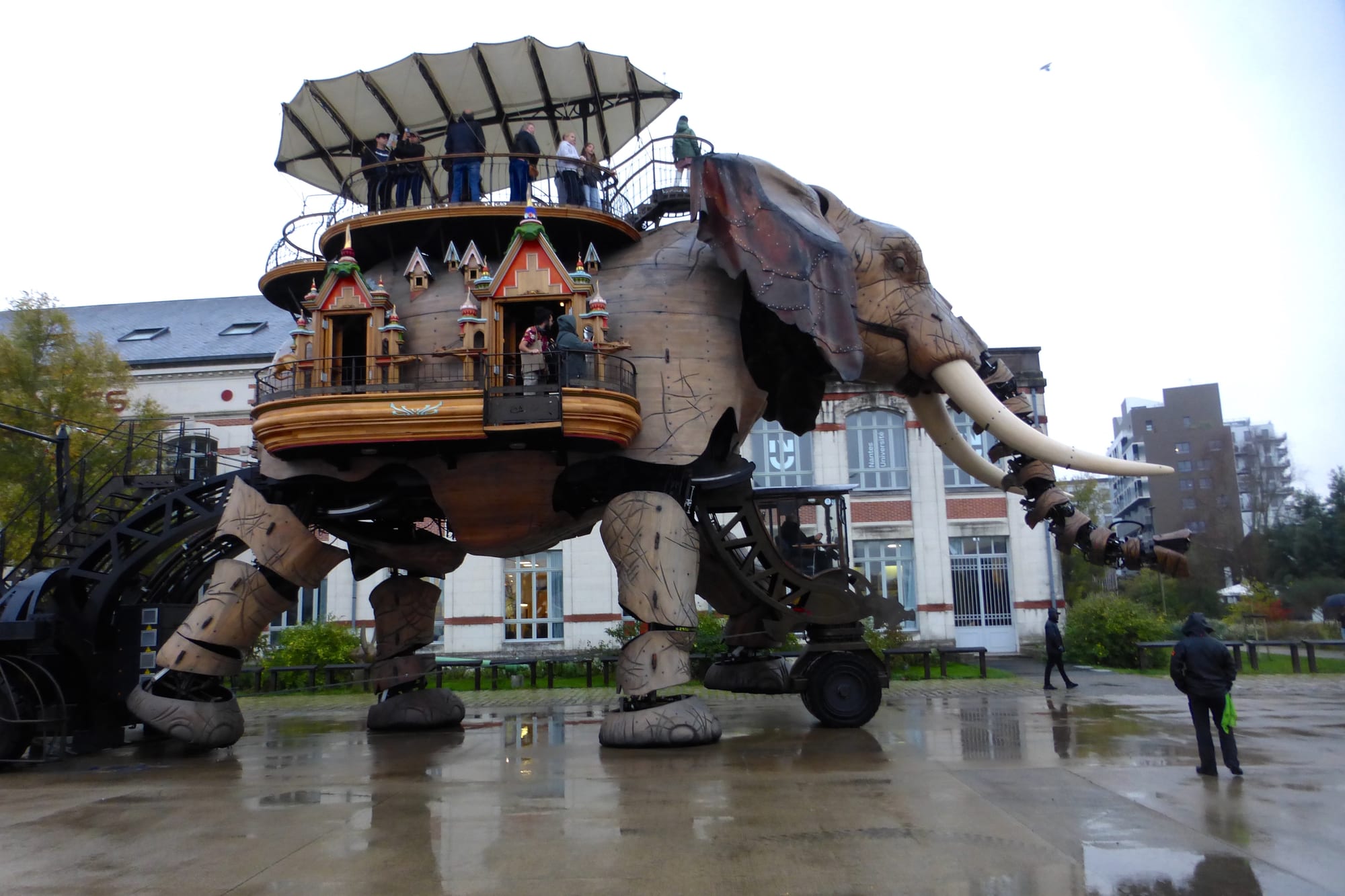
A 12-metre wooden and steel mechanical elephant carrying passengers on its back, walking across a wet square beside a brick hall

The Loire Valley & Atlantic Loire, France

Nantes

The Grand Elephant of the Machines of the Isle of Nantes, in the former shipyards on the Île de Nantes. (MHM55 / Wikimedia Commons · CC BY-SA 4.0)

France's sixth-largest city, on the Loire 50 km from the Atlantic where the Erdre joins it — the old residence of the dukes of Brittany and, in the 18th century, the country's leading slave-trading port. After its shipyards closed it remade itself through culture and services, and it is now known for a mechanical elephant, a ducal castle, fine trams and a young population.

Neighbourhoods

  • Bouffay and the castle
    • First-time visitors
    • Historic district
    • Nightlife

    The medieval core inside the old walls, bordered by the cathedral and the castle of the dukes of Brittany. Narrow streets keep 15th- and 16th-century timber-framed houses, the pedestrian Place du Bouffay was laid out in the 1770s, and bars and crêperies keep the quarter busy late into the night.

    Open in Maps
  • Graslin and Commerce
    • Architecture
    • Shopping
    • Close to public transport

    The neoclassical city built with 18th-century trading fortunes: Place Graslin and its theatre, Place Royale with its fountain, the stock exchange on Place du Commerce and the three-level Passage Pommeraye arcade. It is the main shopping district and a hub of the tram network.

    Open in Maps
  • Île Feydeau
    • Architecture
    • Historic district

    A former island in the Loire, joined to the north bank when the river's arms were filled in, lined with 18th-century merchants' houses decorated with carved masks. Many lean slightly, because they were built on damp ground.

    Open in Maps
  • Île de Nantes
    • Arts and culture
    • Families
    • Nightlife

    The large island in the Loire, its western end the former shipyards — now the Machines, the slavery memorial across the water, the Hangar à bananes with its restaurants and nightclubs, and new housing and offices. The centre keeps an old faubourg, and the east has modern estates.

    Open in Maps
  • Chantenay
    • Local life
    • Quiet and residential

    A former commune on the right bank of the Loire west of the centre, annexed to Nantes in 1908 together with Doulon, now a largely residential district.

    Open in Maps
  • Trentemoult
    • Riverside
    • Best for food

    A former fishing village on the south bank, reached from the north-bank Gare Maritime, close to the centre, by the Navibus river shuttle across the Loire.

    Open in Maps

Things to do

Famous landmarks

  • Château des ducs de Bretagnelandmark

    The moated castle of the dukes of Brittany, with massive schist and granite towers on the town side and a residential palace of white tuffeau around the courtyard, home to the Nantes History Museum.

    Open in Maps
  • Nantes Cathedrallandmark

    The Gothic cathedral that holds the Renaissance tomb of Duke Francis II and his wife, damaged by fire in 1972 and again in July 2020, when its 1621 grand organ was destroyed.

    Open in Maps
  • Passage Pommerayelandmark

    A shopping arcade on three levels, built in 1840–1843, that appears in Jacques Demy's The Umbrellas of Cherbourg.

    Open in Maps
  • Théâtre Graslinlandmark

    The neoclassical theatre of 1788 on Place Graslin, home of the Angers-Nantes Opéra.

    Open in Maps
  • Place Royalelandmark

    A square designed in 1786 by Mathurin Crucy and built in 1790 after the medieval ramparts came down, restored after wartime damage and pedestrianised in 2007–2011.

    Open in Maps
  • Basilica of Saint-Nicolaslandmark

    A neo-Gothic basilica in the city centre, one of two basilicas in Nantes.

    Open in Maps
  • Tour Bretagneviewpoint

    A 144-metre office tower opened in 1976, which dominates the skyline and was long an economic failure.

    Open in Maps

Museums and the Machines

  • Machines of the Isle of Nantesattraction

    Opened in 2007 in the old shipyard halls, with automatons, creatures inspired by the deep sea and the 12-metre walking Grand Elephant, which carries passengers around the island.

    Open in Maps
  • Fine Arts Museum of Nantesmuseum

    One of the largest museums in the region, with works from Tintoretto, Brueghel and Rubens to Georges de La Tour, Ingres, Monet, Picasso, Kandinsky and Anish Kapoor.

    Open in Maps
  • Musée Dobréemuseum

    The département's museum of archaeology and decorative arts.

    Open in Maps
  • Natural History Museum of Nantesmuseum

    One of the largest natural history museums in France.

    Open in Maps
  • Jules Verne Museummuseum

    A museum of the life and work of the writer, who was born in Nantes, opened in 1978.

    Open in Maps
  • Le Lieu Uniqueattraction

    The former LU biscuit factory facing the castle, converted into a cultural centre.

    Open in Maps

Parks, rivers and memory

  • Memorial to the Abolition of Slaverylandmark

    A riverside memorial between the Anne-de-Bretagne bridge and the Victor-Schoelcher footbridge, whose path leads down beneath the quay to a glass wall of texts facing the Loire.

    Open in Maps
  • Jardin des plantes de Nantespark

    The city's oldest park, a botanical garden of 1807 just north of the station, with a 200-year-old magnolia and the national camellia collection.

    Open in Maps
  • Île de Versaillespark

    An island in the Erdre turned into a Japanese garden in the 1980s.

    Open in Maps
  • The Erdrepark

    The river that joins the Loire in Nantes, with a marina, rowing and sailing, and a Navibus shuttle across it.

    Open in Maps

Markets

  • Marché de Talensacmarket

    The city's largest and best-known market, in a covered hall north of the cathedral, selling local vegetables, fish and produce.

    Open in Maps

Music, sport and nights out

  • Stade de la Beaujoireattraction

    The city's largest stadium, built for Euro 1984, home of FC Nantes, holder of several French football records.

    Open in Maps

Short trips from the city

  • Clissonattraction

    A town south-east of Nantes, reached by tram-train, whose castle and town were destroyed in the Vendée war of 1792–93; the Hellfest music festival has been held outside it since 2006.

    Open in Maps
  • Saint-Nazaireattraction

    The port at the mouth of the Loire estuary, established in 1835 to serve Nantes, whose yards build some of the world's largest cruise ships.

    Open in Maps

Seasonal events

  • La Folle Journéewinter

    A classical music festival, now five days long, whose formula has been exported to Bilbao, Tokyo and Warsaw.

  • Le Voyage à NantesJuly and August

    A summer route of around 50 mostly free artworks and cultural sites across the city, marked by a green line painted on the ground, held since 2012.

  • Rendez-vous de l'ErdreSeptember

    A free jazz festival combined with a show of pleasure boats on the Erdre.

Eat and drink

Long-standing places and food districts in Nantes. Hours, ratings and directions come from your maps app, always current.

Nantes classics

  • La Cigalerestaurant

    A brasserie on Place Graslin facing the theatre, listed as a historic monument since 1964.

    Open in Maps
  • Crêperies of Bouffayneighborhood

    The old quarter's crêperies and cafés serve galettes de sarrasin, buckwheat crêpes, often as an affordable set lunch.

    Open in Maps

Food districts and markets

  • Marché de Talensacmarket

    The covered morning market north of the cathedral, the place for Loire fish, market-garden vegetables, cheese and Muscadet.

    Open in Maps
  • Trentemoultneighborhood

    Riverside restaurants and terraces in the old fishing village across the Loire, reached by the Navibus.

    Open in Maps

Cafés and bars

  • Place du Commerceneighborhood

    The central square with outdoor cafés beside the old stock exchange.

    Open in Maps
  • Hangar à bananesneighborhood

    A former fruit warehouse at the western tip of the Île de Nantes, now restaurants, night bars and a club beside the Loire.

    Open in Maps

Experience Nantes

History

Nantes takes its name from the Namnetes, a Gaulish people who settled on the north bank near the mouth of the Erdre around the 1st century BC. The Roman town built a wall after a Germanic attack in 275, and its first martyrs, Donatian and Rogatian, died around 290. Clovis took it about 490; the Breton leader Nominoe seized it in 850; Vikings held it from 919 until Duke Alan II drove them out in 937. After the war of succession of the 14th century, the Montfort dukes made Nantes, then the largest town in Brittany, their main residence. The castle and cathedral were rebuilt, Duke Francis II founded the university in 1460, and his daughter Anne's marriages led to the union of Brittany with France, ratified in 1532.

Henry IV signed the Edict of Nantes here in 1598, ending the Wars of Religion. From 1706 Nantes shipowners entered the slave trade; between 1707 and 1793 the port handled 42 per cent of the French trade, its merchants selling about 450,000 enslaved Africans in the West Indies, and the trade paid for the theatre, the stock exchange and the merchants' houses of Feydeau. During the Terror of 1793–94, under the revolutionary tribunal of Jean-Baptiste Carrier 8,000 to 11,000 people died of typhus or were executed, many of them drowned in the Loire. The illegal slave trade continued well into the 19th century.

The railway arrived in 1851, and canneries, sugar refineries, the LU biscuit works and three shipyards among the largest in France made Nantes industrial, while Saint-Nazaire took over the deep-water trade. The shipyards closed in 1987. Under Jean-Marc Ayrault, mayor from 1989 to 2012, the city turned to services and culture, and it won the European Green Capital Award in 2013.

Culture & Customs

Nantes belongs historically and culturally to Brittany, and its exclusion from the Brittany region, is often traced to Vichy's map of 1941, is still debated: in a 2014 poll 77 per cent of Loire-Atlantique residents favoured reunification. The local dialect is Gallo rather than Breton, but the Breton flag is common and the city's own flag derives from the naval jack of Breton ships.

Since the 1990s culture has been the city's calling card. The street theatre company Royal de Luxe moved here in 1989 and became known for its giant marionettes; its former designer François Delarozière created the Machines of the Isle of Nantes in 2007. The Estuaire art exhibitions left permanent works along the Loire and inspired the Voyage à Nantes, a summer art trail held since 2012, while La Folle Journée, a winter classical festival, sold a record 154,000 tickets in 2015. The Lieu Unique, Stereolux and the Graslin opera house fill the calendar, and festivals cover jazz on the Erdre, cinema of three continents, digital art and science fiction.

Jules Verne was born in Nantes, André Breton wrote that it was perhaps the only French city besides Paris where something worthwhile might happen to him, and the city appears in about 50 folk songs. FC Nantes holds several French football records, and handball, volleyball and basketball clubs play in the top divisions. The city confronts its slave-trading past through a memorial on the Loire opened to remember abolition.

Daily Life

The city had 327,734 inhabitants in 2023, the most in its history, and the metropolitan area 1,050,815, making Nantes France's sixth-largest city and the capital of the Pays de la Loire region and Loire-Atlantique. Its population is young — 44 per cent are under 29 — with many students, while young families often move to the suburbs because of high property prices. In 2020 unemployment was 10.5 per cent.

The economy has moved from the port to services. Euronantes, a business district developed since 2000, holds some 10,000 jobs, the city is the third-largest financial centre in France, and Airbus builds wingboxes and radomes here with about 2,000 staff. Food brands born in Nantes, such as LU, BN, Saupiquet and Bonduelle, still dominate French supermarkets, and a remaining port terminal handles cargo on the Loire.

Most residents live beyond the old centre — in absorbed villages such as Chantenay and Doulon, in post-war estates, on the redeveloped Île de Nantes, or in suburbs such as Rezé, Saint-Herblain and Orvault. The tram ties them together. Rising rents, frequent and sometimes violent clashes between protesters and police, and a 2026 national newspaper report describing the city as a major hub of drug trafficking in western France are among the current concerns.

Food

Beurre blanc, also called beurre nantais, is the city's best-known contribution to French cooking: a warm emulsified sauce in which cold butter is whisked into a reduction of shallots with vinegar or white wine, usually served with fish. It is credited to Clémence Lefeuvre, a cook who later ran a restaurant at Saint-Julien-de-Concelles near Nantes. The Nantes region is the largest producer of dry white wine in France, above all Muscadet and Gros Plant, which go with fish, langoustines and oysters, and its market gardens are a major producer of corn salad, leeks, radishes and carrots.

Biscuits and sweets are a local pride. LU has made the Petit-Beurre since 1886, BN biscuits also come from Nantes, berlingots are boiled sweets of flavoured melted sugar, and rigolettes are similar sweets filled with marmalade. The gâteau nantais, a round cake of flour, sugar, salted butter, eggs and almond meal soaked in rum and topped with a rum glaze, uses the sugar and rum of the colonial trade. Curé nantais is the local cheese.

The 19th-century gastronome Charles Monselet praised the plain local cooking of buckwheat crêpes, caillebotte fermented milk and fouace brioche. Today the city has eighteen markets, of which Talensac is the largest; the Bouffay quarter's crêperies, the terraces of Trentemoult and the brasserie La Cigale on Place Graslin are the classic places to eat.

Planning tools

Budget

Nantes is mid-priced for a large French city — cheaper than Paris or Bordeaux for rooms and meals, with good-value set lunches. Accommodation fills up during La Folle Journée in winter and big events, and the Machines and museums charge admission, but much of the summer Voyage à Nantes route is free.

Daily Budget Midrange
USD 150–260 (central hotel, brasserie and restaurant dinners with Muscadet, museum and Machines tickets, public transport)
Daily Budget Shoestring
USD 70–110 (hostel or budget hotel, crêperie lunches and market food, trams and buses)

Many sights of the Voyage à Nantes route, the slavery memorial and the parks cost nothing.

Best Time to Visit

May to September, when the weather is warm and the riverbanks and terraces are lively; July and August bring the Voyage à Nantes trail across the city. September has the free Rendez-vous de l'Erdre, and winter brings La Folle Journée. Winters are mild and rainy rather than cold.

Suggested Number of Days

Two or three days cover the centre, the island and the main museums. Allow four or five to add the Loire estuary, the vineyards and the surrounding towns; summer events can justify an extra day.

First Visit
2–3 days
With Surroundings
4–5 days

Transportation

Nantes was the first French city to bring back trams, in 1985. Today three tram lines (about 44 km), two Busway lines and a dense bus network cover the metropolis, and the Navibus river shuttles cross the Loire and the Erdre on the same ticket system. The Bicloo bike-share scheme has stations across the centre, and tram-trains run to Clisson and Châteaubriant.

The Navibus to Trentemoult is the pleasant way across the Loire; for the airport, use the shuttle from the station's south entrance.

Airport & Station Connections

TGVs reach Paris in about two hours ten minutes, with direct trains to Lille, Lyon, Marseille and Strasbourg and Intercités to Rennes, Tours, Bordeaux and La Rochelle. Nantes Atlantique Airport in Bouguenais, 8 km south-west of the centre, serves about 80 destinations; a shuttle bus links it with the station. The A11 motorway runs to Paris.

Walkability

The centre is flat and largely pedestrianised from the castle through Bouffay and Commerce to Graslin, and the Île de Nantes is a short walk across the bridges. The green line of the Voyage à Nantes makes a ready-made walking route. Trams cover the longer distances, to the Erdre and the university in the north.

Safety

France is a safe country overall, with violent crime against visitors uncommon. Nantes has seen a rise in drug-related crime, gang rivalry, assaults and burglaries, and the city is known for frequent demonstrations that sometimes turn into clashes with police.

Keep phones out of reach in crowded squares and on trams, take a taxi or tram late at night rather than walking through empty streets, avoid demonstrations, and do not swim in the Loire. Check current official travel advice before travelling.

Climate

Oceanic and mild, shaped by the nearby Atlantic: rain is spread through the year, winters are cool and wet, snow is rare, and summers are warm without the heat of inland France. The mild climate lets exotic trees brought back in colonial times grow in the city's gardens.

Summer
warm — summer temperatures average about 20°C, with occasional heatwaves
Winter
cool and rainy — winter temperatures average about 6°C; snow is rare

Local Customs

A 'bonjour' on entering a shop is expected, and service is included in bills, so tipping is modest. Many Nantais feel Breton: the black-and-white flag is common, and most people in the area favour reuniting the city with Brittany. The city faces its slave-trading past openly, through the memorial and the castle museum.

Treat the slavery memorial as a place of remembrance; dress respectfully and keep quiet in the cathedral and churches.

Common Payment Methods

The currency is the euro. Cards and contactless payment are accepted almost everywhere, including on the transport network's ticket machines; a little cash is useful at market stalls and small bakeries.