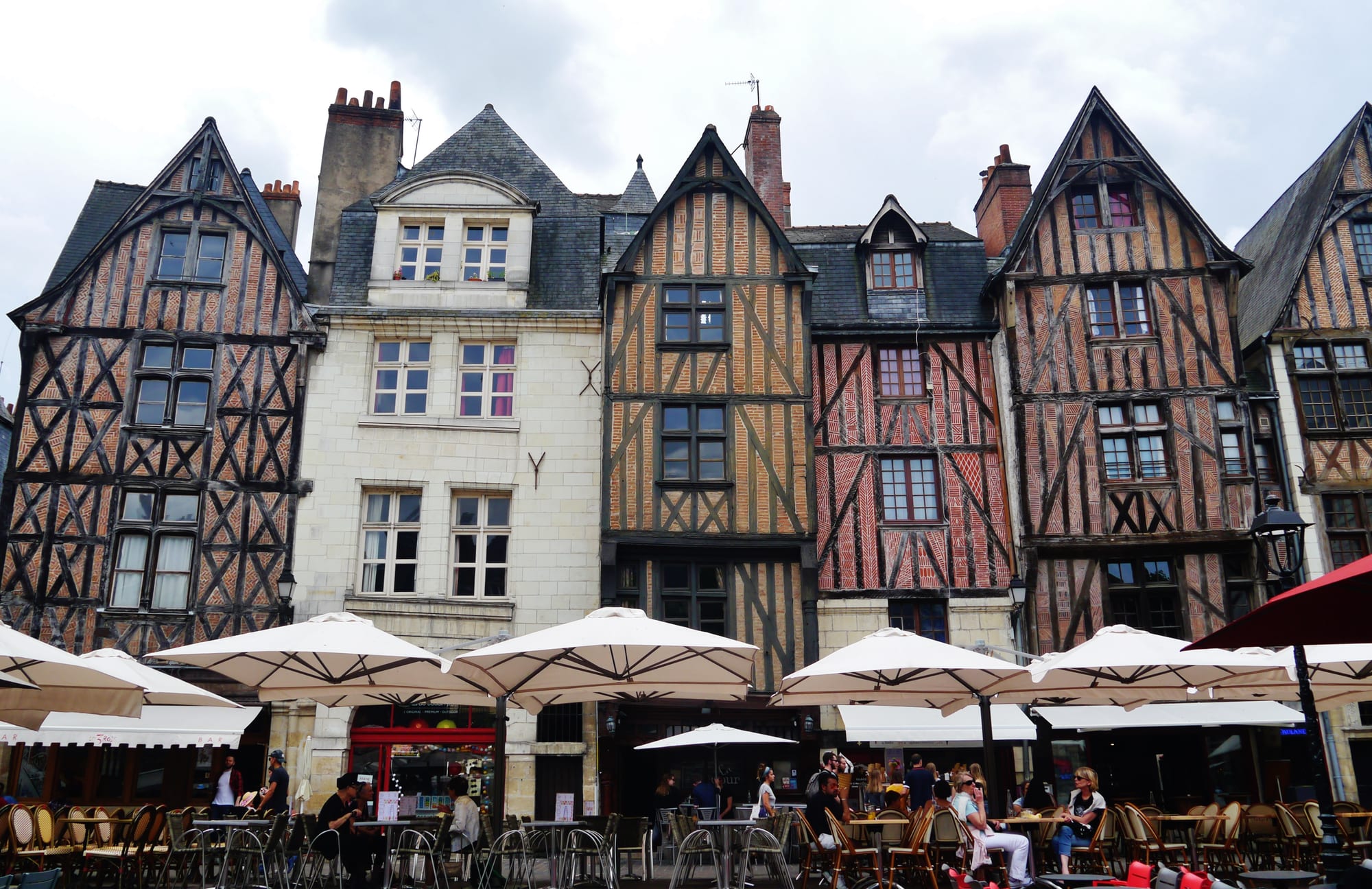
A row of tall timber-framed houses with steep slate roofs above white café umbrellas and terrace tables on Place Plumereau

The Loire Valley & Atlantic Loire, France

Tours

Timber-framed houses and café terraces on Place Plumereau in the old town of Tours. (Zairon / Wikimedia Commons · CC BY-SA 4.0)

The largest city of Centre-Val de Loire, set between the Loire and the Cher — the Roman Caesarodunum, the shrine of Saint Martin and for a time the home of the French court. Half-timbered streets around Place Plumereau, a Gothic cathedral and a large university give it a busy, young feel, and fast trains make it the usual base for the châteaux.

Neighbourhoods

  • Vieux-Tours and Place Plumereau
    • First-time visitors
    • Historic district
    • Nightlife

    The mostly pedestrian medieval quarter west of the Rue Nationale, grown up around the old abbey of Saint Martin. Timber-framed houses frame Place Plumereau, whose café and bar tables fill the square in fine weather, and the Halles market and the remains of the old basilica are a few streets away.

    Open in Maps
  • The cathedral quarter
    • Museums
    • Best for food
    • Quiet streets

    The eastern core around Saint-Gatien cathedral, the old archbishops' palace that holds the fine arts museum and the remains of the Roman amphitheatre. Rue Colbert is lined with restaurants of many cuisines, and the streets east of the cathedral are quiet.

    Open in Maps
  • Rue Nationale and the station
    • Shopping
    • Close to public transport

    The pedestrianised main street, rebuilt after the destruction of 1940, runs south from the Loire bridge to Place Jean-Jaurès and the town hall, with the tram running along it. The main station and the conference centre are a few minutes east.

    Open in Maps
  • Les Prébendes
    • Quiet and residential
    • Parks

    A 19th-century district south of the centre that grew as the city expanded, built around the Jardin des Prébendes d'Oé, a landscaped park admired by the Senegalese poet Léopold Sédar Senghor while he taught in Tours.

    Open in Maps

Things to do

Famous landmarks

  • Tours Cathedrallandmark

    The cathedral of Saint-Gatien, built between 1170 and 1547, with a richly detailed Flamboyant Gothic west front completed as the Renaissance reached Touraine.

    Open in Maps
  • Basilica of Saint Martinlandmark

    A neo-Byzantine church by Victor Laloux, built between 1886 and 1924 over the tomb of Saint Martin on part of the site of the great medieval basilica demolished in the Revolution.

    Open in Maps
  • Charlemagne Towerlandmark

    One of two surviving towers of the medieval basilica of Saint Martin, named by legend after Charlemagne's wife Luitgard, who died in Tours in 800.

    Open in Maps
  • Tour de l'Horlogelandmark

    The other remnant of the old basilica on the Rue des Halles, once the Treasury Tower, renamed after a clock was put at its top during the Revolution.

    Open in Maps
  • Tours Amphitheatrelandmark

    A Roman amphitheatre of the 1st century behind the cathedral, enlarged in the 2nd century into one of the largest in the empire and rediscovered in 1855 from the curve of the streets above it.

    Open in Maps
  • Château de Tourslandmark

    What remains of the riverside castle of the counts and kings, listed in 1913, now used for exhibitions of painting and photography.

    Open in Maps

Museums

  • Musée des Beaux-Arts de Toursmuseum

    A sizeable painting collection, including two Mantegna panels, in the former archbishops' palace beside the cathedral; its grounds have a listed cedar of Lebanon and Fritz, a stuffed elephant from a Barnum & Bailey circus that visited Tours in 1902.

    Open in Maps
  • Hôtel Goüinmuseum

    A grand town house, or hôtel particulier, named after the Goüin family of Breton bankers who bought it in 1738, and now home to the Goüin Museum.

    Open in Maps
  • Musée du Compagnonnagemuseum

    A museum of the French craft guilds, the compagnons, at the river end of the Rue Nationale.

    Open in Maps

Parks and the river

  • Jardin botanique de Tourspark

    The city's oldest public garden, founded by public subscription in 1843, with about 2,000 plant taxa, an English-style arboretum, an orangery and greenhouses.

    Open in Maps
  • Jardin des Prébendes d'Oépark

    A landscaped 19th-century park at the heart of the Prébendes district, a quiet green space south of the centre.

    Open in Maps
  • The Loire bankstrail

    Paths on both banks of the river from the Wilson bridge, part of the Loire à Vélo cycle route, with open-air guinguettes in summer.

    Open in Maps

Markets

  • Les Halles de Toursmarket

    The covered market hall in the old town, full of fresh produce, cheese, charcuterie and other local food.

    Open in Maps
  • Boulevard Béranger marketsmarket

    The tree-lined boulevard crossing the Rue Nationale at Place Jean-Jaurès, where weekly markets and fairs are held.

    Open in Maps

Short trips from the city

  • Priory of Saint-Cosmelandmark

    An 11th-century priory on a former Loire island just west of the city, where the poet Ronsard spent his last twenty years, now a museum devoted to him.

    Open in Maps
  • Château de Plessis-lès-Tourslandmark

    The surviving wing of Louis XI's favourite residence in La Riche, where the king died in 1483; the room where he died can be visited.

    Open in Maps
  • Marmoutier Abbeylandmark

    The site of an early monastery on the right bank of the Loire, later an influential Benedictine abbey whose abbots included Alcuin.

    Open in Maps
  • Vouvrayattraction

    A wine village about 9 km east of the centre, best known for white wines rated among the best in France.

    Open in Maps
  • Château de Villandrylandmark

    A Renaissance country house west of the city, known above all for its gardens.

    Open in Maps
  • Château d'Azay-le-Rideaulandmark

    Built between 1518 and 1527 on an island in the Indre, one of the foremost examples of early French Renaissance architecture.

    Open in Maps
  • Château de Chenonceaulandmark

    The château spanning the river Cher, built in 1514–1522 and extended across the water with a bridge and gallery, one of the best-known of the Loire.

    Open in Maps

Seasonal events

  • Aucard de Toursearly June

    A festival of current music organised by the local station Radio Béton, which outgrew its original island site and now fills the Parc de la Gloriette.

  • Fêtes musicales de TouraineJune

    A chamber music festival held in the medieval barn of the Grange de Meslay, north of the city.

  • Tours sur Loiresummer

    A guinguette with music and events on the banks of the Loire, running through the summer since 2022.

  • Garlic and basil fairlate July

    The Foire à l'ail et au basilic, a traditional one-day fair of garlic and basil sellers in the city.

  • Paris–ToursOctober

    A one-day classic cycle race from the outskirts of Paris to Tours, first run in 1896 and long known as a sprinters' classic.

Eat and drink

Long-standing places and food districts in Tours. Hours, ratings and directions come from your maps app, always current.

Tours classics

  • Les Halles de Toursmarket

    The covered market, the place to buy rillettes, Sainte-Maure goat's cheese, charcuterie and Touraine wines.

    Open in Maps
  • Rue Colbertneighborhood

    The old street running east towards the cathedral, one of the city's two main eating streets, with French restaurants beside Iranian, Turkish, Japanese, Italian and other kitchens.

    Open in Maps

Cafés and bars

  • Place Plumereauneighborhood

    The old-town square whose terraces of cafés and bars fill the whole space in good weather, the centre of student nightlife.

    Open in Maps
  • Guinguettes on the Loireneighborhood

    Open-air riverside bars with music and dancing on the Loire banks in summer.

    Open in Maps

Experience Tours

History

Tours began as a crossing point on the Loire in Gallic times. Under Rome it became Caesarodunum, the 'hill of Caesar', with an amphitheatre that grew into one of the largest in the empire; in the 4th century the town took the name of the Turones, the local people. Martin, its bishop from 371, made it one of the great shrines of Western Christianity, a stop on the pilgrim road to Santiago de Compostela, and in the 6th century Gregory of Tours wrote his Ten Books of History here. Alcuin of York made the abbeys of Tours a centre of the Carolingian Renaissance. Vikings sacked the city in 852.

Medieval Tours was two rival towns: the old episcopal city around the cathedral in the east and Châteauneuf, the merchant quarter around Saint Martin's abbey in the west, joined only in the 14th century. Louis XI made it the capital of France from his château at Plessis and introduced silk weaving, and the court lived in Touraine from about 1430 to 1530. The Wars of Religion damaged the city, and the court's return to Paris began a long decline.

The railway revived Tours as a junction in the 19th century. It was briefly the seat of government in 1870 and again in June 1940; 25,000 American soldiers were based here in 1917, and the Congress of Tours founded the French Communist Party in 1920. German incendiary bombs started a fire that destroyed part of the centre in June 1940, and Allied raids in 1944 killed several hundred around the station. Jean Royer, mayor for 36 years, rebuilt the Rue Nationale, saved the old town with one of France's first conservation areas and pushed the city south by diverting the Cher.

Culture & Customs

For centuries the people of Tours, the Tourangeaux, were said to speak the purest French in the country, because the court lived in Touraine from 1430 to 1530; a Council of Tours in 813 had already told priests to preach in the people's languages rather than Latin. Honoré de Balzac was born in Tours and set stories in its cathedral close, and the painter Jean Fouquet and the poet Yves Bonnefoy were also born here. The city calls itself the garden of France, and its pale stone and blue slate roofs earned it the nickname of the white and blue city.

Religion has shaped it deeply. Saint Martin's tomb still draws pilgrims to the basilica, and in the 19th century Tours became a centre of devotion to the Holy Face, with an oratory that receives many visitors each year. Music has a strong place too: the Florilège Vocal is an important international choral competition, the Fêtes musicales bring chamber music to the barn at Meslay each June, and Radio Béton's Aucard festival fills a park with current music.

With more than 30,000 students, the university founded in 1970 on the riverbank in the centre keeps the old town young, and Place Plumereau's terraces are the city's meeting place. Sport means the Paris–Tours cycle race each October and volleyball; the historic football club, Tours FC, was dissolved in 2025 after 106 years.

Daily Life

The commune had 138,668 inhabitants in 2022 and the metropolitan area about 526,000, making Tours the largest city of Centre-Val de Loire, although Orléans is the regional capital. The economy is mostly services — administration as the prefecture of Indre-et-Loire, hospitals, the university, retail and a busy conference centre designed by Jean Nouvel — and the air base at the airport adds a military presence. Fast trains put Paris under an hour away.

Many residents live in the old centre between the two rivers, in the 19th-century streets of the Prébendes, in Tours-Nord across the Loire or in the newer southern districts built on the land gained by moving the Cher in the 1970s, as well as in suburbs such as Joué-lès-Tours and Saint-Pierre-des-Corps. The tram that opened in 2013 ties north and south together, a second line has been under construction, and in 2025 the city felled about 800 elms along two streets to make way for it, despite opposition.

The day follows a provincial rhythm of morning markets, a proper lunch and quiet Sundays, broken by students in term and visitors in summer. Since 2022 the summer guinguette on the riverbank has become a regular evening outing, and the Loire paths fill with cyclists and joggers.

Food

Tours is known for rillettes, made by seasoning pork, cooking it slowly in its fat for hours, shredding it and packing it under fat, to be spread on bread at room temperature; Tours, Le Mans and Anjou are notable sources. Rillons are the city's other pork speciality, and nougats are among its sweets. The cheese is Sainte-Maure de Touraine, an unpasteurised goat's cheese shaped like a log, rolled in wood ash and pierced lengthways by a straw.

The vineyards of Touraine surround the city. Vouvray, just upstream, is best known for white wines rated among France's best, and the region's red wines come from the Cabernet Franc of Chinon and Bourgueil further west. Wine with lunch is ordinary here, and the Halles de Tours, the covered market in the old town, is the place to find local cheese, charcuterie and wine under one roof.

Eating out centres on two streets. Place Plumereau's terraces serve food and drinks under the timber-framed houses, and Rue Colbert near the cathedral mixes French restaurants with Iranian, Turkish, Japanese and Italian ones. In summer, guinguettes on the Loire banks add music, dancing and simple food by the water.

Planning tools

Budget

Tours is moderately priced for a French city, with good-value hotels near the station and set lunch menus across the centre. The costs that mount are château admissions and the car or bicycle hire needed to reach most of them; staying in the city and using trains, shuttles or bicycles keeps them down. Rooms are busiest in summer and during large conferences.

Daily Budget Midrange
USD 150–270 (central hotel, restaurant dinners with Touraine wine, museum and château entries, a hire car on some days)
Daily Budget Shoestring
USD 70–110 (hostel or budget hotel, market picnics and lunch menus, trams, regional trains and a hired bicycle)

The city's Carte Multi-visites covers several municipal museums, and walking the old town and the Loire banks costs nothing.

Best Time to Visit

May, June and September give long days, open châteaux and gardens without the peak crowds. July and August are hot and busy, but the riverbanks are at their liveliest. October brings the grape harvest nearby and the finish of Paris–Tours. Winters are mild for the latitude, quieter and cheaper, though smaller sites around the city cut their hours.

Suggested Number of Days

Two or three days cover the city itself. Most visitors stay longer and use Tours as a base for the surrounding châteaux, gardens and wine villages; allow five days to a week for that, and more without a car.

First Visit
2–3 days
With Surroundings
5–7 days

Transportation

The centre is walkable and the Fil Bleu network covers the rest: a tram line opened in 2013 runs about 15 km north to south from Tours-Nord through the centre to Joué-lès-Tours, alongside dozens of bus lines on the same ticket, and a second tram line has been under construction. Tours lies on the Loire à Vélo route and has bike hire. Regional trains reach Amboise, Chenonceau and other towns; many châteaux need a car, a seasonal shuttle or a bicycle.

Validate a tram or bus ticket every time a vehicle is boarded, transfers included; inspections are frequent.

Airport & Station Connections

TGVs from Paris take under an hour, and Charles de Gaulle Airport is about an hour and a half by direct TGV. The central Gare de Tours is a terminus, so most through TGVs stop only at Saint-Pierre-des-Corps on the edge of the city, with shuttle trains into the centre; Bordeaux is about 1 hour 40 minutes away. Tours Val de Loire Airport, 5 km north-north-east of the centre, has a small number of flights. The A10, A85 and A28 motorways meet here.

Walkability

The historic centre between the Loire and the station is flat and compact: the old town, the cathedral quarter and the Rue Nationale are all within a short walk of each other, and much of the old town is pedestrianised. The riverside paths are good for longer walks. Tram rails on the main streets need care on a bicycle.

Safety

France is a safe country overall, with violent crime against visitors uncommon. Tours is a calm city by day; the main risks are pickpocketing in crowds and at the station, bicycle theft, and noise and occasional trouble around the bars of the old town late at night. The Loire is dangerous for swimming.

Lock bicycles securely, keep bags closed on busy squares, and do not swim in the Loire, whose currents and shifting sandbanks make it dangerous. Check current official travel advice before travelling.

Climate

Oceanic, and very mild for its latitude: Atlantic air keeps winters gentle, while the inland position brings frequent summer days of 25°C or more. At the nearest weather station, at Fondettes, the annual mean is 11.9°C and about 725 mm of rain falls a year; the record high there is 40.5°C, in July 2019.

Summer
warm, with frequent days of 25°C or more and occasional heatwaves
Winter
mild for the latitude, kept gentle by Atlantic air; the record low at Fondettes is −14.8°C, in January 2009

Local Customs

Touraine prides itself on speaking the purest French, the legacy of a court that lived here for a century, and a 'bonjour' on entering any shop is expected. Service is included in restaurant bills, so tipping is modest. Lunch is taken seriously, and many small shops close on Sundays. As a university city with tens of thousands of students, the old town is lively late into the evening.

Dress respectfully and keep quiet in the cathedral and the basilica, where the tomb of Saint Martin still draws pilgrims; drinking wine with meals is normal, public drunkenness is frowned upon.

Common Payment Methods

The currency is the euro. Cards and contactless payment are accepted almost everywhere, including at tram-stop ticket machines; bus drivers sell tickets for cash only. A little cash is useful for market stalls and small bakeries.