💰 Budget
Orléans is a moderately priced provincial city, cheaper than Paris for rooms and meals. The fixed-price lunch menu is the best value. Costs rise with day trips to the châteaux, each charging admission, and with car hire for the ones the train does not reach; rooms are in more demand during the Joan of Arc festival in early May.
- Daily Budget Midrange
- USD 150–260 (central hotel, restaurant dinners with wine, museum and château entries, a hire car for a day)
- Daily Budget Shoestring
- USD 70–110 (hostel or budget hotel, bakery and market food, tram tickets, one château a day by regional train)
Rooms are best booked early for the Joan of Arc festival in early May.
📅 Best Time to Visit
May, June and September are the best months — long days, gardens in flower and room at the châteaux. Early May brings the Joan of Arc festival, and the Festival de Loire fills the quays in late September every second year. July and August are the warmest and sunniest months. Winters are grey and damp, but the museums and the cathedral are quiet.
⏳ Suggested Number of Days
One or two days cover the city itself. Allow three or four to use it as a base for the châteaux and abbeys along the river, and longer for anyone travelling without a car, as several of them need a shuttle or a bicycle.
- First Visit
- 1–2 days
- With Surroundings
- 3–4 days
🚆 Transportation
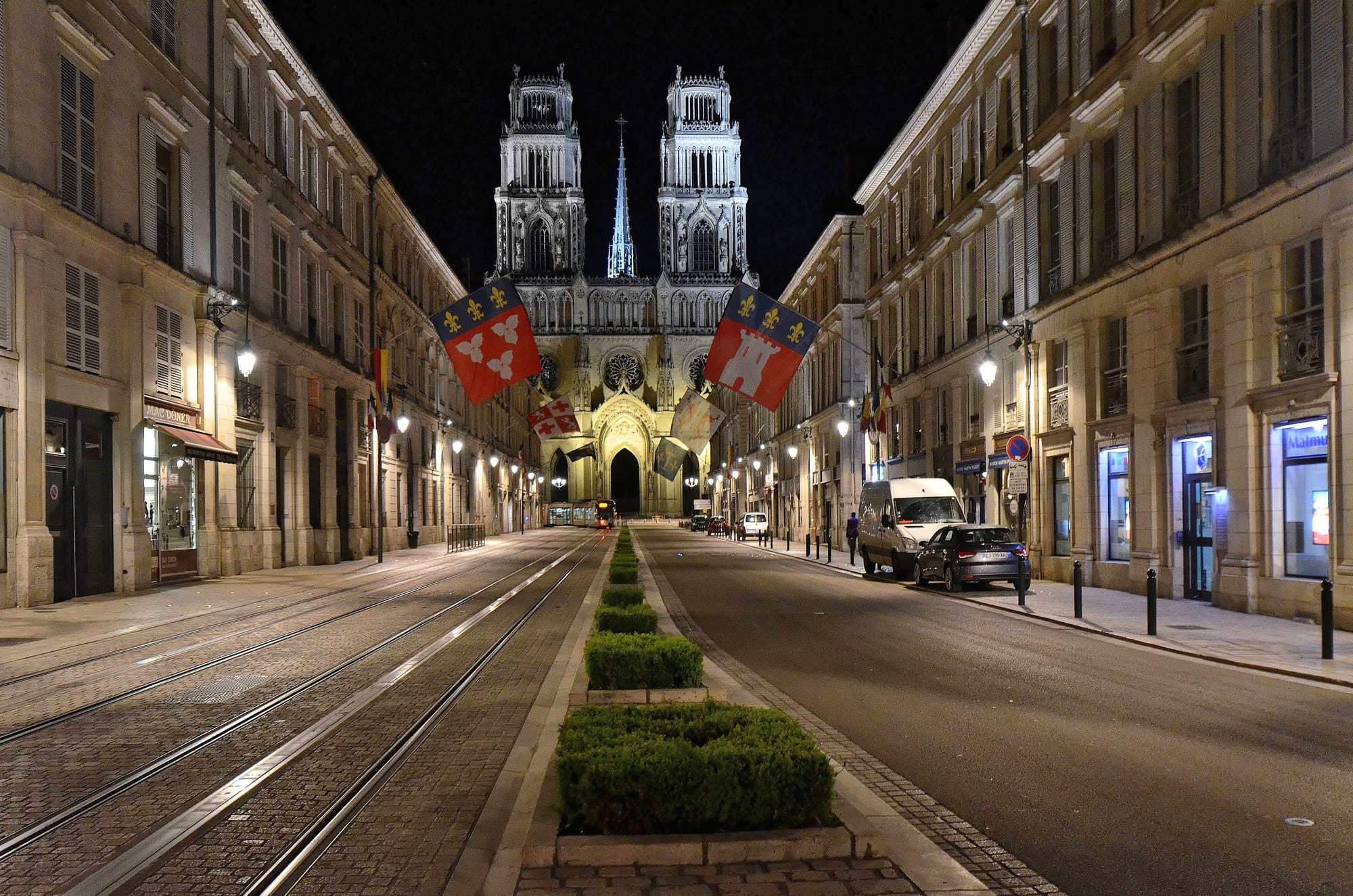
The centre is walkable, and two tram lines run by TAO, inaugurated in 2000 and 2012, cross it — one north to south from Fleury-les-Aubrais over the George V Bridge to La Source and the university, the other east to west. Buses, bike rental and park-and-ride complete the network, and the same tickets work on trams and buses. A car is useful for the châteaux, and the Loire à Vélo cycle route follows the river.
The city's trams and buses are poorly covered by some online map apps, so check routes on the local operator's information instead.
🛬 Airport & Station Connections
Orléans is about 120 kilometres south-west of Paris. Trains from Paris Austerlitz serve the central Gare d'Orléans, but most long-distance trains stop only at Les Aubrais-Orléans in the northern suburbs, which is linked to the centre by tram and connecting trains. The local airport serves mainly business aviation and freight, so international travellers fly to Paris Charles de Gaulle or Orly and continue by train or car. The A10 and A71 motorways meet here.
🚶 Walkability
The historic centre, which matches the area enclosed by the boulevards that replaced the ramparts, is compact and largely pedestrianised around the cathedral and the Rue de Bourgogne, and the river quays make an easy walk. La Source, with the Parc Floral and the university, is about 10 kilometres south and needs the tram.
🛡️ Safety
France is a safe country overall, with violent crime against visitors uncommon. Orléans is a calm provincial city; the usual care is needed at night around the station and in the bar streets. The Loire itself is the main hazard: its current runs fast over the shallows and its bed is scattered with sandbanks.
Do not swim in the Loire, keep valuables out of sight in parked cars, and check for strike action before travel days. Check current official travel advice before travelling.
🌦️ Climate
An oceanic climate like much of central France, with rain spread evenly through the year, about 635 millimetres annually, and around 1,820 hours of sunshine. Summer is the sunniest season, and the winter months are humid and the least sunny.
- Summer
- warm — July and August average 19.7°C, with afternoon highs around 26°C, and heatwaves have reached 41.3°C
- Winter
- cool and damp — January averages 4.4°C, with nights around 2°C
🤝 Local Customs
Greeting shopkeepers with 'bonjour, madame' or 'bonjour, monsieur' on entering matters, and meals are not rushed. Service is included in restaurant prices, so tipping is modest — rounding up or leaving a few euros for good service. The city is proud of its link with Joan of Arc, and the May festival is a civic and religious occasion as well as a party.
Dress modestly and keep voices low inside the cathedral and churches, and avoid photographing services in progress.
💳 Common Payment Methods
France uses the euro. Cards and contactless payment are accepted almost everywhere, including at tram ticket machines, and cash machines are easy to find in the centre. A little cash is useful at markets and small bakeries.