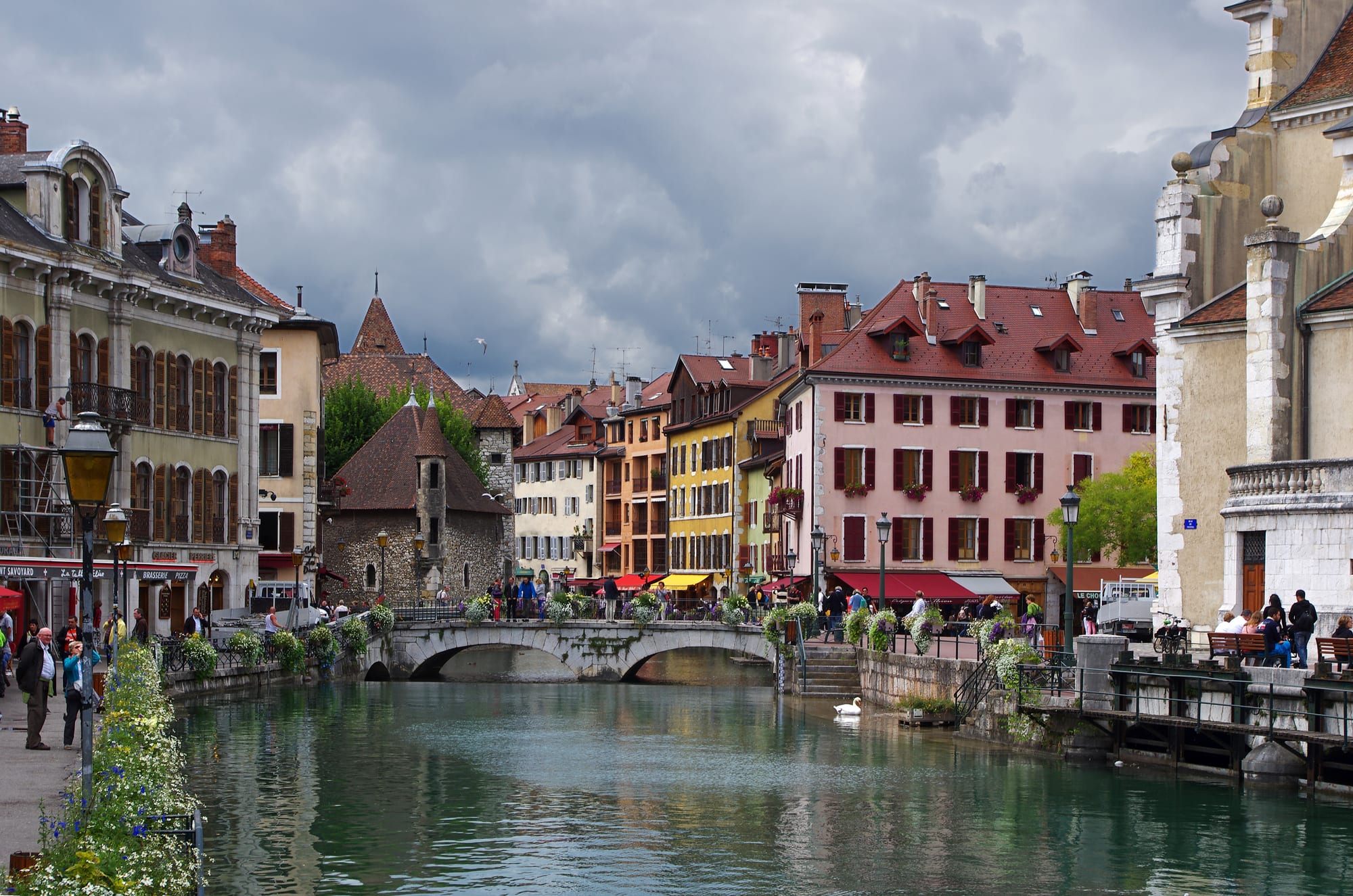
A green canal with a stone arched bridge, a small turreted stone castle on an island and a row of colourful old houses under grey clouds

Auvergne-Rhône-Alpes: Lyon & the French Alps, France

Annecy

The Thiou in Annecy's old town, with the Pont Perrière and the Palais de l'Isle. (Daniel Jolivet / Wikimedia Commons · CC BY 2.0)

The prefecture of Haute-Savoie, on the northern tip of Lake Annecy about 35 km south of Geneva. Once the court of the counts of Geneva and a Catholic stronghold of the Counter-Reformation, it grew on silk and other mills along the Thiou; today its canal-lined old town, castle and lake make it a major tourist destination.

Neighbourhoods

  • Vieille Ville
    • First-time visitors
    • Historic district
    • Best for food

    The old town, crossed by the Thiou and three canals, where most of the monuments are: the Palais de l'Isle, the cathedral and the castle above. Arcaded streets, passages and small bridges are lined with restaurants and shops, and the main markets fill its streets several mornings a week.

    Open in Maps
  • The lakefront and Le Pâquier
    • Parks
    • Swimming
    • Walks

    A broad 4.5-hectare lawn on the shore with an open view across the lake, the Jardins de l'Europe beside it and the 1907 Pont des Amours over the Vassé canal. Lakeside promenades run east along the Avenue d'Albigny towards the beaches.

    Open in Maps
  • Town centre and station
    • Close to public transport
    • Shopping

    The modern centre between the old town and the railway station, with the bus station, shopping streets and the Bonlieu cultural centre, home of the animation festival. Former factory land near the station is being rebuilt as a new eco-district.

    Open in Maps
  • Annecy-le-Vieux
    • Quiet and residential
    • Lake access

    A former commune on the north-eastern shore of the lake, merged into Annecy in 2017, long a residential suburb less than 3 km from the centre.

    Open in Maps

Things to do

Old town landmarks

  • Palais de l'Islelandmark

    A 12th-century castle on an island in the Thiou, used mainly as a prison and courthouse until the Revolution and again as a prison in the Second World War, now a museum of local history.

    Open in Maps
  • Château d'Annecymuseum

    The castle of the counts of Geneva and the dukes of Genevois-Nemours, dominating the old town, bought and restored by the town and now its museum.

    Open in Maps
  • Annecy Cathedrallandmark

    The cathedral of Saint-Pierre, built in the early 16th century as a Franciscan chapel, used as a temple of Reason in the Revolution and made a cathedral in 1822.

    Open in Maps
  • Pont des Amourslandmark

    An iron footbridge of 1907 over the Vassé canal, linking the Jardins de l'Europe to Le Pâquier, with views down the lake.

    Open in Maps

The lake and mountains

  • Lake Annecybeach

    France's third-largest lake if the French shore of Lake Geneva is excluded, about 14 km long, known for its swimming and water sports; the town has free public beaches.

    Open in Maps
  • Thiouattraction

    The lake's outflow river, which runs through the old town between the houses and powered the mills that industrialised Annecy.

    Open in Maps
  • Semnozviewpoint

    The 1,702-metre mountain of the Bauges range rising above the town, crossed by a road that climbs close to its summit.

    Open in Maps

Short trips from the town

  • Château de Menthon-Saint-Bernardlandmark

    A medieval castle on a 200-metre rock about 12 km south of Annecy, its towers looming over the lake and the Roc de Chère nature reserve.

    Open in Maps
  • Talloiresattraction

    A lakeside village that has long been a resort, merged in 2016 into the commune of Talloires-Montmin.

    Open in Maps
  • Aix-les-Bainsattraction

    The lakeside spa town on the Lac du Bourget, the largest natural lake in France.

    Open in Maps

Seasonal events

  • Annecy International Animation Film Festivalearly June

    One of the oldest festivals in France, created in 1960 and annual since 1998, drawing about 100,000 visitors.

  • Fête du Lacfirst weekend of August

    The lake festival held since 1965, with shows around the lake and a large firework display watched from temporary stands on Le Pâquier.

Eat and drink

Long-standing places and food districts in Annecy. Hours, ratings and directions come from your maps app, always current.

Food districts and markets

  • Old town marketsmarket

    Annecy has held its market on Tuesday mornings since the 12th century; food stalls fill the old town on Tuesday, Friday and Sunday mornings, selling Savoy cheeses, charcuterie, fruit and vegetables.

    Open in Maps
  • Vieille Ville restaurantsneighborhood

    The canal-side streets of the old town are lined with restaurants, many serving Savoyard cheese dishes such as fondue and tartiflette.

    Open in Maps

Experience Annecy

History

There was a settlement at the lake's outflow in Roman times, but the town grew from the 10th century as the court of the counts of Geneva, whose castle still stands above the old town. It passed to the counts of Savoy in 1401 and became the seat of the Genevois-Nemours branch of the dynasty, which lasted until 1659. When Geneva turned Calvinist, the bishop of Geneva moved here, and in 1535 the bishopric was transferred to Annecy, making it a centre of the Counter-Reformation. Francis de Sales served as bishop from 1602 to 1622, and the young Jean-Jacques Rousseau spent time in the town.

During the French Revolution Savoy was conquered by France and Annecy attached to the department of Mont Blanc, with its capital at Chambéry; the diocese was suppressed in 1801. Restored to the kingdom of Piedmont-Sardinia in 1815, the town used the water power of the Thiou for mills making silk, linen and cotton goods, glass, cutlery and paper, and it became French with Savoy in 1860.

In the Second World War the Allies bombed the town three times, aiming at its ball-bearing factory, and it was freed by the Resistance fighters of the Glières maquis. The animation festival began in 1960 and the Fête du Lac in 1965, and tourism grew around the lake and the nearby ski resorts. A magnitude 5.25 earthquake centred on Épagny damaged buildings in 1996. In 2017 Annecy merged with five neighbouring communes, among them Annecy-le-Vieux, Cran-Gevrier and Seynod.

Culture & Customs

The town has been called the "Pearl of the French Alps", a phrase from the geographer Raoul Blanchard, and, for its canals and the Thiou running between the houses, the "Venice of the Alps". The image is carefully kept: flowers along the canals, the restored castle with its museum, the Palais de l'Isle on its island and a lakeshore of lawns and promenades.

Animation is Annecy's international calling card. Its film festival, created in 1960 and annual since 1998, is one of the oldest festivals in France, and each June it fills the Bonlieu cultural centre and the town with studios, students and film lovers, attracting about 100,000 visitors; a Cité internationale du cinéma is planned for the former national stud farm. The Fête du Lac draws as many people on the first weekend of August, when fireworks are set off over the water.

Religion has left a strong mark — Francis de Sales remains the town's best-known figure — and so has Savoy, whose separate history and cheese-based cooking are a matter of pride. Life is lived outdoors: swimming, rowing, sailing and wakeboarding on the lake, cycling round it, and skiing in the nearby resorts. The Tour de France has started stages here, among them in 2009 and 2018.

Daily Life

The old commune of Annecy had about 50,000 people for decades, hemmed in by the lake and the protected Semnoz mountain; the 2017 merger raised the city's population to about 128,000, and the urban area had about 187,000 inhabitants in 2023. Most people live in the former communes around the old centre, in Annecy-le-Vieux, Seynod, Cran-Gevrier, Meythet and Pringy.

The economy mixes tourism with a strong industrial base: the bearing maker NTN-SNR, Salomon, Mavic, Fusalp, the cheese company Entremont and Dassault Aviation all have headquarters or major sites here, and Ubisoft has a studio. Former industrial land is being rebuilt: an eco-district of 675 homes is rising on part of the old SNR works, and the 19th-century stud farm is being turned into a public space with a park and a food hall.

The rhythm follows the seasons. Summer brings crowds to the old town and the beaches, while autumn and winter return the town to its residents, who use the Sibra buses, the cycle paths along the lake and the seven markets, the oldest of them held on Tuesday mornings since the 12th century.

Food

Annecy eats the food of Savoy. Reblochon, a soft, washed-rind cheese made from raw cow's milk, was first made in the Thônes and Arly valleys of the Aravis massif, and Thônes remains the centre of production; it is the key to tartiflette, a dish of potatoes, Reblochon, lardons and onions, sometimes with a splash of white wine, inspired by an older gratin called péla and often eaten after a day's skiing. Fondue, melted cheese and wine in a communal pot into which bread is dipped on long forks, is the other great cheese dish.

Diots, Savoy pork and vegetable sausages, are most often boiled in white wine with garlic and onions and served with polenta or crozets, small square flat pasta of buckwheat or wheat. The nearby Bauges mountains make Tome des Bauges, a tomme cheese.

The markets are the best place to find these products: food stalls fill the old town on Tuesday, Friday and Sunday mornings, and producers sell their own goods on Sunday mornings in the Novel-Teppes district. In the evenings the canal-side restaurants of the old town serve Savoyard dishes to visitors and locals alike.

Planning tools

Budget

Annecy is expensive in summer, when rooms near the lake and the old town are in heavy demand, and cheaper in spring and autumn. Free public beaches, lakeside walks and the markets keep daily costs reasonable, and a bike is the cheapest way to get around.

Daily Budget Midrange
USD 160–290 (mid-range hotel, restaurant meals, a boat trip, museum tickets)
Daily Budget Shoestring
USD 80–120 (hostel bed, market food, free beaches, buses or a hired bike)

A set lunch costs much less than the same food at dinner; the lakefront, the old town and the public beaches cost nothing.

Best Time to Visit

June to September for swimming and the lake. July is extremely busy; September brings fewer people and often clearer air and better mountain views. Early June brings the animation festival and the first weekend of August the Fête du Lac, when rooms are scarce. Winter is quiet, with a Christmas market and the ski resorts within reach.

Suggested Number of Days

Two days are enough for the old town, the castle and time by the water. Four or five allow for the lake villages, the surrounding mountains and a day by bike or boat. Summer swimming weather tempts many visitors to stay longer.

First Visit
2 days
With Surroundings
4–5 days

Transportation

The old town and lakefront are best seen on foot, and cycling is the easiest way to get around; riding round the lake is popular. The Sibra bus network covers the city and its merged communes, and boats run trips on the lake in season. A car is useful for the mountains.

Parking in the centre is limited and charged in most places; leave a car outside the old town.

Airport & Station Connections

Geneva Airport is about 45 km away and Chambéry Airport about 35 km; Lyon's airport is about 125 km. Buses link the town with Geneva, and Léman Express trains reach Geneva in about an hour and a half. The station has trains to Lyon, Paris and Grenoble, and the A41 motorway passes the town.

Walkability

Very walkable: the old town, the castle, the lakefront and the station are all within a short walk of one another, and the promenades along the canals and the lake are among the pleasantest walks in the Alps. The streets around the castle climb steeply.

Safety

France is a safe country overall, with violent crime against visitors uncommon. Annecy is calm; the usual care is needed against pickpocketing in the summer crowds of the old town and the festival. Lake water and mountain weather call for ordinary caution.

Swim at supervised beaches, watch for boats on the open lake, and keep bags closed in crowded old-town streets. Check current official travel advice before travelling.

Climate

A temperate oceanic climate despite the inland position, with rain through the year, warm summers and cold winters; the surrounding mountains receive snow in winter.

Summer
warm, with occasional heat waves — in nearby Geneva the record is 39.7°C, from July 2015
Winter
cold, with frost and some snow — in nearby Geneva the record low is −20°C, from February 1956, and the yearly mean is about 11°C

Local Customs

Greet shopkeepers and waiters with 'bonjour', and keep to French meal times. Service is included, so tipping is a matter of leaving small change. Savoyard identity and its cheese dishes are a source of local pride.

Dress modestly in the cathedral and churches, and keep swimwear to the beaches.

Common Payment Methods

The currency is the euro. Cards and contactless payment are accepted almost everywhere; a little cash is useful at market stalls. ATMs are easy to find.