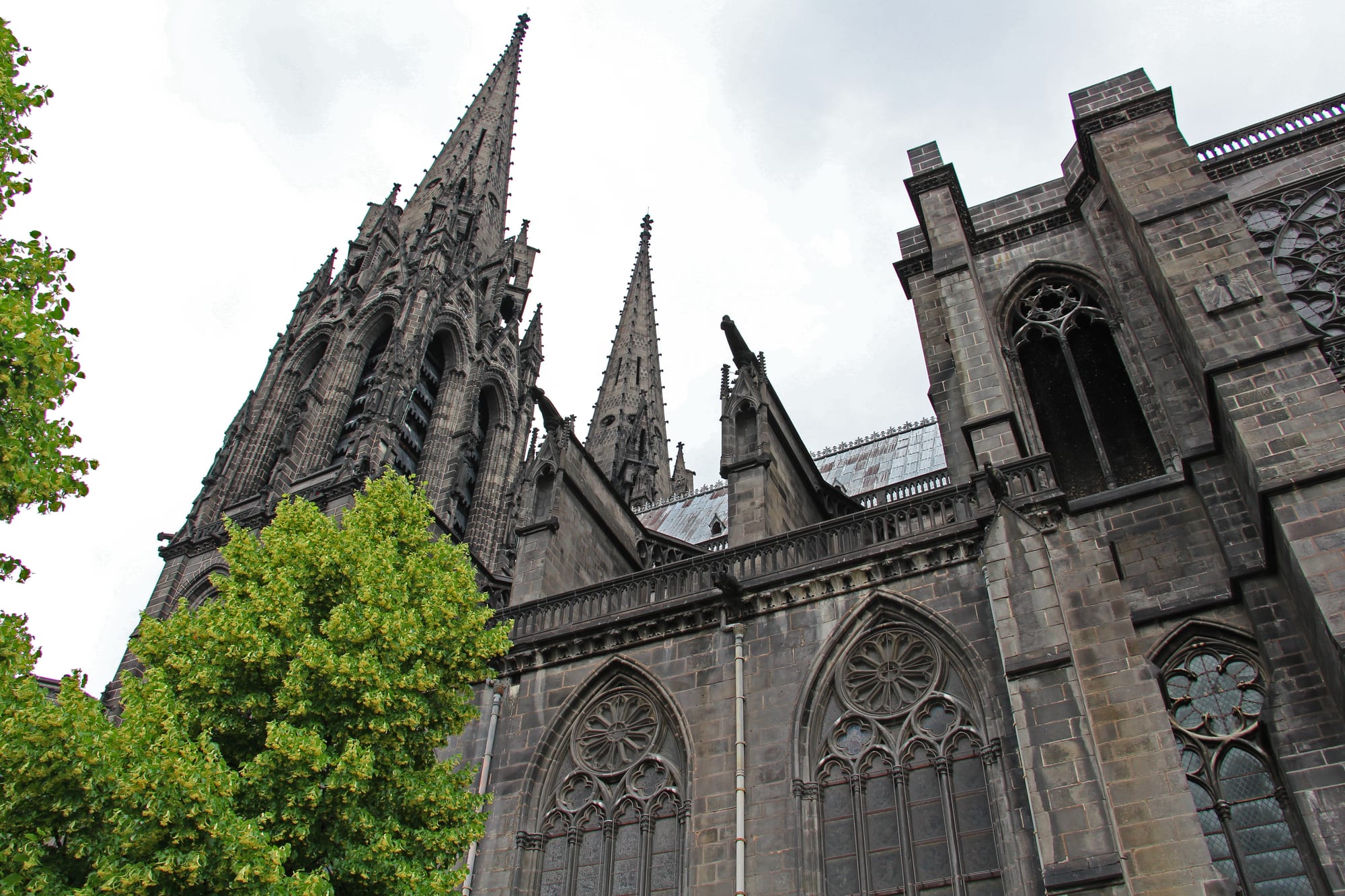
The dark grey stone walls, traceried windows and tall twin spires of a Gothic cathedral rising behind a green tree

Auvergne-Rhône-Alpes: Lyon & the French Alps, France

Clermont-Ferrand

Clermont-Ferrand Cathedral, built in black volcanic stone between 1248 and 1902. (Fred Romero from Paris, France / Wikimedia Commons · CC BY 2.0)

The main city of the Auvergne, on a knoll below the Chaîne des Puys with the Puy de Dôme about 10 km away. A Gaulish and Roman capital where Pope Urban II called the First Crusade in 1095, it was built in dark volcanic stone and later remade by Michelin's factories; today it is a university city with a leading short film festival.

Neighbourhoods

  • Centre ancien
    • First-time visitors
    • Historic district
    • Best for food

    The old town on the knoll where the Gaulish and Roman city stood, crowned by the black cathedral. Place de la Victoire, Place Royale, the covered Saint-Pierre market and steep streets of houses built in dark Volvic stone are all here.

    Open in Maps
  • Jaude
    • Shopping
    • Close to public transport

    The modern heart of the city around Place de Jaude, a large square remodelled in 2006 with Bartholdi's statue of Vercingetorix, the opera theatre, a shopping centre and the tram running through.

    Open in Maps
  • Port quarter
    • Historic district
    • Quiet streets

    The quarter between the cathedral and Place Delille, around the Romanesque basilica of Notre-Dame du Port.

    Open in Maps
  • Montferrand
    • Historic district
    • Rugby

    The former rival town founded by the counts of Auvergne, joined to Clermont by edicts of 1630 and 1731. It keeps its own old centre and a strong identity.

    Open in Maps

Things to do

Famous landmarks

  • Clermont-Ferrand Cathedrallandmark

    A Gothic cathedral built entirely of black lava stone between the 13th and 19th centuries, its twin spires 96 metres tall and visible from far away.

    Open in Maps
  • Basilica of Notre-Dame du Portlandmark

    A Romanesque basilica, rebuilt in the 11th or 12th century and added to the UNESCO World Heritage list in 1998 as part of the Routes of Santiago de Compostela in France; a procession links it with the cathedral.

    Open in Maps
  • Place de Jaudelandmark

    The city's main square, overlooked by Bartholdi's huge statue of Vercingetorix of 1903 and bordered by the opera theatre and the Saint-Pierre-des-Minimes church.

    Open in Maps
  • Fontaine d'Amboiselandmark

    A fountain built between 1511 and 1515 for Jacques d'Amboise, bishop of Clermont.

    Open in Maps

Museums

  • L'Aventure Michelinmuseum

    The museum of the Michelin group's history, opened in 2009 in the city where the tyre company was founded and still has its headquarters.

    Open in Maps
  • Bargoin Museummuseum

    A heritage museum showing mainly archaeological collections and textiles.

    Open in Maps
  • Musée d'art Roger-Quilliotmuseum

    The city's art museum, whose collection includes Paul Huet's painting of Clermont-Ferrand seen from Royat.

    Open in Maps

Parks and sport

  • Jardin Lecoqpark

    The central public garden, once the city's jardin des plantes; the botanical garden it grew from was created in 1781 and moved several times. A place for picnics.

    Open in Maps
  • Stade Marcel-Michelinattraction

    The home ground since 1911 of ASM Clermont Auvergne, the rugby club founded by Marcel Michelin, son of the tyre company's founder.

    Open in Maps

Short trips to the volcanoes

  • Puy de Dômeviewpoint

    A lava dome formed some 10,700 years ago, the highest point of the Chaîne des Puys, about 10 km from the city and visible from its streets.

    Open in Maps
  • Panoramique des Dômestransit hub

    The 5.2-km rack railway that has carried visitors to the summit of the Puy de Dôme since 2012.

    Open in Maps
  • Chaîne des Puyspark

    A volcanic field about 40 km long of cinder cones, lava domes and maars, listed by UNESCO in 2018 as an outstanding example of continental rifting.

    Open in Maps
  • Vulcaniaattraction

    The European Park of Volcanism, an educational theme park and museum opened in 2002, about 15 km north-west of the city.

    Open in Maps
  • Gergoviaattraction

    The plateau of the Arverni's fortified town, where Vercingetorix's Gauls defeated Julius Caesar's legions in 52 BC.

    Open in Maps

Seasonal events

  • Clermont-Ferrand International Short Film Festivallate January to early February

    Founded as a short film week in 1979, now the second largest film festival in France after Cannes by audience, drawing about 160,000 professionals and filmgoers.

  • Jazz en têteOctober

    A jazz festival created in 1988.

  • Christmas marketDecember

    The annual Christmas market fills Place de la Victoire below the cathedral.

Eat and drink

Long-standing places and food districts in Clermont-Ferrand. Hours, ratings and directions come from your maps app, always current.

Food districts and markets

  • Marché Saint-Pierremarket

    The covered food market on Place Saint-Pierre in the old town, the place to buy Auvergne cheeses, charcuterie and produce.

    Open in Maps
  • Old town restaurantsneighborhood

    The streets around the cathedral and Place de la Victoire hold many of the city's restaurants, including those serving Auvergne dishes such as truffade and potée.

    Open in Maps

Experience Clermont-Ferrand

History

The city began on the knoll where the cathedral now stands, as Nemossos, a Gaulish name meaning a sacred forest, the chief town of the Arverni. Vercingetorix was born somewhere in the area around 72 BC, and in 52 BC he drove back Julius Caesar's legions at nearby Gergovia. Under Rome it became Augustonemetum, the "sanctuary of Augustus". It was a bishop's seat by the 5th century, and its castle of Clarus Mons gave the town its name in 848. In 1095 Pope Urban II preached the First Crusade at the Council of Clermont.

Quarrels between the counts of Auvergne and the bishops led the counts to found a rival town, Montferrand, on a nearby mound, and for centuries the two were separate: Clermont the bishop's city, Montferrand the count's. The Edict of Troyes joined them in 1630, a union confirmed in 1731, though Montferrand asked for independence again in 1789, 1848 and 1863. Blaise Pascal was born here in 1623, and his brother-in-law carried a barometer up the Puy de Dôme to test the theory of air pressure.

In the 20th century Michelin, founded in the city by the brothers André and Édouard Michelin, built factories employing up to 30,000 people, and with them came the housing and garden suburbs that finally joined the two old towns. The city featured in The Sorrow and the Pity, the documentary on France under occupation and the Vichy regime. Michelin moved most of its manufacturing abroad but kept its headquarters here, and the city diversified into research and services. A tram line opened in 2006, and in 2026 voters elected Julien Bony mayor, defeating the Socialist incumbent Olivier Bianchi.

Culture & Customs

The look of the city comes from its stone. Volvic stone, a dark basalt from the lava flows of the Chaîne des Puys, was the traditional building material, and the cathedral, built from it between 1248 and 1902, gives the centre its sombre, striking skyline. The Romanesque basilica of Notre-Dame du Port, in lighter stone, was added to the UNESCO World Heritage list in 1998 as part of the Routes of Santiago de Compostela in France.

Film is the city's international calling card. The short film festival, begun as a student film society's week in 1979, is the world's first international short film festival and now the second largest film festival in France after Cannes by attendance. More than twenty other music, film, dance, theatre and digital art festivals are held each year, among them Jazz en tête in October.

Rugby is the great passion. ASM Clermont Auvergne, founded by Marcel Michelin, has played at the Stade Marcel-Michelin since 1911, and the city also hosts a round of the women's world sevens series; Clermont Foot played in the top football league from 2021 to 2024. Bartholdi's statue of Vercingetorix on Place de Jaude, inscribed "I took up arms for the freedom of all", sums up local pride in the Arverni.

Daily Life

About 146,000 people lived in the commune in 2023, and about 511,000 in its metropolitan area. A quarter of the city's population are students, many at the University of Clermont Auvergne, formed in 2017 and counting more than 37,000 students, and there are some 6,000 researchers; it was the first city in France to join UNESCO's network of Learning Cities.

Michelin's headquarters remain the best-known employer, alongside food production and processing, engineering, and research centres of software and pharmaceutical companies. The decline of tyre manufacturing was gradual, and the area has stayed prosperous rather than suffering the fate of many old industrial cities.

The city is organised around Place de Jaude and the old town, with residential districts, the Cézeaux university campus and Montferrand linked to it by the tram. Weekends often mean the volcanoes, a short drive away, or a rugby match. Transport is a recurring issue: the Auvergne is one of the last French regions without a TGV stop, which is not expected before 2030.

Food

Auvergne cooking is hearty country food. Truffade is a thick pancake of thinly sliced potatoes cooked slowly in goose fat and then mixed with strips of tomme fraîche, sometimes with lardons. Potée auvergnate is a one-pot dish of cabbage, carrots and turnips with fresh or salt pork, sausages and half a pig's head, cooked in stock and served as a single course.

The region is cheese country. Saint-Nectaire has been made in the Auvergne since at least the 17th century; Cantal, a firm uncooked cheese, received its AOC in 1956; Bleu d'Auvergne, a cow's milk blue cheese, was developed in the 1850s by Antoine Roussel; and Fourme d'Ambert, a semi-hard blue in a narrow cylinder, is one of France's oldest cheeses, dating back to Roman times.

The covered Saint-Pierre market in the old town is the place to buy them, along with charcuterie and produce, and many of the city's restaurants cluster in the streets around the cathedral and Place de la Victoire.

Planning tools

Budget

Clermont-Ferrand is one of the more affordable cities in France, with moderate prices for rooms and meals. The rack railway up the Puy de Dôme and a hire car for the volcanoes and the countryside are the main extras.

Daily Budget Midrange
USD 140–240 (mid-range hotel, restaurant meals, museums, a hire car or the rack railway)
Daily Budget Shoestring
USD 65–100 (hostel or budget hotel, market food and set lunches, tram and buses)

Lunchtime set menus are much cheaper than dinner; the cathedral, the basilica and the old streets are free to visit.

Best Time to Visit

Late spring to early autumn for the volcanoes and walks in the Chaîne des Puys, though summer can bring heat and violent thunderstorms. The short film festival fills the city at the turn of January and February. Winters are cold, with frequent frost and fog trapped in the valley.

Suggested Number of Days

One or two days are enough for the city itself. Three or four allow time for the volcanoes and the surrounding countryside, ideally with a car; bad weather on the summits can add a day.

First Visit
1–2 days
With Surroundings
3–4 days

Transportation

A single tram line, a rubber-tyred Translohr system opened in 2006, runs north–south through the centre over 15.7 km, backed by buses. The old town is compact and best seen on foot. A car is useful for the volcanoes and villages beyond the city.

The rack railway is the easy way to the summit of the Puy de Dôme; check the weather first, as cloud often covers the top.

Airport & Station Connections

Clermont-Ferrand Auvergne Airport is at Aulnat, about 6 km from the city centre, with mostly domestic flights; the nearest international airport is Lyon–Saint-Exupéry, about 190 km east. Trains run to Paris and to Lyon, Vichy, Le Puy-en-Velay and other regional towns, but there is no TGV line yet. Motorways lead towards Orléans and Bourges, Montpellier, Bordeaux, Lyon and Saint-Étienne.

Walkability

The old town is compact and walkable, though it sits on a knoll, so streets climb to the cathedral. Jaude and the centre ancien are close together, while Montferrand is a tram ride away.

Safety

France is a safe country overall, with violent crime against visitors uncommon. Clermont-Ferrand is generally calm, needing only ordinary care at night and in crowds. On the volcanoes, weather changes quickly and fog can come down on the summits.

Carry warm layers for the Puy de Dôme even in summer, and keep bags closed in festival and market crowds. Check current official travel advice before travelling.

Climate

A rain-shadow climate behind the Chaîne des Puys, one of the driest in France outside the Mediterranean, with colder winters and hotter summers than cities west of the mountains. Temperature inversions often leave the city cold and grey while the summits are sunny.

Summer
hot at times — temperatures sometimes pass 35°C with violent thunderstorms, and the record is 40.9°C, set in 2019
Winter
cold — frost is very frequent from November to March, snow is common but usually light and short-lived, and the record low is −29°C

Local Customs

Greet shopkeepers and waiters with 'bonjour', and keep to French meal times. Service is included, so tipping is a matter of rounding up. Rugby is a passion, and ASM home matches bring the city out; a quarter of the population are students.

Dress modestly in the cathedral and churches, and keep to marked paths on the UNESCO-listed volcanoes.

Common Payment Methods

The currency is the euro. Cards and contactless payment are accepted almost everywhere; a little cash is useful at market stalls. ATMs are easy to find in the centre.