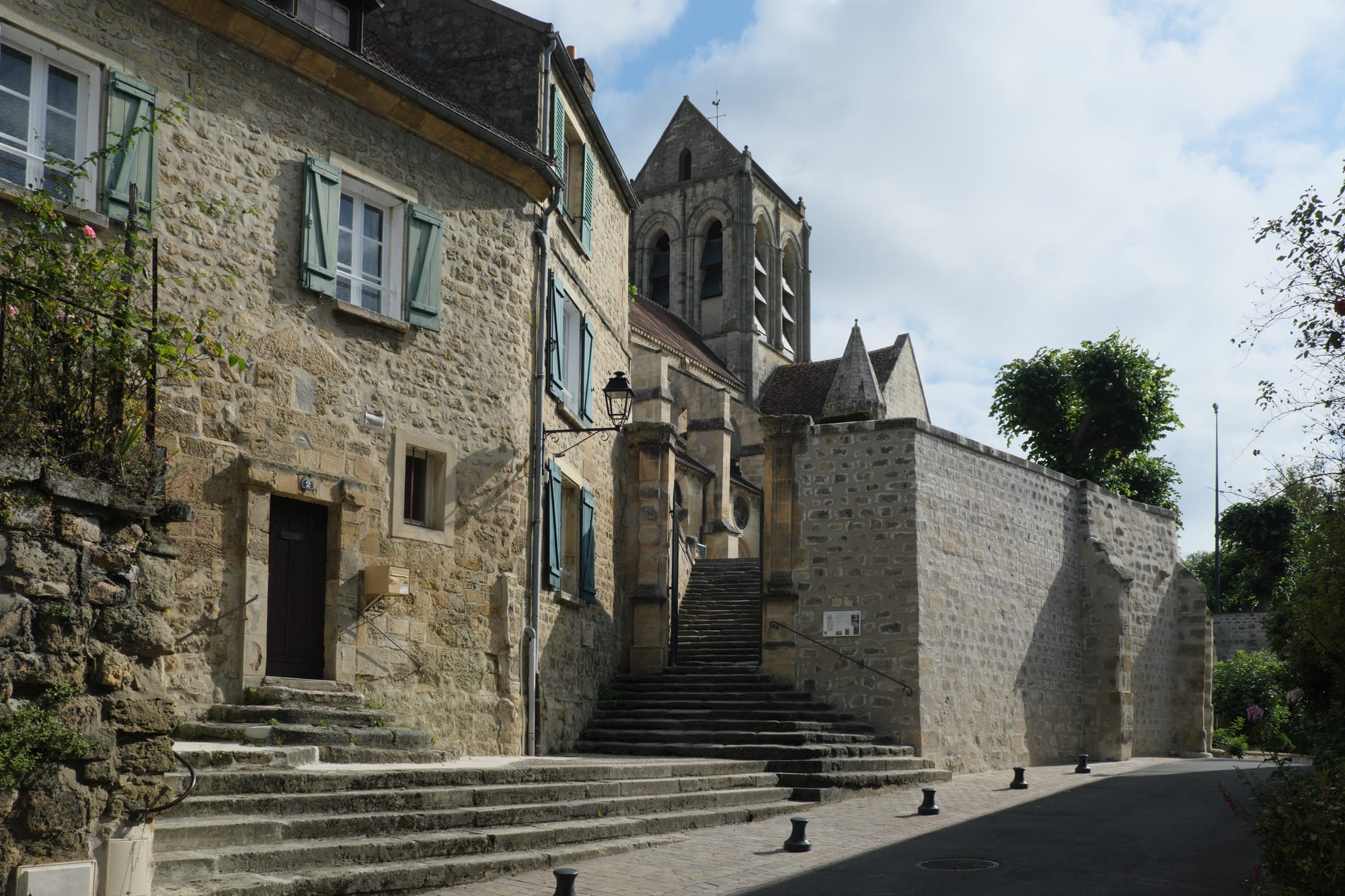
Stone steps between old limestone houses with green shutters climbing to a Gothic church tower

Paris & Île-de-France, France

Auvers-sur-Oise

The stairway from the rue Daubigny up to the church of Notre-Dame-de-l'Assomption in Auvers-sur-Oise. (GFreihalter / Wikimedia Commons · CC BY-SA 4.0)

A village of limestone houses strung along the right bank of the Oise, about 27 kilometres north-west of central Paris. Landscape painters from Daubigny to Cézanne and Pissarro worked here, and Vincent van Gogh spent the last 70 days of his life in an attic room at the Auberge Ravoux. Today it is a quiet commuter commune that draws about 300,000 visitors a year.

Neighbourhoods

  • The village centre
    • First-time visitors
    • Historic district
    • Close to public transport

    The old core where the dry valley of Les Vallées meets the Oise, around the station, the town hall and the rue Daubigny. The Auberge Ravoux, the Daubigny museum and studio and the stone stairways up to the church are all a few minutes apart on foot.

    Open in Maps
  • The church and the plateau
    • Painters' views
    • Walks

    Above the centre the early Gothic church stands on its promontory, and beyond it the road climbs to the cemetery, moved north of the village in 1858, and the open fields of the Vexin plateau that Van Gogh painted in his final weeks.

    Open in Maps
  • Chaponval and the riverside
    • Quiet and residential
    • River walks

    The commune stretches about seven kilometres along the river between the Oise and its limestone cliffs. Chaponval, at the western end, has its own station on the Pontoise line, and much of the narrow strip between the river and the cliffs was built up with houses in the 20th century.

    Open in Maps

Things to do

Van Gogh's Auvers

  • Maison de Van Gogh (Auberge Ravoux)museum

    The Van Gogh house museum, in the building where the painter rented room 5, a seven-square-metre attic lit by one skylight, from May 1890 until his death that July; the bare room has been restored and is open to visitors.

    Open in Maps
  • Église Notre-Dame-de-l'Assomptionlandmark

    A church begun near a royal manor in the late 11th century and rebuilt from 1137 in the shift from Romanesque to Gothic, the subject of Van Gogh's June 1890 painting The Church at Auvers.

    Open in Maps
  • Graves of Vincent and Theo van Goghlandmark

    The two brothers lie side by side against the north wall of the village cemetery, beyond the church; Theo died six months after Vincent, and the painter Corneille is buried a few metres away.

    Open in Maps

Painters' houses and museums

  • Musée Daubignymuseum

    A museum in the Colombières manor, above the tourist office, with works by Charles-François Daubigny, his son Karl and other painters of the Oise valley, plus changing exhibitions.

    Open in Maps
  • Maison-atelier de Daubignymuseum

    The house and studio built for Daubigny in 1861–62 on the rue Daubigny, a listed historic monument; the landscape painter worked in Auvers for some 18 years.

    Open in Maps
  • Château d'Auverslandmark

    A château built in 1633 for an Italian banker above terraced gardens on the rue de Léry, home to a visitor show on the age of the Impressionists.

    Open in Maps
  • Musée de l'Absinthemuseum

    A small museum on the rue Callé telling the story of the green spirit loved by 19th-century artists and banned in France in 1915.

    Open in Maps

Short trips from the village

  • Pontoiseneighborhood

    The departmental capital, about six kilometres away, where Camille Pissarro lived for 17 years; it has medieval lanes, the Saint-Maclou cathedral and a Pissarro museum.

    Open in Maps
  • Royaumont Abbeylandmark

    A former Cistercian abbey near Asnières-sur-Oise, further up the Oise valley.

    Open in Maps
  • Château de Chantillymuseum

    The château of the Princes of Condé, home of the Musée Condé and its collection of paintings, overlooking the Chantilly racecourse and the Great Stables.

    Open in Maps

Seasonal events

  • Festival d'Auvers-sur-OiseMay and June

    An international festival of chamber music and opera founded in 1979, held in the church of Auvers and at the château and church of neighbouring Méry-sur-Oise.

  • Jazz au fil de l'OiseNovember

    A jazz festival created in 1996, run over five successive weekends.

Eat and drink

Long-standing places and food districts in Auvers-sur-Oise. Hours, ratings and directions come from your maps app, always current.

Auvers classics

  • Van Gogh's dining roomrestaurant

    The restored dining room of the Auberge Ravoux, where Van Gogh took his meals, now a restaurant serving dishes inspired by 19th-century regional cooking.

    Open in Maps
  • Village-centre cafés and restaurantsneighborhood

    A few cafés, bakeries and restaurants cluster around the town hall and the station in the old centre.

    Open in Maps

Experience Auvers-sur-Oise

History

A church was founded at Auvers towards the end of the 11th century beside a royal manor, which became part of the royal domain in 1081. King Louis VI often came to hunt there, and in 1131 his son Philippe, the heir to the throne, died after falling from his horse. From 1137 Louis's widow, Adelaide of Savoy, had the church rebuilt, a work that spanned the passage from Romanesque to early Gothic. Like the rest of the French Vexin, the village suffered in the Hundred Years' War and the religious wars, and in the early 17th century its people fortified the church and the churchyard as a refuge for themselves, their animals and their grain.

The railway from Paris to Lille, which followed the Oise valley when it opened in 1846, brought the capital within about an hour. From the late 1850s the landscape painter Charles-François Daubigny worked here from his studio boat, the Botin, and built a house and studio in the village in 1861–62. Corot, Cézanne and Pissarro followed, and in 1872 the physician Paul Gachet, an amateur painter and a friend of painters, bought a house in the village.

Gachet's presence brought Vincent van Gogh to Auvers on 20 May 1890. In the 70 days he lodged at the Auberge Ravoux he produced more than 80 paintings and 64 sketches, including the church and the town hall. He shot himself in late July and died in his attic room on 29 July 1890; his brother Theo died six months later and lies beside him. Painters kept coming in the 20th century, among them Otto Freundlich and the CoBrA artist Corneille, who is buried a few metres from Van Gogh. In 1948 part of the commune was split off to form Butry-sur-Oise.

Culture & Customs

Painting defines Auvers. Its people point out the places that appear on famous canvases — the church, now painted on a canvas in the Musée d'Orsay, the town hall, the fields above the village — and the village has built its tourism around this memory. Van Gogh's room at the Auberge Ravoux, never rented again after his death, was first shown to visitors by the family who then held the lease; it was later restored to its original bare state, and more than a million people have climbed up to it since 1993. A non-profit institute created in 1987 hopes one day to buy one of his Auvers paintings and hang it in the room.

The village also keeps the earlier painters in view. The Daubigny museum, set up in 1987 by a group of art lovers, shows works by Daubigny, his son Karl and other painters of the Oise valley, and Daubigny's own house and studio is a listed monument. A memorial to Daubigny by Léon Fagel has stood in the village since 1906, and the Absinthe museum recalls the drink that was the green muse of many 19th-century artists.

Music is the other strand. The Festival d'Auvers-sur-Oise, founded in 1979, brings chamber music and opera to the church each May and June; the Auvers'Jazz association has organised concerts since 1991 and a November festival since 1996; and a rock festival has been held each October since 2000.

Daily Life

Auvers had 6,863 inhabitants in 2023, a figure that has barely changed in recent years. It is largely a commune of detached houses, most of them owner-occupied, and its working population is made up mainly of office workers and professionals, typical of the outer suburbs of Paris. Many people commute towards Pontoise and Paris by train or along the D928, while the village itself lives from small shops, services and tourism.

The setting shapes the place. The commune stretches about seven kilometres along the right bank of the Oise, squeezed between the river and limestone cliffs, which were once quarried and held cave dwellings. The narrow strip limits new building: the commune faces a legal target of 25 per cent social housing that it struggles to meet, given the flood risk from the river and the protection rules around its many historic monuments.

Tourism is the main local issue. With about 300,000 visitors a year, Auvers is the leading attraction of the Val-d'Oise department, and its council has to manage the crowds of the warm season, coach parking in particular, so that the village remains a pleasant place to live.

Food

Auvers has no dish of its own; it eats as the Paris region does, with bakeries, cafés and a few restaurants in the old centre. The most famous table is the restored dining room of the Auberge Ravoux, where Van Gogh took his half-board meals in 1890 and which now serves dishes inspired by 19th-century regional cooking.

The countryside around Paris supplies the region's best-known products: Brie de Meaux and Brie de Melun, protected cheeses from the plains of Seine-et-Marne; the champignon de Paris, the button mushroom long grown in old quarries; and the Montmorency cherry, a sour cherry named after the Paris suburb and grown near the Montmorency forest since the 18th century. The everyday Paris repertoire — the jambon-beurre ham-and-butter baguette, the croque-monsieur, steak-frites — appears on village menus as it does everywhere in the region.

Absinthe has a special place in the village's story. The anise-flavoured spirit, made from wormwood with green anise, sweet fennel and other herbs and nicknamed la fée verte, the green fairy, was hugely popular among Parisian artists and writers in late 19th- and early 20th-century France, was opposed by social conservatives and prohibitionists, and had been banned in France by 1915. The small museum on the rue Callé tells its history.

Planning tools

Budget

Auvers is usually visited on a day out from Paris, so the main costs are the train fare, the entry fees for the Van Gogh room, the château and the small museums, and a meal in the village. Staying in Paris and coming out for the day is the common choice; the village itself is quieter and closer to normal French prices than the capital.

Daily Budget Midrange
USD 150–280 (a night in Paris or the Oise valley, museum entries, a restaurant lunch, trains or a hire car)
Daily Budget Shoestring
USD 60–100 (regional trains from Paris, a bakery picnic, the free church, cemetery and riverside walks)

The church, the cemetery, the painters' viewpoints and the riverbank cost nothing; a regional travel pass covers the trains from Paris.

Best Time to Visit

April to October. The direct weekend trains from Paris run from spring to autumn, the fields Van Gogh painted in May, June and July 1890 look their part in the same months, and the music festival fills the church in May and June. Summer weekends bring coach parties; weekdays are calmer. In winter the village is very quiet and some sights keep shorter seasons.

Suggested Number of Days

Most people come for a day from Paris, and half a day is enough for the village alone. Allow longer to include the neighbouring towns of the Oise valley. The seasonal direct trains make a day trip simpler than in winter, when changing trains adds time.

First Visit
half a day to 1 day
With Surroundings
1–2 days

Transportation

The village is small enough to cover on foot. Two stations on the Transilien line from Pontoise to Creil serve the commune, Auvers-sur-Oise in the centre and Chaponval to the west, and two bus lines link it with Cergy-Pontoise. A short cycle path follows part of the D928 road, and the long-distance GR1 footpath passes through.

Coming from Paris outside the season of direct trains, change at Pontoise, Saint-Ouen-l'Aumône or Valmondois.

Airport & Station Connections

Auvers lies about 27 kilometres north-west of central Paris, and most visitors arrive by suburban train. From Paris Saint-Lazare, the Gare du Nord or RER line C, the journey involves a change at Pontoise, Saint-Ouen-l'Aumône or Valmondois; between early April and late October a direct train runs from the Gare du Nord on Saturdays, Sundays and public holidays. By road, the D928 runs north from Saint-Denis and crosses the Oise at the pont d'Auvers.

Walkability

The centre is compact and easy on foot, with the station, the Auberge Ravoux, the museums and the church within a few minutes of each other. Stone stairways and a steady climb lead up to the church and on to the cemetery and the fields, and some lanes are narrow with little pavement. The commune is long and thin, so the riverside walk to Chaponval or towards Pontoise takes longer.

Safety

France is a safe country overall, with violent crime against visitors uncommon. Auvers is a quiet residential village where crime is not a concern for visitors. The river brings a real risk of flooding to the low-lying streets, and the lanes are narrow and shared with cars.

Take care on the narrow lanes without pavements, keep bags closed on the suburban trains through Paris, and check for rail strikes before the journey. Check current official travel advice before travelling.

Climate

Oceanic, with rain spread across the year. At nearby Pontoise the average annual temperature is about 12.5°C and annual rainfall about 670 millimetres, in a part of the Paris basin known for its low rainfall.

Summer
warm — in nearby Paris, July temperatures typically run between 15 and 25°C, with a few days above 32°C each year
Winter
cool — in nearby Paris, winter nights are generally just above freezing, around 3°C, with light frosts common

Local Customs

A greeting of 'bonjour' on entering a shop, café or museum is expected across France. Tipping is neither required nor expected, and is usually left only for exceptional service. The church is a working parish church, and the cemetery is a public one where families still tend their graves.

Keep voices low and dress modestly in the church, stay on the paths in the cemetery, and respect private gardens when photographing the painters' views.

Common Payment Methods

The currency is the euro. Cards and contactless payment are accepted almost everywhere, including the museums and most cafés; a little cash helps at a bakery or market stall.