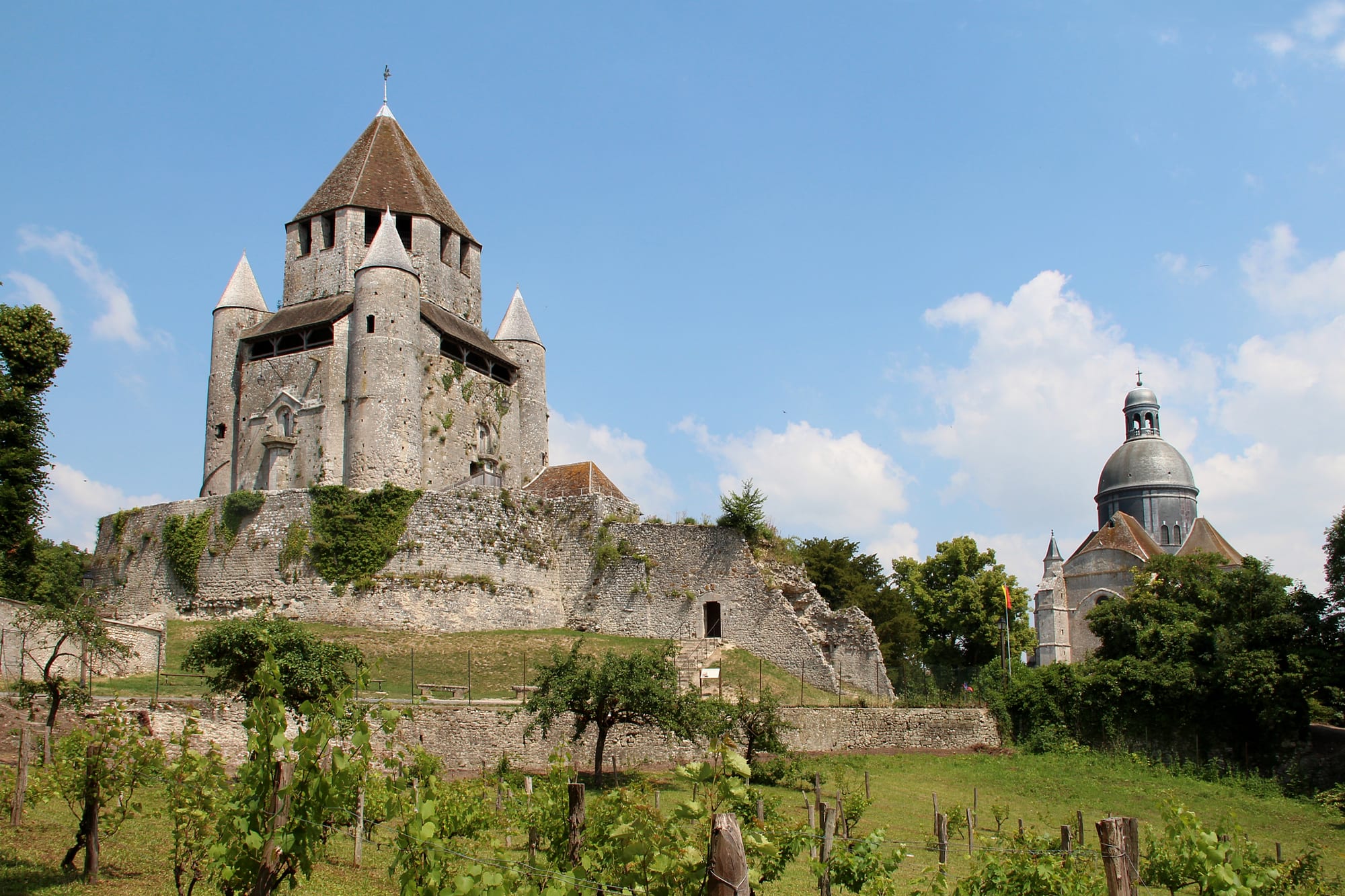
The stone keep of the Tour César with its pointed roof and turrets on a walled mound, the domed Saint-Quiriace church beside it

Paris & Île-de-France, France

Provins

The 12th-century Tour César and the dome of the Saint-Quiriace collegiate church in the upper town of Provins. (Jean-Pol GRANDMONT / Wikimedia Commons · CC BY 4.0)

A town of about 11,600 people some 77 km south-east of Paris, which grew rich in the Middle Ages as one of the great Champagne fair towns under the Counts of Champagne. Bypassed by later history and the Industrial Revolution, it kept its medieval ramparts, 12th-century keep and merchants' houses, now a UNESCO World Heritage Site, and is known today for its roses.

Neighbourhoods

  • The upper town (ville haute)
    • First-time visitors
    • Historic district

    The walled medieval town on its hill, around the Place du Châtel, with the Tour César, the domed Saint-Quiriace church, half-timbered merchants' houses and the 1,200-metre ring of ramparts. The falconry and knights' shows and most of the sights are here.

    Open in Maps
  • The lower town (ville basse)
    • Local life
    • Close to public transport
    • Best for food

    The everyday town on the former marshes below the hill, along the Voulzie and Durteint streams, with the station, the church of Saint-Ayoul, shops, cafés and the market.

    Open in Maps

Things to do

Ramparts and the upper town

  • Tour Césarlandmark

    The 12th-century keep on an artificial mound at the heart of the upper town, octagonal above a square base, with views over the rooftops and the surrounding plain.

    Open in Maps
  • Ramparts and Porte Saint-Jeanlandmark

    The walls of the upper town, 1,200 metres long with 22 towers of varied shapes, built between 1226 and 1314 to protect the fairs, entered through gates such as the Porte Saint-Jean.

    Open in Maps
  • Saint-Quiriace Collegiate Churchlandmark

    The great church begun in the 12th century by Henry I of Champagne to hold the head of Saint Cyriacus, never finished and capped with a dome in the 17th century; Charles VII and Joan of Arc heard Mass here in 1429.

    Open in Maps
  • Grange aux Dîmeslandmark

    A 13th-century building on the rue Saint-Jean in the upper town, used as a covered market during the medieval fairs and from the 17th century to store the tithe that gives it its name.

    Open in Maps
  • Musée de Provinsmuseum

    The town museum in the Romanesque House, with a 12th-century façade, displaying a chasuble once kept at Saint-Quiriace, golden monstrances and a 15th-century Trinity icon.

    Open in Maps

Underground and the lower town

  • Underground galleriesattraction

    Medieval tunnels beneath the old town, used to store food and dig fuller's earth, which feature in Umberto Eco's novel Foucault's Pendulum.

    Open in Maps
  • Church of Saint-Ayoullandmark

    The lower-town church founded for the relics of Saint Ayoul, where excavations have uncovered frescoes and Georges Jeanclos carved new sculptures for the portal in the 1980s.

    Open in Maps
  • Roseraie de Provinspark

    A three-hectare rose garden at the foot of the upper town, restored since 2008, celebrating the Provins rose.

    Open in Maps

Medieval shows

  • Les Aigles des Rempartsattraction

    A falconry show in a theatre within the upper-town walls near the Porte de Jouy, staged from spring to autumn.

    Open in Maps
  • La Légende des Chevaliersattraction

    An equestrian show of knights near the Porte Saint-Jean, just outside the walls, staged most days from spring to autumn.

    Open in Maps

Eat and drink

Long-standing places and food districts in Provins. Hours, ratings and directions come from your maps app, always current.

Provins classics

  • Rose confectionery shopsmarket

    Provins calls itself the capital of rose confectionery: rose-petal jam, rose honey, rose sweets and rose syrup, made from the local Provins rose.

    Open in Maps

Food districts and markets

  • Place du Châtelneighborhood

    The main square of the upper town, ringed by half-timbered houses, where visitors find cafés and restaurants.

    Open in Maps
  • The lower townneighborhood

    The shopping streets below the hill, with bakeries, cafés and the market used by residents.

    Open in Maps

Experience Provins

History

Provins stood at the crossroads of two Roman roads, from Soissons to Troyes and towards Sens, and the hilltop of today's upper town is thought to have been fortified under Roman rule. By the 9th century it was minting its own coin, the denier provinois, and a first wall had formed around the castle at the site of the Tour César. Under the protection of the Counts of Champagne it became one of the great Champagne fair towns: from 1120 to 1320 merchants from across Europe met here, with fairs in May and November in the upper town and a September market in the lower, and Provins became a banking centre whose coin was accepted across the continent.

The counts built Saint-Quiriace, begun by Henry I of Champagne to display a relic brought from Jerusalem, and the 1,200-metre ring of ramparts went up between 1226 and 1314. Prosperity ended in the late 13th century when Philip IV's heavy taxes drove residents away, and between the 14th and 16th centuries the town was besieged and changed hands repeatedly. On 3 August 1429 the newly crowned Charles VII heard Mass at Saint-Quiriace with Joan of Arc.

Largely untouched by the Industrial Revolution, Provins remained a small market town through the 19th century, which is why so much of its medieval fabric survives. German troops occupied it in 1870 and were only barely held off in 1914. In 2001 the town was listed by UNESCO as a World Heritage Site; of the four great Champagne fair towns, it is the only one to keep much of its medieval character.

Culture & Customs

Medieval heritage is the town's identity and its main industry. Of the fair towns of Champagne — Troyes, Lagny-sur-Marne, Bar-sur-Aube and Provins — only Provins still looks the part, with 12th-century merchants' houses, counting houses and shops in the upper town, and the town is a regular filming location for television series and films. Falconry and jousting shows draw families through the warmer months. The underground galleries and the Grange aux Dîmes found a place in literature in Umberto Eco's Foucault's Pendulum.

Roses are the other emblem. The Provins rose, Rosa gallica, a small, hardy bush much closer to wild roses than modern varieties, has long been grown here, and the town calls itself the capital of rose confectionery. Rose gardens remain in production, and a three-hectare rose garden below the upper town has been restored since 2008. Wine was once a large business, and some residents still make it with old methods.

Religion has left two great churches, Saint-Quiriace in the upper town and Saint-Ayoul in the lower, where a medieval garden and modern sculpture and stained glass sit together. Once a year, a heritage railway association runs steam-hauled trains from Provins station.

Daily Life

About 11,600 people lived in Provins in 2023, a slight fall since 2017 while Seine-et-Marne as a whole grew. It is the sub-prefecture of its arrondissement, though not its largest town, and the seat of the canton. Its inhabitants are called Provinois.

The town is divided between the walled upper town, which holds monuments, schools — among them the Lycée Thibaut-de-Champagne — and many visitors, and the larger lower town, where most people live and shop. On the edge of town a large housing estate, classed as a priority neighbourhood, had about 2,830 residents in 2020, half of them living below the poverty line.

Tourism, rose growing and confectionery, local services and farming on the surrounding plains provide most work. Days in the upper town follow the rhythm of the visitors, busiest at weekends and in summer, while the lower town keeps the pattern of an ordinary French market town.

Food

Provins is best known for rose confectionery. From the petals of the Provins rose its producers make rose-petal jam, Provins rose honey, rose sweets and rose syrup, sold in small shops all over the town. The rose itself, Rosa gallica, also called the French rose or rose of Provins, was one of the first roses cultivated in central Europe.

The town also has a long winemaking past. Provins was once a large producer of wine, and while the vineyards are now few, some residents still make wine using traditional methods.

Around the town, the farmland of Seine-et-Marne roughly corresponds to the old region of Brie that gave the cheese its name; the town has its own brie de Provins, a name registered as a brand in 1979, and the bakeries, markets and brasseries of the lower town serve everyday regional food. In the upper town, the cafés and restaurants around the Place du Châtel cater to visitors between the monuments and the shows.

Planning tools

Budget

Provins is much cheaper than Paris. Tickets for the tower, the underground galleries and the shows are the main costs; walking the ramparts and the streets of the upper town costs nothing. Most visitors come on a day trip by train from the Gare de l'Est.

Daily Budget Midrange
USD 170–300 (room in the town, show and monument tickets, lunch and dinner in restaurants)
Daily Budget Shoestring
USD 70–120 (day return by train from Paris, a show or the underground galleries, café lunch or a picnic)

A day pass covering all fare zones of Île-de-France includes the train to Provins, and the falconry and knights' shows run only from spring to autumn.

Best Time to Visit

Spring to autumn, when the medieval shows run, the gardens are in flower and the upper town is at its liveliest. Summer weekends are the busiest. In winter many shows stop and the town is quiet, but the ramparts and streets are open.

Suggested Number of Days

A single full day covers the upper town, the galleries and a show. An overnight stay allows a slower pace, the evening atmosphere once day-trippers leave and time for the surrounding countryside.

First Visit
1 day
With Surroundings
2 days

Transportation

Trains run from the Gare de l'Est to Provins station, in the lower town, in about an hour and twenty-five minutes, roughly hourly. The town has bus stations by the railway, in the centre and at the tourist office. The upper town is a steep walk from the station; a car is useful only for the surrounding countryside.

Buy Île-de-France tickets for Provins from the regional ticket machines rather than the long-distance ones at the Gare de l'Est.

Airport & Station Connections

Provins is about 77 km south-east of central Paris. Most visitors take the regional train from the Gare de l'Est, which reaches Provins in about an hour and twenty-five minutes; others drive across the plains of Seine-et-Marne. The Paris airports are reached through the city.

Walkability

The town is small and best explored on foot, but hilly: the rue Saint-Thibault, the old route up to the Châtel, is steep, and the cobbles of the upper town are uneven. The ramparts, the tower and the main sights of the upper town are close together.

Safety

France is a safe country overall, with violent crime against visitors uncommon. Provins is a quiet market town; the practical hazards are steep slopes, uneven cobbles and tower stairs.

Wear sturdy shoes for the cobbles and ramparts, and keep children close on the walls and in the underground galleries. Check current official travel advice before travelling.

Climate

A temperate oceanic climate with cool summers and no dry season. At Voulton, 7 km away, the average annual temperature is about 11°C and rainfall about 740 mm; the record high is 41.9°C, set on 25 July 2019, and the record low −21°C, on 17 January 1985.

Summer
warm — in nearby Paris, July temperatures typically range between 15 and 25°C, with occasional heatwaves
Winter
cool — in nearby Paris, winter nights are generally just above freezing, around 3°C, with light frosts common

Local Customs

Everyday manners follow the French norm: a 'bonjour' before any request in a shop or café, the formal 'vous' with strangers and an unhurried pace at the table. Tipping is neither required nor expected, and is usually left only for exceptional service. The townspeople are known as Provinois.

Dress respectfully and speak quietly in Saint-Quiriace and Saint-Ayoul, and ask before photographing costumed performers outside the shows.

Common Payment Methods

France uses the euro. Cards and contactless payment are accepted at the monuments, shows and most restaurants; a little cash is useful for the market and small shops.