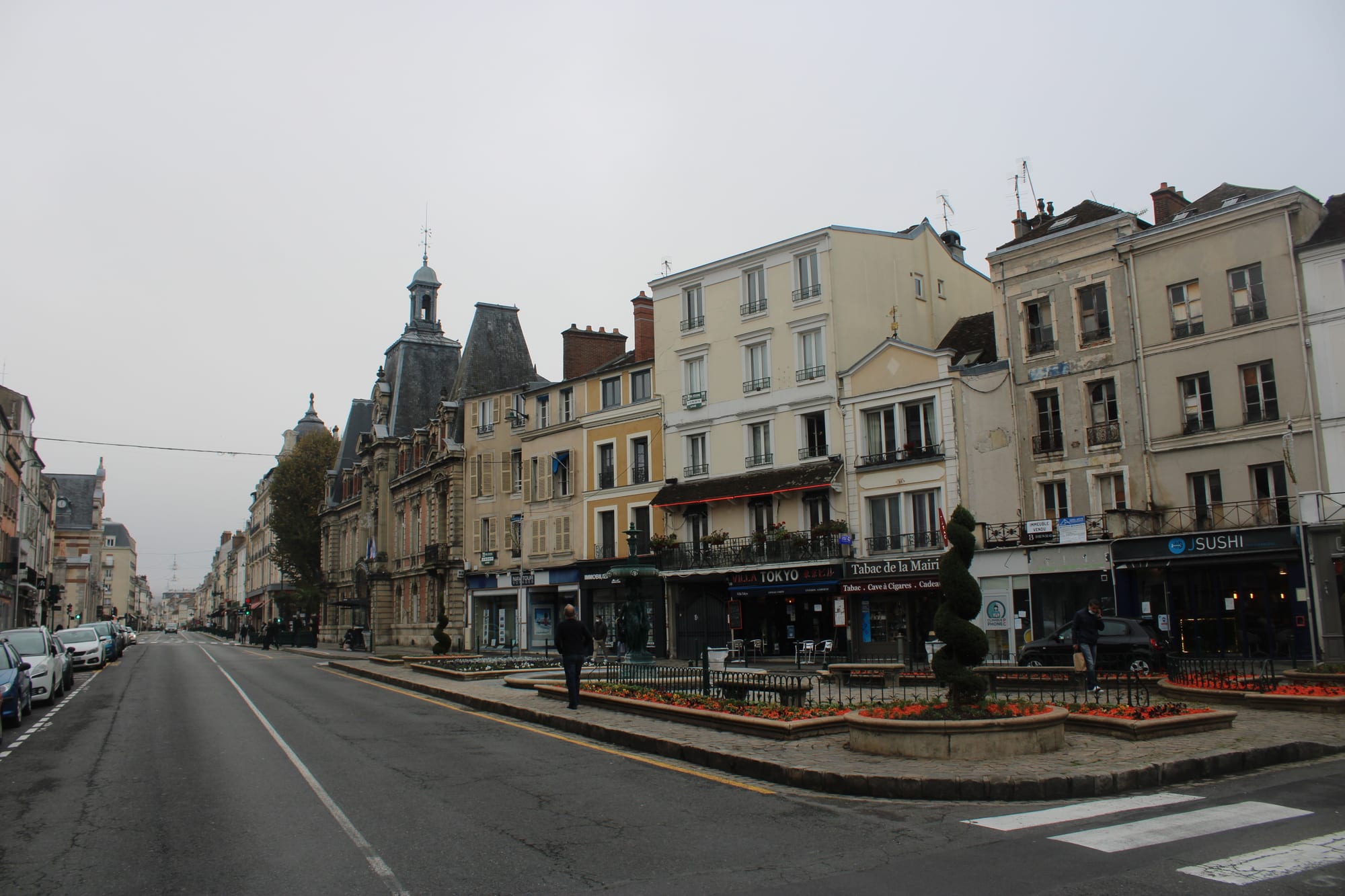
The Rue Grande in Fontainebleau, with cream-coloured houses, shopfronts, flower beds and the slate-roofed town hall

Paris & Île-de-France, France

Fontainebleau

The Rue Grande and the Place Franklin-Roosevelt in the centre of Fontainebleau, with the town hall on the left. (Baidax / Wikimedia Commons · CC BY-SA 4.0)

A town of about 15,600 people some 55 km south-south-east of Paris, grown up around a royal hunting lodge that Francis I turned into one of the great Renaissance palaces of France. Surrounded by a vast forest of broadleaf trees, heath and sandstone boulders, it is now a residential sub-prefecture, home to the INSEAD business school and a weekend escape for Parisians, walkers and climbers.

Neighbourhoods

  • The palace and the Rue Grande
    • First-time visitors
    • Historic district
    • Best for food

    The compact centre between the palace gates and the town hall. The Rue Grande, the one main street, runs from the château across the town past the Place Napoléon-Bonaparte, lined with shops, bars, brasseries and restaurants, and nothing in the centre is more than a short walk away.

    Open in Maps
  • Avon and the station
    • Close to public transport
    • Quiet and residential

    The neighbouring commune to the east, joined to Fontainebleau in a single urban area. Fontainebleau–Avon station, where trains from Paris arrive, is here near the boundary, and the town centre is a bus ride or a walk of around half an hour away.

    Open in Maps
  • The forest edge
    • Walks and nature
    • Climbing

    The forest wraps around the town and dozens of nearby villages, and its trails, rock outcrops and viewpoints begin almost at the end of the streets. Walkers, riders and boulderers fill it at weekends.

    Open in Maps

Things to do

The palace

  • Palace of Fontainebleaulandmark

    One of the largest royal châteaux in France and a UNESCO World Heritage Site, lived in by kings from Louis VII to Napoleon III, with the Renaissance gallery of Francis I, the horseshoe staircase and the courtyard where Napoleon bade farewell to his Old Guard in 1814.

    Open in Maps

The forest

  • Forest of Fontainebleaupark

    A mixed deciduous forest of about 250 square kilometres, a former royal hunting ground now crossed by walking and riding trails and visited by millions of people a year.

    Open in Maps
  • Fontainebleau boulderingattraction

    The sandstone boulders scattered through the forest form the biggest and most developed bouldering area in the world, climbed since the 19th century and the origin of the Font grading system.

    Open in Maps

Short trips from the town

  • Barbizonattraction

    The village on the forest's edge that gave its name to the Barbizon School of landscape painters, active roughly from 1830 to 1870, among them Théodore Rousseau and Jean-François Millet.

    Open in Maps
  • Moret-sur-Loingattraction

    A small town at the meeting of the Loing and the Seine that inspired Monet, Renoir and Sisley.

    Open in Maps
  • Vaux-le-Vicomtelandmark

    The Baroque château near Melun built between 1658 and 1661 for Louis XIV's finance minister Nicolas Fouquet, where Le Vau, Le Nôtre and Le Brun first worked together.

    Open in Maps

Eat and drink

Long-standing places and food districts in Fontainebleau. Hours, ratings and directions come from your maps app, always current.

Fontainebleau classics

  • Brasserie Franklin Roosevelt (Les Glaces)restaurant

    A traditional brasserie on the Rue Grande, a long-standing gathering place for INSEAD students.

    Open in Maps
  • Fontainebleau cheesemarket

    The town's own fresh speciality, a mousse of cream or fresh cheese with whipped cream, held in muslin; the cream-only version keeps just two days.

    Open in Maps

Food districts and markets

  • Fontainebleau marketmarket

    The town's food market, best known for its Sunday morning session.

    Open in Maps
  • Rue Grandeneighborhood

    The main street, where restaurants from French to Japanese and Mexican, bars and pubs line both pavements between the palace and the town hall.

    Open in Maps

Experience Fontainebleau

History

A royal hunting lodge and chapel were built here by Louis VII in the middle of the 12th century, in a hamlet beside a spring in the forest — the "Fontaine Belle-Eau" from which, by one account, the town takes its name. Louis IX called the place "his wilderness" and built a country house and a hospital; Philip the Fair was born here in 1268 and died here in 1314. In all thirty-four sovereigns, from Louis VI to Napoleon III, spent time at Fontainebleau.

Francis I transformed the house into a palace from about 1528, bringing Italian artists such as Rosso Fiorentino and Primaticcio to decorate it, and the court entertained here the new ideas of the Renaissance. Every monarch from Francis I to Louis XV left changes. Louis XIV signed the Edict of Fontainebleau here in 1685, revoking the toleration of Protestants, and the 1762 treaty concerning Louisiana was concluded here. Napoleon held Pope Pius VII at the château from 1812 to 1814, and on 20 April 1814, shortly before his first abdication, bade farewell to his Old Guard in the courtyard now called the Cour des Adieux.

Until the 19th century Fontainebleau was a village and a suburb of Avon; the railway station in Avon has served it since the middle of that century. It hosted the Franco-Vietnamese conference of 1946 and, from NATO's beginnings until 1967, the Allied command for Central Europe. The palace became a national museum in 1927 and a UNESCO World Heritage Site in 1981.

Culture & Customs

Fontainebleau's culture has always been bound up with the forest. In the 19th century the painters of the Barbizon School, among them Théodore Rousseau and Jean-François Millet, worked on its edges and campaigned against the planting of pines; in 1853 old woods and rocky areas were withdrawn from timber cutting, and in 1861 this "artistic reserve" was enlarged. Writers followed: Flaubert sent the hero of Sentimental Education to the palace and forest, and Patricia Highsmith's Tom Ripley lives near the town.

The forest's sandstone boulders have been climbed since the 19th century and now form the biggest bouldering area in the world, giving their name to the Font grading system; at weekends the car parks fill with climbers carrying foam pads. The town is also known for horse racing and riding, and the palace has one of only two active real-tennis courts in France, where the 2008 world championship was played.

The INSEAD business school brings students from around the world, giving the bars and restaurants of the Rue Grande an international mix unusual for a town of its size. The people of Fontainebleau are known as Bellifontains.

Daily Life

About 15,600 people lived in the commune in 2023, and the urban area formed with Avon and three smaller communes had about 36,700 in 2018. The commune covers the largest land area in Île-de-France, larger than Paris itself, because it takes in much of the forest. It is a sub-prefecture of Seine-et-Marne, linked to the Gare de Lyon in Paris by Transilien trains.

The palace draws around 300,000 visitors a year and the forest more than 13 million, and besides tourism the town has the sub-prefecture's offices, a court, a hospital campus and INSEAD's European campus. Life in town revolves around the Rue Grande, the market and the schools, while the forest, managed and protected by the national forestry office, is used daily by walkers, runners, riders and climbers.

In July 2026, during a strong heatwave, a fire broke out in the forest. The forest covers about 250 square kilometres, and its trails and rocks begin at the edge of the town's streets.

Food

Fontainebleau has given its name to a cheese: le fontainebleau, a fresh speciality whose recipe was never registered and varies from shop to shop. It may be made purely from crème fraîche or from fresh cow's-milk cheese folded with whipped cream, and it comes as a creamy cheese topped with a light white mousse about ten centimetres across, held in place by muslin. Made only with cream, it keeps for just two days.

The surrounding plains of Seine-et-Marne are cheese country too: Brie de Melun and Brie de Meaux, both protected cheeses, come from the department, and Melun lies just north of the forest. The barley sugar of nearby Moret-sur-Loing has been made since the 17th century.

In town, the market is busiest on Sunday mornings, and the Rue Grande has brasseries in the classic style alongside restaurants serving food from Japan, Mexico and elsewhere, with bars and pubs used by INSEAD students. A picnic in the forest, with bread, cheese and fruit bought in town, is a favourite way to spend a fine day.

Planning tools

Budget

Fontainebleau is closer to normal French prices than Paris. Palace admission is the main sight cost; the forest, its trails and its boulders are free. Many visitors come on a day return from the Gare de Lyon, while climbers and walkers often base themselves in the town or the forest villages for several days.

Daily Budget Midrange
USD 180–330 (room in the town, palace ticket, brasserie lunch and restaurant dinner, bike or bus in the forest)
Daily Budget Shoestring
USD 70–120 (day return by train from Paris or a budget room, market picnic, free forest walks)

An all-zones weekly Navigo pass covers the train from Paris and the local buses between the station and the palace.

Best Time to Visit

Spring and autumn suit the forest best — cool enough for long walks and for climbing, with the trees at their freshest or in autumn colour. Summer weekends are busy in the forest and hot spells can be strong. Winter is quiet in the palace and the town, and the bare forest is still walkable on dry days.

Suggested Number of Days

One day covers the palace and the town; two allow time in the forest as well. Climbers, keen walkers and anyone adding the surrounding villages and châteaux need three or four days.

First Visit
1–2 days
With Surroundings
3–4 days

Transportation

Transilien line R trains from the Gare de Lyon stop at Fontainebleau–Avon and Fontainebleau-Forêt on the way to Montereau and Montargis. Local buses link the station with the château, and a network of lines serves the town and Avon. In the forest, walking, cycling or a car are the ways to reach the boulder areas and trailheads.

Pick up walking maps at the tourist office on the Place de la République, and note that some forest stops are served only by certain weekend trains.

Airport & Station Connections

Fontainebleau is about 55 km south-south-east of central Paris. Trains from the Gare de Lyon reach Fontainebleau–Avon in around 40 minutes; from there a bus to the château takes 15 to 20 minutes, or the walk about half an hour. The Paris airports are reached through the city.

Walkability

The town centre is small and easy on foot: the Rue Grande runs from the château through the centre, and most places are within a 20-minute walk. The station is further out in Avon. The forest trails start close to town, but distances inside the forest are long.

Safety

France is a safe country overall, with violent crime against visitors uncommon. Fontainebleau is a quiet, prosperous town, and the region beyond Paris is calm; in the forest the risks are ticks, losing the path, falls from the boulders and fire in dry summers.

Carry a map or offline route, check for ticks after walks, climb with crash pads and a spotter, and respect any fire-risk closures in hot weather. Check current official travel advice before travelling.

Climate

An oceanic climate with a continental edge. The town's average annual temperature is about 11°C and rainfall about 740 mm a year; the record high is 42.7°C, set on 25 July 2019, and the record low −16.1°C, in January 2010.

Summer
warm — in nearby Paris, July temperatures typically range between 15 and 25°C, with occasional heatwaves
Winter
cool and grey — in nearby Paris, night-time lows are around 3°C, with light frosts common

Local Customs

Everyday manners follow the French norm: a 'bonjour' before any request, the formal 'vous' with strangers and an unhurried pace at the table. Service is included in restaurant bills, so tipping is modest. The forest is shared by walkers, riders and climbers, and paths and rocks are kept clean.

Stay on marked paths in the protected reserves, take litter home, and brush chalk marks off boulders after climbing.

Common Payment Methods

France uses the euro. Cards and contactless payment are accepted in the town's shops, restaurants and the palace; cash is useful at the market and small bakeries. ATMs are found in the town centre.