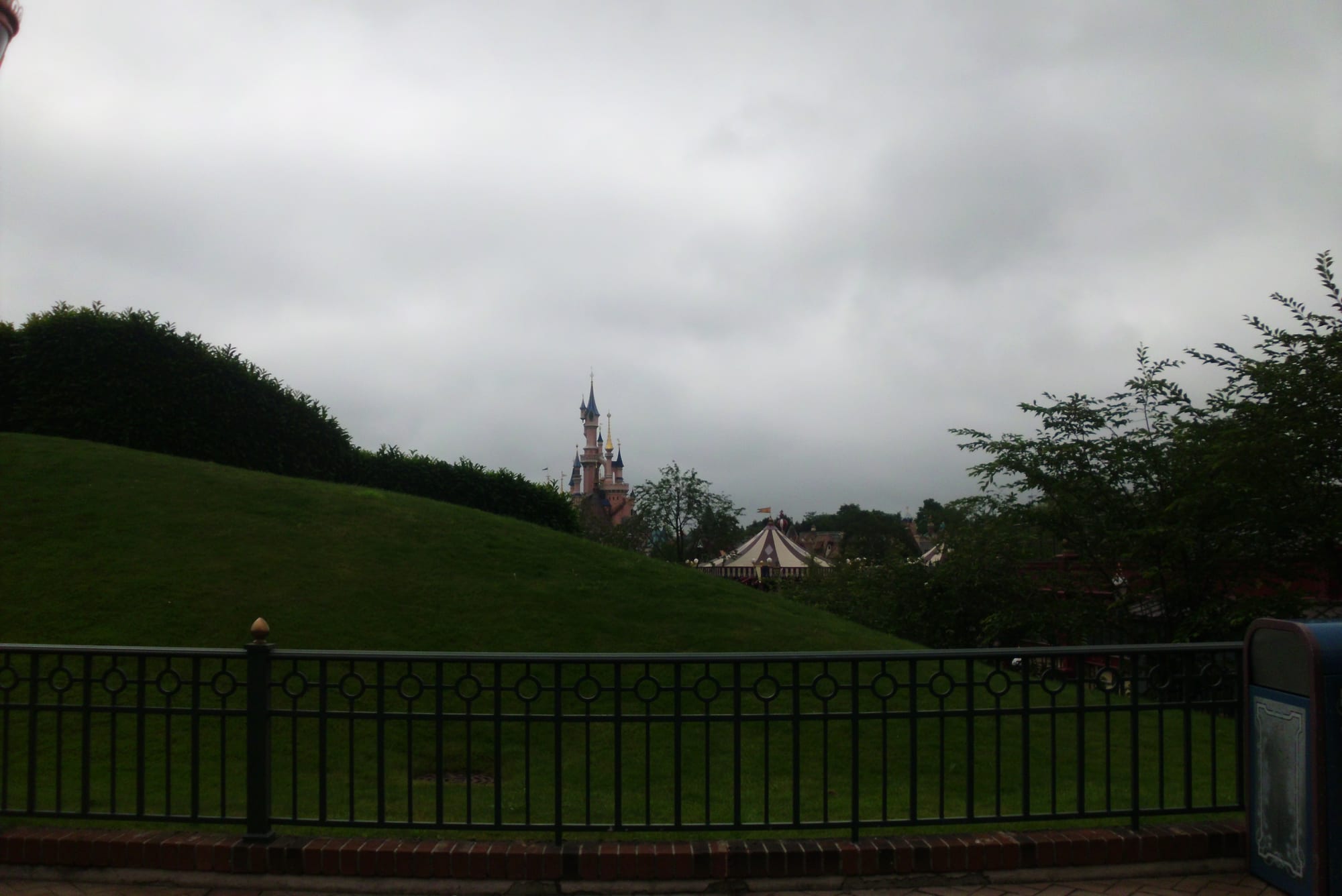
The pink spires of the Sleeping Beauty Castle rising beyond a grassy mound and trees at Disneyland Park under a grey sky

Paris & Île-de-France, France

Disneyland Paris

Le Château de la Belle au Bois Dormant seen across the gardens of Disneyland Park at Marne-la-Vallée. (Kapsuglan / Wikimedia Commons · CC BY-SA 4.0)

An entertainment resort at Marne-la-Vallée, much of it in the commune of Chessy, about 32 km east of central Paris. Opened in 1992 on former farmland after a Europe-wide search for a site, it holds two theme parks, Disneyland Park and Disney Adventure World, a shopping and dining district and its own rail station, and is the most visited theme park resort in Europe.

Neighbourhoods

  • Disneyland Park
    • First-time visitors
    • Families

    The original park of 1992, dedicated to fairy tales and Disney characters and laid out much like the Disney parks in California and Florida, with the Sleeping Beauty Castle at its centre and lands such as Fantasyland, Frontierland, Adventureland and Discoveryland around it.

    Open in Maps
  • Disney Adventure World
    • Thrill rides
    • Families

    The second park, opened in 2002 as Walt Disney Studios Park and renamed in March 2026, when its World of Frozen land opened. Areas inspired by Disney, Pixar and Marvel films surround a new central lake.

    Open in Maps
  • Disney Village and the station
    • Close to public transport
    • Evenings out
    • Best for food

    The shopping, dining and entertainment street designed by Frank Gehry, between the two park entrances and the lake. Marne-la-Vallée–Chessy station, served by the RER A and high-speed trains, opens onto it.

    Open in Maps
  • Val d'Europe
    • Shopping
    • Quiet and residential

    The planned new-town district built next to the resort under the 1987 agreement between Disney and the French state, with homes, offices, a large shopping centre with outlet shops and department stores, and its own RER station one stop before the parks.

    Open in Maps

Things to do

The parks

  • Disneyland Parkattraction

    The most visited theme park in Europe, with 10.2 million visitors in 2024; its top attractions include It's a Small World, Big Thunder Mountain, Pirates of the Caribbean and the Star Wars Hyperspace Mountain roller coaster.

    Open in Maps
  • Disney Adventure Worldattraction

    The second park, enlarged by a €2 billion overhaul in 2026, whose World of Frozen land recreates the kingdom of Arendelle around a 36-metre mountain, with the Frozen Ever After boat ride.

    Open in Maps

Shopping and evenings

  • Disney Villageattraction

    Opened with the resort in 1992 as Festival Disney, a free-to-enter street of restaurants, shops and entertainment venues under Frank Gehry's steel towers and canopy of lights.

    Open in Maps
  • Val d'Europeneighborhood

    The new-town district beside the resort, with a large shopping centre of outlet shops and department stores.

    Open in Maps

Short trips from the resort

  • Meauxattraction

    The historic sub-prefecture town on the Marne north-east of the resort, which gives its name to Brie de Meaux and has a large museum of the First World War, near where the German advance was halted in 1914.

    Open in Maps
  • Parisattraction

    The capital, about 32 km west, reached directly from the resort's station on the RER A.

    Open in Maps

Eat and drink

Long-standing places and food districts in Disneyland Paris. Hours, ratings and directions come from your maps app, always current.

Food districts and markets

  • Disney Villageneighborhood

    The resort's main dining street outside the parks, with themed restaurants, a pub and fast food, open into the evening after the parks close.

    Open in Maps
  • Val d'Europe shopping centreneighborhood

    Restaurants and food shops around the shopping centre one RER stop away, used by locals as well as visitors.

    Open in Maps
  • Meauxneighborhood

    The nearby town that gives its name to Brie de Meaux, a protected cheese of the Brie region since 1980.

    Open in Maps

Experience Disneyland Paris

History

The idea of a European Disney park emerged in 1966, after the success of Disneyland in California, and gained momentum after Tokyo Disneyland opened in 1983. In 1984 Disney drew up a list of about 1,200 possible European sites; by 1985 four remained, two in Spain and two in France. A Mediterranean site at Pego, near Alicante, was the front-runner and Toulon was considered, but Marne-la-Vallée won for its closeness to Paris and its central place in Western Europe. Michael Eisner signed the first agreement with the French government in December 1985, the final contract followed in March 1987, and construction began in August 1988.

Euro Disney opened on 12 April 1992, with its RER station opening the same month. Its arrival was fiercely debated: French intellectuals denounced it as cultural imperialism, and the stage director Ariane Mnouchkine called it a "cultural Chernobyl". Attendance fell short of forecasts during a recession, and the company struggled with debt; alcohol was allowed with meals from 1993, and in 1995 attendance rose by 21 per cent. The TGV station opened in 1994 and the second park, Walt Disney Studios, in 2002.

Disney took full control of the resort in 2017 and launched a multi-year expansion. A record 16.1 million visitors came in the 2023 financial year. On 29 March 2026 the second park was renamed Disney Adventure World as its World of Frozen land opened, and a Lion King area has been under construction since autumn 2025.

Culture & Customs

The resort is American by design — the original hotels were themed on regions of the United States, and menus kept "an American flavour" — but it has adapted to Europe: Disney expected visitors to prefer eating outdoors, installing thousands of patio seats, and staff were recruited in Paris, London and Amsterdam to speak French and at least one other European language. Roughly half of all visitors are French and half come from abroad.

The parks themselves follow the Disney tradition of themed lands, parades, character meetings and night-time shows, with seasonal programmes through the year and limited-time festivals. Disneyland Park's Sleeping Beauty Castle is a version of the castle from the 1959 film, and the second park's Earffel Tower, a water tower with Mickey Mouse ears, is its emblem. The resort has also hosted events from music festivals to the 2012 Minecraft convention.

The early controversy has not stopped the resort becoming a fixture: by 2023 more than 375 million visits had been made, and it remains Europe's leading theme park resort.

Daily Life

The resort covers about 2,100 hectares, about half of it developed so far, including the planned community of Val d'Europe, built by Disney and the French state as the easternmost sector of the new town of Marne-la-Vallée. Disneyland Paris is the largest single-site employer in France, with 17,000 employees, and was still Seine-et-Marne's largest employer in 2022. Unlike Disney's American parks, it set out to rely on permanent staff rather than seasonal workers, and it trains them at its own Disney University.

Much of the resort lies in the commune of Chessy, on the left bank of the Marne about 30 km from Paris, in a former farming village transformed since the resort arrived. Around the parks, farmland has given way to housing estates, offices and the Val d'Europe shopping centre, and the RER A, which starts here, links the new towns with Paris.

Life in the surrounding communes follows the parks, whose visitors fill the trains and the station through the day.

Food

Food inside the resort was planned on a vast scale: Euro Disney opened with 29 restaurants inside Disneyland Park alone, with an American flavour predominant and recipes adapted for European tastes in test kitchens in Florida. Menus range from quick-service burgers and snacks to themed table-service restaurants, and alcohol, at first banned, has been served with meals inside the parks since June 1993. Disney Village adds restaurants and bars outside the gates.

The countryside around the resort is the Brie region, and Brie de Meaux — named after the town of Meaux a short way north-east on the Marne — has been a protected AOC cheese since 1980. It is, with the local mustard, what Meaux is mainly known for, and cheese shops and markets in the nearby towns sell it alongside Brie de Melun.

For everyday eating, Val d'Europe's shopping centre and the surrounding new towns have the usual French bakeries, supermarkets and brasseries, which visitors staying outside the resort use for cheaper meals.

Planning tools

Budget

Park tickets are the biggest cost, and prices vary by date: school holidays and weekends are dearest. Food inside the parks and the resort is expensive compared with the surrounding towns, and on-site rooms are priced as part of the experience. Staying in Paris or in the nearby new towns and arriving by RER cuts costs.

Daily Budget Midrange
USD 280–480 (two-park ticket, room near the resort, park meals and a dinner in Disney Village)
Daily Budget Shoestring
USD 120–190 (day trip by RER from Paris, one-park ticket, packed lunch and snacks)

An all-zones weekly Navigo pass covers the RER A to the resort, and tickets bought for specific dates in quieter periods are usually cheaper.

Best Time to Visit

Weekdays outside French and other European school holidays bring the shortest queues. Spring and early autumn have mild weather; summer is the busiest season, with occasional heat. Winter is cool and grey but can be quiet on weekdays.

Suggested Number of Days

Two days give time for both parks without rushing. Families with young children, or anyone adding the capital or the surrounding towns, need three or four days; school-holiday crowds make every visit slower.

First Visit
2 days
With Surroundings
3–4 days

Transportation

Everything in the resort — the parks, Disney Village and the station — lies within walking distance, and shuttle buses link the station with the resort's accommodation. The RER A runs directly between the resort and central Paris in about 35 minutes, with a second stop at Val d'Europe. A car is needed only for the wider countryside.

Check the last RER times after the evening shows, and allow for long queues at the station when the parks close.

Airport & Station Connections

Marne-la-Vallée–Chessy station sits inside the resort beside the park entrances, about 30 km east of Paris. It is the end of the RER A from central Paris and a stop on the high-speed line, with TGV and Ouigo trains from many French cities and Eurostar trains to Brussels and Amsterdam; direct Eurostar trains to London were suspended in 2023. The Paris airports are reached by road or rail.

Walkability

The core of the resort is compact and pedestrian: the station, Disney Village and both park gates are a few minutes apart. Inside the parks there is a great deal of walking and standing in queues. Val d'Europe is walkable but a separate district, best reached by the RER.

Safety

France is a safe country overall, with violent crime against visitors uncommon. At the resort the practical risks are pickpocketing in crowds and on the RER, and children getting lost.

Agree a meeting point with children, keep valuables zipped away in queues and on the train. Check current official travel advice before travelling.

Climate

An oceanic climate, like that of Paris: mild and often grey, with rain spread across the year, warm summers with occasional heatwaves and cool winters with frosts.

Summer
warm — in nearby Paris, July temperatures typically range between 15 and 25°C, with a few days above 32°C each year
Winter
cool and grey — in nearby Paris, night-time lows are around 3°C, with light frosts common

Local Customs

Staff were recruited to speak French and at least one other European language. Everyday French manners apply in the surrounding towns: a 'bonjour' before any request and the formal 'vous' with strangers. Service is included in restaurant bills, so tipping is modest. Alcohol has been served with meals inside the parks since 1993.

Queue-jumping is frowned upon; follow staff instructions at rides and shows, and greet staff in the surrounding towns with a 'bonjour'.

Common Payment Methods

France uses the euro. Cards and contactless payment are accepted throughout the resort, including at food stalls; cash machines are available, and a little cash is useful in the surrounding towns.