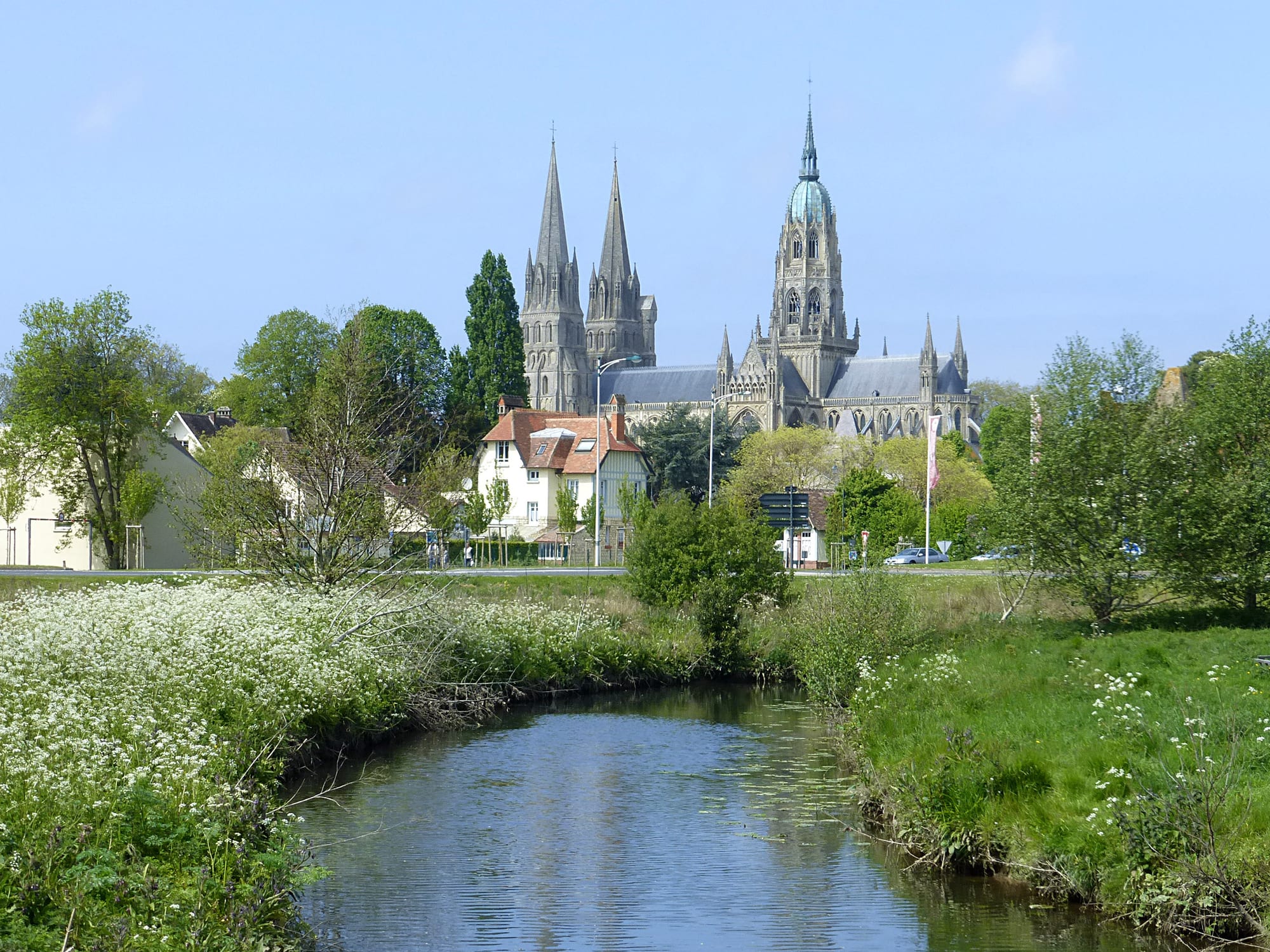
The spires and domed central tower of Bayeux Cathedral rising above trees and houses beyond a quiet green riverbank

Normandy, France

Bayeux

Bayeux Cathedral seen from the banks of the Aure. (ChBougui / Wikimedia Commons · CC BY-SA 4.0)

A cathedral town on the River Aure, seven kilometres from the Channel coast and 30 kilometres north-west of Caen, capital of the Bessin. Roman Augustodurum, a bishop's seat since the 4th century and home of the Bayeux Tapestry, it was the first sizeable town liberated after D-Day and came through the war almost untouched, so its medieval streets now serve as a base for the landing beaches.

Neighbourhoods

  • The old town and the cathedral quarter
    • First-time visitors
    • Historic district

    The area inside the line of the old Roman and medieval walls, with the cathedral in its south-east corner. Narrow streets such as the rue des Cuisiniers, once the roasters' quarter, and the rue Saint-Malo keep late-medieval houses and timber façades, and the main street, which changes names along its length, holds most of the shops.

    Open in Maps
  • Along the Aure
    • River walks
    • Quiet and residential

    The small river runs through the centre between old stone houses and gardens, and a riverside path leads out through the town towards the campsite on the ring road.

    Open in Maps
  • The memorial quarter on the ring road
    • Second World War history

    On the boulevard Fabian Ware stand the Battle of Normandy museum, the Commonwealth war cemetery and the Bayeux Memorial opposite, with the reporters' memorial garden nearby.

    Open in Maps
  • Saint-Patrice and the station
    • Close to public transport
    • Local life

    Around the church of Saint-Patrice, built in 1544–48 with its Renaissance bell tower, are everyday streets of shops and houses; the railway station lies south of the centre, about ten minutes' walk from the main street.

    Open in Maps

Things to do

Cathedral and museums

  • Bayeux Cathedrallandmark

    Notre-Dame de Bayeux, consecrated in 1077 in the presence of William the Conqueror by his half-brother Bishop Odo, a Norman Romanesque church rebuilt in Gothic style, with crypts beneath and a crossing tower finished only in the 19th century.

    Open in Maps
  • Bayeux Tapestry Museummuseum

    The museum in a former seminary begun in 1693 that has displayed the 11th-century embroidery of the Norman Conquest since 1983; the tapestry is on loan to the British Museum in London until July 2027, and the museum is closed for renovation until October 2027.

    Open in Maps
  • Musée d'Art et d'Histoire Baron-Gérardmuseum

    The town's art and history museum in the former bishop's palace beside the cathedral, with archaeology, paintings, furniture and Bayeux's own porcelain and lace.

    Open in Maps
  • Musée mémorial de la Bataille de Normandiemuseum

    A museum of the 77 days of fighting in the Battle of Normandy, from 7 June to 29 August 1944, with uniforms and military vehicles, on the boulevard Fabian Ware.

    Open in Maps

Memorials and gardens

  • Bayeux War Cemeterylandmark

    The largest Second World War cemetery of Commonwealth soldiers in France, with 4,648 burials, most from the invasion of Normandy; the Bayeux Memorial opposite commemorates more than 1,800 casualties.

    Open in Maps
  • Mémorial des reporterspark

    A memorial garden inaugurated in 2007 with Reporters Without Borders, listing the names of journalists killed at work since 1944.

    Open in Maps
  • Jardin botanique de Bayeuxpark

    A free 2.6-hectare botanical garden and public park opened in 1864, where many trees planted in its first years still stand.

    Open in Maps

Short trips to the landing beaches

  • Arromanches and the Mulberry harbourattraction

    The seaside village on Gold Beach where the remains of the British Mulberry B artificial harbour, used for ten months after D-Day, still lie offshore.

    Open in Maps
  • Longues-sur-Mer batterylandmark

    A German coastal battery on a clifftop between Gold and Omaha beaches, the only one in Normandy that keeps several of its original guns.

    Open in Maps
  • Normandy American Cemeterylandmark

    The cemetery above Omaha Beach at Colleville-sur-Mer, dedicated in 1956, with a memorial, a visitor centre and about a million visitors a year.

    Open in Maps
  • Pointe du Hoclandmark

    A cratered clifftop promontory west of Omaha Beach, where US Army Rangers scaled 35-metre cliffs to attack German gun positions on D-Day.

    Open in Maps
  • Caenattraction

    The prefecture of Calvados, with William the Conqueror's castle and abbeys; William himself was buried there.

    Open in Maps

Seasonal events

  • D-Day commemorations6 June

    Remembrance services in the cathedral and at the war cemetery, part of the commemorations that fill the landing beaches each June.

  • Fête médiévalefirst weekend of July

    A medieval festival held around the cathedral since 1987, with craftspeople, street performers and a medieval book fair.

  • Bayeux Calvados-Normandy Award for war correspondentsOctober

    An annual prize for war reporting, awarded since 1994 during a week of exhibitions, screenings, a book fair and public debates.

Eat and drink

Long-standing places and food districts in Bayeux. Hours, ratings and directions come from your maps app, always current.

Bayeux classics

  • Restaurants of the old townneighborhood

    Crêperies, brasseries and restaurants serving Norman cream, cider and seafood cluster around the cathedral and the main street.

    Open in Maps
  • Bakeries on the main streetneighborhood

    The long main street through the town is lined with bakeries, handy for a picnic before a day on the beaches.

    Open in Maps

Local produce

  • Isigny-sur-Merneighborhood

    The small town to the west whose butter and crème fraîche carry a protected name.

    Open in Maps

Experience Bayeux

History

Bayeux began as Augustodurum, a Gallo-Roman town founded in the 1st century BC as the capital of the Baiocasses, the Gaulish people whose name became Bayeux and the Bessin. Its main street was already the heart of the town; two Roman baths have been found beneath the church of Saint-Laurent and the old post office, and by the end of the 3rd century a wall enclosed the town, with the citadel in one corner and the cathedral in another. The walls stood until the 18th century, and their line can still be traced. A bishop's seat from the 4th century, the town was largely destroyed by Viking raids in the late 9th century and rebuilt in the 10th, when chroniclers noted that "Danish" was commonly spoken there.

Odo, half-brother of William the Conqueror, completed the cathedral, dedicated in 1077, and the tapestry of the Conquest was probably made for it. Bayeux lost ground once William made Caen his capital, was burned by Henry I in his war with his brother Robert Curthose, and was repeatedly pillaged during the Hundred Years' War until Henry V of England took it in 1417. After the French recaptured it in 1450, new families built some 60 stone mansions, many of which survive. In the 19th century the town was known for its farmland, its lace and its porcelain.

On 7 June 1944, the day after D-Day, British troops of the 50th Division entered Bayeux, the first major town of mainland France to be liberated, and its buildings came through the Battle of Normandy virtually untouched. General de Gaulle made the first of his two great Bayeux speeches there on 16 June, and the Allies built a bypass around the narrow streets, which became France's first ring road.

Culture & Customs

The tapestry is the town's emblem. The almost 70-metre embroidery of the events leading to the Norman Conquest was long called the tapestry of Queen Matilda, after a tradition that her attendants made it, but its English spellings suggest it was designed and stitched in England. It was displayed in the cathedral for centuries, has been shown in the former seminary since 1983 and was added to UNESCO's Memory of the World register in 2007. In 2026 it left France for the first time, on loan to the British Museum until July 2027, while the Bayeux museum is renovated.

The Second World War is the other pillar of local identity. The Commonwealth war cemetery, the largest of its kind in France, and the Battle of Normandy museum beside it draw visitors throughout the year; the frieze of the Bayeux Memorial, opposite the cemetery, carries a Latin epitaph referring to William the Conqueror's invasion of England in 1066. The Royal British Legion holds services in the cathedral and the cemetery each 6 June, and since 1994 the town has awarded an international prize for war correspondents, with a memorial garden to reporters killed at work.

The calendar also includes a medieval festival around the cathedral on the first weekend of July and a circus festival held every two years in early March. Local crafts are remembered in the art and history museum's lace and porcelain, and the town's biweekly newspaper, La Renaissance - Le Bessin, was founded in the liberation year of 1944.

Daily Life

Bayeux had 12,659 inhabitants in 2023, about 3.5 per cent fewer than in 2017. It is the sub-prefecture for the Bessin and the seat of the bishop of Bayeux and Lisieux, so local government, schools and church institutions are major employers alongside shops and services for the surrounding farming country. Tourism has grown into a pillar of the economy: the town has been officially designated a "commune touristique" since 2011, and visitors come for the tapestry, the cathedral and above all as a base for the landing beaches.

The centre is a compact web of stone streets inside the old line of the walls, with residential districts such as Argouges and Saint-Jean spreading beyond it and out to the neighbouring communes of Saint-Vigor-le-Grand and Saint-Martin-des-Entrées, which the town bus also serves. Life follows a provincial rhythm: bakeries open early, lunch is eaten at noon, and the town grows busy with visitors in summer.

With the tapestry on loan in London until July 2027, the cathedral, the war sites and the beaches carry the town's tourism. The town sharply reduced its debt from 2011 and was in sound financial health by 2016, and the D-Day commemorations each June remain the busiest days of the year.

Food

Bayeux sits in the heart of Norman dairy country, and its cooking rests on cream, butter and apples. Isigny butter and crème fraîche, both with a protected name, come from Isigny-sur-Mer, west of Bayeux, and cream finishes many of the classic dishes found on local menus, such as poulet vallée d'Auge, chicken browned in butter, flamed in calvados and cooked slowly with mushrooms and thick crème fraîche, served with cider apples. The protected cheeses of Normandy — Camembert, square Pont-l'Évêque and pungent Livarot — appear on every cheese board.

The coast supplies the rest. Port-en-Bessin, the fishing harbour of the Bessin, is known for its scallops, and seafood is a staple of restaurants in the town. Crêperies serve galettes and sweet crêpes, and the long main street is lined with bakeries.

Drinks come from the orchard rather than the vineyard: cider, pommeau, a blend of apple must and calvados, and calvados itself, the oak-aged apple brandy, sometimes drunk between courses as the trou normand. An organic farmer sells his own cider, calvados and apple juice in the town centre, and a cider house works just outside the town. Teurgoule, a rice pudding baked for hours with cinnamon, and apple tarts are the traditional desserts.

Planning tools

Budget

Bayeux is the usual base for the landing beaches and costs less than the coastal resorts, with chambres d'hôtes and lunch menus in the centre. The main extra costs are getting around the beaches — a hire car, a guided minibus tour or the limited buses — and museum entries. Rooms fill months ahead for the June commemorations.

Daily Budget Midrange
USD 150–280 (hotel or chambre d'hôte in the centre, restaurant dinners, museum entries, a guided D-Day tour or hire car)
Daily Budget Shoestring
USD 70–110 (hostel or simple room, bakery and crêperie meals, the bus to the beaches, free cemeteries)

The war cemeteries, the cathedral and the beaches themselves are free; the main expense is transport along the coast.

Best Time to Visit

May to September, when the days are long and the beach sites and buses run their fullest services. Early June brings the D-Day commemorations, when beds for miles around are booked well ahead, and the first weekend of July the medieval festival. October has the war correspondents' week; winter is quiet and damp, with shorter hours at many sites.

Suggested Number of Days

The town itself needs a day. Most visitors stay longer because Bayeux is the base for the landing beaches, which are spread along the coast and need a car, a tour or careful use of the infrequent buses; allow three or four days for the beaches as well.

First Visit
1–2 days
With Surroundings
3–4 days

Transportation

The town centre is walkable, and a small town bus, the Bybus, links the centre with the outer districts and neighbouring communes. Buses leave the station for some of the landing beaches, but with only a few services a day; most visitors use a hire car, a bicycle or a minibus tour. Bayeux lies on the EuroVelo 4 cycle route.

The beach buses run only a handful of times a day, so check the return time before setting out.

Airport & Station Connections

Trains from Paris Saint-Lazare reach Bayeux via Caen in about two hours and twenty minutes, every couple of hours, and continue to Cherbourg; a bus also runs from Caen. By road the town lies on the N13 between Caen and Cherbourg. Ferries from England dock at Caen (Ouistreham) and Cherbourg.

Walkability

Very good. The centre is small and flat enough to cross on foot in a few minutes, the station is about ten minutes' walk from the main street, and the war cemetery and Battle of Normandy museum are a short walk out on the ring road. A path follows the Aure through the town.

Safety

France is a safe country overall, with violent crime against visitors uncommon. Bayeux is a quiet market town with little crime. The practical risks are on the coast: thefts from cars at beach and cemetery car parks, cold water with strong currents, and tides that can cut walkers off below the cliffs.

Leave nothing visible in a parked car at the beaches and cemeteries, check the tide before walking under the cliffs, and keep to marked paths around old bunkers. Check current official travel advice before travelling.

Climate

Oceanic, mild and changeable, with rain possible in any week and wind off the Channel. At Bernières-sur-Mer, the nearest main weather station, the average annual temperature is about 11.7°C.

Summer
cool and breezy — summers in this part of Normandy average about 15.5°C, cool by French standards
Winter
mild and damp — the lowest temperature recorded at Bernières-sur-Mer is −8°C, on 9 January 2009

Local Customs

A 'bonjour' on entering shops and restaurants is expected, and tipping is neither required nor expected, being left only for exceptional service. The war cemeteries are places of mourning visited by veterans' families, and the cathedral and the church of Saint-Patrice still hold regular masses.

Dress modestly in the cathedral, keep voices low and do not climb on headstones or monuments in the cemeteries, and ask before photographing veterans at the June ceremonies.

Common Payment Methods

The currency is the euro. Cards and contactless payment are accepted almost everywhere, including museums and most restaurants; a little cash is useful for markets and small bakeries.