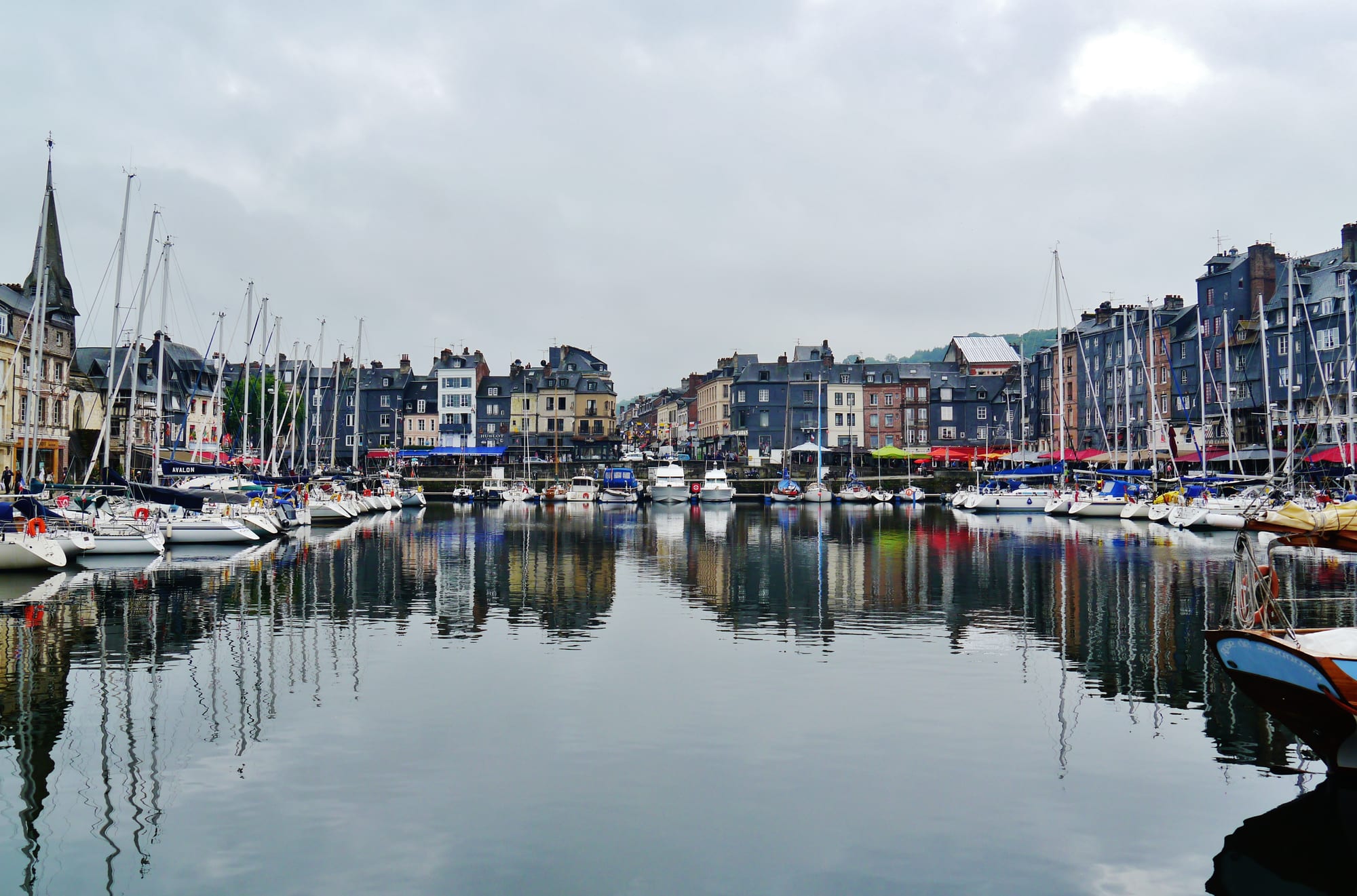
Sailing boats moored in a calm harbour lined with tall slate-fronted houses, reflected in the water under a grey sky

Normandy, France

Honfleur

The Vieux Bassin, Honfleur's old harbour, with the tall houses of its quays. (Zairon / Wikimedia Commons · CC BY-SA 4.0)

A small harbour town on the south bank of the Seine estuary, facing Le Havre beside the Pont de Normandie. A medieval port of trade and exploration, from which Champlain sailed to found Quebec in 1608, it later drew Boudin, Courbet, Jongkind and the young Monet. Today its slate-fronted houses around the Vieux Bassin make it one of the most popular small towns in France.

Neighbourhoods

  • L'Enclos and the Vieux Bassin
    • First-time visitors
    • Historic district
    • Best for food

    The old walled core around the harbour basin, with the Lieutenance at its entrance, the church of Saint-Étienne, now the marine museum, and the salt barns. The quays are lined with tall slate-hung houses and dozens of restaurants.

    Open in Maps
  • The Sainte-Catherine quarter
    • Markets
    • Historic district

    The district around the great wooden church and its separate bell tower, whose square holds the town's markets on Wednesday and Saturday mornings.

    Open in Maps
  • Côte de Grâce
    • Views
    • Walks

    The heights above the town, crowned by the pilgrimage chapel of Notre-Dame de Grâce, looking out over Honfleur and the Seine estuary.

    Open in Maps
  • Vasouy and the estuary shore
    • Quiet and residential

    The former village of Vasouy, merged into Honfleur in 1973, and the quieter residential streets along the shore of the estuary away from the harbour crowds.

    Open in Maps

Things to do

The old port and churches

  • Vieux Bassin and the Lieutenancelandmark

    The old harbour basin, completed in 1684 under Abraham Duquesne and enlarged in the 1720s, with the Lieutenance, the former home of the town's governor, guarding its entrance.

    Open in Maps
  • Église Sainte-Catherinelandmark

    One of the largest wooden churches in France, built from the second half of the 15th century after the stone church was destroyed in the Hundred Years' War, with a detached bell tower meant to reduce the risk of fire from lightning.

    Open in Maps
  • Église Saint-Léonardlandmark

    A church whose Flamboyant Gothic façade and one bay escaped a fire set by Calvinists in 1562; the interior, wooden vault included, is entirely painted.

    Open in Maps
  • Greniers à sellandmark

    Two 17th-century salt barns, survivors of three, which stored salt to preserve the fishing fleet's catch under wooden roofs built by naval carpenters.

    Open in Maps
  • Chapelle Notre-Dame de Grâceviewpoint

    A pilgrimage chapel on the Côte de Grâce, rebuilt after the cliff collapsed, with a carillon of 24 bells outside and views over the estuary.

    Open in Maps

Museums

  • Musée Eugène-Boudinmuseum

    The town's main museum, with works by Boudin, exhibitions on artists who worked in Normandy, and an annexe of religious art in the bell tower of Sainte-Catherine.

    Open in Maps
  • Maisons Satiemuseum

    The house where the composer Erik Satie was born in 1866, now a museum offering a surrealist walk through his music and wit.

    Open in Maps
  • Musée de la Marinemuseum

    A maritime museum in the church of Saint-Étienne on the Vieux Bassin, the oldest church in the town, dating partly from the 14th and 15th centuries.

    Open in Maps
  • Naturospaceattraction

    A butterfly house home to about 15,000 butterflies of some 150 species, open from February to November.

    Open in Maps

Short trips from the town

  • Pont de Normandielandmark

    The cable-stayed road bridge over the Seine estuary linking Honfleur with Le Havre, more than two kilometres long.

    Open in Maps
  • Le Havreattraction

    The port city across the estuary, founded by Francis I in 1517 and rebuilt in concrete after the war by Auguste Perret, a UNESCO World Heritage Site.

    Open in Maps
  • Trouville-sur-Mer and Deauvillebeach

    The neighbouring beach resorts on either side of the Touques, painted by Monet, Boudin and Dufy and long known as the 21st arrondissement of Paris.

    Open in Maps
  • Étretatviewpoint

    The village of the chalk arches and sea stack on the Alabaster Coast, north-east of Le Havre.

    Open in Maps

Seasonal events

  • Festival Estuaire d'en rireearly September

    A comedy festival held at the start of September.

  • Festival du cinéma russelate November

    A festival of Russian cinema held every year since 1995, said to be the largest of its kind in France.

Eat and drink

Long-standing places and food districts in Honfleur. Hours, ratings and directions come from your maps app, always current.

Honfleur classics

  • Restaurants of the Vieux Bassinneighborhood

    More than a hundred restaurants serve the town, many of them clustered around the old harbour, with seafood such as oysters and lobster on many menus.

    Open in Maps
  • Place Hamelin and the lanes near the Lieutenanceneighborhood

    A square near the Lieutenance, just behind the harbour, with restaurants among its old houses.

    Open in Maps

Markets

  • Saturday marketmarket

    The traditional market on the place Sainte-Catherine on Saturday mornings, with a fish market at the harbour the same day and an organic market on Wednesdays.

    Open in Maps

Experience Honfleur

History

Honfleur first appears in writing in 1025, in a charter of Duke Richard III of Normandy. By the middle of the 12th century it was a significant transit point for goods from Rouen to England, and its sheltered harbour on the estuary of the Seine made it strategic when the Hundred Years' War began. Charles V strengthened its defences to guard the estuary, but the English took the town in 1357 and held it again from 1419 to 1450; when in French hands, raiders sailed from it to attack the English coast, partly destroying Sandwich in Kent in the 1450s.

Peace brought a maritime boom that lasted until the end of the 18th century. Binot Paulmier de Gonneville sailed for Brazil in 1503, Jean Denis for Newfoundland and the St Lawrence in 1506, and in 1608 Samuel de Champlain's expedition left Honfleur to found Quebec. Trade with Canada, the West Indies, Africa and the Azores followed, and Honfleur became one of the five principal slave-trading ports of France. Colbert ordered part of the walls taken down from 1664 to enlarge the harbour, and Abraham Duquesne turned it into a wet dock, the Vieux Bassin, completed in 1684 and enlarged in the 1720s.

The wars of the Revolution and Napoleon's continental blockade ruined the port. It recovered only partly in the 19th century, with timber from northern Europe, as silt built up at its entrance and Le Havre grew across the estuary. Painters arrived instead: Boudin, Courbet, Jongkind and Monet met at a farm on the hillside, a gathering that helped give rise to Impressionism. The town was liberated without fighting on 25 August 1944 by British, Belgian and Canadian troops, and its old centre survives intact.

Culture & Customs

Painting is the town's great cultural legacy. Its houses, harbour, skies and estuary light drew Courbet, Eugène Boudin, Johan Jongkind and Claude Monet, a circle sometimes called the École de Honfleur, and their gatherings at a farm on the hill above the town contributed to the birth of Impressionism. The Boudin museum tells that story.

Honfleur is also the birthplace of the humorist Alphonse Allais and the composer Erik Satie, both born in the same street; the Maisons Satie celebrate the composer in his birthplace, and a garden by the estuary holds busts of famous Honfleurais, from Champlain and the explorer Gonneville to Satie, Allais and the writer Lucie Delarue-Mardrus. The town counts 57 listed historic monuments, among them Sainte-Catherine, Saint-Étienne, Saint-Léonard, the salt barns, the Lieutenance and most of the houses on the quai Sainte-Catherine.

The seafaring past is honoured too. The pilgrimage chapel of Notre-Dame de Grâce on the hill has a carillon of 24 bells, and the Sainte-Bernadette, the last crayfishing sloop still able to sail, is a listed historic monument. The calendar includes a festival of Russian cinema each November since 1995 and a comedy festival in early September.

Daily Life

Honfleur had 6,640 inhabitants in 2023, a fall of more than 10 per cent since 2017; its population peaked at 9,946 in 1866. It is the seat of the canton of Honfleur-Deauville and of the communauté de communes du Pays de Honfleur-Beuzeville. In 1973 it absorbed the small commune of Vasouy.

Tourism dominates the economy. Visitors fill the quays from spring to autumn, and the town has more than a hundred restaurants for a population of under 7,000. The port, though limited since the 19th century by silting and by the growth of Le Havre, still functions. The town is also the seat of the Pays d'Auge chamber of commerce, which partly manages the port and Deauville–Normandie Airport.

The town's position shapes daily life. The Pont de Normandie, which locals nickname the Honfleur bridge, links it with Le Havre across the estuary, and Deauville and Trouville are close by along the Côte Fleurie. Women make up a clearly larger share of the population than the average for the department.

Food

Honfleur's cooking looks both to the sea and to the Pays d'Auge, the countryside of orchards and dairy pasture in which the town lies. Seafood features on many restaurant menus around the Vieux Bassin, and on Saturday mornings a fish market sets up at the harbour beside the traditional market on the place Sainte-Catherine; an organic market fills the same square on Wednesdays. The salt barns are a reminder that the town once salted the catch of a large fishing fleet.

The Pays d'Auge supplies the rest of the table. Square Pont-l'Évêque cheese takes its name from a town close by, and pungent Livarot and Camembert de Normandie come from the same countryside. Butter and cream are central to Norman cooking, and several dishes are prepared in the vallée d'Auge style, among them poulet vallée d'Auge.

The drinks are from the orchard: the cidre of the Pays d'Auge, pommeau, a blend of apple must and calvados, and calvados itself, the brandy made from apples or pears and aged in oak, traditionally taken between courses as the trou normand. Desserts include apple tarts and teurgoule, a rice pudding flavoured with cinnamon and baked for several hours.

Planning tools

Budget

Honfleur charges resort prices, especially on summer weekends when visitors from Paris arrive, and rooms in the old town are limited. Eating on the Vieux Bassin costs more than in the side streets. Le Havre across the bridge and the inland Pays d'Auge are cheaper places to stay, and the harbour, churches and Côte de Grâce cost nothing.

Daily Budget Midrange
USD 170–310 (hotel or chambre d'hôte in town, seafood dinners, museum entries, a hire car)
Daily Budget Shoestring
USD 80–120 (simple room or chambre d'hôte outside the centre, market and crêperie meals, buses)

Visit on a weekday or early in the morning to avoid the weekend crowds, and pick a restaurant a street back from the harbour.

Best Time to Visit

May to September, when the days are long and the terraces on the Vieux Bassin are open, though summer weekends are crowded. Apple blossom covers the Pays d'Auge in late April and May. Autumn brings the cider harvest and the film and comedy festivals, and winter is quiet, grey and mild.

Suggested Number of Days

A day covers the old town at a gentle pace. Allow two or three days to add the resorts of the Côte Fleurie, the Pays d'Auge countryside and the cities and cliffs across the estuary; a car makes the longer stay easier.

First Visit
1 day
With Surroundings
2–3 days

Transportation

The town centre is small enough to cover entirely on foot. A car or a bicycle is the practical way to explore the Pays d'Auge countryside and the Côte Fleurie, and the Pont de Normandie puts Le Havre within easy reach by road.

The Pont de Normandie is a toll bridge for cars; on summer weekends the roads into the old town are congested.

Airport & Station Connections

Honfleur is about 194 kilometres west of Paris by the A13 motorway, across the estuary from Le Havre by the Pont de Normandie and 64 kilometres north-east of Caen. Most visitors come by road; neighbouring Trouville and Deauville are easily reached by train from Paris. Deauville–Normandie Airport, a small airport east of Deauville, is the nearest, and ferries from Portsmouth dock at Le Havre and at Ouistreham near Caen.

Walkability

Very good. The Vieux Bassin, Sainte-Catherine, the museums and the salt barns are all within a few minutes' walk on cobbled, sometimes steep lanes. The Côte de Grâce is a climb up the hill above the town, and the garden by the estuary is a short walk from the harbour.

Safety

France is a safe country overall, with violent crime against visitors uncommon. Honfleur is a quiet town; the main risks are pickpockets in the summer crowds on the quays, thefts from parked cars, and slippery cobbles and quay edges in wet weather.

Keep valuables out of sight in parked cars, watch children near the unfenced quay edges, and check the tide before walking on the estuary shore. Check current official travel advice before travelling.

Climate

Oceanic, with rain in every season, mild winters and cool summers. At Saint-Gatien-des-Bois, the nearest main weather station, the average annual temperature is about 11°C.

Summer
mild — in nearby Le Havre, the temperature rises above 25°C on only about 11 days a year
Winter
cool and damp — in nearby Le Havre, the temperature drops below 0°C on about 25 days a year

Local Customs

A 'bonjour' on entering any shop, gallery or restaurant is expected, and tipping is modest because service is included. Sainte-Catherine and Saint-Léonard are working churches, and the chapel on the Côte de Grâce is a place of pilgrimage.

Dress modestly and keep quiet during services, and ask before photographing artists at work along the quays.

Common Payment Methods

The currency is the euro. Cards and contactless payment are accepted almost everywhere, including most restaurants, galleries and museums; market stalls sometimes prefer cash. There are cash machines in the town centre.