💰 Budget
Rouen is good value for Normandy and far cheaper than Paris, with lunch menus, student bars and a large stock of mid-range rooms. Most churches and the quays are free. Prices rise during the Armada, when the whole region fills.
- Daily Budget Midrange
- USD 150–280 (central hotel, restaurant dinners, museum entries, a day trip by train or hire car)
- Daily Budget Shoestring
- USD 70–110 (hostel or budget hotel, market and bakery food, tram and bus tickets)
A day ticket on the tram and buses covers both banks; the Gothic churches and the Gros-Horloge street cost nothing to see.
📅 Best Time to Visit
May to September for long, mild days and the gardens of the Jardin des Plantes. The Armada years fill the quays with tall ships and visitors, and the Foire Saint-Romain runs through October and November. Winter is grey and damp but quiet, and the museums and churches are uncrowded.
⏳ Suggested Number of Days
Two days cover the old town and its museums at a comfortable pace. Allow three to five days to add the abbeys and castles of the Seine valley and the gardens upstream, which are easiest to reach with a car or by combining trains and buses.
- First Visit
- 2 days
- With Surroundings
- 3–5 days
🚆 Transportation
A tram running partly in a tunnel under the centre links Boulingrin in the north with the left bank, where it branches into two lines, and the TEOR bus lines cross the city east to west and north to south. Ordinary buses cover the rest of the metropolitan area, and the city has bike rental and cycle lanes. The centre itself is best on foot.
Rail and city transport fares have been integrated for season-ticket holders since 2024; occasional visitors buy tickets at tram stations or from machines.
🛬 Airport & Station Connections
Trains from Paris Saint-Lazare reach Rouen-Rive-Droite station, on the line to Le Havre, and lines continue to Le Havre, Caen and Dieppe, with direct trains to Amiens and Lille and daily TGVs to Lyon and Marseille. Rouen's own airport has no scheduled flights; most travellers use Paris Charles de Gaulle, about 159 kilometres away. Ferry ports at Dieppe, Le Havre and Caen are within easy driving distance.
🚶 Walkability
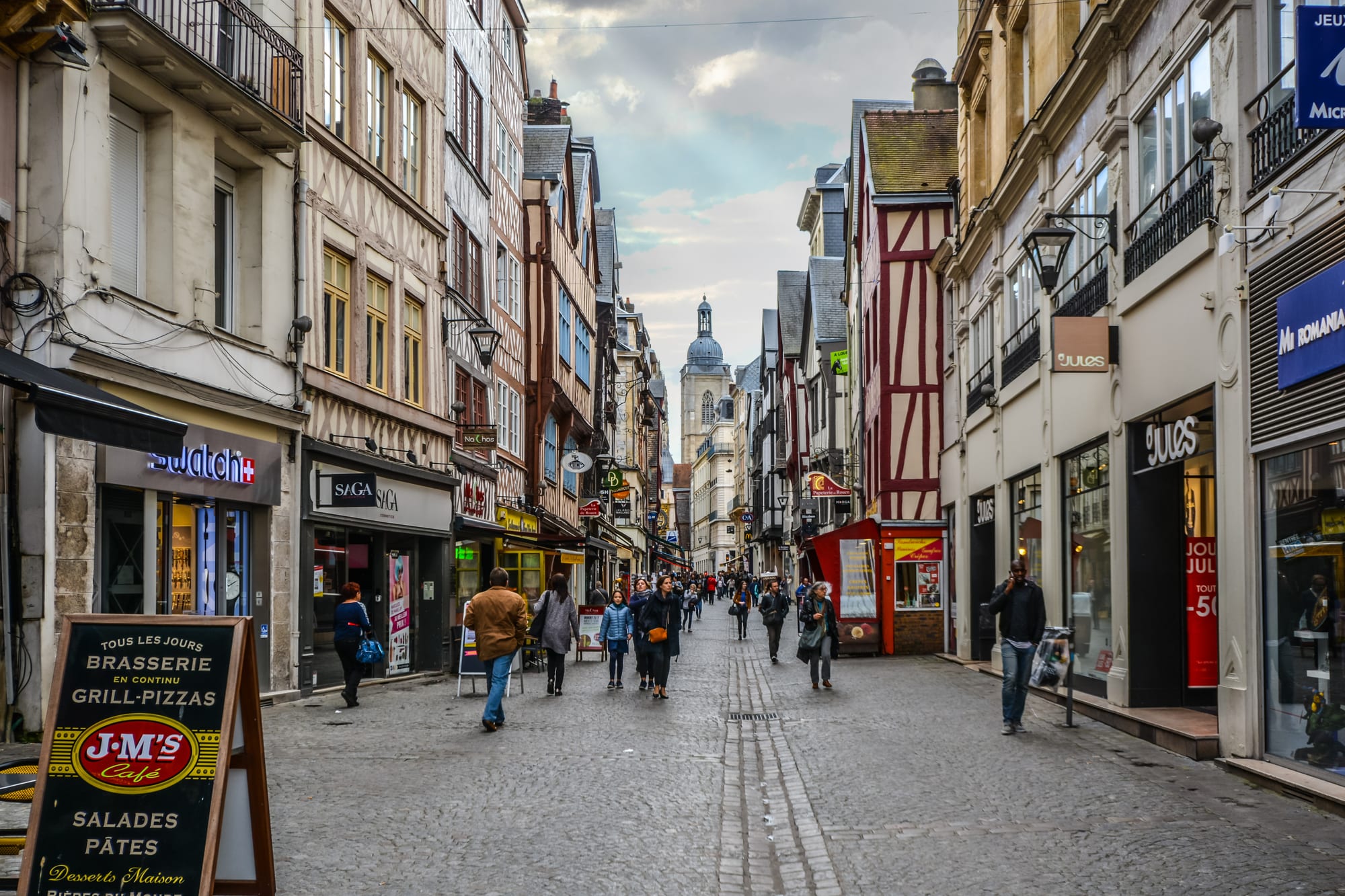
Excellent in the old town: about eight kilometres of streets are reserved for pedestrians, and the cathedral, the Gros-Horloge, the Vieux-Marché, Saint-Maclou and Saint-Ouen are all within a short walk. The quays are pleasant for walking, but crossing to the left bank means busy bridges, and the outer districts are better reached by tram.
🛡️ Safety
France is a safe country overall, with violent crime against visitors uncommon. In 2024 the Interior Ministry ranked Rouen fourth among France's most dangerous cities, so the usual big-city care is needed in crowds and at night; some outer districts, such as the Hauts-de-Rouen and la Grand'Mare, have high poverty and social problems but see few visitors. The city sits beside large industrial sites, and a fire at the Lubrizol chemical plant in 2019 caused a pollution cloud.
Keep bags closed in busy streets and on the tram, take the usual care late at night around the station, and follow official instructions in the rare event of an industrial alert. Check current official travel advice before travelling.
🌦️ Climate
Oceanic and changeable, with rain spread through the year. Rouen's average annual temperature is about 12.6°C and its rainfall a little over 800 millimetres; the record high, 43°C, was set in July 2019.
- Summer
- mild to warm — summers are generally cool in this oceanic climate, though heatwaves can be severe, as when 43°C was reached on 25 July 2019
- Winter
- cool and damp — cold spells are possible; the record low is −17°C, set on 8 January 1985
🤝 Local Customs
A 'bonjour' on entering a shop or café is expected, and tipping is neither required nor expected, being left only for exceptional service. The cathedral, Saint-Maclou and Saint-Ouen are churches as well as monuments, and Joan of Arc is honoured at the Vieux-Marché, where a small garden marks the place of the pyre.
Dress modestly and keep quiet in churches during services, and respect the memorial garden at the Vieux-Marché.
💳 Common Payment Methods
The currency is the euro. Cards and contactless payment are accepted almost everywhere, including markets and museums; a little cash is handy at market stalls and small bakeries.