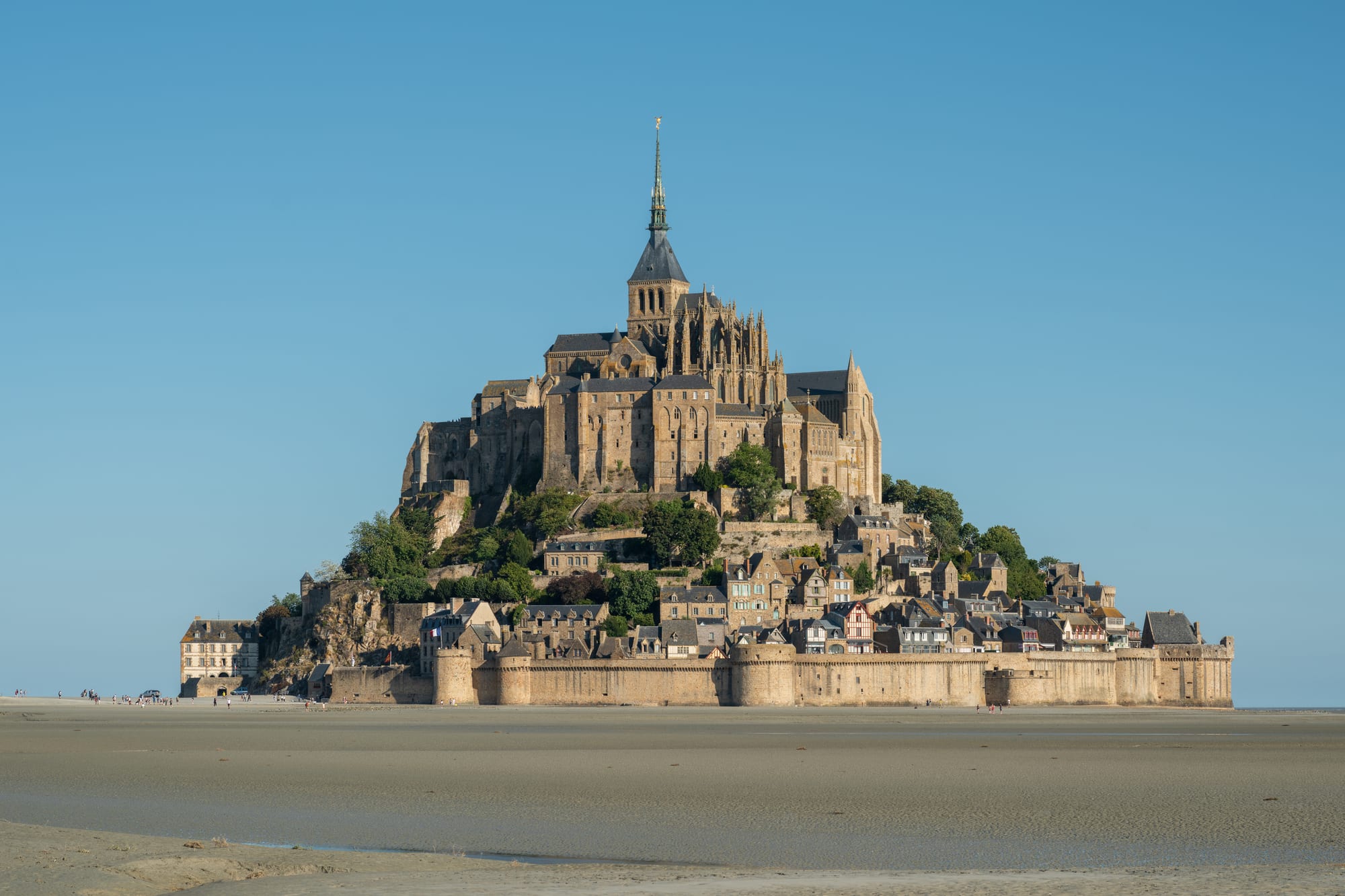
The abbey and walled village of Mont-Saint-Michel rising from flat sands at low tide under a clear blue sky

Normandy, France

Mont-Saint-Michel

Mont-Saint-Michel seen across the sands of the bay at low tide in the morning. (Lynx1211 / Wikimedia Commons · CC BY-SA 4.0)

A granite tidal island about a kilometre off the Normandy coast at the mouth of the Couesnon, crowned by a Benedictine abbey and wrapped in medieval ramparts. Pilgrims have come since the Middle Ages, the abbey served as a prison after the Revolution, and today a few dozen residents share the rock with millions of visitors who cross a bridge opened in 2014.

Neighbourhoods

  • The rock: Grande Rue and the ramparts
    • First-time visitors
    • Historic district

    Inside the walls, the Grande Rue climbs from the main gate towards the abbey, lined with souvenir shops, restaurants and old houses, many of them 19th- and early 20th-century recreations. The ramparts, with seven towers, are a little calmer and look out over the bay.

    Open in Maps
  • The mainland at the foot of the bridge
    • Close to transport
    • Salt meadows

    On the shore, about 2.5 kilometres from the rock, are the car parks, the shuttle stop and the hotels, shops and supermarket built outside the walls, set among the salt meadows where sheep graze.

    Open in Maps
  • Pontorson
    • Budget base
    • Close to public transport

    The nearest real town, about nine kilometres inland, with the railway station that serves the Mount, buses timed to meet the trains and a flat route for cycling out to the bay.

    Open in Maps

Things to do

The abbey and the village

  • Mont-Saint-Michel Abbeylandmark

    The abbey at the summit, with a Romanesque church whose transept crossing sits on the very top of the rock, held up by crypts and chapels, and the Gothic buildings of la Merveille rebuilt after a fire of 1204.

    Open in Maps
  • Grande Rueneighborhood

    The single main street of the village, running from the Porte de l'Avancée up to the abbey through the old pilgrims' quarter.

    Open in Maps
  • The rampartsviewpoint

    A wall walk with machicolations and seven towers, built up between the late 14th and 16th centuries, giving views over the sands and the houses of the village.

    Open in Maps
  • Chapelle Notre-Dame-sous-Terrelandmark

    The double-nave pre-Romanesque church added by the Benedictine monks who settled here in 966, where remains of Saint Aubert's oratory were found; it now lies beneath the nave of the abbey church.

    Open in Maps
  • Les Micheletteslandmark

    Two wrought-iron bombards abandoned by the English after their failed assault of 1434 in the Hundred Years' War, displayed in the courtyard of the Avancée at the entrance to the village.

    Open in Maps

The bay

  • Guided walk across the baytrail

    Licensed guides lead barefoot walks across the sands at low tide, often from Genêts on the Normandy shore, through mud and channels where the tides are among the biggest in Europe.

    Open in Maps

Short trips from the Mount

  • Tombelainelandmark

    The small granite island a few kilometres to the north, reached on foot only at low tide and with a guide.

    Open in Maps
  • Avranchesmuseum

    The hilltop town of the bishop said to have founded the first church on the Mount, whose Scriptorial museum holds the abbey's medieval illuminated manuscripts.

    Open in Maps
  • Cancaleattraction

    A fishing port on the Breton side of the bay known as the oyster capital of Brittany, with an oyster market at the harbour.

    Open in Maps
  • Granvilleattraction

    A walled former privateer port and seaside resort on the Normandy side of the bay, home of the Dior family.

    Open in Maps
  • Saint-Maloattraction

    The walled corsair city on the Breton coast, heavily bombed in 1944 and rebuilt, with ferries to the Channel Islands.

    Open in Maps

Seasonal events

  • Saint Michael pilgrimageSeptember

    The annual pilgrimage to the sanctuary of the archangel, which drew some 4,000 people in 2024; walkers still follow the old routes of the medieval Miquelots.

  • Abbey concertsMay to September

    A season of concerts held in the abbey by the national monuments centre since 2010.

  • Equinox high tidesaround the March and September equinoxes

    The largest tides of the year in the bay, whose range can reach about 15 metres; in March 2015 an exceptional tide covered the whole bridge.

Eat and drink

Long-standing places and food districts in Mont-Saint-Michel. Hours, ratings and directions come from your maps app, always current.

Mont-Saint-Michel classics

  • Salt-meadow lamb on the mainlandneighborhood

    Restaurants around the bay serve agneau de pré-salé from the sheep that graze the salt marshes of the shore.

    Open in Maps
  • Pontorsonneighborhood

    The nearest town's cafés and restaurants, an everyday alternative to the crowded eating places inside the walls.

    Open in Maps

Experience Mont-Saint-Michel

History

Before it was an island the rock stood on dry land, and as the sea rose it became one of several granite outcrops in the bay, known as Mont Tombe. According to legend the archangel Michael appeared in 708 to Aubert, bishop of Avranches, and told him to build a church on it. In 933 William Longsword annexed the Cotentin and the Avranchin, making the Mount Norman for good, and in 966 Benedictine monks settled on the rock. In the 11th century the Italian builder William of Volpiano designed a Romanesque church with its crossing set on the very summit; after Breton troops burned the village and the abbey in 1204, Philip Augustus paid for Gothic rebuilding, the origin of the Merveille.

During the Hundred Years' War the English besieged the Mount twice, in 1423–24 and 1433–34, and failed both times; the small garrison kept two of their bombards as trophies. Louis XI made the abbey a prison, a role it held again from the Revolution, when it took clerical opponents of the republic and then political prisoners. Victor Hugo campaigned for its restoration; the prison closed in 1863 and the Mount became a historic monument in 1874.

A raised causeway of 1879, polders and the canalised Couesnon let silt build up around the rock. After the German occupation and the liberation in August 1944, the Mount and its bay were listed by UNESCO in 1979. A dam on the Couesnon began work in 2009, the causeway and its car park were removed, and in 2014 a light bridge by Dietmar Feichtinger opened so that the sea could flow freely around the island again.

Culture & Customs

The Mount has been a pilgrimage site since at least the 9th century. Medieval pilgrims, called Miquelots, walked from Italy, Germany and England as well as across France, bought lead flasks filled with sand from the shore and later pilgrim badges, and found board and lodging in the village at the foot of the abbey. Ten long-distance walking routes now retrace their paths, and the annual September pilgrimage still draws thousands. Benedictine monks returned in 1966; since 2001 a community of the Monastic Fraternities of Jerusalem has lived on the rock and prays in the abbey church, or in the crypt of Notre-Dame des Trente Cierges in winter.

The rock has a strong hold on the imagination. It appears in the Bayeux Tapestry, where Harold rescues Norman knights from the quicksand, and it was the model for St Michael's Mount in Cornwall, a priory given to the abbey after the Conquest. Its silhouette is said to have inspired the city of Minas Tirith in The Lord of the Rings films and the kingdom of Corona in Disney's Tangled.

Daily custom here is shaped by the tide and the crowds. Visitors watch the water come in from the ramparts, barefoot walkers come back across the sands with muddy legs, and the Grande Rue's shopkeepers have long competed for trade; a handful of families have dominated the village's businesses and its administration for generations.

Daily Life

Only 23 people lived in the commune in 2023, and about 25 people, monks included, sleep on the rock on an ordinary night apart from hotel guests. Most of the commune's 400 hectares are on the mainland, among the salt meadows of the shore. The population has been falling since the prison closed in 1863: the old houses on the rock are small, damp and unreachable by car, and residents have moved to more comfortable homes inland.

Tourism is almost the only source of income. There are about 50 shops and 132 hotel rooms within the walls, and a few groups own most of the businesses inside and outside them, including half of the restaurants and three of the museums. On peak summer days up to 20,000 people arrive, most of them day-trippers who crowd the village between late morning and late afternoon. The average visit lasts two to three hours.

Managing those numbers is the standing local issue. Free parking after the evening rush outside July and August is meant to spread visits through the day, while the higher parking charges, the long walk from the car park and shuttles that stop short of the gate have been blamed for a fall in visitor numbers since the early 2000s. In summer, dolphins follow the currents into the bay, where they are often seen near the small fishing boats known as barquettes.

Food

The Mount is best known for its omelette, whipped until frothy and light. Its best-known version was created by Anne Boutiaut Poulard, who came to the Mount as the maid of the architect Édouard Corroyer, restorer of the abbey, and the omelette has drawn wide attention ever since. Inside the walls the Grande Rue and its side lanes are lined with restaurants, crêperies, cafés and snack bars, and their prices reflect the crowds.

The other great local dish comes from the shore. The polders and salt marshes around the bay are grazed by sheep, and agneau de pré-salé, salt-meadow lamb, comes from animals grazed on the salt-tolerant grasses of these pastures. It appears on the menus of restaurants that depend on the visitors, and sheep grazing beneath the rock are part of the view from the bridge.

The bay also supplies seafood: Cancale, on its Breton side, is known as the oyster capital of Brittany and sells oysters straight from the producers at its harbour market, and the wider Normandy table brings cider, calvados, butter and cream. Outside the walls, Pontorson and the villages around the bay have simpler restaurants where locals eat.

Planning tools

Budget

Anything within sight of the Mount charges resort prices: meals inside the walls cost more than in nearby towns, the mainland car park charges a daily fee, and the abbey has an entry charge. Staying in Pontorson, Avranches or the villages of the bay and coming in early or late keeps the cost down. Walking the bridge, the village streets and the ramparts is free.

Daily Budget Midrange
USD 170–320 (hotel on the mainland or in a bay town, a seafood or lamb dinner, abbey entry and a guided bay walk, a hire car)
Daily Budget Shoestring
USD 70–120 (hostel or simple room in Pontorson, picnic and crêperie meals, train and bus, abbey entry)

Free parking after the evening rush outside July and August makes a late visit cheaper as well as quieter.

Best Time to Visit

May to September for the warmest weather and the abbey concerts, but summer days are crowded from late morning to late afternoon, and spring weekends are busy too. The largest tides come around the March and September equinoxes. Early mornings and evenings are the calmest times all year, and winter brings few visitors and grey, mild days.

Suggested Number of Days

The Mount itself fills a long day, and a night nearby allows a visit before and after the crowds. Allow two or three days to take in the bay and the towns along its shores; low-tide activities depend on the tide times.

First Visit
1 day
With Surroundings
2–3 days

Transportation

Private cars stop at the mainland car parks, about 2.5 kilometres from the rock. From there visitors walk along the edge of the salt meadow and over the bridge, or ride the free shuttle buses, which leave a few hundred metres' walk to the gate. Bicycles can be parked free, and the ride from Pontorson is easy. On the rock everything is on foot.

Expect long queues for the car park and a single congested road in and out on summer days; arriving early or late avoids the worst.

Airport & Station Connections

There is no direct train from Paris: most visitors without a car take the TGV from Paris Montparnasse to Rennes and a connecting coach of about 90 minutes, or a train to Pontorson and a bus to the car park. Coaches also run from Saint-Malo and, by local bus, from Granville and Avranches. The nearest airport is Rennes–Saint-Jacques, about 88 kilometres to the south. By road the Mount is about four hours from Paris and an hour and a half from Caen.

Walkability

Entirely on foot once on the rock, but steep: the Grande Rue and the stairways climb steadily to the abbey, with many steps and uneven paving, and the main street is packed in the middle of the day. The quieter Porte Échauguette and the ramparts lead up by other routes. The walk from the car park to the gate takes about 50 minutes on a flat path.

Safety

France is a safe country overall, with violent crime against visitors uncommon. On the Mount the real danger is the bay: the tide rises fast, the sands hide deep mud and quicksand, and walking out without checking the tide or without a licensed guide is dangerous. Crowds in the Grande Rue at midday attract the occasional pickpocket.

Never walk on the sands without a licensed guide and the tide tables, keep valuables close in the crowded street, and leave nothing visible in a parked car. Check current official travel advice before travelling.

Climate

Oceanic and mild, with rain possible in any month and wind off the bay. At nearby Pontorson the average annual temperature is about 12°C and the yearly rainfall about 840 millimetres.

Summer
mild — in nearby Pontorson, August is the warmest month, with an average temperature of about 18°C
Winter
cool and damp — in nearby Pontorson, January averages about 6°C

Local Customs

The abbey is still a place of worship: a small community of monks and nuns of the Monastic Fraternities of Jerusalem prays there several times a day. A 'bonjour' on entering any shop or restaurant is expected, and tipping is neither required nor expected in France, and is usually left only for exceptional service.

Dress modestly and keep quiet during services in the abbey church, and wash the mud off at the foot-washing points after a barefoot walk rather than in the streets.

Common Payment Methods

The currency is the euro. Cards and contactless payment are accepted in almost all shops, restaurants and at the abbey; a little cash is useful for small purchases.