💰 Budget
Colmar is one of the dearer bases in Grand Est, above all in December, when the Christmas markets push hotel prices up sharply. Food is good value at lunchtime, and wine tastings in the surrounding villages are often cheap or free; the main extras are museum tickets and a car or bike for the wine route.
- Daily Budget Midrange
- USD 160–290 (mid-range hotel, Alsatian dinners, the Unterlinden Museum, a hire car or bike on the wine route)
- Daily Budget Shoestring
- USD 75–115 (budget hotel or campsite, tarte flambée and bakery lunches, local buses)
Rooms for December go months ahead; staying in Mulhouse or Sélestat and arriving by train is an alternative.
📅 Best Time to Visit
May to October for the wine villages and outdoor terraces, with the grape harvest from September and the classical music festival in summer. Late November and December bring the Christmas markets and the year's largest crowds. January to March is cold and quiet.
⏳ Suggested Number of Days
One or two days are enough for the old town, its canals and the main museums. Three or four allow time for the wine villages and castles along the foot of the Vosges, which are easiest with a car or bike.
- First Visit
- 1–2 days
- With Surroundings
- 3–4 days
🚆 Transportation
The old town is small enough to cover on foot. The Trace bus network serves the town and neighbouring communes, including the camp site about 2 km from the centre, and a small tourist train runs around the old town. A car or a bike is the usual way to reach the wine villages.
Bikes can be hired in town, which suits the short distances to the nearest wine villages.
🛬 Airport & Station Connections
Colmar is about 64 km south-south-west of Strasbourg. The nearest international airports are EuroAirport Basel Mulhouse Freiburg, about 52 km away, and Strasbourg Airport, about 68 km away. Most visitors arrive by train at Colmar station, which is also the hub for interurban buses, or by road; a bus links the town with Breisach in Germany, which has trains to Freiburg.
🚶 Walkability
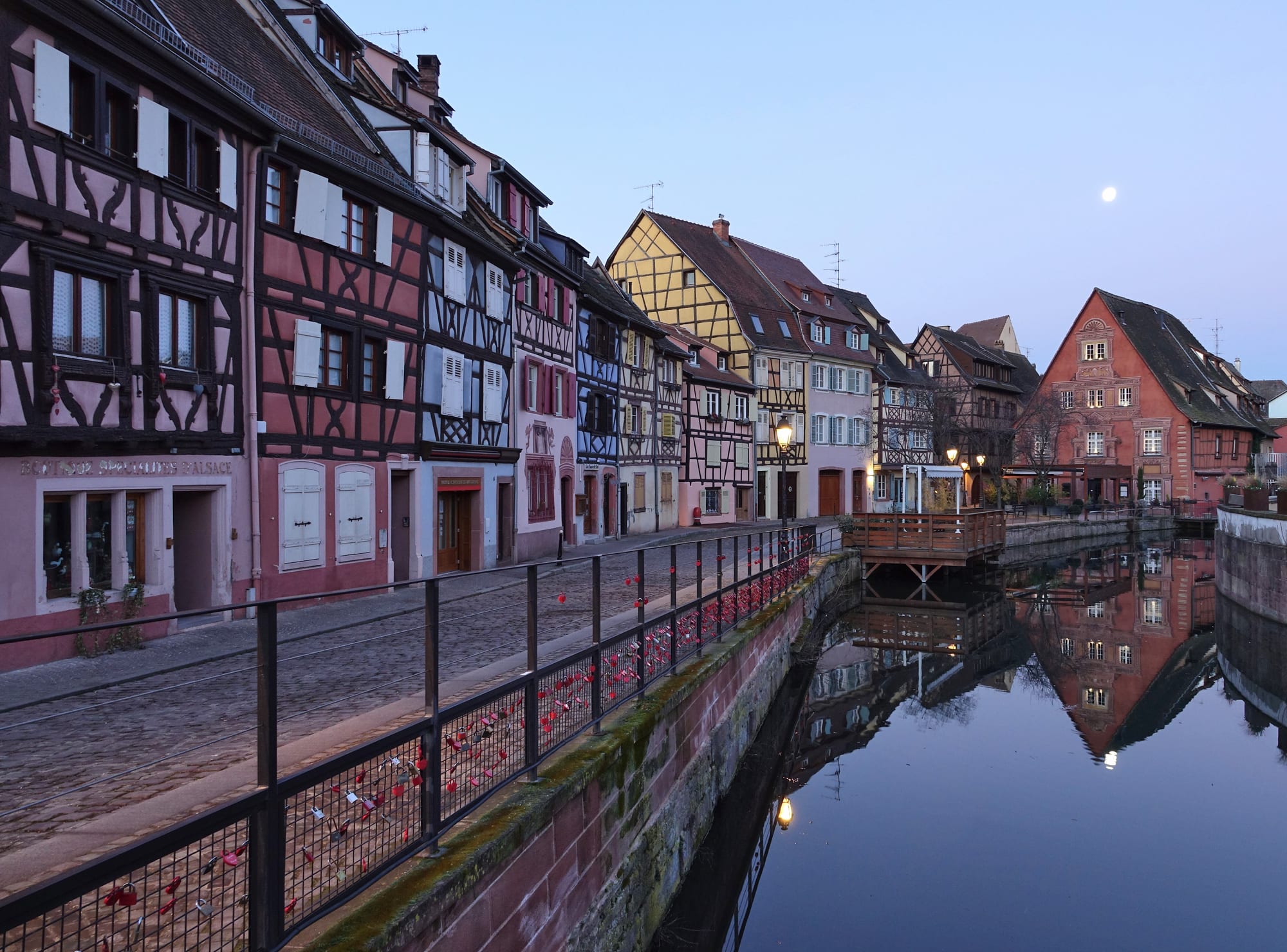
The old town and Little Venice are compact and largely pedestrian, with cobbled streets, and the station is a short walk from the centre. Crowds in the narrow streets at weekends and in December slow everything down.
🛡️ Safety
France is a safe country overall, with violent crime against visitors uncommon. Colmar is an affluent town, and the usual care with bags in crowded streets and markets is enough.
Watch bags at the Christmas markets and take care on cobbles and canal edges after dark. Check current official travel advice before travelling.
🌦️ Climate
Sheltered by the Vosges, Colmar has a sunny microclimate and is one of the driest cities in France, with roughly 560–600 mm of rain a year and an annual mean of about 11°C. Winters are cold and dry, summers warm to hot and wetter; the town's record high is 39.6°C, set in August 2003.
- Summer
- warm to hot and wetter than winter; the record high is 39.6°C
- Winter
- cold and dry; the record low is −22.5°C, set in February 1986
🤝 Local Customs
Service is included in French restaurant bills, so tipping is modest. A greeting of 'bonjour' on entering a shop is expected. Alsatian is the traditional local dialect, and Alsace keeps Good Friday and 26 December as public holidays.
Saint-Martin is a working church: dress modestly and keep quiet during services. The houses of Little Venice are homes, so keep noise down in the evenings.
💳 Common Payment Methods
The currency is the euro. Cards and contactless payment are accepted almost everywhere; a little cash is useful at market stalls, small bakeries and some village wine growers, and ATMs are easy to find in the centre.