💰 Budget
Reims is cheaper than Strasbourg or Colmar for rooms and food, and the fixed-price lunch menu is good value. The real extra is Champagne: house tours and tastings cost noticeably more than a museum ticket, and prices rise for the premium visits. The cathedral, Saint-Remi and the Porte de Mars are free to see.
- Daily Budget Midrange
- USD 150–280 (mid-range hotel, brasserie dinners, a Champagne cellar tour, museum entry)
- Daily Budget Shoestring
- USD 70–110 (budget hotel, bakery and market lunches, tram tickets)
Wine shops facing the cathedral sell Champagne at much the same prices as the houses themselves, and the Saturday market is good for picnic food.
📅 Best Time to Visit
May to October for the vineyards, with the grape harvest from September and the Joan of Arc festival in June. December brings the Christmas market on the cathedral square. The cellars stay cool all year, so Champagne visits work in any season.
⏳ Suggested Number of Days
Two days suit a first visit, including a Champagne cellar or two. Three or four allow time for the vineyard villages and towns of the surrounding hills, which are easiest with a car or on an organised tour.
- First Visit
- 2 days
- With Surroundings
- 3–4 days
🚆 Transportation
A tramway opened in 2011 runs about 11 km north to south through the city, linking the centre with the TGV station, and buses cover the rest; since 2024 the network has been run as Grand Reims Mobilités. The centre is compact enough to walk, and a car is the simplest way into the vineyards.
The tram links the TGV station at Bezannes with the city centre, so arriving by high-speed train needs no taxi.
🛬 Airport & Station Connections
Reims lies about 129 km north-east of Paris. TGV trains from Paris take about 45 minutes and stop either at Gare de Reims in the centre or at the Champagne-Ardenne TGV station in Bezannes, about 5 km south-west, linked to the centre by tram; TGVs also run to Metz, Nancy and Strasbourg. Paris Charles de Gaulle Airport, about 136 km away, is the usual airport, and the A4, A26 and A34 motorways meet near the city.
🚶 Walkability
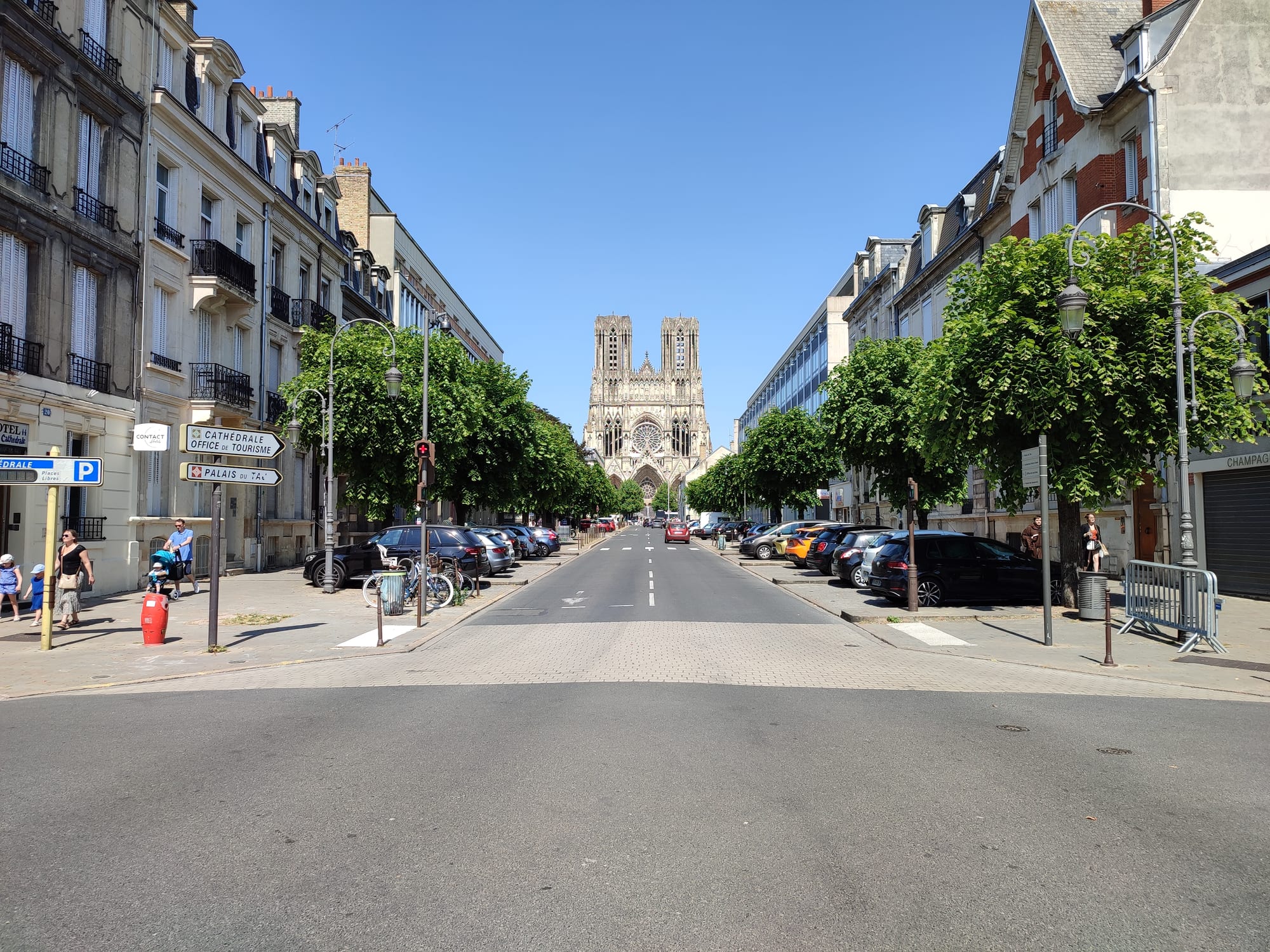
The centre is flat and compact: the station, Place Drouet-d'Erlon and the cathedral are all within easy walking distance, with Saint-Remi a little further south. The Champagne houses and Parc de Champagne are a longer walk, or a short ride.
🛡️ Safety
France is a safe country overall, with violent crime against visitors uncommon. In Reims the main concerns are petty theft in busy places such as Place Drouet-d'Erlon at night and around the stations, and the crowds of the Christmas market.
Keep bags closed in crowds and late at night around the bars, and arrange a taxi or designated driver after Champagne tastings. Check current official travel advice before travelling.
🌦️ Climate
An oceanic climate influenced by the city's inland position, with around 1,700 hours of sunshine a year, most of it in summer. Summers are dry and sometimes stormy, with occasional heatwaves, and winters can be sharp; much of the year is grey.
- Summer
- warm, with occasional heatwaves — the record is 41.1°C, set in July 2019
- Winter
- can be sharp, though the Champagne plain around Reims is milder than the rest of the region, with an annual mean of about 10.5°C
🤝 Local Customs
Service is included in French restaurant bills, so tipping is modest — rounding up or leaving a little for good service. A greeting of 'bonjour' on entering a shop is expected.
The cathedral and Saint-Remi are working churches: dress modestly and keep quiet during services. Drink-driving limits are strict in France.
💳 Common Payment Methods
The currency is the euro. Cards and contactless payment are accepted almost everywhere, including at the Champagne houses; a little cash is useful at market stalls and small bakeries, and ATMs are easy to find in the centre.