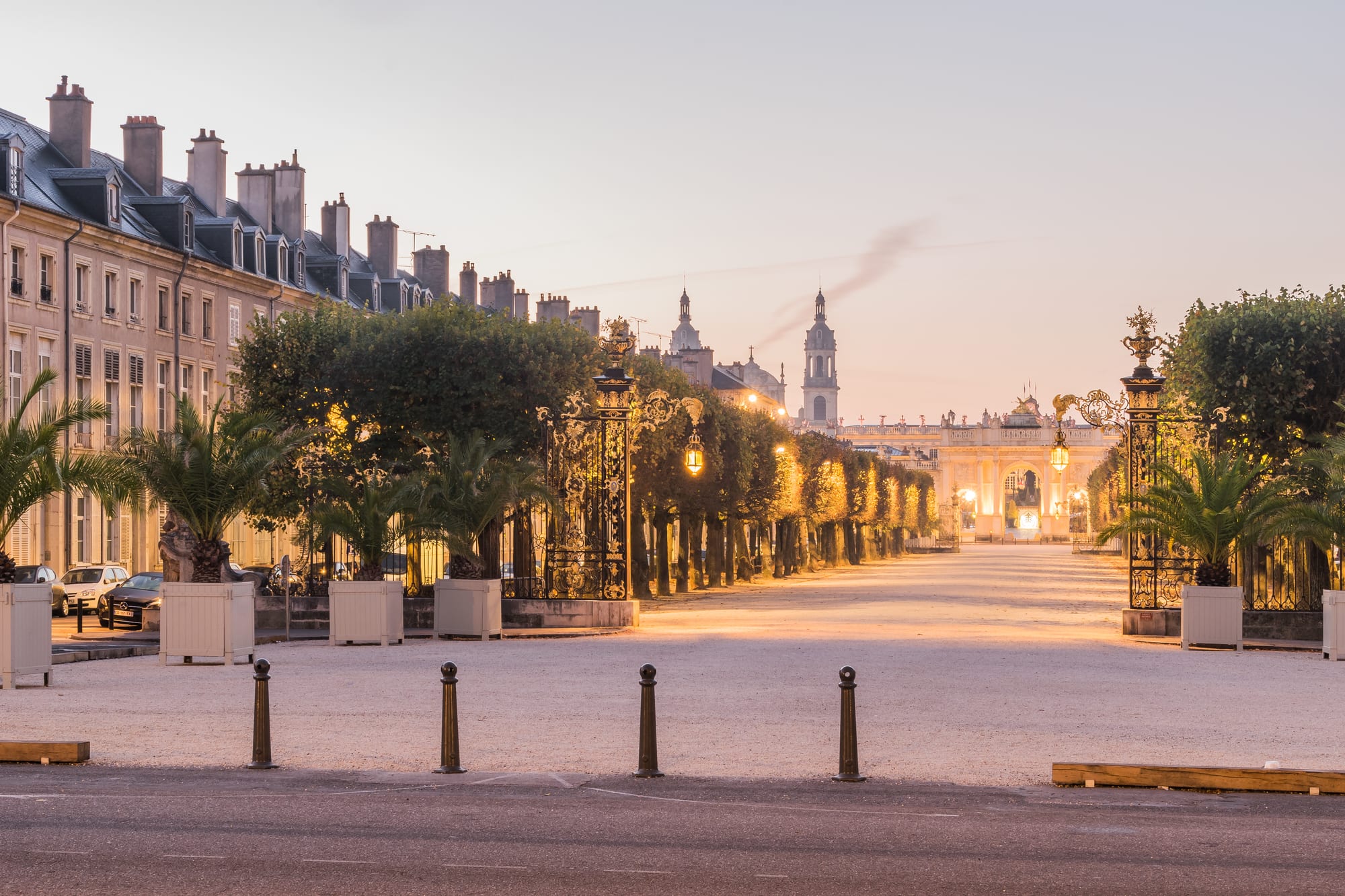
A long tree-lined square at dawn with gilded wrought-iron gates, rows of stone houses and church towers in the distance

Grand Est: Alsace, Champagne & Lorraine, France

Nancy

The Place de la Carrière in Nancy, part of the 18th-century ensemble listed by UNESCO. (Krzysztof Golik / Wikimedia Commons · CC BY-SA 4.0)

The prefecture of Meurthe-et-Moselle, on the left bank of the Meurthe in Lorraine — the old capital of the dukes of Lorraine, rebuilt in the 18th century by Stanislas, the exiled king of Poland, around the gilded Place Stanislas. A century later the École de Nancy made it a centre of Art Nouveau; today it is a university city of about 100,000 people.

Neighbourhoods

  • Ville Vieille
    • Historic district
    • Best for food

    The oldest part of the city, around the Ducal Palace, with the 14th-century Porte de la Craffe, the Cordeliers church and the 19th-century Basilica of Saint-Epvre. The Grande Rue that runs through it is lined with small restaurants and shops.

    Open in Maps
  • Place Stanislas and the Ville-Neuve
    • First-time visitors
    • Architecture
    • Close to public transport

    The 18th-century heart of the city, built under Stanislas around the Place Stanislas, the Place de la Carrière and the Place d'Alliance, with the cathedral, the Opéra national de Lorraine, the Museum of Fine Arts and the main railway station all close by.

    Open in Maps
  • Marché central quarter
    • Best for food
    • Local life

    A pedestrian quarter around the covered central market and Place Charles III, with streets of shops and cafés running from rue de la Primatiale towards avenue Foch.

    Open in Maps

Things to do

Famous landmarks

  • Place Stanislaslandmark

    A large pedestrian square built in 1752–1756 by Emmanuel Héré for Stanislas, framed by gilded wrought-iron gates and fountains, and a UNESCO World Heritage Site since 1983.

    Open in Maps
  • Place de la Carrièrelandmark

    A long tree-lined square, a fine example of 18th-century architecture and part of the UNESCO-listed ensemble.

    Open in Maps
  • Ducal Palace of Nancymuseum

    The former residence of the dukes of Lorraine, home to the Musée Lorrain, devoted to the art, history and popular traditions of Lorraine.

    Open in Maps
  • Porte de la Craffelandmark

    A 14th-century gate at the northern end of the Grande Rue, flanked by two round towers added in 1463.

    Open in Maps
  • Nancy Cathedrallandmark

    The 18th-century Baroque cathedral, seat of the bishop of Nancy and Toul.

    Open in Maps
  • Saint-Epvre Basilicalandmark

    A 19th-century neo-Gothic basilica by the architect Prosper Morey, rising above the old town.

    Open in Maps
  • Church of Saint-François-des-Cordelierslandmark

    A church beside the Ducal Palace with historic ties to the ducal House of Lorraine.

    Open in Maps

Art Nouveau and museums

  • Musée de l'École de Nancymuseum

    Opened in 1964 in the villa of the Art Nouveau patron Eugène Corbin, with furniture, glass, stained glass and ceramics by Gallé, Majorelle, Daum and others, and a garden with an aquarium pavilion.

    Open in Maps
  • Villa Majorellelandmark

    The home and studio of the furniture designer Louis Majorelle, built in 1901–1902 by Henri Sauvage and one of the first and most influential Art Nouveau houses in France.

    Open in Maps
  • Museum of Fine Artsmuseum

    One of the oldest museums in France, in a pavilion on the Place Stanislas, with European paintings, a large Daum glass collection and a gallery devoted to Jean Prouvé.

    Open in Maps
  • Aquarium and Natural History Museummuseum

    The city's natural history museum, with an aquarium.

    Open in Maps

Parks and gardens

  • Parc de la Pépinièrepark

    A park of about 22 hectares in the city centre, created by Stanislas in the 18th century, with a small zoo and a children's puppet theatre.

    Open in Maps
  • Parc Sainte-Mariepark

    A public park that tends to be less crowded than the Pépinière in summer.

    Open in Maps
  • Jardin Botanique du Montetpark

    The botanical garden in neighbouring Villers-lès-Nancy, at the end of a bus line from the centre.

    Open in Maps

Short trips from the city

  • Basilica of Saint-Nicolaslandmark

    A Flamboyant Gothic pilgrimage basilica in Saint-Nicolas-de-Port, said to hold relics of Saint Nicholas brought from Italy, built by Duke René II in thanksgiving for his victory at the Battle of Nancy in 1477.

    Open in Maps

Seasonal events

  • Le Livre sur la PlaceSeptember

    The first national book fair of the French literary season, held on the Place de la Carrière on the second weekend of September.

  • Nancy Jazz PulsationsOctober

    A festival of jazz and contemporary music held in the first half of October since 1973.

  • Saint Nicholas celebrationsearly December

    Lorraine's patron saint is celebrated over about two weeks, with a parade on the first weekend of December.

Eat and drink

Long-standing places and food districts in Nancy. Hours, ratings and directions come from your maps app, always current.

Nancy classics

  • Macarons and bergamotescafe

    Nancy is known for its macarons and for bergamotes, translucent golden sweets flavoured with bergamot essential oil, sold in the city's confectioners.

    Open in Maps
  • Quiche lorrainerestaurant

    The Lorraine variant of the quiche, a pastry case filled with savoury custard and lardons or bacon.

    Open in Maps

Food districts and markets

  • Marché centralmarket

    The covered central market at the heart of a pedestrian quarter, with local produce, and bars around it.

    Open in Maps
  • Grande Rueneighborhood

    The old town's main street, near the Basilica of Saint-Epvre, lined with small restaurants.

    Open in Maps
  • Rue Stanislasneighborhood

    The street leading west from the Place Stanislas, with bars, including several known for speciality beers, and casual restaurants.

    Open in Maps

Experience Nancy

History

Nancy began in the 11th century as a fortified town founded by Gerard, Duke of Lorraine, and grew into the seat of the dukes. Its great moment of medieval history came in 1477, when Charles the Bold of Burgundy was defeated and killed outside its walls at the Battle of Nancy and René II secured the duchy; the thistle he adopted as his emblem is still on the city's coat of arms. The Ducal Palace and the Porte de la Craffe survive from this ducal town.

In the 18th century the duchy was given to Stanislas Leszczyński, the exiled king of Poland and father-in-law of Louis XV of France. His patronage produced the city's most notable monuments: between 1752 and 1756 the architect Emmanuel Héré built the Place Stanislas, part of an ensemble with the Place de la Carrière and the Place d'Alliance. When Stanislas died in February 1766 Lorraine became part of the kingdom of France, with Nancy kept as the capital of the province.

In 1871, when Germany annexed Alsace and part of Lorraine, Nancy remained French, and by the late 19th century it was known as the "capital of eastern France". It was also the home of the École de Nancy, the Art Nouveau movement founded in 1901 by Émile Gallé, Victor Prouvé, Louis Majorelle, Antonin Daum and Eugène Vallin. In September 1944 the US Third Army liberated the city. The squares were listed by UNESCO in 1983, and the restored Place Stanislas was reopened in 2005 by the leaders of France, Germany and Poland.

Culture & Customs

Two periods define Nancy's look: the 18th-century ensemble of Stanislas, and the Art Nouveau of the École de Nancy. Gallé's glass and furniture, Majorelle's furniture, Daum's crystal and Jacques Grüber's stained glass made the city one of the major centres of the movement in Europe, and its legacy survives in the Musée de l'École de Nancy and the Villa Majorelle. The Museum of Fine Arts, one of the oldest in France, adds a large Daum collection and a gallery devoted to the designer Jean Prouvé.

The city has a strong cultural calendar. Le Livre sur la Place opens the literary season every September, Nancy Jazz Pulsations has filled October since the 1970s, and the Opéra national de Lorraine stands in the 18th-century quarter around the Place Stanislas. In early December the city celebrates Saint Nicholas, patron saint of Lorraine since 1477, with a parade, and the nearby basilica of Saint-Nicolas-de-Port has long been a place of pilgrimage.

Sport has its own history. AS Nancy-Lorraine won the French Cup in 1978 with Michel Platini as captain and scorer of the only goal of the final, and counts Arsène Wenger and Aimé Jacquet among its former figures; SLUC Nancy won the last Korać Cup in basketball in 2002 and the French championship in 2008.

Daily Life

About 104,000 people lived in the city proper in 2022, and about 509,000 in the metropolitan area in 2021 — the largest urban area in Lorraine, even though the city itself is slightly smaller than Metz. The city's population has dipped slightly in recent years while its suburbs have grown.

Education is a major economic driver: the University of Lorraine is one of the largest in France, and the city had about 52,000 students in 2020. The city is also the prefecture of Meurthe-et-Moselle, the seat of a bishop and a regional centre for hospitals and services.

Public transport changed recently: the unusual guided-tram line closed in 2023 and was replaced in 2025 by long trolleybuses that run on batteries through the historic centre to avoid overhead wires. Residents shop at the central market, meet on the squares and in the bars of the old town and rue Stanislas, and use the Pépinière and Parc Sainte-Marie in summer. Outer suburban communes grew with new housing in the 1980s and 1990s.

Food

The quiche lorraine is the region's variant of the quiche: a pastry case filled with savoury custard and lardons or bacon, served hot, warm or cold. Nancy itself is known for two sweets: its macarons, and bergamotes, sweets flavoured with the essential oil of the bergamot orange.

The covered central market, at the heart of a pedestrian quarter around Place Charles III, is the place for local produce, and the bars nearby include some known for speciality beers. Products made from mirabelle plums are another local speciality.

For eating out, the Grande Rue in the old town has a string of small restaurants, rue Stanislas leading off the Place Stanislas has bars and casual places, and the terraces of the great squares fill on summer evenings. Several bars near the Place Stanislas and the market specialise in beer, Belgian beers especially, and the city's students keep the cheaper restaurants and bars busy throughout the year.

Planning tools

Budget

Nancy is good value compared with Strasbourg and Colmar, with lower hotel prices and plenty of inexpensive restaurants around the market and the old town. Most of the 18th-century squares and the Art Nouveau street fronts cost nothing to see; the museums are the main extra.

Daily Budget Midrange
USD 140–260 (mid-range hotel, restaurant dinners, museum entry)
Daily Budget Shoestring
USD 65–105 (budget hotel, market and bakery lunches, bus tickets)

The fixed-price lunch menu is the cheapest way to eat well, and the squares and Art Nouveau façades are free to enjoy.

Best Time to Visit

May to September for terraces on the squares and long evenings in the parks. September brings the book fair and October the jazz festival, and early December the Saint Nicholas parade. Winters are cold, often foggy, and quiet.

Suggested Number of Days

Two days are enough for the squares, the old town and the Art Nouveau museums and houses at an easy pace. Three days leave room for the towns and pilgrimage churches nearby, or for combining the visit with Metz.

First Visit
2 days
With Surroundings
3 days

Transportation

The guided-tram line that ran from the early 2000s was withdrawn in March 2023 and replaced on 5 April 2025 by bi-articulated trolleybuses, which run on battery power through much of the city centre. Buses run by STAN cover the rest of the city and suburbs, and the centre is easily walked.

Tickets can be bought from the driver on buses or from machines at the former tram stops.

Airport & Station Connections

Nancy-Ville station, in the heart of the city on the Paris–Strasbourg railway, has TGV services to Paris in about 1 hour 30 minutes and regional trains across Lorraine. The Lorraine TGV station at Louvigny, between Metz and Nancy, opened in 2007 near the regional airport. Metz–Nancy–Lorraine Airport, halfway between the two cities, has scheduled flights to several French cities and North Africa; the nearest international airport is EuroAirport Basel-Mulhouse-Freiburg, about 206 km away. Long-distance buses also serve the city.

Walkability

The centre is compact and flat: the station, the Place Stanislas, the old town and the market are all within a short walk of each other, and large areas are pedestrianised. The Musée de l'École de Nancy and the Villa Majorelle are a longer walk or a short bus ride from the centre.

Safety

France is a safe country overall, with violent crime against visitors uncommon. Nancy's centre is busy and well used, and the usual city precautions with bags in crowds are enough.

Keep bags closed in crowds and on buses, and take normal care around the station late at night. Check current official travel advice before travelling.

Climate

More continental than most French cities, with cold winters, frequent fog in autumn and winter, and warm summers. At the nearby Tomblaine weather station the annual mean is about 11°C and annual rainfall about 750 mm; the record high there is 40.1°C, set in July 2019.

Summer
warm, with occasional heatwaves — the record is 40.1°C, set in July 2019
Winter
cold, often foggy — across Lorraine winters average about 1.5°C, and the record low at Tomblaine is -24.8°C

Local Customs

Service is included in French restaurant bills, so tipping is modest — rounding up or leaving a little for good service. A greeting of 'bonjour' on entering a shop is expected. The thistle on the city's coat of arms was adopted as an emblem by René of Anjou and later by Duke René II.

Churches are places of worship: dress modestly and keep quiet during services. The Place Stanislas is a pedestrian square.

Common Payment Methods

The currency is the euro. Cards and contactless payment are accepted almost everywhere; a little cash is useful at market stalls and small bakeries, and ATMs are easy to find in the centre.