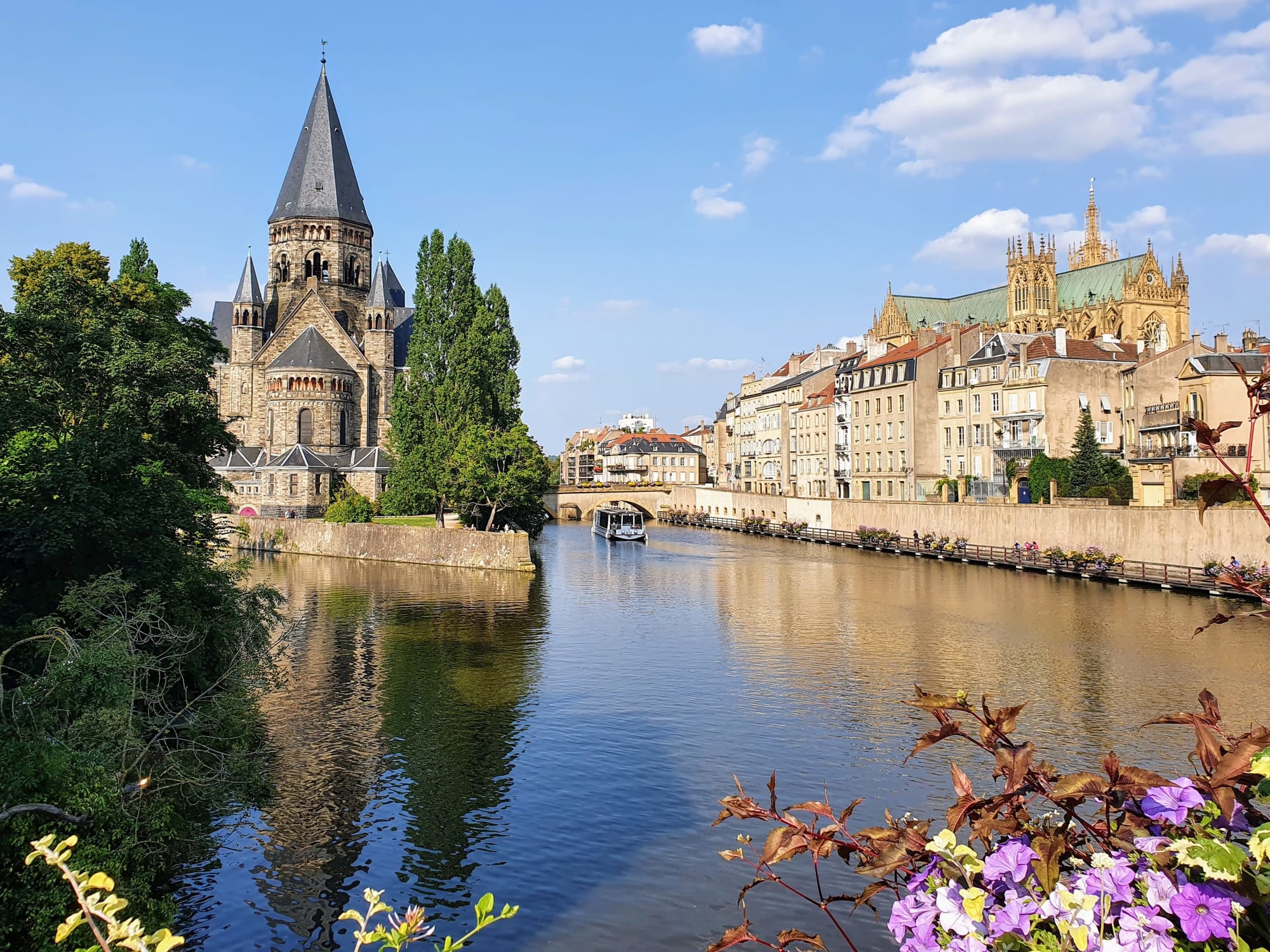
The Moselle river with a dark-roofed stone church on the left bank and a row of houses below the Gothic cathedral on the right

Grand Est: Alsace, Champagne & Lorraine, France

Metz

The Temple Neuf, the Moselle and Saint-Stephen's Cathedral seen from the Moyen Pont in Metz. (Pieter van Everdingen / Wikimedia Commons · CC BY-SA 4.0)

The prefecture of the Moselle, at the confluence of the Moselle and the Seille near the borders with Germany and Luxembourg — a Celtic stronghold, a major Roman city, a Merovingian capital and a medieval republic, later twice annexed by Germany. Its Gothic cathedral holds the world's largest expanse of stained glass, and the Centre Pompidou-Metz has made it a modern art destination.

Neighbourhoods

  • Old town
    • First-time visitors
    • Historic district
    • Best for food

    The historic centre that grew from the Sainte-Croix hill, where the Gallo-Roman town began, with the cathedral, the covered market and the arcaded Place Saint-Louis, whose façades show Italian-influenced Gothic. Its streets form one of the largest commercial pedestrian areas in France.

    Open in Maps
  • Imperial Quarter
    • Architecture
    • Close to public transport

    The new town built by the German Empire between 1902 and 1914, from the railway station to the Serpenoise Gate, with grand stone buildings in many styles and some of the best-preserved German imperial town planning anywhere.

    Open in Maps
  • Amphithéâtre
    • Museums
    • Modern architecture

    A new district built around the Centre Pompidou-Metz, conceived by the architects Nicolas Michelin, Jean-Paul Viguier and Jean-Michel Wilmotte and the designer Philippe Starck.

    Open in Maps
  • Sablon
    • Quiet and residential
    • Local life

    A residential district partly built after 1871 in German style, with some Art Nouveau buildings and the city's railway yards nearby.

    Open in Maps

Things to do

Famous landmarks

  • Metz Cathedrallandmark

    Saint-Stephen's Cathedral, begun in the early 14th century, with the third-highest nave in France and about 6,500 square metres of stained glass — the largest expanse in the world — including windows by Chagall.

    Open in Maps
  • Basilica of Saint-Pierre-aux-Nonnainslandmark

    One of the oldest churches in Europe, begun in the 4th century as part of the Gallo-Roman city and now used for concerts.

    Open in Maps
  • Germans' Gatelandmark

    A medieval bridge castle and city gate with two 13th-century round towers and two 15th-century gun bastions, whose restored Renaissance halls and towers are open to the public.

    Open in Maps
  • Metz-Ville stationlandmark

    The monumental railway station built under German rule, sometimes called the Station Palace for its apartments of Kaiser Wilhelm II.

    Open in Maps
  • Temple Neuflandmark

    A Protestant church on the Petit-Saulcy island in the Moselle, next to the opera house, begun in 1901 when Metz was part of the German Empire.

    Open in Maps
  • Opéra-Théâtre de Metzlandmark

    A 750-seat opera house on the Petit-Saulcy island, the oldest working opera house in France.

    Open in Maps
  • Place Saint-Louislandmark

    An arcaded square in the old town whose façades are among the city's examples of Italian-influenced Gothic of the 13th and 14th centuries.

    Open in Maps

Museums and music

  • Centre Pompidou-Metzmuseum

    The regional branch of the Pompidou Centre, opened in 2010 under a vast roof by Shigeru Ban, showing exhibitions from France's national modern art collection.

    Open in Maps
  • Musée de la Cour d'Ormuseum

    The city's museums of history and archaeology, architecture and fine arts, set in a former abbey, granary and church, where extension works revealed the remains of Gallo-Roman baths.

    Open in Maps
  • Arsenal concert hallattraction

    A former arsenal converted by Ricardo Bofill into a concert hall in 1989, home of the Orchestre National de Lorraine and known for its acoustics.

    Open in Maps
  • Maison de Verlainemuseum

    The house where the poet Paul Verlaine was born, now a museum of his life and work.

    Open in Maps

Markets

  • Covered Marketmarket

    One of the oldest and grandest covered markets in France, in the historic centre, home to traditional local producers and food shops.

    Open in Maps

Short trips from the city

  • Museum of the 1870 War and of the Annexationmuseum

    In Gravelotte, about 11 km from Metz on the site of the battle of 1870, the only museum in Europe devoted to the Franco-Prussian War and the annexation.

    Open in Maps
  • Scy-Chazellesattraction

    A town near Mont Saint-Quentin where the former house of the statesman Robert Schuman is now a museum of his life and work; he is buried in its fortified church.

    Open in Maps
  • Fort de Queuleulandmark

    A fort south-east of the city, begun by the French in 1868 and improved by the German Empire between 1872 and 1875, after the war of 1870–71.

    Open in Maps

Seasonal events

  • Mirabelle FestivalAugust

    Two weeks devoted to the mirabelle plum, with markets of fresh plums, tarts and liqueur, live music, fireworks, a parade of floral floats and the crowning of the Mirabelle Queen.

  • Christmas marketNovember and December

    The second most popular Christmas market in France.

Eat and drink

Long-standing places and food districts in Metz. Hours, ratings and directions come from your maps app, always current.

Metz classics

  • Lorraine dishesrestaurant

    Local restaurants serve quiche, potée lorraine, pâté lorrain and suckling pig, with Moselle wine or local beer.

    Open in Maps
  • Mirabelle tarts and brandycafe

    The mirabelle plum of Lorraine is made into jams, tarts and fruit brandy, sold in pastry shops and at the summer festival.

    Open in Maps

Food districts and markets

  • Covered Marketmarket

    The grand covered market in the historic centre, with stalls of local producers and traders.

    Open in Maps
  • Place Saint-Louisneighborhood

    Café and restaurant terraces under the arcades of the old town's medieval square.

    Open in Maps

Experience Metz

History

Before Julius Caesar's conquest of Gaul, Metz was the stronghold of the Celtic Mediomatrici. As Divodurum Mediomatricorum it became one of the principal towns of Roman Gaul, with about 40,000 people; its main streets still follow the Roman cardo and decumanus, and the Basilica of Saint-Pierre-aux-Nonnains began as a Roman building of the 4th century. In the 5th century the name became Mettis, and from the 6th to the 8th century the city was the residence of the Merovingian kings of Austrasia. It is also counted as the birthplace of the Carolingian dynasty, and under bishops such as Chrodegang it became a centre of Gregorian chant and of manuscript illumination, producing the Drogo Sacramentary.

In the 12th century Metz became a republic, which lasted until the 15th century. By the Treaty of Chambord of 1552 German Protestant princes handed it, with Toul and Verdun, to the king of France, although the Holy Roman Empire recognised the change only at the Peace of Westphalia in 1648. The city became one of France's great fortresses, and in 1789 the capital of the new Moselle department.

After the Franco-Prussian War the Treaty of Frankfurt of 1871 made largely French-speaking Metz part of the German Empire, as capital of the district of Lorraine, and between 1902 and 1914 the Germans built the Imperial Quarter around a monumental new station. The city returned to France in 1918, was annexed by Nazi Germany in 1940, and was attacked and taken by US forces in 1944. Since the decline of the steel industry, Metz has worked to diversify, and the opening of the Centre Pompidou-Metz in 2010 marked a new cultural ambition.

Culture & Customs

Metz has been steeped in French culture while strongly influenced by German culture through its location and history. The cathedral, nicknamed la Lanterne du Bon Dieu, the Good Lord's lantern, for its stained glass, displays windows from the Gothic master Hermann von Münster through the Renaissance to Roger Bissière, Jacques Villon and Marc Chagall, and another church in the city has a complete set of windows by Jean Cocteau. Between 1834 and 1870 the Metz School, an art movement centred on Charles-Laurent Maréchal, flourished here until the war and the annexation broke it up.

Music matters here. The Opéra-Théâtre is the oldest working opera house in France, the Arsenal concert hall is home to the Orchestre National de Lorraine, Saint-Pierre-aux-Nonnains hosts concerts of Gregorian chant, and the BAM is the venue for rock and electronic music. The Centre Pompidou-Metz has become one of the most visited cultural venues in France outside Paris. The poet Paul Verlaine was born in the city, and his birthplace is now a museum.

The city's emblem is the Graoully, a dragon said to have been defeated by Saint Clement, the first bishop of Metz, and it has appeared on the city's insignia since the 10th century. Metz calls itself la Ville Verte, the green city, for its many gardens along the Moselle and the Seille, and every August it devotes two weeks to the Mirabelle Festival. FC Metz is the city's football club.

Daily Life

About 122,000 people lived in Metz in 2022, and about 377,000 in the metropolitan area. The city is the prefecture of the Moselle and the seat of the regional council of Grand Est, and it lies about 43 km from the tripoint where France, Germany and Luxembourg meet, within the cross-border Greater Region.

A historic garrison town, Metz is the economic heart of Lorraine. The steel industry once dominated the Moselle's economy, and the city has since built up commerce, tourism, information technology and the car industry. The University of Lorraine, Georgia Tech Europe and other engineering schools are based here, and research in metallurgy continues the region's iron and steel heritage.

Residents live in the old town, in the German-built Imperial Quarter and Sablon, and in suburbs spread across the Moselle valley. The Mettis rapid buses link the centre with the campus and hospitals, and the riverside gardens fill on summer evenings. Like the rest of the Moselle, the city keeps the special local law inherited from the annexation years.

Food

Metz shares the cooking of Lorraine. Quiche is a pastry case filled with savoury custard, in its Lorraine form with lardons or bacon; potée lorraine is meat and vegetables, especially cabbage and potatoes, cooked together in stock; and pâté lorrain is a meat terrine in pastry, regarded as emblematic of the region. Suckling pig is another local speciality.

The mirabelle plum and the damson are made into jams, tarts, charcuterie and fruit brandy, and in August the Mirabelle Festival fills the city with stalls selling fresh plums, mirabelle tarts and liqueur. Local drinks include the wines of the Moselle and Amos beer.

The Covered Market in the historic centre, one of the oldest and grandest in France, is home to traditional producers and food shops and is the best place to find these specialities in one place. Restaurants and cafés spread across the pedestrian old town, with terraces under the arcades of the Place Saint-Louis.

Planning tools

Budget

Metz is good value compared with Strasbourg or Colmar, with moderate hotel prices and plenty of inexpensive places to eat in the pedestrian centre. The cathedral and the old streets are free; the Centre Pompidou-Metz and concerts at the Arsenal or the opera are the main extras.

Daily Budget Midrange
USD 140–260 (mid-range hotel, restaurant dinners, museum entry, a concert)
Daily Budget Shoestring
USD 65–105 (budget hotel, market and bakery lunches, Mettis and bus tickets)

Hotel prices rise during the Christmas market; the covered market is a good source of a cheap lunch.

Best Time to Visit

May to September for the riverside gardens and terraces, with the Mirabelle Festival in August. November and December bring one of the most popular Christmas markets in France. Winters are cold, but the museums and concert halls are busy all year.

Suggested Number of Days

Two days are enough for a first visit to the city at an easy pace. Three leave room for the museums and fortifications in the surrounding communes, or for combining the visit with Nancy.

First Visit
2 days
With Surroundings
3 days

Transportation

Mettis, a bus rapid transit system of high-capacity hybrid bi-articulated buses on dedicated lanes, runs two lines, A and B, linking the centre, the university campus and the hospitals, with a hub next to the railway station. Ordinary buses cover the rest of the city, and the centre is easily walked.

Speed limits of 30 km/h cover the whole city centre, which suits cycling.

Airport & Station Connections

Metz-Ville station has direct TGV services to Paris, taking about 80 minutes, and to Luxembourg, plus regional trains; the Lorraine TGV station at Louvigny, about 25 km south, serves high-speed trains to Lille, Nantes, Rennes and Bordeaux without changing in Paris. Luxembourg Airport is the nearest international airport, reached by train to Luxembourg City and then a bus, in about an hour and a half. The A31 and the A4 motorways meet at the city.

Walkability

The old town, the station, the Imperial Quarter and the Centre Pompidou-Metz all lie within walking distance of one another, and the centre is largely pedestrian. The Sainte-Croix hill and the cathedral area involve some gentle climbs, and paths along the Moselle and the Seille link the riverside gardens.

Safety

France is a safe country overall, with violent crime against visitors uncommon. Metz's centre is busy and calm; the usual risks are pickpocketing in the Christmas market crowds and around the station, and some outer districts have higher crime but are not on visitor routes.

Keep bags closed in crowds and take normal care around the station late at night. Check current official travel advice before travelling.

Climate

A semi-continental climate with cold winters and warm, sometimes stormy summers. At the nearby Augny weather station the annual mean is about 11°C, and the record high is 39.7°C, set in July 2019.

Summer
warm and humid, sometimes stormy — July days average about 25°C
Winter
cold but not often snowy — January nights average about -0.5°C

Local Customs

Service is included in French restaurant bills, so tipping is modest — rounding up or leaving a little for good service. A greeting of 'bonjour' on entering a shop is expected. Despite the nearby border, French is the language of daily life and few locals are fluent in German. The Moselle keeps its own local law from the annexation years, with Good Friday and 26 December as public holidays.

The cathedral is a working church: dress modestly and keep quiet during services. The Graoully dragon, the city's emblem, appears on many of its insignia.

Common Payment Methods

The currency is the euro. Cards and contactless payment are accepted almost everywhere; a little cash is useful at market stalls and small bakeries, and ATMs are easy to find in the centre. Prices across the border in Luxembourg are in euros too.