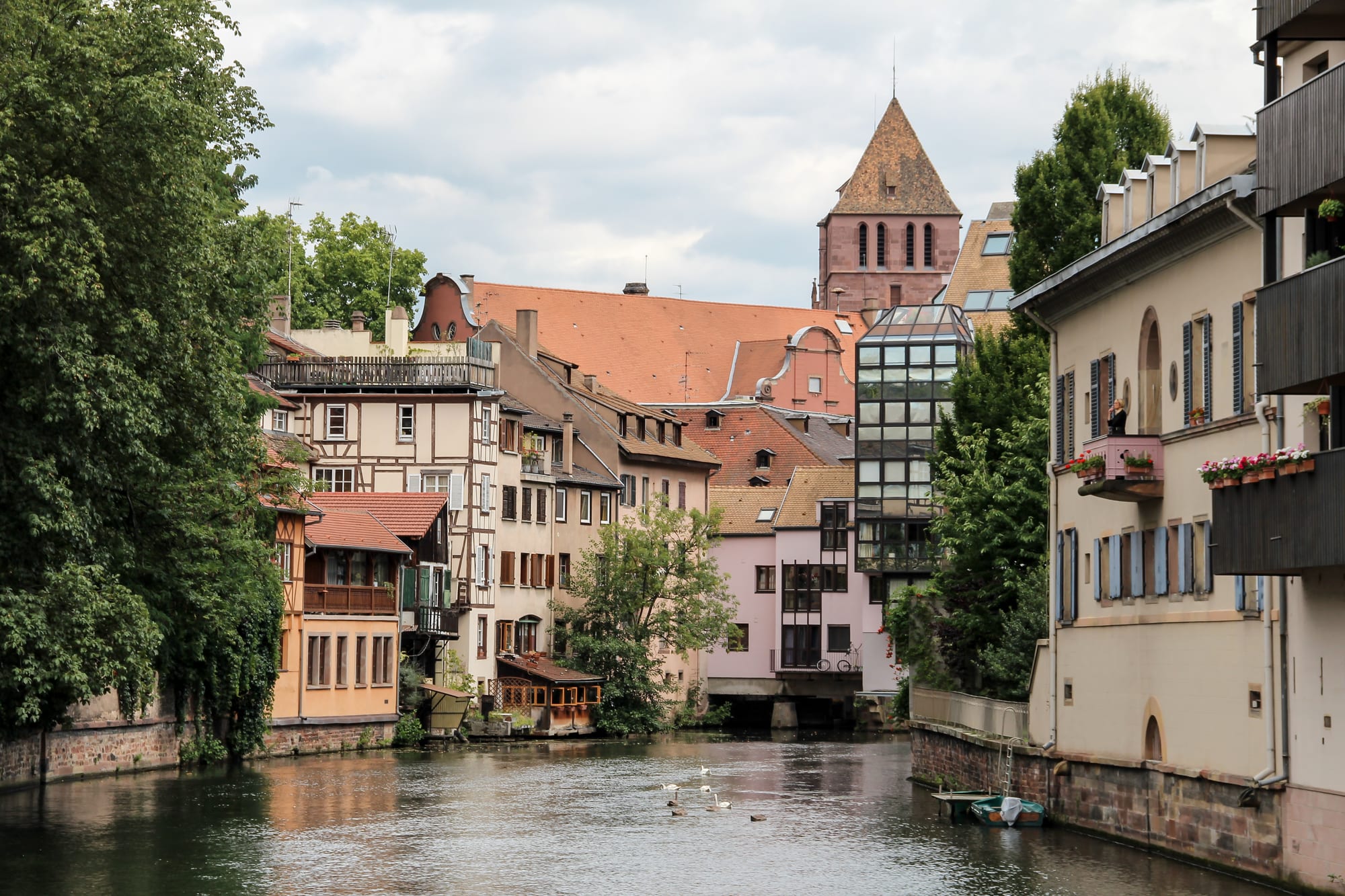
A canal of the Ill lined with half-timbered and plastered houses, swans on the water and a red sandstone church tower behind

Grand Est: Alsace, Champagne & Lorraine, France

Strasbourg

The Ill in Petite France, with the tower of the Église Saint-Thomas behind. (Dietmar Rabich / Wikimedia Commons · CC BY-SA 4.0)

The largest city of Grand Est, on the Ill just west of the Rhine and the German border — a Roman camp that became a free imperial city, a centre of printing and the Reformation, and a prize passed between France and Germany. Today it is the official seat of the European Parliament, with a sandstone cathedral, the canals of Petite France and a large university.

Neighbourhoods

  • Grande Île
    • First-time visitors
    • Historic district
    • Close to public transport

    The island old town ringed by the Ill, listed in its entirety by UNESCO in 1988. The cathedral, the Palais Rohan, Place Kléber and streets of timber-framed houses are all here, along with most of the shops, restaurants and the main Christmas market.

    Open in Maps
  • Petite France
    • Historic district
    • Canals
    • Photography

    The south-western corner of the Grande Île, where the Ill splits into channels once worked by tanners, millers and fishermen. Half-timbered houses lean over the water between the Covered Bridges and the Pont Saint-Thomas, and it is one of Strasbourg's main tourist attractions.

    Open in Maps
  • Neustadt
    • Architecture
    • Quiet and residential

    The German imperial new town built after 1871 to the north and north-east of the old centre, with wide avenues and some of the most complete town planning of the German Empire. Its heart was added to the UNESCO listing in 2017.

    Open in Maps
  • Krutenau
    • Students and nightlife
    • Best for food

    An old quarter beside the Grande Île with small restaurants, bars and a student crowd.

    Open in Maps
  • European Quarter and the Orangerie
    • European institutions
    • Parks

    North-east of the centre, the buildings of the European Parliament, the Council of Europe and the European Court of Human Rights stand along the Ill beside the Orangerie park.

    Open in Maps

Things to do

Famous landmarks

  • Strasbourg Cathedrallandmark

    A Gothic cathedral of red Vosges sandstone whose 142-metre spire made it the world's tallest building from 1647 to 1874, visible far across the plain of Alsace.

    Open in Maps
  • Strasbourg astronomical clockattraction

    The third clock on its spot inside the cathedral, dating from 1843, where figures of Christ and the Apostles process every day at solar noon while a rooster crows.

    Open in Maps
  • Kammerzell Houselandmark

    An ornately carved timber-framed house on Place de la Cathédrale, built in 1427 and remodelled in 1467 and 1589, its interior painted with frescoes by Léo Schnug.

    Open in Maps
  • Place Kléberlandmark

    The largest square in the centre, named after the revolutionary general Jean-Baptiste Kléber, whose statue stands over a vault holding his remains, with the 18th-century Aubette on its north side.

    Open in Maps
  • Ponts Couvertslandmark

    Three bridges and four towers forming a 13th-century defensive work at the western edge of Petite France.

    Open in Maps
  • Barrage Vaubanviewpoint

    A 17th-century weir and defensive work built to Vauban's plans to flood the land south of the city in a siege, with a roof terrace looking over the Covered Bridges and Petite France.

    Open in Maps
  • Palais Rohanmuseum

    The Baroque palace of the prince-bishops beside the cathedral, completed in 1742, which houses the archaeological, decorative arts and fine arts museums.

    Open in Maps

Museums

  • Musée de l'Œuvre Notre-Damemuseum

    The museum of Upper Rhenish art up to 1681, known for the cathedral's original sculptures, stained glass and building plans.

    Open in Maps
  • Musée alsacienmuseum

    A museum of traditional Alsatian daily life, with furniture, everyday objects and costumes; it closed for works in July 2025, with reopening planned for 2027.

    Open in Maps
  • Museum of Modern and Contemporary Artmuseum

    One of the largest museums of its kind in France, opened in its own building beside the Ill in 1998, covering art from 1870 to the present.

    Open in Maps

Parks and the river

  • Parc de l'Orangeriepark

    A large park opposite the Council of Europe, first laid out as a French garden and later remodelled in the English style for Joséphine de Beauharnais.

    Open in Maps
  • Boat trips on the Illattraction

    Tour boats leave from below Place du Marché aux Poissons for trips on the city's waterways.

    Open in Maps

The European Quarter

  • European Parliamentlandmark

    The official seat of the Parliament, which must meet here twelve times a year; the main chamber is in the Louise Weiss building, inaugurated in 1999.

    Open in Maps
  • Palace of Europelandmark

    The headquarters of the Council of Europe, an organisation separate from the European Union, based in Strasbourg since 1949.

    Open in Maps

Short trips from the city

  • Kehlattraction

    The German town directly across the Rhine, reached by tram line D or on foot over the Passerelle des Deux Rives through a garden that spans both banks.

    Open in Maps
  • Mont Sainte-Odileviewpoint

    A 764-metre peak in the Vosges west of Barr, topped by the Hohenburg convent and ringed by the ancient stone fortification known as the Pagan Wall.

    Open in Maps
  • Château du Haut-Koenigsbourglandmark

    A medieval castle on a spur above the Rhine plain west of Sélestat, abandoned in the Thirty Years' War and rebuilt in 1900–1908 for Kaiser Wilhelm II.

    Open in Maps

Seasonal events

  • Christkindelsmäriklate November to late December

    The Christmas market on the Grande Île around the cathedral and Place Kléber, dating back to 1570 and drawing about two million visitors a year.

Eat and drink

Long-standing places and food districts in Strasbourg. Hours, ratings and directions come from your maps app, always current.

Strasbourg classics

  • Choucroute and tarte flambée in the old townneighborhood

    Traditional Alsatian restaurants across the Grande Île serve choucroute garnie, sauerkraut with sausages and salted meats, and tarte flambée, often with a local beer.

    Open in Maps
  • Kammerzell Houserestaurant

    A restaurant inside the carved 15th-century timber-framed house beside the cathedral, its rooms painted with frescoes.

    Open in Maps

Food districts and markets

  • Petite Franceneighborhood

    Restaurants in old timber-framed houses along the canals of the tanners' quarter.

    Open in Maps
  • Krutenauneighborhood

    A student quarter with small, inexpensive restaurants from many cuisines and plenty of bars.

    Open in Maps
  • Christmas market stallsmarket

    In December the stalls on Place Broglie and around the cathedral sell mulled wine, bredele biscuits and other Alsatian seasonal food.

    Open in Maps

Experience Strasbourg

History

Strasbourg grew from the Roman camp of Argentoratum, first mentioned in 12 BC, on the left bank of the Rhine; the city celebrated its 2,000th anniversary in 1988. In 357 a Roman army defeated the Alamanni nearby, and in 842 the Oaths of Strasbourg, sworn in early forms of French and German, sealed an alliance between two of Charlemagne's grandsons. After the fifth century the old name gave way to Strateburgus, from which Strasbourg comes. From 362 the city was ruled by its bishops, until the citizens rose against them at the Battle of Hausbergen in 1262 and Strasbourg became a free imperial city of the Holy Roman Empire.

The free city flourished. Johannes Gutenberg worked here, and Strasbourg became one of the first centres of printing; in 1605 Johann Carolus printed what is considered the world's first newspaper. Martin Bucer, John Calvin and Katharina Zell made it a leading city of the Protestant Reformation, and the university was founded in 1538. There were dark years too — the massacre of the Jews in 1349 and the dancing plague of 1518. Louis XIV's armies took the city in 1681, and in 1792 the song that became La Marseillaise was written here.

After the siege of 1870 the city became the capital of the German imperial territory of Alsace–Lorraine, and the Germans built the Neustadt. It returned to France in 1918, was annexed by Nazi Germany in 1940 and bombed by the Allies, and was liberated by the 2nd French Armoured Division in 1944. In 1949 it became the seat of the Council of Europe, and later of the European Parliament, turning a city fought over for centuries into a symbol of reconciliation.

Culture & Customs

Strasbourg has long been a cultural bridge between France and Germany, and it shows. The old town's black-and-white timber-framed houses belong to the Rhineland, the Neustadt's avenues to imperial Germany, and the Palais Rohan to French Baroque. Catholic and Protestant traditions live side by side — Saint-Pierre-le-Vieux has a Catholic church and a Protestant church next to each other — and Alsatian, Strossburi in its local form, remains the traditional dialect, though far less spoken than a century ago.

The university, associated with 19 Nobel prizes, has drawn students since the days when Goethe studied law here, and gives the city much of its energy. The Orchestre philharmonique de Strasbourg, founded in 1855, is one of the oldest symphony orchestras in western Europe, and the city has eleven municipal museums. The presence of the European institutions brings diplomats, interpreters and lobbyists from across the continent.

Christmas is the great season: the Christkindelsmärik, which dates back to 1570, fills the squares of the Grande Île from late November through December and gives the city its claim to be the "capital of Christmas". Sport has a loyal following around Racing Club de Strasbourg Alsace in football, SIG Strasbourg in basketball and the Étoile Noire in ice hockey. Cycling is part of everyday life, on more than 500 km of paths.

Daily Life

About 294,000 people lived in the city in 2023, about 523,000 in Greater Strasbourg, and about 875,000 in the wider metropolitan area on the French side, making it the eighth-largest in France. The population is growing slowly and steadily, as is the university, which had about 52,000 students in 2019. Across the Rhine, the Strasbourg-Ortenau Eurodistrict ties the city to Kehl and the German towns of the Ortenau.

The economy rests on public institutions as much as industry: the European Parliament, the Council of Europe and the European Court of Human Rights, more than twenty international bodies in all, the regional government of Grand Est, the university and the hospitals. Strasbourg is the second city in France for international congresses after Paris.

Residents live in the apartment blocks of the Neustadt and Krutenau, in districts such as Esplanade and the Conseil des XV, and in suburbs spread along the tram lines. Many commute by bicycle or tram, and the city's transport network keeps cars out of much of the centre. Once a month the Parliament's session fills hotels and restaurants for a few days, and in December the Christmas market crowds change the rhythm of the whole city.

Food

Strasbourg eats as Alsace does. Choucroute garnie — sauerkraut with sausages, salted meats and charcuterie, often with potatoes — is the city's signature dish, and some restaurants also serve it with fish. Tarte flambée, flammekueche in Alsatian, is bread dough rolled out very thin and covered with fromage blanc or crème fraîche, sliced onions and lardons; despite its French name it is not flambéed but baked in a wood-fired oven.

The traditional restaurants of the Grande Île and Petite France serve these and other Alsatian dishes in timber-framed rooms, while Krutenau's smaller places cater to students with food from many countries. In December the Christmas market stalls add mulled wine and trays of bredele, the small Christmas biscuits Alsatian households bake for the season.

Beer matters here more than almost anywhere else in France: Alsace is the country's leading beer-producing region, with breweries in and near Strasbourg that include Fischer and Kronenbourg. The white wines of the Alsace wine route are mostly made and labelled by grape — Riesling, Gewurztraminer, Pinot Gris and Sylvaner among them.

Planning tools

Budget

Strasbourg is one of the dearer bases in Grand Est, though cheaper than Paris. Hotel prices jump in December, when the Christmas market fills the city, and during the European Parliament's monthly sessions. Many of the best sights — the streets of Petite France and the Grande Île and the Orangerie park — cost nothing.

Daily Budget Midrange
USD 160–300 (mid-range hotel, Alsatian restaurant dinners, museum entry, a boat trip)
Daily Budget Shoestring
USD 75–120 (hostel or budget hotel, tarte flambée and bakery lunches, tram tickets)

Rooms for December and for Parliament session weeks are booked up early; staying in Kehl or a nearby town on the tram or train is an alternative.

Best Time to Visit

May to September brings long days and terraces along the Ill. Late November and December are the busiest weeks, when the Christkindelsmärik draws about two million visitors. January to March is cold and quiet, with the museums to oneself.

Suggested Number of Days

Two or three days suit a first visit to the city at an easy pace. Four or five allow trips across the Rhine and into the Vosges and the wine villages. December crowds make everything slower, so allow a little more time then.

First Visit
2–3 days
With Surroundings
4–5 days

Transportation

The tram, opened in 1994, has six lines (A to F) covering about 56 km, backed by two rapid bus lines and a bus network on the same tickets, and line D crosses the Rhine to Kehl in Germany. Tickets are validated before use. The city has more than 500 km of cycle paths and a Vélhop bike-share scheme, and cycling is one of the easiest ways to get around.

Bicycles may be taken on trams outside peak hours; driving into the old centre is slow, and park-and-ride car parks combine parking with a tram ticket.

Airport & Station Connections

Strasbourg Airport is at Entzheim, about 15 km south-west of the city, linked to the main station by a frequent train service. TGV trains reach Paris in about 1 hour 46 minutes and also run to Lyon, and long- distance buses serve the city. The German rail network is reached via Kehl, just across the Rhine.

Walkability

The Grande Île is compact and largely pedestrianised, and walking from the main station to the cathedral or around Petite France takes minutes rather than hours. The Neustadt and the European Quarter are a longer walk or a short tram ride away, and the riverside paths make pleasant routes between them.

Safety

France is a safe country overall, with violent crime against visitors uncommon. In Strasbourg the main nuisance is pickpocketing around the cathedral and in the old town in the busy season; during the Christmas market, access to the Grande Île passes through security checkpoints.

Keep bags closed and in front in the Christmas market crowds and on busy trams, and watch for cyclists on shared paths. Check current official travel advice before travelling.

Climate

A mild oceanic climate with continental influences and an annual mean of about 11°C at the nearby Entzheim weather station. Summers are warm and sunny, autumn and winter fairly dry; the highest temperature recorded there is 38.9°C, in July 2019.

Summer
hot and sunny, with heatwaves — the record at nearby Entzheim is 38.9°C
Winter
cool and variable, with short spells of very cold weather — the record low at Entzheim is −23.6°C, in 1942

Local Customs

Service is included in French restaurant bills, so tipping is modest — rounding up or leaving a little for good service. A greeting of 'bonjour' on entering a shop is expected. Alsatian, called Strossburi in its local form, is the traditional dialect, though far fewer people speak it than a century ago. Alsace keeps Good Friday and 26 December as public holidays.

The cathedral is a working church: dress modestly and keep quiet during services. Cyclists have priority on marked lanes, so stay off them when walking.

Common Payment Methods

The currency is the euro. Cards and contactless payment are accepted almost everywhere, including tram ticket machines; a little cash is useful at market stalls and small bakeries, and ATMs are easy to find in the centre.