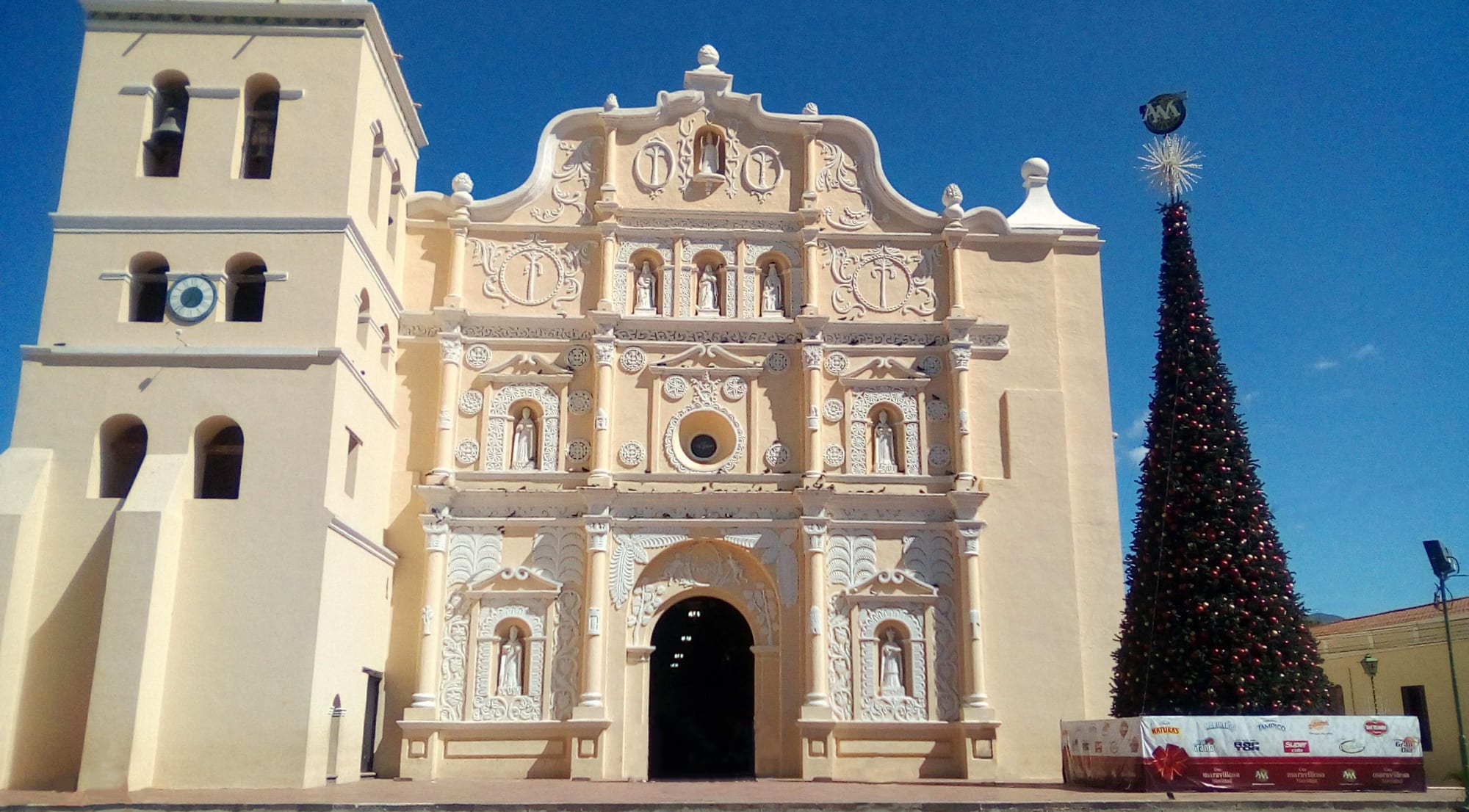
The cream-coloured carved baroque façade and bell tower of Comayagua Cathedral under a deep blue sky, beside a Christmas tree

Tegucigalpa, the Centre & the Pacific South, Honduras

Comayagua

The Cathedral of the Immaculate Conception on the main square of Comayagua, in December. (Einkimadu / Wikimedia Commons · CC BY-SA 4.0)

The old capital of Honduras, in a broad valley on the highway between Tegucigalpa and San Pedro Sula. Founded by the Spanish in 1537, it governed the province through the colonial era and lost the capital in 1880; today it is a busy departmental town whose restored colonial centre, churches and Holy Week carpets draw visitors, with the capital's international airport just to the south.

Neighbourhoods

  • The colonial centre
    • First-time visitors
    • Historic district
    • Museums

    The restored grid around the main square and the cathedral, with the churches of La Merced, San Francisco and La Caridad a few blocks apart and eighteenth-century houses turned into museums. Its historic centre is described as the best restored and preserved in the country.

    Open in Maps
  • The highway and the new boulevards
    • Transport
    • Practical stops

    The modern town along the CA-5 highway and the boulevards that link it to the centre, with bus stops, fast-food restaurants, petrol stations and shops serving traffic between the capital and San Pedro Sula.

    Open in Maps
  • The valley towards Palmerola
    • Close to the airport

    Farmland and growing suburbs south of the town along the highway to the Soto Cano air base, where the Palmerola international airport has operated since 2021.

    Open in Maps

Things to do

Churches and the old town

  • Comayagua Cathedrallandmark

    The Cathedral of the Immaculate Conception on the main square, one of the oldest cathedrals in Central America, completed in 1711 after building phases going back to the sixteenth century, with gilded baroque altarpieces.

    Open in Maps
  • The cathedral clocklandmark

    A medieval gear clock in the cathedral tower, said to have been made by the Moors in Spain around 1100 and considered the oldest clock in the Americas.

    Open in Maps
  • Plaza Central León Alvaradopark

    The main square in front of the cathedral, the meeting point of the old town.

    Open in Maps
  • Iglesia de la Mercedlandmark

    The town's oldest church, dated to 1550, facing a square with an obelisk monument.

    Open in Maps
  • Iglesia de San Franciscolandmark

    A sixteenth-century church a short walk from the cathedral, whose Antonina bell, cast in Alcalá de Henares in 1460, is said to be the oldest bell in the Americas.

    Open in Maps
  • Iglesia de la Caridadlandmark

    A sixteenth-century church a few blocks north-west of the cathedral, one of the group of colonial churches that give the town its character.

    Open in Maps

Museums

  • Museum of Colonial Religious Artmuseum

    Religious paintings, sculpture and altar pieces from the colonial churches, housed in the former San Agustín college of 1678.

    Open in Maps
  • Archaeological Museummuseum

    A late sixteenth-century house holding pre-Hispanic Lenca pottery and finds from the Comayagua valley.

    Open in Maps
  • Casa Cabañasmuseum

    An eighteenth-century house near the cathedral, now a museum of local culture and Honduran history that holds a sword of Francisco Morazán.

    Open in Maps

Short trips from the town

  • Yarumelaattraction

    An archaeological site in the valley, occupied from about 1000 BC to AD 250 by ancestors of the Lenca and once a trading centre for precious goods.

    Open in Maps
  • Montaña de Comayagua National Parkpark

    Forested mountains north of the town, established as a national park in 1987, with waterfalls such as the 50-metre Cascada de los Ensueños reached by a rough road and a forest trail.

    Open in Maps
  • Palmerola International Airporttransit hub

    The country's newest international airport, opened in 2021 on the Soto Cano air base just south of the town, which now serves the capital as well.

    Open in Maps

Seasonal events

  • Holy WeekMarch or April

    Comayagua's Semana Santa keeps processions in the old Spanish manner, and townspeople cover the processional streets with alfombras de aserrín — carpets of coloured sawdust showing scenes from the life of Jesus and figures of the saints.

Eat and drink

Long-standing places and food districts in Comayagua. Hours, ratings and directions come from your maps app, always current.

Comayagua classics

  • Comedores in the old townrestaurant

    Small family-run restaurants found on almost every block, serving typical Honduran plates and fried or rotisserie chicken.

    Open in Maps
  • Street grillsmarket

    Vendors around town grilling skewers of meat and white corn on the cob.

    Open in Maps

Food districts

  • The CA-5 highway stripneighborhood

    Grills, fast-food restaurants and Chinese restaurants along the main highway, used by travellers on the road between Tegucigalpa and San Pedro Sula.

    Open in Maps

Experience Comayagua

History

People lived in the Comayagua valley long before the Spanish arrived: the site of Yarumela shows that ancestors of the Lenca settled here around 1000 BC, and its flat land and trade routes linking the Caribbean and the Pacific helped them prosper. The Spanish captain Alonso de Cáceres founded the town in 1537 on orders to find a place for a city between the two oceans. A stone church and a Mercedarian convent followed within two decades, and Comayagua became the seat of the province and its bishopric.

The town remained the capital throughout the colonial period, even as silver drew wealth towards Tegucigalpa and Comayagua itself declined; by the early nineteenth century it was a sleepy place, and its two parishes counted 5,369 people in 1802. After independence it stayed the capital of the state of Honduras. On 4 April 1827 federal forces under Colonel Justo Milla took the town and burned and looted much of it; Francisco Morazán defeated Milla that November at the battle of La Trinidad.

The rivalry with Tegucigalpa ended on 30 October 1880, when President Marco Aurelio Soto moved the capital there, and Comayagua's population, trade and importance shrank. Growth returned in the twentieth century: between 1945 and 1975 the population quadrupled. The Soto Cano air base, operational since 1940, became an important US military base in the 1980s, and in 2021 a civilian international airport opened on the same site.

Culture & Customs

Comayagua's identity rests on its colonial heritage. The cathedral, completed in 1711, holds gilded baroque altarpieces and a medieval clock considered the oldest in the Americas, and the churches of La Merced, San Francisco, San Sebastián and La Caridad date from the sixteenth century. Many eighteenth-century houses have been restored and turned into museums of religious art, archaeology and history, and the town's historic centre is described as the most restored and preserved in the country.

Holy Week is the high point of the year. The processions follow the Spanish tradition introduced in the sixteenth century, and they have been compared with those of Andalusia. On the night before the main processions townspeople lay alfombras de aserrín, carpets of dyed sawdust, along the streets, portraying scenes from the life of Jesus, the Virgin Mary and saints such as Jude the Apostle, only for them to be trampled when the procession passes.

The town's art collections span pre-Columbian Lenca pottery and religious works from the Spanish colonial era, some dating from the late sixteenth century. The town keeps the manners of a provincial capital: Catholic, family-centred and attached to its saints' days.

Daily Life

The city of Comayagua had an estimated 120,500 people in 2023, and it is the capital of the department of the same name. Its population grew fast in the second half of the twentieth century with migration from the countryside, and the municipal authorities have had to plan for new districts spreading across the valley floor.

The flat, fertile valley supports farming, and the town is a commercial centre for the surrounding countryside and a stop on the highway between Tegucigalpa and San Pedro Sula. The Soto Cano air base, home to the Honduran Air Force academy and the US military's Joint Task Force Bravo, and the new Palmerola airport beside it lie just south of the town.

Daily life moves between the colonial centre, with its churches, offices and shops, and the newer neighbourhoods along the highway and boulevards. The midday heat empties the streets, and the main square fills again in the cool of the evening.

Food

Comayagua eats the food of central Honduras. Small family-run comedores on almost every block serve plates of rice, refried beans, fried plantain, cuajada (fresh curd cheese), cream and tortillas, with grilled meat, eggs or chicken, and fried and rotisserie chicken shops are everywhere.

Street vendors around the town grill skewers of meat and cobs of white corn, and the baleada — a flour tortilla folded over mashed red beans, cream and hard cheese — is the standard quick meal. Maize dominates in the surrounding highlands, with fresh corn tamalitos, atol, a warm corn drink, and rosquillas, small baked rings of maize dough and cheese eaten with coffee.

Along the CA-5 highway, grills and fast-food outlets feed passing travellers, and the town has a surprising number of Chinese restaurants. Pastelitos de carne, fried turnovers filled with meat, and nacatamales, maize dough filled with pork or chicken and wrapped in banana leaves, are weekend favourites across central Honduras. Coffee, fruit licuados and horchata are the everyday drinks.

Planning tools

Budget

Comayagua is one of the cheaper places to stay in central Honduras, with simple hotels and comedores in and around the old town. Museum entry and meals cost little; the main extra is a driver or a four-wheel-drive vehicle for the national park.

Daily Budget Midrange
USD 60–110 (hotel near the old town, restaurant meals, taxis and a driver for a day trip)
Daily Budget Shoestring
USD 25–40 (guesthouse, comedor meals, intercity buses)

Carry cash in small notes; rooms are scarce during Holy Week, when the town fills.

Best Time to Visit

November to February, after the rains, is the most comfortable time. Holy Week, in March or April, is the town's great moment, with processions and sawdust carpets, but it is also the hottest and busiest time of year. The rainy season runs roughly from May to October.

Suggested Number of Days

One full day covers the old town and its museums. Two or three allow time for the archaeological site and the waterfalls of the mountain park, and Holy Week justifies a longer stay. The airport nearby makes the town an easy first or last stop.

First Visit
1 day
With Surroundings
2–3 days

Transportation

The old town is small enough to cover on foot; taxis are the usual way across the wider town. Buses running between Tegucigalpa and San Pedro Sula stop on the CA-5 highway. The national park needs a four-wheel-drive vehicle, and hiking guides can be hired there.

Use daytime buses or a hired driver on the highway, and arrange transport to the airport in advance.

Airport & Station Connections

Comayagua lies about 80 km north-west of Tegucigalpa on the CA-5 highway to San Pedro Sula, served by frequent buses. Palmerola International Airport, the main international gateway for the capital since 2021, is on the Soto Cano air base just south of the town. San Pedro Sula's airport is farther north along the same highway.

Walkability

The colonial centre is compact and flat, and its churches, squares and museums are a few blocks apart, so it is pleasant to walk by day. The newer town along the highway is spread out and built for traffic. Midday heat is the main discomfort.

Safety

Honduras has had one of the highest homicide rates in the world, driven by gangs (MS-13 and Barrio 18) and drug trafficking, and San Pedro Sula and parts of Tegucigalpa remain dangerous. Comayagua is much calmer, with petty theft the usual risk.

Keep valuables out of sight in crowds, take taxis after dark and travel by road only in daylight. Check current official travel advice before travelling.

Climate

Comayagua lies in a valley at about 600 metres and has a tropical savanna climate, with a wet and a dry season. In this part of central Honduras the rainy season runs from May to October, and the dry season from November to April grows hot by March and April.

Summer
rainy season May–October; in Tegucigalpa, the capital, days are typically 25–30 °C
Winter
dry season November–April; in Tegucigalpa, average lows are about 14 °C in December and January, and the heat builds by March and April

Local Customs

Comayagua is a traditional Catholic town, proud of its colonial past and its role as the first capital. Religious processions are taken seriously, and the sawdust carpets laid for Holy Week are made for the processions to pass over.

Dress modestly in churches, keep off the carpets during Holy Week, and ask before photographing people.

Common Payment Methods

The currency is the Honduran lempira. Hotels and some restaurants take cards; comedores, market stalls, taxis and museums expect cash in small notes.