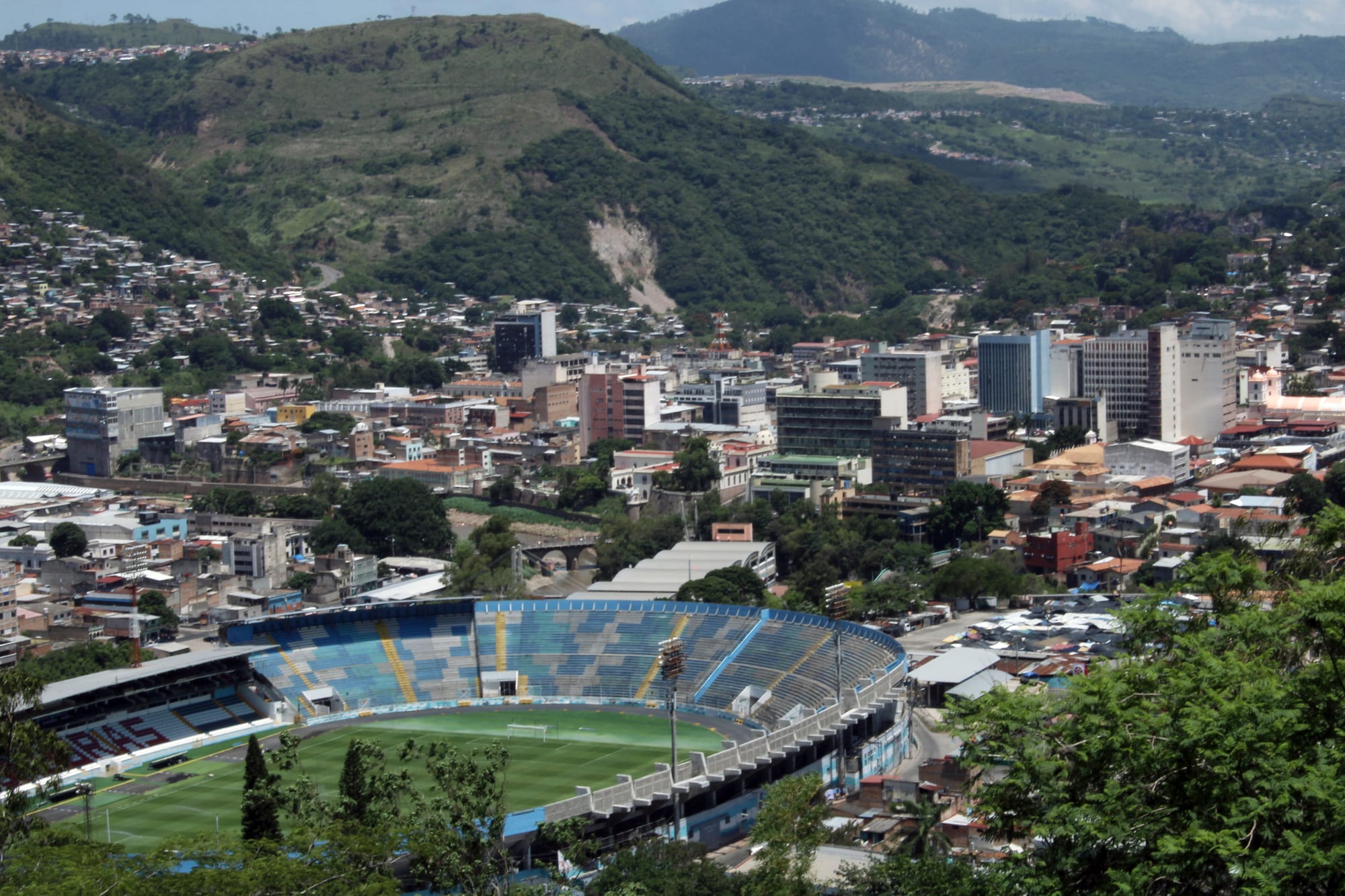
A football stadium in the foreground below the mixed old and modern buildings of central Tegucigalpa, with green hills behind

Tegucigalpa, the Centre & the Pacific South, Honduras

Tegucigalpa

The National Stadium and the centre of Tegucigalpa and Comayagüela. (Luis Alfredo Romero / Wikimedia Commons · CC BY-SA 4.0)

The capital of Honduras, set in a highland valley ringed by mountains and joined to its sister city Comayagüela across the Choluteca River. A Spanish silver-mining town founded in 1578, it became the capital in 1880 and has since sprawled over the surrounding hills — a crowded, hard-edged seat of government with a baroque cathedral, a pilgrim basilica and old mining villages close by.

Neighbourhoods

  • The historic centre
    • First-time visitors
    • Historic district

    The old colonial core around the cathedral, with the National Congress, City Hall, museums, parks and the city's oldest churches. Long neglected and run down, it has seen efforts to revive its colonial heritage; it is busy by day and best left by night.

    Open in Maps
  • Comayagüela
    • Markets
    • Local life

    The sister city across the Choluteca River, part of the same Central District. Its sprawling market streets around the San Isidro market and the intercity bus terminals are the commercial engine of the capital, but much of it is rough and not a place to wander.

    Open in Maps
  • Colonia Palmira and Boulevard Morazán
    • Best for food
    • Embassies and hotels

    Middle-class districts east of the historic centre, where Boulevard Morazán carries foreign embassies, upscale restaurants and many of the hotels used by business travellers. Avenida Los Próceres runs parallel through the same area.

    Open in Maps
  • Boulevard Suyapa and Boulevard Juan Pablo II
    • Shopping
    • Business district

    A busy commercial and financial strip south of Boulevard Morazán, with malls including Multiplaza, office towers and the Presidential House in Colonia Los Profesionales. Life here is built around the car and the air-conditioned mall.

    Open in Maps
  • Suyapa
    • Pilgrimage
    • Religious sites

    A former village on the eastern edge of the city, home to the small statue of the Virgin of Suyapa and the large twentieth-century basilica built to receive the pilgrims who come to see her.

    Open in Maps

Things to do

Famous landmarks

  • Tegucigalpa Cathedrallandmark

    The baroque cathedral of San Miguel Arcángel, built between 1765 and 1786, which remained the largest building in the city until the end of the nineteenth century, with a main altarpiece and a silver-fronted main altar.

    Open in Maps
  • Basilica of Suyapalandmark

    The large modern basilica in Suyapa, raised to a minor basilica in 2015, which keeps the tiny cedar-wood statue of the Virgin of Suyapa, patroness of Honduras.

    Open in Maps
  • El Picacho and the Cristo del Picachoviewpoint

    The United Nations park on El Picacho hill above the city, with a small zoo and a large statue of Christ looking out over the valley — one of the capital's most popular outings.

    Open in Maps
  • Chelato Uclés National Stadiumattraction

    The 35,000-seat national stadium, shared by the rival clubs Olimpia and Motagua, and the setting for historic football matches, concerts and presidential inaugurations.

    Open in Maps
  • Toncontín Airporttransit hub

    The city's old airport, 6 km from the centre, known for one of the most difficult approaches in the world; since 2021 it has handled domestic and regional flights.

    Open in Maps

Museums

  • Museo para la Identidad Nacionalmuseum

    The National Identity Museum, opened in 2006 in the nineteenth-century Palace of the Ministries, telling the story of Honduras from pre-Hispanic times to the present, with a popular virtual Copán room.

    Open in Maps
  • Museo de Historia Republicana Villa Roymuseum

    A museum of the republic's history, from independence in 1821 to 1975.

    Open in Maps
  • Chiminikemuseum

    An interactive children's museum opened in 2003, the first in Honduras designed for children, covering science, the body, geography and the environment.

    Open in Maps

Markets

  • Mercado San Isidromarket

    The great market of Comayagüela, spreading over about sixteen blocks near the river — food, clothes and household goods for the city's ordinary shoppers, best visited in daylight with few valuables.

    Open in Maps

Short trips from the city

  • La Tigra National Parkpark

    Honduras's first national park, created in 1980, protecting cloud forest on the mountains north of the city that supply part of the capital's water, with visitor centres at Jutiapa and El Rosario.

    Open in Maps
  • Valle de Ángelesattraction

    A former mining town in the hills north-east of the capital, popular for its colonial architecture and its crafts — wood carving, pottery and contemporary art.

    Open in Maps
  • Santa Lucíaattraction

    An old mining village whose well-preserved colonial houses, stone streets and church make it a favourite outing from the capital.

    Open in Maps
  • Ojojonaattraction

    A small town south of the capital, with buildings from the colonial era, and the birthplace of the painter Pablo Zelaya Sierra.

    Open in Maps

Seasonal events

  • Feast of the Virgin of Suyapaearly February

    Pilgrims from across Honduras come to the basilica to honour the patroness of the country around 3 February, the anniversary of the statue's finding in 1747.

Eat and drink

Long-standing places and food districts in Tegucigalpa. Hours, ratings and directions come from your maps app, always current.

Tegucigalpa classics

  • Baleadasrestaurant

    The national snack sold all over the city: a flour tortilla folded over refried red beans, cream and crumbled hard cheese, with egg, avocado or meat added on request.

    Open in Maps
  • Mercado San Isidro food stallsmarket

    Comedores and stalls inside Comayagüela's main market serving plates of rice, beans, plantain and grilled meat to the people who work there.

    Open in Maps

Food districts

  • Boulevard Morazánneighborhood

    The capital's main restaurant strip, through Colonia Palmira and the embassy district, with grills, international restaurants and bars.

    Open in Maps
  • Valle de Ángelesneighborhood

    The former mining town north-east of the city, a popular outing for its colonial streets and crafts, with places to eat around its centre.

    Open in Maps

Experience Tegucigalpa

History

Tegucigalpa was founded by Spanish settlers on 29 September 1578 as the Real de Minas de San Miguel de Tegucigalpa, a silver-mining camp on the site of an existing settlement of Lenca and Tolupan people. The name is usually traced to Nahuatl, most often as "hills of silver", though that reading is disputed. The camp prospered and in 1762 became a royal villa. Its first important buildings date from this period: the Dolores church of 1735, the cathedral of San Miguel begun in 1765, the mint of 1780 and the Immaculate Conception church of 1788.

For three centuries the town lived in the shadow of Comayagua, the colonial capital; after independence the seat of government alternated between the two towns. On 30 October 1880 President Marco Aurelio Soto moved the seat of government to Tegucigalpa — a popular story claims he did so because Comayagua's society snubbed his wife. The 1936 constitution joined Tegucigalpa and Comayagüela, across the Choluteca River, in a single Central District. Between the 1930s and the 1960s the city passed 250,000 people, and new districts such as Colonia Kennedy and the national university campus spread across the valley.

Growth outran planning, and the poorest neighbourhoods climbed the surrounding slopes. On 30 October 1998 Hurricane Mitch struck: days of rain brought floods and landslides that destroyed parts of Comayagüela and the riverbanks, and its scars remained visible for years. In 2009 the capital was the stage of the political crisis that removed President Manuel Zelaya. In 2021 international flights moved from the city's cramped Toncontín airport to Palmerola, near Comayagua.

Culture & Customs

Tegucigalpa is the seat of the country's institutions: the government, the National Congress, the Central Bank, embassies and the National Autonomous University of Honduras, founded in 1847 and the largest university in the country. The city's two big clubs, Olimpia and Motagua, share the National Stadium, where their derby divides families and neighbourhoods.

Religion runs deep. The tiny cedar-wood statue of the Virgin of Suyapa, found in 1747, was declared patroness of Honduras in 1953; Pope John Paul II visited her shrine in 1983, and Pope Francis made it a minor basilica in 2015. Every February pilgrims crowd the basilica on the city's eastern edge. The Catholic majority has shrunk, however: estimates put Protestants at more than a third of the population, and evangelical churches have been established in the city since the 1950s.

The city's museums tell the national story, from the National Identity Museum, opened in 2006 in a nineteenth-century government palace, to the history of the republic at Villa Roy. Weekends are spent at the malls, at the football, or in the cooler hill villages of Valle de Ángeles and Santa Lucía, known for their colonial streets and crafts.

Daily Life

The Central District recorded 1,157,509 people at the 2013 census, up from 850,445 in 2001, making it the largest city in Honduras. The city is officially divided into nearly nine hundred barrios and colonias: barrios are the old inner-city neighbourhoods, colonias the twentieth-century suburbs, ranging from wealthy residential districts to hillside settlements without proper services. Colonia Kennedy, in the south, is the largest, with more than 137,000 residents.

Government jobs, commerce, banking and services drive the economy, with maquila assembly plants in an industrial park in the Amarateca valley on the northern highway. A large share of the population works in the informal economy and lives in poverty, and infrastructure has not kept up with growth: traffic jams on the boulevards, dry-season water shortages and flooding in the rainy season are part of life.

The better-off live around the boulevards of the east and south and shop in air-conditioned malls; most people rely on crowded buses and rapiditos. Extortion of bus drivers and small shopkeepers by gangs is a constant concern, and many families depend on money sent by relatives in the United States.

Food

The capital eats the national food. Breakfast and lunch are often a plate of rice, refried beans, fried plantain, cuajada (fresh curd cheese), cream and tortillas, with grilled meat or eggs. The baleada — a flour tortilla folded over mashed red beans, cream and crumbled hard cheese — is sold from street stalls and small shops everywhere, plain or with egg, avocado or meat.

Weekends bring heavier dishes. Nacatamales, maize dough filled with pork or chicken and wrapped in banana leaves, are eaten at weekends and Christmas, and sopa de mondongo, a tripe soup slow-cooked with vegetables, is a classic. Street grills sell carne asada with chismol, a chopped tomato and onion salsa, and pastelitos, fried turnovers filled with meat.

Comayagüela's market streets feed the working city with comedores and fruit stalls, while the restaurants of Boulevard Morazán and the malls serve the middle class. Coffee from the Honduran highlands, fresh fruit licuados, horchata and local beers are the everyday drinks.

Planning tools

Budget

Tegucigalpa is inexpensive by international standards. The main costs are a hotel in one of the secure districts around Boulevard Morazán or the malls and the taxis or app rides that replace walking. Comedor meals and market food cost little; a driver for La Tigra or the hill villages adds the most to a day.

Daily Budget Midrange
USD 65–130 (hotel in a secure district, restaurant meals, app taxis and a driver for day trips)
Daily Budget Shoestring
USD 25–40 (guesthouse, comedor meals, app rides)

Use app or hotel-arranged taxis rather than hailing on the street, and carry cash in small notes for markets and villages.

Best Time to Visit

November to February, after the rains, when the hills are green and the days mild. March and April, around Holy Week, are the hottest months; the rainy season runs roughly from May to October and can bring flooding in the valley. Early February fills Suyapa with pilgrims.

Suggested Number of Days

Two days cover the city itself. Allow three or four to add the cloud forest and the old mining villages in the hills. Traffic and the need to travel by car between districts make everything slower than distances suggest.

First Visit
2 days
With Surroundings
3–4 days

Transportation

The city spreads over hundreds of barrios and colonias linked by busy boulevards and a ring road, and traffic jams are heavy at rush hour and on match days. Visitors use ride-hailing apps or hotel taxis; street taxis are cheaper but fares are negotiated. City buses and rapiditos run to every neighbourhood but are not recommended for visitors.

Agree the fare before getting into a street taxi, or use an app ride; avoid city buses.

Airport & Station Connections

Since 2021 the capital's main international airport has been Palmerola, near Comayagua, about 60 km north-west of the city centre. The old Toncontín airport, 6 km from the centre, now handles domestic and regional flights. Long-distance coaches arrive from San Pedro Sula along the CA-5 highway, and international lines link the city with other Central American capitals.

Walkability

Walking is limited. The historic centre is compact and can be explored on foot by day; elsewhere the city is built around boulevards, malls and the car. Nobody should walk anywhere after dark, and Comayagüela beyond the market area is best avoided on foot at any time.

Safety

Honduras has had one of the highest homicide rates in the world, driven by gangs (MS-13 and Barrio 18) and drug trafficking, and San Pedro Sula and parts of Tegucigalpa remain dangerous. In the capital gang crime, extortion and armed robbery are concentrated in poorer neighbourhoods, markets and bus terminals. Pickpockets and grab-and-run thieves work the San Isidro market even by day.

Stay in well-known districts, never walk after dark, take app or hotel taxis, do not use city buses, and do not travel by road at night. Check current official travel advice before travelling.

Climate

The altitude tempers the tropical climate: Tegucigalpa is less humid than the lowlands, with average temperatures between about 19 °C and 23 °C. December and January are the coolest months, with average lows of around 14 °C; March and April are the hottest, and the hottest days can reach 40 °C.

Summer
rainy season roughly May–October, with average temperatures of about 19–23 °C and frequent rain
Winter
dry season roughly November–April; average lows around 14 °C in December and January, and up to 40 °C on the hottest days of March and April

Local Customs

The capital is mostly Catholic, with a large and growing evangelical population, and church festivals matter — above all the feast of the Virgin of Suyapa. Greetings are polite and formal at first: a handshake, 'buenos días' and the respectful 'usted'. Football divides the city between Olimpia and Motagua.

Dress modestly in churches and at the basilica, ask before photographing people, and do not display phones or cameras in markets or on the street.

Common Payment Methods

The currency is the Honduran lempira. Cards are accepted in malls, hotels and the better restaurants; markets, comedores, street taxis and village shops want cash in small notes.