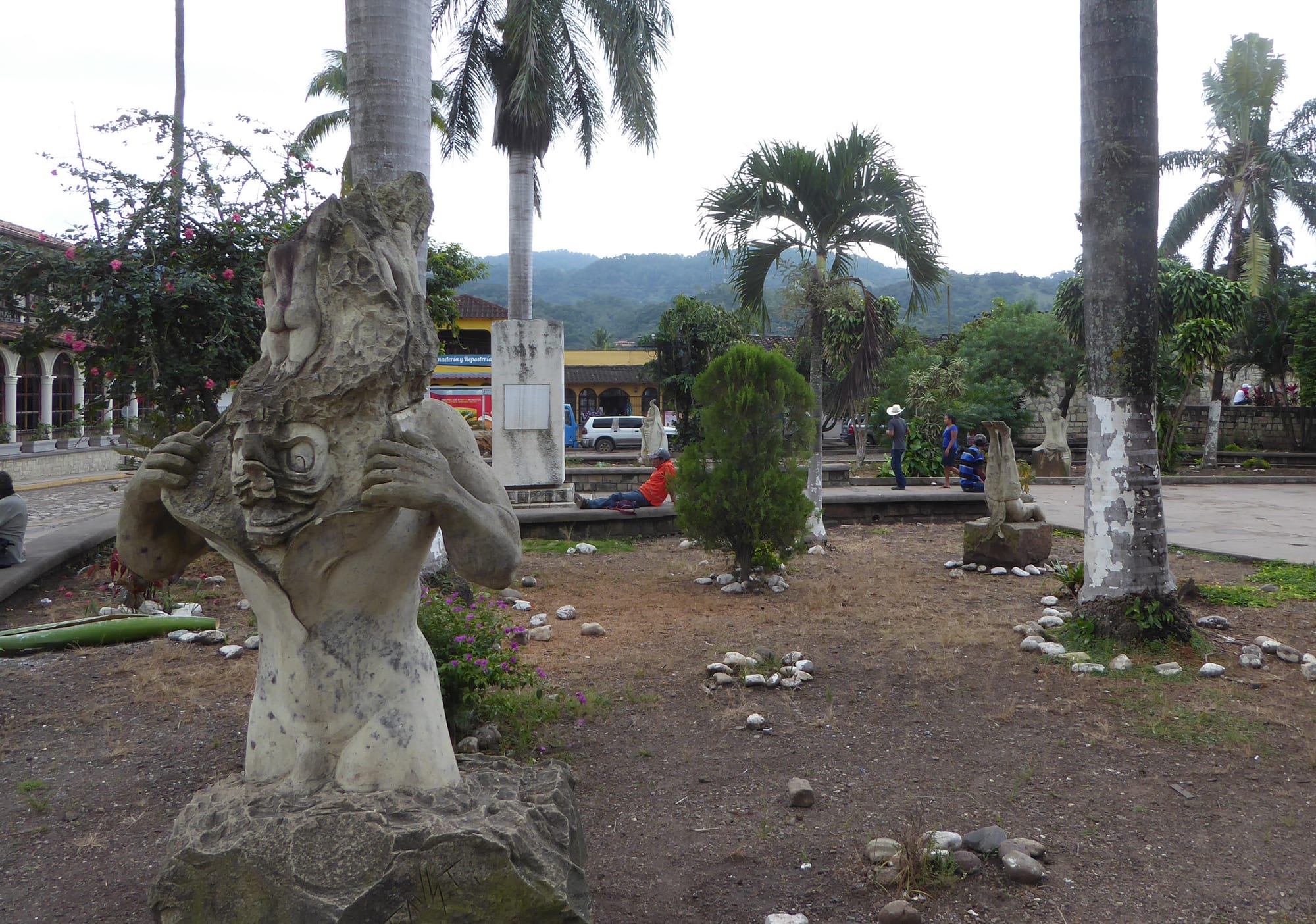
Stone sculptures, palm trees and paths in the central park of Copán Ruinas, with green hills beyond

Copán & the West, Honduras

Copán Ruinas

The Parque Central of Copán Ruinas, set with stone sculptures, with green hills beyond. (Hans Birger Nilsen / Wikimedia Commons · CC BY-SA 2.0)

A small hill town of cobbled streets in the Copán river valley of western Honduras, close to the Guatemalan border and about 1.6 kilometres from the ruins of Copán, one of the great cities of the Classic Maya. It grew as the village beside the ruins and now lives from visitors, coffee and farming, with Ch'orti' Maya communities in the hills around it.

Neighbourhoods

  • Parque Central and the centre
    • First-time visitors
    • Best for food
    • Walkable

    The few blocks of cobbled streets around the main square and its church, where most of the town's guesthouses, cafés, craft shops and language schools are found. Low post-colonial houses line the streets, and the ruins are a short walk away.

    Open in Maps
  • The hill above town
    • Views
    • Quiet and residential

    The streets that climb towards the old Fuerte Cabañas barracks, now a children's museum, with views across the Copán valley. Quieter than the centre, with smaller lodgings and homes.

    Open in Maps
  • The road to the ruins
    • Close to the ruins
    • Nature

    The road east from the centre past the football field and the bridge towards the archaeological park, with the paths to Las Sepulturas and the bird park beyond. Greener and more spread out than the town.

    Open in Maps

Things to do

The Maya city

  • Copán archaeological sitelandmark

    The ruins of a Classic Maya royal city about 1.6 kilometres from town, with the Great Plaza of carved stelae, the ball court, the Hieroglyphic Stairway and the Acropolis; a UNESCO World Heritage Site since 1980.

    Open in Maps
  • Museum of Maya Sculpturemuseum

    The museum beside the ruins that holds original sculptures and temple facades, including Altar Q with its sixteen kings, and a full-size replica of the painted Rosalila temple.

    Open in Maps
  • Las Sepulturaslandmark

    An open residential group of the ancient city, linked to the main group by an ancient causeway and reached by a walk of about 20 minutes beyond the ruins.

    Open in Maps
  • The Acropolis tunnelsattraction

    Tunnels dug by archaeologists under the Acropolis that show the buried earlier temples beneath the later buildings, entered on a separate ticket.

    Open in Maps

In and around town

  • Parque Centralpark

    The town's main square, shaded by palms and set with stone sculptures in the Maya style, where fruit sellers park their pickups on Sundays.

    Open in Maps
  • Casa K'inichmuseum

    A hands-on children's museum opened in 2002 in the Fuerte Cabañas, a barracks built in 1940, explaining Maya glyphs, building and the ballgame in Spanish, English and Ch'orti'.

    Open in Maps
  • Macaw Mountainpark

    A bird sanctuary a short mototaxi ride from the centre, where rescued birds are rehabilitated, with a swimming hole.

    Open in Maps
  • Los Saposlandmark

    A small ruin outside the archaeological park, visited on horseback rides from town.

    Open in Maps

Short trips from the town

  • La Pintadaneighborhood

    A Ch'orti' Maya village in the hills near town, visited on horseback rides.

    Open in Maps
  • Hot springspark

    Natural hot springs about 25 kilometres from town, feeding man-made pools of different temperatures, reached by minibus or pickup.

    Open in Maps

Eat and drink

Long-standing places and food districts in Copán Ruinas. Hours, ratings and directions come from your maps app, always current.

Copán Ruinas classics

  • Plato típicorestaurant

    The standard meal in most restaurants: the restaurant form of the carneada, a plate of grilled meat counted among Honduras's national dishes.

    Open in Maps
  • Licuadoscafe

    Fruit smoothies made with water or milk, sold all over town and drunk every day in the heat.

    Open in Maps
  • Copán coffeecafe

    Coffee grown on the surrounding hills is served in the cafés around the square, and farms just outside town run tours of how it is grown and processed.

    Open in Maps

Food streets and markets

  • Calle de la Plazaneighborhood

    A street near the main square where several restaurants and cafés serve Honduran food, coffee and international dishes.

    Open in Maps
  • Town marketmarket

    A small market near the centre for fruit, vegetables and everyday goods.

    Open in Maps

Experience Copán Ruinas

History

The modern town stands on the site of a large complex of the Classic Maya city of Copán, whose ruined core lies about 1.6 kilometres away. Copán was occupied for more than two thousand years and from the fifth to the ninth centuries AD was the capital of a powerful kingdom at the south-eastern edge of the Maya world, known for a sculptural style all its own. In 738 its king Uaxaclajuun Ub'aah K'awiil was captured and executed by the ruler of Quiriguá, and by the early tenth century the city had been abandoned.

The present town began as a village beside the ruins. By 1887 it was a hamlet in the jurisdiction of Santa Rita; the municipality of Copán Ruinas was created on 1 January 1893, and in 1942 it was given the title of city. Archaeological work brought visitors and steady attention: the British archaeologist Alfred Maudslay surveyed the site, and later excavations dug tunnels under the Acropolis that uncovered earlier temples, among them the almost intact Rosalila shrine. The site was declared a UNESCO World Heritage Site in 1980 and a national cultural monument in 1982.

In 1940 the army built the Fuerte Cabañas barracks above the town to guard the border; restored, it has housed the Casa K'inich children's museum since 2002. Tourism has since reshaped the centre with guesthouses, cafés and language schools, while most of the municipality remains farming country.

Culture & Customs

The town's identity is bound up with the ruins. Guides, carvers and shop owners live from the ancient city, and craft shops sell work in clay, jade, stone and woven cloth. Scarlet macaws, a bird that appears in the art of Copán's early kings, fly over the ruins and even through the town, and a bird park outside town cares for rescued birds.

Ch'orti' Maya communities live in the surrounding hills, and their language is one of the three used in the Casa K'inich museum, alongside Spanish and English. Villages such as La Pintada are visited on horseback rides from town. Within the town, life follows the Catholic calendar and the main square, where fruit sellers line up their pickups on Sundays.

Because so many foreigners pass through, the town has many small Spanish schools, and every December it hosts the Conference on Honduras, where grassroots organisations meet to discuss education, health and community projects across the country.

Daily Life

The municipality had about 39,500 people in 2015, most of them living in rural villages and hamlets rather than in the town itself. Behind the cafés of the centre, most families live from subsistence farming and from growing maize, coffee and beans, and development indicators for the municipality show high levels of poverty.

The town is the administrative centre and the place where tourism money is earned: in guesthouses, restaurants, tour agencies, mototaxis and the ruins themselves. Coffee from the surrounding hills is both a crop and a visitor attraction, with farms offering tours. Local life in the valley is slow-paced and calm, and mototaxis carry most short trips, since the town has no public transport network.

The CA-11 highway through the Copán valley is the main link between western Honduras and eastern Guatemala, and the El Florido border is about 20 minutes away, so traffic and trade cross the town's edge daily.

Food

Most restaurants serve the plato típico, the restaurant form of the carneada, a plate of grilled meat counted among Honduras's national dishes. Tortillas come with most meals, along with cuajada, a fresh cheese, and mantequilla, a Honduran cream. Beans, refried and served with slices of fried green plantain, turn up at almost every meal, as they do across Honduras. Licuados, fruit smoothies blended with water or milk, are the everyday drink.

Coffee is the local crop, grown on the hills around town alongside maize and beans; the cafés near the square serve it, and farms outside town show how it is grown and processed. Rosquillas, a Honduran ring of corn dough made with cheese, are a breakfast treat.

Thanks to tourism, the town has the most varied restaurants in western Honduras, with Mexican and international food alongside comedores serving Honduran meals, and a small market near the centre for fruit and vegetables. On Sundays fruit sellers line the centre with their pickup trucks.

Planning tools

Budget

Copán Ruinas has the widest choice of places to stay and eat in western Honduras, from hostels to boutique hotels, priced a little above the rest of the region because of tourism. The ruins, the Sculpture Museum and the tunnels each have their own entry ticket, and a guide at the gate is an extra cost best shared among a small group. Meals in comedores are cheap.

Daily Budget Midrange
USD 65–130 (boutique hotel, restaurant meals, a guide at the ruins, hot springs)
Daily Budget Shoestring
USD 25–40 (hostel, comedor meals, mototaxis)

Gather a small group at the gate of the ruins to share the cost of a licensed guide.

Best Time to Visit

November to April is the dry season, with clear days and dry trails; March and April are warm and hazy with smoke from field burning. The rains from May to October usually fall as afternoon storms, and the ruins are quieter then. The site gets very hot by midday at any time of year, so early mornings are best.

Suggested Number of Days

Many people stop for just one day, but two days give time for the ruins, the museum and the outlying groups at an easy pace. Three or four allow time for the countryside around the town. Keen students of Maya art may want longer.

First Visit
2 days
With Surroundings
3–4 days

Transportation

There is no public transport network in town. Mototaxis, small three-wheeled taxis, cover short trips around town and out to the ruins and the bird park, and the ruins are an easy walk from the centre. Pickups and minibuses leave from near the football field for the hot springs, and horseback rides go out to the villages.

Mototaxi fares around town are small, so carry low-value notes.

Airport & Station Connections

San Pedro Sula, with the country's main international airport, is about three hours away by road along the CA-11 and CA-4, which can be rough; buses also link the town with Tegucigalpa. The El Florido border crossing into Guatemala is about 20 minutes away, and private shuttles run to Guatemala City and Antigua. A small airport about 20 kilometres east of town opened in 2015, but most visitors arrive by road.

Walkability

The town is small and easily walked, though its cobbled streets are steep in places and need sure footing. The ruins are a short walk out of the centre along the road, and Las Sepulturas a further 20 minutes or so.

Safety

Honduras has had one of the highest homicide rates in the world, driven by gangs (MS-13 and Barrio 18) and drug trafficking, and San Pedro Sula and parts of Tegucigalpa remain dangerous. Copán Ruinas is one of the calmer places in the country and sees little violent crime against visitors; petty theft is the main risk. Drug-trafficking routes run along the Guatemalan border, so remote border areas are best avoided.

Take ordinary precautions with valuables, travel the border roads by day and use established operators for trips into the hills. Check current official travel advice before travelling.

Climate

The town sits in a green river valley and is warm and humid. For the region as a whole, the dry season runs from about November to April and the rains from May to October, usually as afternoon storms.

Summer
the region's rainy season, 22–30°C in the valleys, with heavy afternoon showers
Winter
the region's dry season, clear, 15–28°C, with cool nights

Local Customs

Copán Ruinas is a small, Catholic, rural town used to visitors. Greetings are polite and fairly formal, and dress outside the hotels is modest. Ch'orti' Maya communities live in the hills around the town; ask before photographing people, especially in the villages.

Greet people before asking a question, and ask permission before taking photographs of people.

Common Payment Methods

The currency is the Honduran lempira. Prices at the ruins and in many hotels and tour agencies are quoted in US dollars as well. Cards are taken in larger hotels, but cash is needed for comedores, mototaxis and small shops, so small notes are useful.