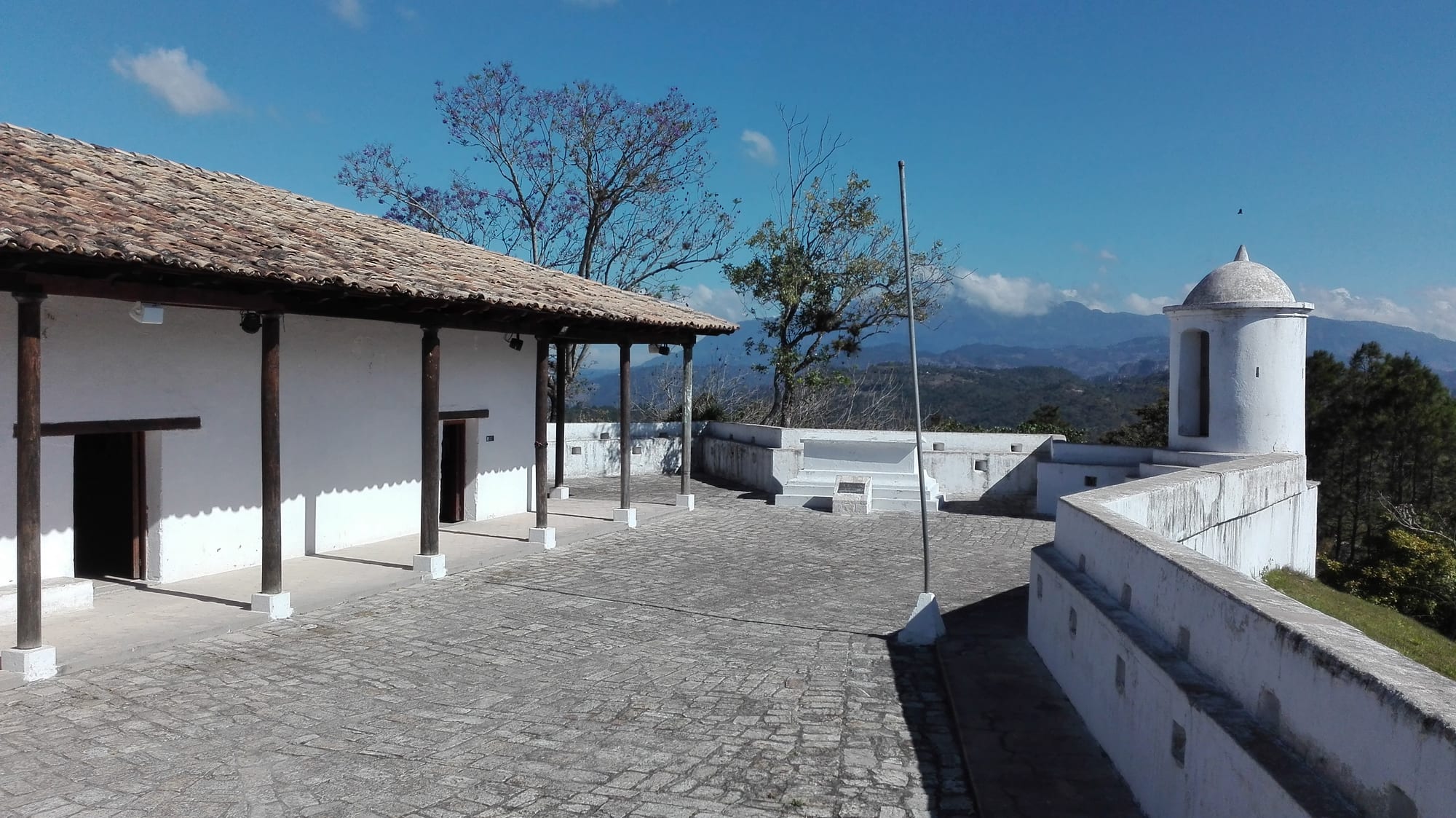
Whitewashed walls, a domed watchtower and a tiled veranda of a hilltop fort, with blue mountains on the horizon

Copán & the West, Honduras

Gracias

Inside the San Cristóbal fortress on its hill above Gracias, with the mountains of Lempira beyond. (Mónica J. Mora / Wikimedia Commons · CC BY-SA 4.0)

The capital of Lempira department in the mountains of western Honduras, founded by the Spanish in 1536 and briefly the seat of the court that governed Central America. Today it is a small colonial town of old churches and a hilltop fort, with hot springs nearby, Lenca villages around it and the cloud forest of Celaque rising above.

Neighbourhoods

  • The historic centre
    • First-time visitors
    • Historic district
    • Walkable

    The grid of streets around the renovated Parque Central, with the church of San Marcos beside the square, La Merced a block away and the market two blocks west. Most of the town's lodgings, restaurants and craft shops are here, all within walking distance.

    Open in Maps
  • San Sebastián and the fort hill
    • History
    • Views

    The area around the Plaza San Sebastián, which holds a church, the Casa Galeano museum and a botanical garden, and the small hill on the west side of town crowned by the San Cristóbal fortress.

    Open in Maps

Things to do

Colonial Gracias

  • San Cristóbal fortresslandmark

    A whitewashed fort on a hill above the town, completed in the 1870s on the site of an earlier Spanish work, with watchtowers, old cannons and the tomb of the nineteenth-century president Juan Lindo.

    Open in Maps
  • Iglesia de La Mercedlandmark

    The oldest of the town's three historic churches, dating from 1611 and restored in recent years, one block from the central square.

    Open in Maps
  • Iglesia de San Marcoslandmark

    An eighteenth-century church beside the Parque Central, the one most regularly used for Mass.

    Open in Maps
  • Casa Galeanomuseum

    A former family house on the Plaza San Sebastián that is now the town's history museum, with a botanical garden next to it.

    Open in Maps

Hot springs

  • Hot springspark

    Two sets of thermal pools lie just outside town — public pools in a natural setting south-east of Gracias, about 20 minutes by mototaxi, and a complex with bigger pools off the road to Santa Rosa de Copán.

    Open in Maps

Short trips from the town

  • Celaque National Parkpark

    A rugged cloud-forest park established in 1987 on the mountain above Gracias, holding Cerro Las Minas, the highest peak in Honduras; its rivers supply water to the town and to around 120 villages.

    Open in Maps
  • La Campaneighborhood

    A Lenca village in the hills, known as a centre of Lenca pottery made by hand by women.

    Open in Maps

Seasonal events

  • Feria de San MarcosApril (25 April)

    One of the town's two patron-saint fairs, held on the feast of St Mark.

  • Feria de Santa LucíaDecember (13 December)

    The second patron-saint fair, on the feast of St Lucy.

  • Holy WeekMarch or April

    Widely celebrated in Gracias; as across Honduras, processions carry images of saints in the week before Easter.

Eat and drink

Long-standing places and food districts in Gracias. Hours, ratings and directions come from your maps app, always current.

Gracias classics

  • Highland comedor mealsrestaurant

    The usual Honduran breakfast of eggs, refried beans, queso fresco, crema (a salty sour cream), fried plantains and maize tortillas.

    Open in Maps
  • Rosquillas and coffeecafe

    Rings of maize dough made with cheese, a Honduran snack eaten with coffee from the surrounding hills.

    Open in Maps

Markets

  • Gracias marketmarket

    The town market two blocks west of the central square, selling produce from the farms of the valley and the mountain.

    Open in Maps

Experience Gracias

History

Gracias was founded in October 1536 as Gracias a Dios by Gonzalo de Alvarado y Chávez, a cousin of the conquistador Pedro de Alvarado, at a place called Opoa near the Higuito river. The name, it is said, came from the relief of Spanish explorers who had crossed the mountains: "Thank God we have arrived at flat land." It was made a municipality in 1539, and on 16 May 1544 it became the seat of the Audiencia de los Confines, the royal court that applied Spanish law across Central America, ruling on land claims, encomiendas and taxes.

The court moved to Santiago de Guatemala, today Antigua, in 1549, and Gracias was eclipsed by Antigua and Comayagua. The church of La Merced was built in 1611 and San Marcos in the eighteenth century. In 1863 General José María Medina took office as president of Honduras in Gracias while staying at his nearby ranch, and the present San Cristóbal fortress, begun that year, was completed in the mid-1870s on a hill where a Spanish work had stood since the seventeenth century.

Rebel forces took the town in the civil war of 1924, and in 1959 rebel army officers made the fort their stronghold in a short-lived uprising in which two soldiers died. A public drinking-water supply arrived only in 1949. In recent years historic buildings such as La Merced have been restored, and Gracias has become one of the places Hondurans themselves most like to visit.

Culture & Customs

Gracias is the capital of Lempira, the department named after the Lenca leader who resisted the Spanish, and Lenca culture is part of daily life in the town and the hills around it. In the 2013 census about a quarter of the municipality's people identified as Lenca. In nearby villages such as La Campa, women make Lenca pottery by hand, and the name Celaque itself is said to mean "box of water" in the now-extinct Lenca language.

The town keeps a strong sense of its colonial importance, visible in its three churches — La Merced, San Marcos and San Sebastián — and in the Casa Galeano, a family house turned history museum. Religious life follows the Catholic calendar: Holy Week is widely celebrated, and Gracias holds two patron-saint fairs, on 25 April for St Mark and on 13 December for St Lucy.

Many visitors come from within Honduras, drawn by the colonial streets, the hot springs and the mountain, and the town's quiet, small-town pace is much of its appeal. People are courteous and reserved, in the manner of the west.

Daily Life

The town of Gracias has about 18,500 people and the wider municipality about 61,000, by 2023 calculations, most of them living in rural villages. Most people work in farming, cattle and forestry, and crops change with height: maize and beans in the lower valleys, fruit and vegetables higher up the mountain. Many households still cook with firewood, and few own a car.

As the department capital, Gracias is the regional centre for government, banking, schooling and health care, with a hospital, university centres, local radio and television stations, markets and craft shops. It is also a transport hub for the surrounding area, linked by paved road to Santa Rosa de Copán and by bus to La Esperanza and San Pedro Sula.

Tourism, built on the colonial churches, Celaque and the hot springs, is seen locally as a way to develop the economy, and it has paid for much of the recent improvement to the town's buildings and services. Celaque's rivers supply the town's water.

Food

Gracias eats the food of the western highlands, and maize is at the heart of it. Tortillas are made fresh each day and served with eggs, refried beans, queso fresco, crema, a salty sour cream, and quesillo, a lightly salted cheese that melts easily. Tamales and tamalitos de elote, small tamales of sweet yellow corn dough, are common, and the dairy of the area goes into many dishes.

Chicha, a fermented maize drink, is drunk in Lenca ceremonies during the crop seasons, and atol is a warm corn drink. Rosquillas, rings of maize dough made with cheese, and semitas, a kind of bread, are eaten with coffee, which is grown on the slopes of Celaque around the town. In the west, Lenca families still eat traditional foods such as tamales pisques and atol shuko, a purple paste of black maize.

Restaurants and small eateries are found in the compact centre, and the market two blocks west of the square sells produce from the farms of the valley and the mountain.

Planning tools

Budget

Gracias is cheaper than Copán Ruinas. There are simple hotels and guesthouses as well as a few more comfortable places with pools, and comedores and cafeterías all over town serve cheap meals. The hot springs, the museum and the national park charge modest entry fees, and a local guide is the main extra cost for Celaque.

Daily Budget Midrange
USD 65–130 (comfortable hotel, restaurant meals, hot springs, a guide in Celaque)
Daily Budget Shoestring
USD 25–40 (guesthouse, comedor meals, mototaxis and buses)

Hire a local guide for Celaque and carry warm, waterproof clothing for the upper slopes.

Best Time to Visit

November to April is the dry season, when Celaque's trails are firmer and the skies clearer; March and April are warm and hazy with smoke from field burning. Holy Week brings processions, and the town's fairs fall in late April and mid-December. The rainy season from May to October turns the mountain trails muddy.

Suggested Number of Days

Two days are enough for the town itself. Allow three or four to take in the mountain and the villages in the hills, and more for an overnight climb to the summit.

First Visit
2 days
With Surroundings
3–4 days

Transportation

Red mototaxis can be hailed anywhere in town and carry most short trips, including to the hot springs. Buses run along the main road towards Santa Rosa de Copán and stop near the entrance to the second set of springs. Roads into the Lenca villages are rough and slow.

Ask in town for the bus departure point and check the time of the last bus of the day.

Airport & Station Connections

The nearest international airport is in San Pedro Sula. Buses run from San Pedro Sula, either direct or by fast bus to Santa Rosa de Copán and then on along the paved two-lane road to Gracias. From Copán Ruinas the trip involves changes at La Entrada and Santa Rosa, and buses also link Gracias with La Esperanza for Tegucigalpa. The town has a 1,300-metre airstrip opened in 2013.

Walkability

Most of the town is easily covered on foot: the square, the churches, the museum and the market are all within a few blocks, and the fort stands on a small hill on the west side of town. Walking to the public hot springs takes about an hour.

Safety

Honduras has had one of the highest homicide rates in the world, driven by gangs (MS-13 and Barrio 18) and drug trafficking, and San Pedro Sula and parts of Tegucigalpa remain dangerous. Gracias is in one of the calmer parts of the country and sees little violent crime against visitors; petty theft is the main risk, and some mountain roads are prone to landslides in the rains.

Hike Celaque with a guide, stick to established trails and avoid road travel at night. Check current official travel advice before travelling.

Climate

The town square stands at about 800 metres, and climate changes sharply with height: the valley has a wet-and-dry pattern, while the upper slopes of Celaque are cold, misty and wet. No figures are published for the town itself; across the region, the dry season runs from about November to April and the rains from May to October.

Summer
the region's rainy season, 22–30°C in the valleys, heavy afternoon showers and muddy trails in Celaque
Winter
the region's dry season, 15–28°C, with cold nights in the highlands and near freezing on the Celaque summit

Local Customs

Gracias is a Catholic, conservative town, and about a quarter of the municipality's people identify as Lenca. Greetings are formal and courteous, and dress in the villages is modest. Churches are often closed outside Mass times. Ask before photographing people, especially in the Lenca villages.

Greet people before asking a question, dress modestly in churches and villages, and ask permission before taking photographs.

Common Payment Methods

The currency is the Honduran lempira. The town has several banks, but hot springs, mototaxis, comedores and the market deal in cash, and small notes are needed for fares and entry fees. Cards are much less widely accepted than in the big cities.