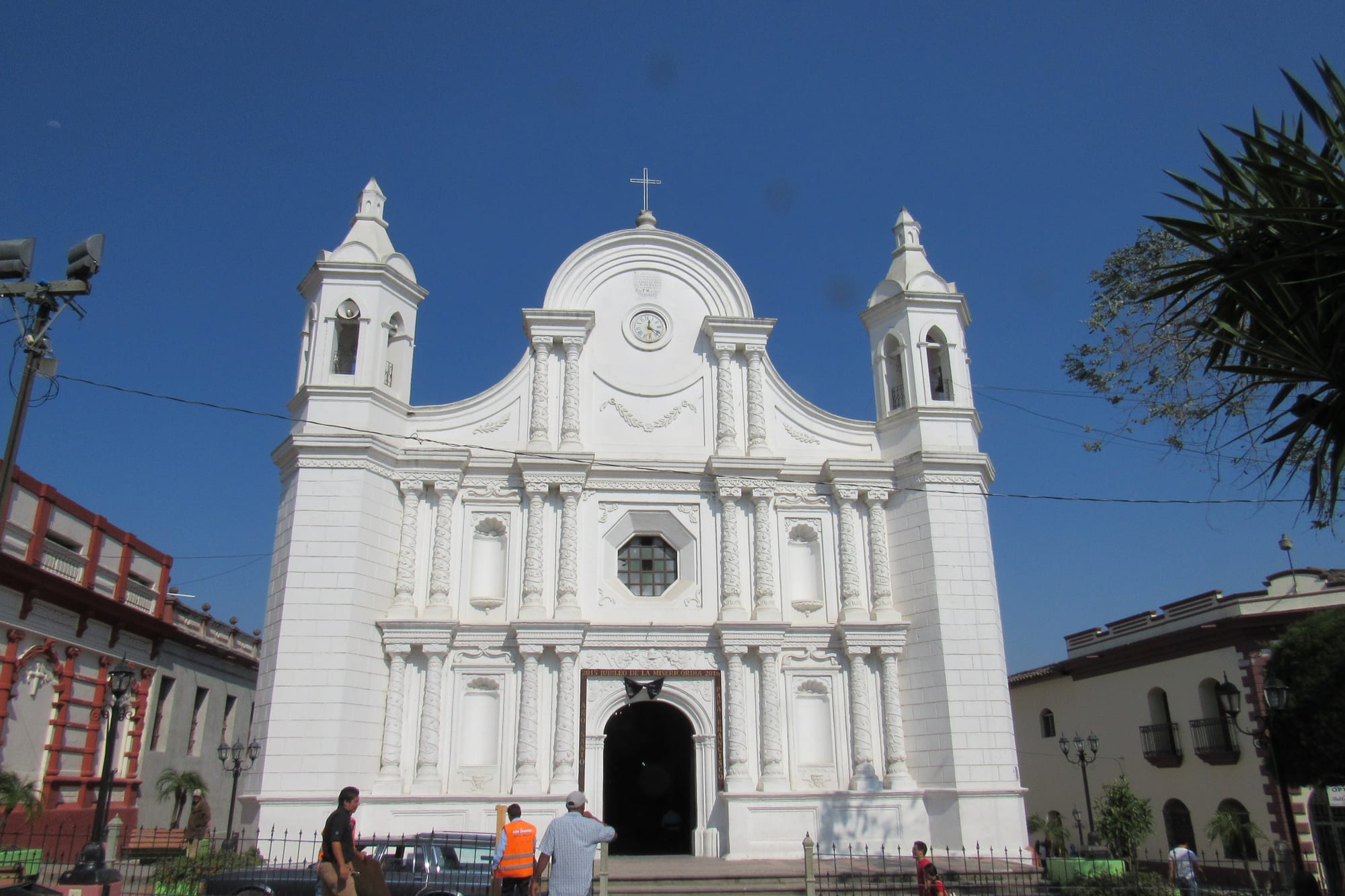
The white baroque facade and twin bell towers of a cathedral under a deep blue sky, with colonial buildings either side

Copán & the West, Honduras

Santa Rosa de Copán

The Cathedral of St Rose of Lima on the main square of Santa Rosa de Copán. (JMRAFFi / Wikimedia Commons · CC BY-SA 4.0)

The capital of Copán department and the largest town in western Honduras, set at about 1,150 metres on the highway from San Pedro Sula to the Salvadoran and Guatemalan borders. It grew in the eighteenth century around the Spanish crown's tobacco factory, and its cobbled, protected historic centre, white cathedral and cigar making still reflect that trade.

Neighbourhoods

  • El Centro
    • First-time visitors
    • Historic district
    • Best for food

    The protected historic centre of cobbled streets and neoclassical buildings around the central park and the cathedral. Nearly all the town's hotels, restaurants and bars are within a few blocks of the park, along with the old royal tobacco factory building.

    Open in Maps
  • Barrio Santa Teresa
    • Markets
    • Local life

    A working barrio close to the centre, home to the municipal market built in 1912 and a weekend farmers' market, as well as the old general cemetery.

    Open in Maps
  • Miraflores
    • Close to public transport
    • Sport

    The district at the bottom of the hill, with the main bus terminal and the city's football stadium; the town bus runs from here up through the centre.

    Open in Maps

Things to do

The historic centre

  • Cathedral of Santa Rosalandmark

    The whitewashed baroque cathedral on the central park, dedicated to St Rose of Lima, first built between 1798 and 1803 and repaired after earthquakes in 1877 and 1915.

    Open in Maps
  • Parque Centralpark

    The well-kept central square facing the cathedral, with benches for watching the town go by and a tourist information kiosk in the middle.

    Open in Maps
  • Casa Nacionallandmark

    The building of the Real Factoría de Tabacos, the crown tobacco factory completed in 1796, later home to a college and a university, in the centre of town.

    Open in Maps
  • La Flor de Copán cigar factoryattraction

    A cigar factory in the city where guided tours show how premium cigars are rolled by hand, a living link to the tobacco trade that built the town.

    Open in Maps

Markets and viewpoints

  • Municipal marketmarket

    The town market in Barrio Santa Teresa, completed in 1912, with a farmers' market at weekends selling vegetables and fruit from the surrounding hills.

    Open in Maps
  • Old cemeterylandmark

    A colourful, maze-like old cemetery, about half an hour's walk from the centre.

    Open in Maps
  • Town viewpointviewpoint

    A lookout at the edge of town, reached by more than a hundred steps, with a replica Maya statue and a view over the city.

    Open in Maps

Short trips from the town

  • Graciasattraction

    The colonial capital of Lempira department to the south-east, with old churches, a hilltop fort and hot springs nearby.

    Open in Maps
  • Celaque National Parkpark

    The cloud-forested massif above Gracias that holds Cerro Las Minas, the highest peak in Honduras.

    Open in Maps

Seasonal events

  • Holy WeekMarch or April

    Processions pass over carpets of coloured sawdust laid out on the streets by local artists.

  • Feria patronal and Juegos Floralesaround the feast of St Rose of Lima

    The patron-saint fair, with dances in the town's social halls and the Juegos Florales, a literary contest held every year since the 1980s.

Eat and drink

Long-standing places and food districts in Santa Rosa de Copán. Hours, ratings and directions come from your maps app, always current.

Santa Rosa classics

  • Baleadas and plato típicorestaurant

    Thick tortillas stuffed with beans and cream, with egg or avocado added, and the plato típico of meat, beans and plantain served in the town's comedores.

    Open in Maps
  • Ticucosmarket

    Corn masa with beans and a whole hard-boiled egg wrapped in a corn husk, sold by women in the park along with bags of fresh-cut pineapple.

    Open in Maps
  • Santa Rosa coffeecafe

    Coffee grown on the hills around the town, served in cafés in the centre, sometimes as a granita, a frozen coffee drink.

    Open in Maps

Markets

  • Farmers' market, Barrio Santa Teresamarket

    The weekend market for fresh vegetables and fruit from the area, beside the municipal market.

    Open in Maps

Experience Santa Rosa de Copán

History

The town began on 8 August 1705, when the Spanish captain Juan García de la Candelaria acquired the land then called Los Llanos from the crown and set up an estate of four ranches. Settlers named the place Santa Rosa, after St Rose of Lima. Indigo, cattle and above all tobacco made it prosperous: in 1765 it was chosen as the site of the Real Factoría de Tabacos, the crown's tobacco monopoly factory, whose building was completed in 1796, and the tobacco boom drew settlers from Comayagua, Gracias and other towns. The first cathedral was finished in 1803, and the town became a municipality as Los Llanos de Santa Rosa.

After independence it was on several occasions the capital of the State of Honduras, and in 1865 it was renamed Santa Rosa de Copán. The old tobacco factory building was given over to a college in 1874 and later to a university. Earthquakes in 1877 and 1915 damaged the cathedral, which was partly rebuilt in its baroque style; its repair coincided with the founding of the Diocese of Santa Rosa de Copán in 1916.

The twentieth century brought a municipal market in 1912, an airstrip in 1934 used by the first national airlines and air mail, and a long role as the administrative and commercial centre of the west. The town was attacked by rebel forces during the civil war of 1919. Today its historic centre, with neoclassical buildings and cobbled streets rooted in the tobacco wealth of the eighteenth century, is protected as a Honduran national monument.

Culture & Customs

Tobacco is still the town's emblem. Premium cigar tobacco is grown in the surrounding countryside, and the La Flor de Copán factory in the city rolls cigars by hand, carrying on a trade begun under the Spanish crown. The town also has a strong sense of itself as the cultivated capital of the west, and since the 1980s it has held the Juegos Florales, a literary competition judged by a permanent commission, as part of its patron-saint fair, along with dances in the town's social halls.

Religious life is centred on the cathedral, seat of a diocese since 1916. In Holy Week local artists lay carpets of coloured sawdust on the streets for the processions, one of the town's best-known traditions. Football is followed closely: the local club, Deportes Savio, plays at the municipal stadium in Miraflores.

People in the west are known as reserved and courteous. The central park is the town's meeting place, where people sit on the benches and women sell fresh-cut pineapple and street snacks.

Daily Life

The city has about 62,000 people, by a 2023 calculation, making it the largest and most important town in western Honduras and the governmental hub of Copán department. Its government offices also serve people from the neighbouring departments of Ocotepeque and Lempira.

Commerce is the main urban occupation, and the town is a market for the farms around it, which grow tobacco, coffee, basic grains and citrus. Tobacco for premium cigars remains a staple of the local economy, and local businesses are also building up tourism, helped by the town's position between the ruins of Copán and Gracias and Celaque.

Most daily life happens within a few blocks of the central park, where hotels, restaurants, banks and bars are concentrated, while the market district of Santa Teresa fills up on weekends with farmers selling produce. The town bus loops between the terminal at the bottom of the hill and the centre, and the highway carries steady traffic to San Pedro Sula and the borders.

Food

Santa Rosa eats the food of the western highlands, with a few sweets and drinks of its own. Local dishes include dulce de plátano, a sweet made from plantain; torrejas, a kind of French toast; ayote en dulce, squash cooked in sugar; tamalitos de elote, made from fresh corn; and totopostes, a hard maize bread. Ticucos, corn masa with beans and a hard-boiled egg wrapped in a husk, are sold in the park, and baleadas are served all over town.

The drinks are a point of local pride. Copán Dry is a fruit-flavoured soft drink made in the town and sold in small glass bottles. Atol de piña, made from pineapple and corn, chilate and other maize drinks are traditional, and coffee grown on the surrounding hills is served everywhere. The Honduran beers Salva Vida, Port Royal, Imperial and Barena are drunk ice-cold in the town's bars.

The municipal market and the weekend farmers' market in Barrio Santa Teresa sell fruit, vegetables and produce from the farms of the area.

Planning tools

Budget

Santa Rosa de Copán is cheaper than Copán Ruinas, with simple hotels, a few more comfortable ones, cheap comedores and baleada stalls, and taxis and town buses that cost very little. The cigar factory tour and trips out to Gracias or Copán are the main extra costs.

Daily Budget Midrange
USD 65–130 (comfortable hotel, restaurant meals, a cigar factory tour, a day trip by car)
Daily Budget Shoestring
USD 25–40 (guesthouse, comedor meals and street food, town bus and taxis)

Pick up a city map at the tourist kiosk in the central park.

Best Time to Visit

November to April is the drier season, with clear days, though December to February nights are cool at this height. March to June is the warmest stretch, and Holy Week brings the sawdust carpets and processions. The rains fall mostly from May to October, usually as afternoon storms.

Suggested Number of Days

One or two days are enough for the town itself. Allow three or four to use it as a base for the wider coffee and tobacco country of the west.

First Visit
1–2 days
With Surroundings
3–4 days

Transportation

The centre is compact and easily walked. Taxis are cheap anywhere in the centre, and the town bus, the Urbano, runs up and down the hill between the bus terminal and the centre, stopping at the central park. Old school buses leave frequently for nearby villages.

Use the town bus between the terminal at the bottom of the hill and the centre.

Airport & Station Connections

The town lies on the CA-4, the International Highway of the West, which runs north to San Pedro Sula, with the nearest international airport, and west to the borders with El Salvador at El Poy and Guatemala at Agua Caliente. Several bus companies run daily services to San Pedro Sula from the terminal at the bottom of the hill, and buses connect with Gracias and, via La Entrada, Copán Ruinas.

Walkability

Easy on foot: the hotels, restaurants and bars are all within a handful of blocks of the central park, though the town is on a hill and the walk up from the bus terminal is steep. The old cemetery is about half an hour's walk from the centre.

Safety

Honduras has had one of the highest homicide rates in the world, driven by gangs (MS-13 and Barrio 18) and drug trafficking, and San Pedro Sula and parts of Tegucigalpa remain dangerous. Santa Rosa de Copán is in one of the calmer parts of the country and sees little violent crime against visitors; petty theft is the main risk. Drug-trafficking routes run along the Guatemalan border, so remote border areas are best avoided.

Take ordinary care with valuables, use taxis after dark and do not travel the border roads at night. Check current official travel advice before travelling.

Climate

A subtropical highland climate, milder than most of the tropics because of the altitude, with about 1,500 mm of rain a year and a pronounced drier season in the winter months. Temperatures stay fairly even through the year.

Summer
the warmest months are March to June, with temperatures of about 25–29°C
Winter
December to February is cool, with temperatures of about 13–15°C

Local Customs

Santa Rosa is a Catholic, conservative town with strong regional pride, the seat of a diocese and of the department's government. People are reserved and courteous, and greetings are formal. Holy Week, with its processions over sawdust carpets, is the high point of the religious year.

Greet people before asking a question, dress modestly in churches, and ask permission before photographing people.

Common Payment Methods

The currency is the Honduran lempira. As the commercial centre of the west, the town has banks and cash machines in the centre, and cards are more widely used than in the smaller towns, but taxis, buses, street food and the markets deal in cash, so small notes are useful.