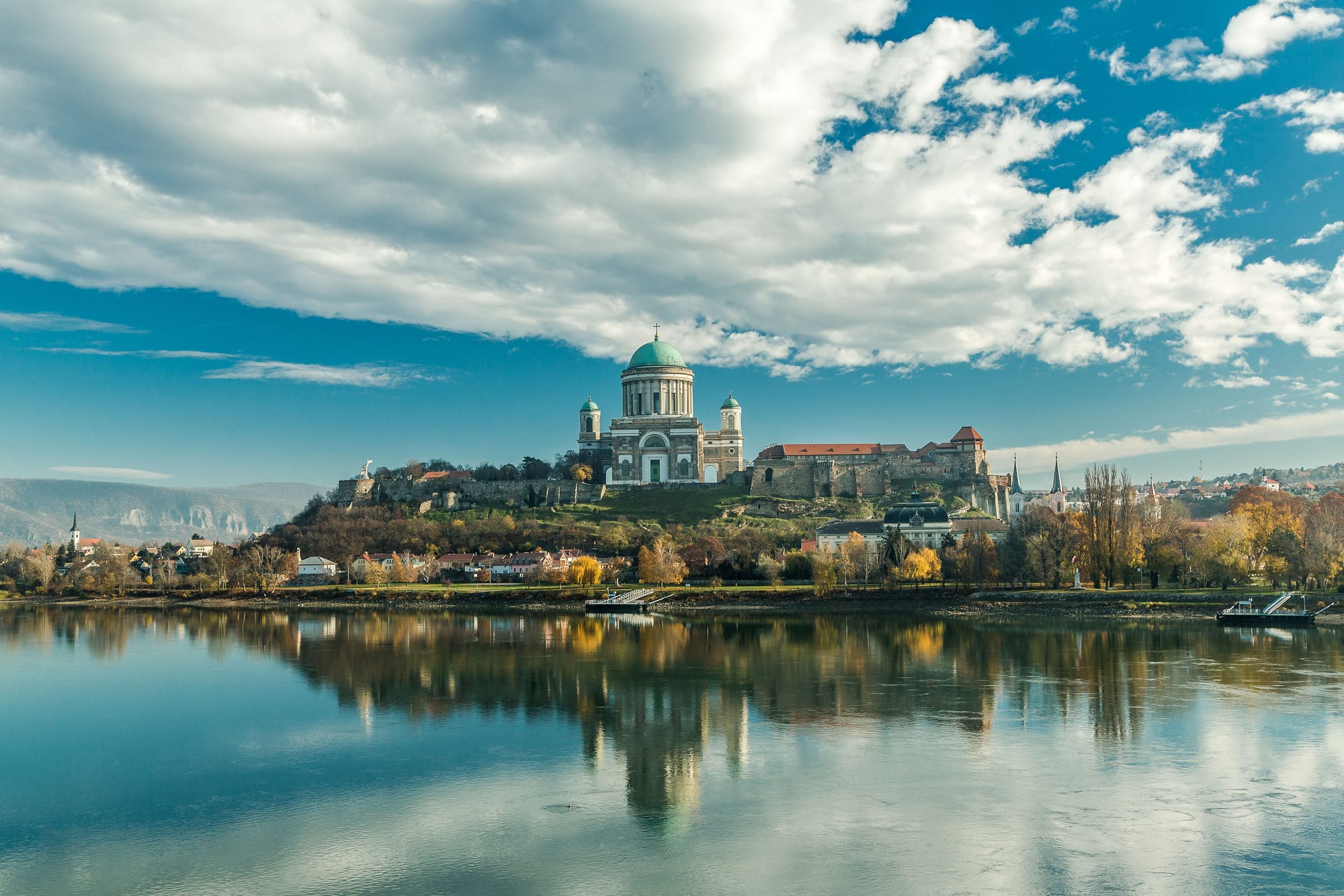
A domed basilica and castle buildings on a wooded hill above autumn trees, reflected in the still water of a wide river

Budapest & Central Hungary, Hungary

Esztergom

Esztergom Basilica and the castle on Castle Hill, seen across the Danube. (Gábor Bejó (artbejo) / Wikimedia Commons · CC0)

A Danube town on the Slovak border north-west of Budapest, where Hungary's first Christian king was born and crowned and which served as the royal capital until the 13th century. The seat of the Catholic primate ever since, it is dominated by a vast 19th-century basilica on Castle Hill above the baroque Watertown and a bridge to Štúrovo.

Neighbourhoods

  • Castle Hill
    • First-time visitors
    • Historic district
    • Viewpoints

    The hill above the Danube where the royal palace stood and where the basilica now rises, with the excavated remains of the medieval castle beside it. Its terraces look across the river to Slovakia and down on the Watertown.

    Open in Maps
  • Víziváros (Watertown)
    • Historic district
    • Museums
    • Riverside walks

    The baroque quarter at the foot of Castle Hill along the Kis-Duna, the narrow side arm of the river, with the Primate's Palace and its Christian Museum, the Jesuit parish church, the Cathedral Library and the Bálint Balassa Museum.

    Open in Maps
  • Town centre and Széchenyi tér
    • Cafés and restaurants
    • Close to public transport

    The main square of the town centre, with the Town Hall in the Vak Bottyán palace, the former savings bank and many cafés and restaurants; Bottyán János utca, with the former county hall, leads off it.

    Open in Maps
  • Primate Island
    • Parks
    • Riverside walks

    The island between the Kis-Duna and the main river, linked to the Watertown by the Kossuth Bridge at its northern tip and to Slovakia by the Mária Valéria Bridge, the largest green space near the centre, with sports grounds and the Aquasziget spa.

    Open in Maps

Things to do

Castle Hill

  • Esztergom Basilicalandmark

    The largest church in Hungary, built from 1822 and dedicated in 1856, with a dome 71.5 m high inside, the Renaissance Bakócz Chapel of 1507 and a crypt where archbishops including József Mindszenty are buried.

    Open in Maps
  • Castle Museummuseum

    A branch of the Hungarian National Museum beside the basilica, in the restored rooms of the medieval royal and archbishop's palace on the hill where Saint Stephen was born.

    Open in Maps

The Watertown

  • Christian Museummuseum

    The largest ecclesiastical collection in Hungary, in the Primate's Palace, with medieval altarpieces such as the Calvary Altarpiece by Thomas of Coloswar.

    Open in Maps
  • Bálint Balassa Museummuseum

    The town museum, in a baroque building on medieval foundations that served as the first county hall after the Ottomans were driven out.

    Open in Maps
  • Cathedral Librarylandmark

    One of Hungary's richest religious libraries, built in 1853 to plans by József Hild, holding about 250,000 books including codices and incunabula.

    Open in Maps
  • Jesuit parish churchlandmark

    The baroque church at the centre of the Watertown, built by the Jesuits in 1728–38 and dedicated to Saint Ignatius of Loyola.

    Open in Maps

The river and the bridge

  • Mária Valéria Bridgelandmark

    The bridge of about 500 metres to Štúrovo in Slovakia, designed in 1893, destroyed in the Second World War and reopened only in 2001; there are no border checks.

    Open in Maps
  • Saint Thomas Hillviewpoint

    The small residential hill where the town centre, the Watertown and Castle Hill meet, with a baroque Calvary of 1781 and the classicist chapel of Our Lady of Sorrows of 1823 on its summit.

    Open in Maps

Short trips from the town

  • Štúrovoattraction

    The Slovak town across the bridge, two-thirds of whose people belong to the Hungarian minority, with the Vadas Thermal Resort, the biggest aquapark in Slovakia.

    Open in Maps
  • Visegrádattraction

    The Danube Bend town upriver towards Budapest, with a ruined royal palace and a hilltop citadel.

    Open in Maps

Eat and drink

Long-standing places and food districts in Esztergom. Hours, ratings and directions come from your maps app, always current.

Esztergom classics

  • Restaurants around Széchenyi térneighborhood

    The main square and the streets around it hold many of the town's cafés and restaurants.

    Open in Maps
  • Watertown cafésneighborhood

    Cafés and restaurants along the Kis-Duna promenade and around the Primate's Palace, at the foot of Castle Hill.

    Open in Maps
  • Primatial wine cellarsmarket

    The wine museum in the primate's old cellar system beneath Castle Hill and the basilica.

    Open in Maps

Experience Esztergom

History

Castle Hill has been inhabited since the end of the last Ice Age, and the Romans built a fort here on the Danube frontier. After the Magyar conquest Grand Prince Géza built his palace on the old Roman site, and his son Vajk, later King Stephen I, was born there around 969–975. Stephen was crowned at Esztergom on Christmas Day 1000 or New Year's Day 1001, and he made it the seat of the archbishop who led the kingdom's ten bishoprics. Esztergom remained the royal residence and the centre of the Hungarian state until the Mongol siege of 1241, after which Béla IV handed the palace to the archbishop and moved to Buda.

The archbishops rebuilt and adorned the castle; in 1507 Archbishop Tamás Bakócz had Italian architects build the chapel that is the earliest and most significant surviving Renaissance building in Hungary. After Mohács in 1526 the town was besieged six times in seventeen years, and in 1543 Suleiman the Magnificent captured it. Esztergom became the centre of an Ottoman sanjak and a key fortress on the empire's north-western frontier. The poet Bálint Balassa died in the failed siege of 1594, and Ottoman rule lasted, with an interval, until 1683.

The baroque Watertown and town centre took shape after the reconquest, and the archbishopric returned in 1820. The new basilica, begun in 1822, was dedicated in 1856 with a Mass composed and conducted by Franz Liszt. After the Treaty of Trianon in 1920 Esztergom became a border town, and the bridge to Párkány, now Štúrovo, was destroyed in the Second World War. It reopened only in 2001, rebuilt with European Union support.

Culture & Customs

Esztergom is often called the Hungarian Rome or the town of Saint Stephen. As the seat of the primate of the Catholic Church in Hungary it is the country's ecclesiastical capital, and religious institutions shape its cultural life: the basilica, the Christian Museum with the largest church art collection in Hungary, the Cathedral Library of about 250,000 volumes, and a campus of the Pázmány Péter Catholic University near the basilica.

The basilica's music has a famous beginning. Franz Liszt wrote his Gran Mass, named after the town's German name, for the consecration of 1856 and conducted the premiere himself. Visitors also come to the crypt where Cardinal József Mindszenty, remembered for his opposition to both Nazi and Communist rule, is buried.

The border is the other part of local identity. Esztergom and Štúrovo across the river form a single cross-border area, and two-thirds of Štúrovo's people belong to the Hungarian minority in Slovakia. Since the Mária Valéria Bridge reopened and both countries joined the Schengen Area, there are no border controls on the bridge, and lively cross-border traffic links the two towns.

Daily Life

The 2022 census counted about 28,600 people in Esztergom, the second-largest town in Komárom-Esztergom county after Tatabánya. Nearly a fifth of them live in Esztergom-Kertváros, a district about 5 km south of the centre that has grown together with the neighbouring town of Dorog. Since 2022 Esztergom has been a city with county rights.

A major employer is the Magyar Suzuki plant, opened in 1992 as the European base of the Japanese car maker, and the town has long been a centre of the Hungarian tool and machinery industry. Church institutions, the university campus, schools, tourism and cross-border trade make up much of the rest of the economy.

Life in the centre is quiet and provincial. The Watertown and the streets around Széchenyi tér hold the shops, cafés and offices, families walk along the Kis-Duna and on Primate Island, and the Aquasziget spa on Primate Island draws on the town's hot springs, which also gave the Watertown part of its name. Day visitors fill Castle Hill at weekends and in summer, while the evenings belong to residents.

Food

Esztergom eats in the Danube style. Halászlé, the bright-red fisherman's soup made with plenty of hot paprika and carp or mixed river fish, belongs to the Danube and Tisza river regions and is one of the spiciest dishes native to Europe, and a natural dish for a town on the river. The restaurants around Széchenyi tér and in the Watertown serve the wider Hungarian repertoire.

Wine has deep roots here. The primates kept an extensive cellar system dug beneath Castle Hill and the basilica, now presented as a wine museum. Cafés in the town centre and along the Kis-Duna promenade serve cakes and coffee in the Hungarian coffee-house manner.

Across the river, Štúrovo's restaurants and supermarkets draw shoppers from both sides of the border, and its annual Fair of Saints Simon and Jude brings stalls and food to the Slovak bank. For many families in Esztergom, a meal or shopping trip in the next country is simply a walk over the bridge.

Planning tools

Budget

Most visitors come on a day trip, so the main costs are transport, a museum or two and a meal. Entrance to the basilica itself is free.

Daily Budget Midrange
USD 100–180 (guesthouse or small hotel, restaurant meals, museum tickets, a spa visit)
Daily Budget Shoestring
USD 45–75 (guesthouse or a day trip by train or bus, bakery and market food)

A day trip by train or bus from Budapest costs little; Štúrovo's shops and restaurants across the bridge price in euros.

Best Time to Visit

April to October, when the river boats run along the Danube Bend. Summer is warm and the town's busiest season. Winter is quiet and grey, with short days for the views from Castle Hill.

Suggested Number of Days

A single day covers Castle Hill, the Watertown and a walk across the bridge. Two or three days allow a slower pace and time for the rest of the Danube Bend and the hills behind the town.

First Visit
1 day
With Surroundings
2–3 days

Transportation

The centre is small enough to walk. The railway station is about twenty minutes on foot from the town centre and the basilica, and since 2020 the bus station has stood beside it on Bem tér. Local buses serve outlying districts such as Esztergom-Kertváros, about 5 km south of the centre.

The climb to Castle Hill is steep; the dome adds about 400 steps for those going up to the balcony.

Airport & Station Connections

Esztergom lies 46 km north-west of Budapest. Trains run from the capital, and buses run from Budapest either via Dorog or along the Danube via Visegrád. Seasonal river boats link the Danube Bend towns. Budapest's Ferenc Liszt International Airport is the nearest major airport. Trains on the Slovak side stop at Štúrovo, a walk of an hour or more from Esztergom across the bridge.

Walkability

Good: the town centre, the Watertown, Primate Island and the foot of Castle Hill are all within a short walk, and the bridge to Slovakia is a pleasant crossing on foot. The only real effort is the climb to the basilica and the steps up into its dome.

Safety

Hungary is a safe country with low levels of violent crime. Esztergom is a quiet provincial town; the main precautions are keeping an eye on bags in the crowds on Castle Hill and care on the steep paths and steps.

Carry a passport or national ID card when crossing the bridge into Slovakia, even though there are normally no border checks. Check current official travel advice before travelling.

Climate

Close to that of the capital: a climate between humid temperate and humid continental, with warm to hot summers and chilly winters in which snow is fairly frequent.

Summer
warm — in nearby Budapest July, the warmest month, averages close to 21°C
Winter
cold — in nearby Budapest January averages about -1.6°C

Local Customs

Esztergom is the centre of Catholic Hungary, the seat of the primate and a place of pilgrimage; the basilica is a working cathedral, so visitors dress modestly and keep quiet during services. Tips are customary in restaurants and cafés.

Check the bill for a service charge of about 10 per cent before adding a tip; avoid sightseeing inside the basilica during Mass.

Common Payment Methods

The currency is the Hungarian forint (HUF); across the bridge Štúrovo uses the euro. Cards are widely accepted in Esztergom, and ATMs are found in the town centre, but small cafés and stalls may prefer cash.