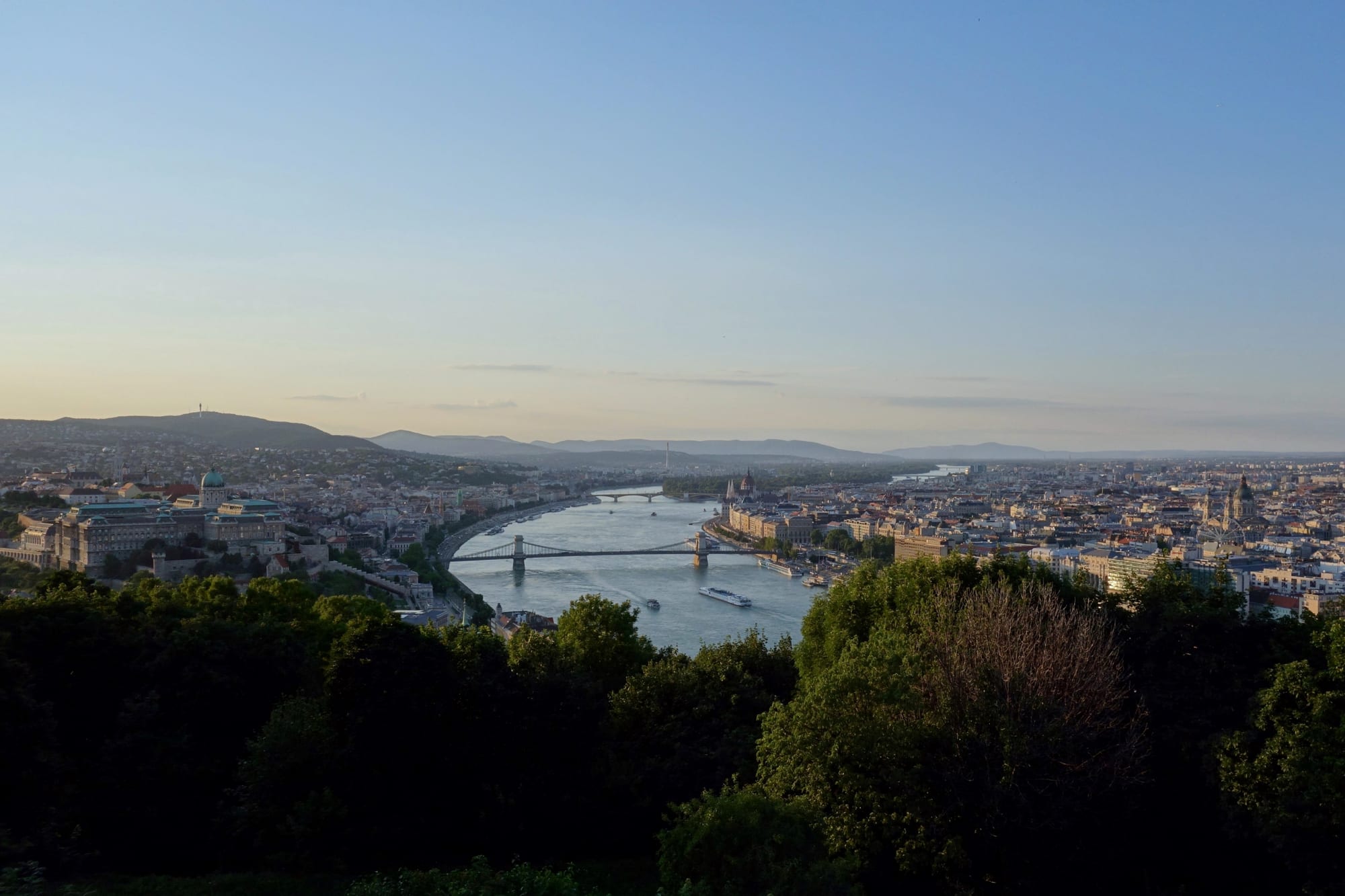
Evening view along the Danube with Buda Castle on the left, the Chain Bridge and Pest's rooftops on the right

Budapest & Central Hungary, Hungary

Budapest

The Danube, Buda Castle and the Chain Bridge seen from Gellért Hill on a summer evening. (Jean Eti / Wikimedia Commons · CC BY-SA 4.0)

Hungary's capital, split by the Danube into hilly Buda and flat Pest — a Roman frontier town, a medieval royal seat and an Ottoman stronghold before it was united in 1873 and grew into a great Central European city. Today it is a city of about 1.7 million known for its riverside parliament, castle hill, thermal baths and ruin bars.

Neighbourhoods

  • Castle District
    • First-time visitors
    • Historic district
    • Viewpoints

    The walled plateau of Castle Hill on the Buda side, with the royal palace at its southern end and quiet streets of baroque and medieval houses around the Matthias Church and the Fishermen's Bastion. It is busy with visitors by day and very calm at night.

    Open in Maps
  • Belváros (Inner City)
    • First-time visitors
    • Close to public transport
    • Shopping

    The historic core of Pest along the river, between the Chain Bridge and the Great Market Hall. Váci utca, Vörösmarty tér and the Danube promenade are here, and Lipótváros to the north holds the Parliament and St Stephen's Basilica.

    Open in Maps
  • Jewish Quarter
    • Nightlife
    • Best for food
    • Jewish heritage

    The old Jewish quarter of District VII, around the Dohány Street Synagogue, in the most densely populated district of Budapest. Its courtyards and half-empty tenements became the first ruin bars, and the streets around Kazinczy utca and Gozsdu Courtyard are the centre of the city's nightlife.

    Open in Maps
  • Terézváros and Andrássy út
    • Architecture
    • Opera and theatre
    • Close to public transport

    The district on either side of Andrássy út, the grand avenue running from the inner city to Heroes' Square, with the State Opera, the theatres of Nagymező utca and the Liszt Academy on Liszt Ferenc tér. The original metro line runs beneath the avenue.

    Open in Maps
  • Józsefváros
    • Local life
    • Museums
    • Students

    District VIII, behind the Hungarian National Museum, has a grand inner part of 19th-century palaces and a rougher, changing outer part. It is home to universities and the Rákóczi Square Market Hall.

    Open in Maps
  • Óbuda
    • Quiet and residential
    • Roman history

    One of the three towns united as Budapest in 1873, on the Buda bank to the north, where the Roman ruins of Aquincum and its amphitheatres survive and the old main square keeps baroque façades. Óbuda Island, the Sziget festival site, lies just offshore.

    Open in Maps

Things to do

Famous landmarks

  • Hungarian Parliament Buildinglandmark

    The neo-Gothic parliament on the Pest bank, finished in the early 20th century, the largest building in Hungary and home to the Holy Crown.

    Open in Maps
  • Buda Castlelandmark

    The royal palace complex on the southern end of Castle Hill, rebuilt many times since the Middle Ages and now home to museums and the national library.

    Open in Maps
  • Matthias Churchlandmark

    The Gothic church of the Castle District with a colourful tiled roof, where the last two kings of Hungary, Franz Joseph I and Charles IV, were crowned.

    Open in Maps
  • Fishermen's Bastionviewpoint

    A neo-Romanesque terrace of turrets beside the Matthias Church, built at the end of the 19th century, with views across the Danube to Pest.

    Open in Maps
  • Széchenyi Chain Bridgelandmark

    Opened in 1849, the first permanent bridge across the Danube in Budapest, guarded at each end by stone lions.

    Open in Maps
  • St Stephen's Basilicalandmark

    The largest church in Budapest, a domed neoclassical basilica in Lipótváros that keeps the mummified right hand of Hungary's first king.

    Open in Maps
  • Heroes' Squarelandmark

    The great square at the end of Andrássy út, with the Millennium Memorial's column and statues of the chieftains of the Magyar conquest.

    Open in Maps

Museums and heritage

  • Dohány Street Synagoguelandmark

    The largest synagogue in Europe, built in Moorish Revival style in the 1850s, with a memorial, a graveyard and the Hungarian Jewish Museum beside it.

    Open in Maps
  • Shoes on the Danube Banklandmark

    Sixty pairs of iron shoes on the Pest embankment near the Parliament, a memorial to the Jews shot into the river by Arrow Cross militiamen in 1944–45.

    Open in Maps
  • Hungarian National Museummuseum

    The national museum of history in a neoclassical building in Józsefváros, on whose front steps Sándor Petőfi's poem Nemzeti dal was read in the revolution of 1848.

    Open in Maps
  • House of Terrormuseum

    A museum on Andrássy út, in the building once used by the Arrow Cross and then the communist secret police, about the fascist and communist regimes.

    Open in Maps
  • Museum of Fine Artsmuseum

    The museum of international art, covering all periods of European art, in an eclectic-neoclassical building on Heroes' Square.

    Open in Maps
  • Aquincummuseum

    The ruins of the Roman town that was the capital of Pannonia Inferior, with streets, baths and an amphitheatre in Óbuda, and a museum.

    Open in Maps
  • Memento Parkmuseum

    An open-air museum in South Buda, far from the centre, where statues and monuments removed from Budapest after the fall of communism were brought together.

    Open in Maps

Thermal baths

  • Széchenyi Thermal Bathattraction

    The largest medicinal bath in Europe, a neo-baroque complex in City Park with three outdoor and 15 indoor pools.

    Open in Maps
  • Rudas Bathsattraction

    A bath of the Ottoman period between Gellért Hill and the Danube, with an octagonal pool under a 16th-century dome.

    Open in Maps

Parks, hills and the river

  • Margaret Islandpark

    A 2.5 km island park in the Danube between Buda and Pest, with gardens, a running track, medieval ruins and swimming pools.

    Open in Maps
  • Gellért Hillviewpoint

    The hill rising about 140 m above the river, crowned by the Citadella and the Liberty Statue, with a panoramic view over the river and both halves of the city.

    Open in Maps
  • City Parkpark

    The large park behind Heroes' Square, home to the Széchenyi Bath, Vajdahunyad Castle, the zoo and a boating lake that becomes an ice rink in winter.

    Open in Maps

Music and nights out

  • Hungarian State Operaattraction

    The opera house on Andrássy út, founded in 1884 as the Royal Hungarian Opera.

    Open in Maps
  • Liszt Academyattraction

    The music academy founded by Franz Liszt, whose Art Nouveau concert hall on Liszt Ferenc tér is one of the city's main concert venues.

    Open in Maps
  • Szimpla Kertattraction

    The pioneer of the ruin bars, a rambling courtyard bar in the Jewish Quarter that also hosts films, concerts and a farmers' market.

    Open in Maps

Short trips from the city

  • Gödöllő Royal Palacelandmark

    A baroque mansion north-east of the city, given to Franz Joseph and Elisabeth as a coronation gift and her favourite retreat in Hungary; the HÉV suburban railway reaches it.

    Open in Maps

Seasonal events

  • Budapest Spring Festivalspring

    The city's main arts festival, focused on classical music.

  • Hungarian Grand Prixsummer, between mid-July and late August

    The Formula One race at the Hungaroring on the north-eastern outskirts, on the calendar every year since 1986.

  • Sziget FestivalAugust

    A week-long music festival on Óbuda Island, with more than a thousand performances and about half its visitors from abroad.

  • Saint Stephen's Day20 August

    The national holiday in memory of the founding of the state and its founder, King Saint Stephen, marked with parades and fireworks.

Eat and drink

Long-standing places and food districts in Budapest. Hours, ratings and directions come from your maps app, always current.

Budapest classics

  • Café Gerbeaudcafe

    A traditional coffee house on Vörösmarty tér, opened in 1858, known for its cakes and pastries.

    Open in Maps
  • Coffee houses of the inner districtsneighborhood

    The grand cafés of Pest's inner districts keep up the city's coffee-house tradition, with Dobos torte and other layered cakes.

    Open in Maps

Markets and food districts

  • Great Market Hallmarket

    The largest and oldest indoor market in Budapest, opened in 1897 at the end of Váci utca, with stalls of paprika, sausage and salami, and Tokaji wine.

    Open in Maps
  • Rákóczi Square Market Hallmarket

    A market hall in Józsefváros built in 1894, burned down in 1988 and operating in its present form since 1991.

    Open in Maps
  • Gozsdu Courtyardneighborhood

    A passage of seven linked courtyards built in 1901 between Király utca and Dob utca, known for its cafés and bars.

    Open in Maps

Bars

  • Ruin bars of the Jewish Quarterneighborhood

    Bars set up since the early 2000s in the abandoned buildings of District VII's old Jewish Quarter.

    Open in Maps

Experience Budapest

History

The Romans built Aquincum on the Danube frontier, and in 106 AD it became the main city of the province of Pannonia Inferior; its streets and amphitheatre survive in Óbuda. After the Magyar conquest the area grew around three settlements: Óbuda, Pest on the flat eastern bank, and later Buda, where Béla IV built a castle on the hill after the Mongols pillaged the area in 1241. Buda became a royal seat, and under Matthias Corvinus in the 15th century it was a Renaissance court.

The Ottomans took Buda in 1526 and 1529 and occupied it for good in 1541. Nearly 150 years of Ottoman rule followed, and some of the baths built in that period, the Rudas and Király among them, are still in use. A Habsburg-led army retook Buda in 1686, and the towns were slowly rebuilt and resettled. Pest became the centre of the revolution of 1848; the Chain Bridge, the first permanent bridge across the Danube, opened in 1849, and in 1873 Buda, Pest and Óbuda were united as Budapest.

The new capital grew fast. The millennium of 1896 brought Andrássy út's underground railway, the first on the European continent, and the city was rebuilt with grand boulevards, the Parliament and the market halls. The 20th century was harsh: air raids in 1944, the siege from 24 December 1944 to 13 February 1945, which wrecked much of the city, and the murder of a large part of its Jewish community. In October 1956 the revolution against communist rule began in its streets. Since 1989 the city has restored its historic centre and become a major tourist destination.

Culture & Customs

Budapest thinks of itself as two cities. Buda, on the hills to the west, is residential, green and quiet; Pest, on the plain, holds the government, the business district, the theatres and most of the nightlife. The river between them, with its bridges, the Parliament and Castle Hill, is the city's shared symbol, and the banks of the Danube, the Castle District and Andrássy út are listed together as a UNESCO World Heritage Site.

The thermal baths are part of ordinary life. More than a hundred springs feed bath complexes where people swim and soak in every season, and the Ottoman-era domes of Rudas sit alongside the neo-baroque palace of Széchenyi. The coffee houses are part of the city's tradition, and classical music runs deep: the Liszt Academy, founded by Franz Liszt, and the State Opera on Andrássy út are among the busiest venues, and the Budapest Spring Festival is the city's main arts festival.

Since the early 2000s the ruin bars of the old Jewish Quarter, set up in the courtyards of rundown tenements, have made Budapest known for its nightlife, while the Dohány Street Synagogue, the largest in Europe, serves the fifth largest Jewish community on the continent. Sport also has a large following: the Puskás Aréna, with nearly 70,000 seats, hosted the 2026 UEFA Champions League final, and the city staged the World Athletics Championships in 2023.

Daily Life

Budapest itself had more than 1.7 million registered residents in 2017, and about 3.3 million people live in the wider metropolitan area, around a third of Hungary's population. The city produces more than 40 per cent of the country's economic output and is home to the national government, the head offices of the largest Hungarian companies, such as MOL and OTP Bank, and more than 30 universities with over 150,000 students. Tourism is a large employer: the city received about 7 million international overnight visitors in 2025.

The city is divided into 23 districts, each with its own mayor and council. Many residents live in older apartment blocks in the inner Pest districts, on the greener Buda side, or in the large housing estates built under communism. Since the 1990s many families have moved to the surrounding suburbs of Pest county, and the city's population has fallen from its 1980s peak of about 2.1 million.

Public transport carries more than two million passengers a day, and the yellow trams on the Grand Boulevard and along the river are part of the daily routine. Lunch is traditionally the main meal of the day, and the inner districts stay busy late into the evening.

Food

Budapest's food culture grew up in its coffee houses and pastry shops. The Dobos torte, a sponge cake layered with chocolate buttercream and topped with caramel, was invented by the Budapest delicatessen owner József C. Dobos in the late 19th century, and Café Gerbeaud, opened in 1858 and on Vörösmarty tér since 1870, is among the city's traditional coffee houses. The Ottoman period left its mark too, in sweets such as the white nougat called törökméz, in stuffed peppers and in töltött káposzta, stuffed cabbage.

Everyday eating is plainer. Lángos, deep-fried flatbread, is sold at markets, fairs and bus stations; főzelék, a thick vegetable dish that sits between a soup and a stew, is eaten as a lunchtime main course or alongside meat. The Great Market Hall, opened in 1897 at the end of Váci utca, is the largest and oldest indoor market in the city, with stalls of paprika, sausages and other produce, while neighbourhood halls such as the Rákóczi Square Market Hall serve local shoppers.

Unicum, the bitter herbal liqueur, is made by Zwack, one of the large Hungarian companies headquartered in the city. The bars of District VII have made the ruin bar, set up in an abandoned building, a Budapest institution, and the Gozsdu Courtyard nearby is known for its cafés and bars.

Planning tools

Budget

Prices in Budapest are lower than in many other major European cities. Hotels in the inner districts and restaurants along Váci utca and in the Castle District cost the most; eating where locals do, in market halls, canteens and the outer districts, cuts the bill sharply. Bath tickets are a noticeable daily cost for anyone who visits several.

Daily Budget Midrange
USD 110–220 (central hotel, restaurant meals, a bath visit, museum tickets)
Daily Budget Shoestring
USD 50–85 (hostel dorm, market-hall food, lángos and bakery snacks, a public-transport pass)

Travel cards for 24 or 72 hours cost far less than single tickets for anyone using public transport a lot.

Best Time to Visit

April to June and September to October bring mild weather and the best conditions for walking and river trips. July and August are hot and crowded, with the Sziget festival and the Grand Prix. Winter is cold and has little sunshine, but it is the season for steaming outdoor bath pools.

Suggested Number of Days

Three or four days give time for both banks of the city and a bath. A week allows trips to the Danube Bend towns and the palace at Gödöllő. Hot summer afternoons and short winter days slow the pace.

First Visit
3–4 days
With Surroundings
5–7 days

Transportation

Public transport is dense and the main way around: four metro lines, including the M1 under Andrássy út, which opened in 1896 as the first on the European mainland, a large tram network, trolleybuses, buses and the HÉV suburban railway. Tram 2 runs along the Pest riverbank, and trams 4 and 6 are among the busiest city tram lines in the world. Boats run on the Danube, and the funicular climbs Castle Hill from the Chain Bridge.

Validate tickets each time on boarding, as inspectors guard many metro entrances; use licensed taxis or order one by phone or app.

Airport & Station Connections

Budapest Ferenc Liszt International Airport is 16 km south-east of the centre, linked by the 100E airport bus and by bus 200E to the end of metro line 3 at Kőbánya-Kispest; Főtaxi is the licensed taxi operator at the airport. International trains arrive at Keleti, Nyugati and Déli stations from Vienna and other Central European cities, and long-distance coaches use Népliget.

Walkability

The inner districts of Pest are flat, compact and easy on foot, and the Danube promenade links the main riverside sights. Buda is hilly: Castle Hill and Gellért Hill involve steep climbs, which buses and the funicular avoid. Distances across the river grow quickly, and trams are the easy way to cover them.

Safety

Hungary is a safe country with low levels of violent crime. In Budapest the risks for visitors are pickpockets on busy trams, in the metro and around the main sights, bars and clubs that run up large bills, and unlicensed taxis. The nightlife streets of District VII are crowded and noisy late at night.

Use licensed taxis or an app, check prices before ordering in bars, and keep bags closed on public transport. Check current official travel advice before travelling.

Climate

A climate between humid temperate and humid continental, with warm to hot summers and chilly winters. Snow is fairly frequent in most years, and the built-up centre holds heat in summer.

Summer
warm to hot — July, the warmest month, averages close to 21°C, and the record high is 40.7°C
Winter
chilly — January averages about -1.6°C, and night-time temperatures of -10°C are not uncommon between mid-December and mid-February

Local Customs

Tips are customary in restaurants, bars and taxis, and social norms encourage them even though they are not required. Swimwear is worn in the thermal baths, which are social places where people come to soak and talk rather than to swim fast. Modest dress suits visits to the city's churches and synagogues.

Ask whether a service charge is already included in the bill before tipping; otherwise a tip of about 10 per cent is customary.

Common Payment Methods

The currency is the Hungarian forint (HUF). Cards and contactless payment are accepted almost everywhere, including on public transport ticket machines. Independent exchange booths in tourist areas vary widely; ATMs of the major banks are the safer way to get cash.