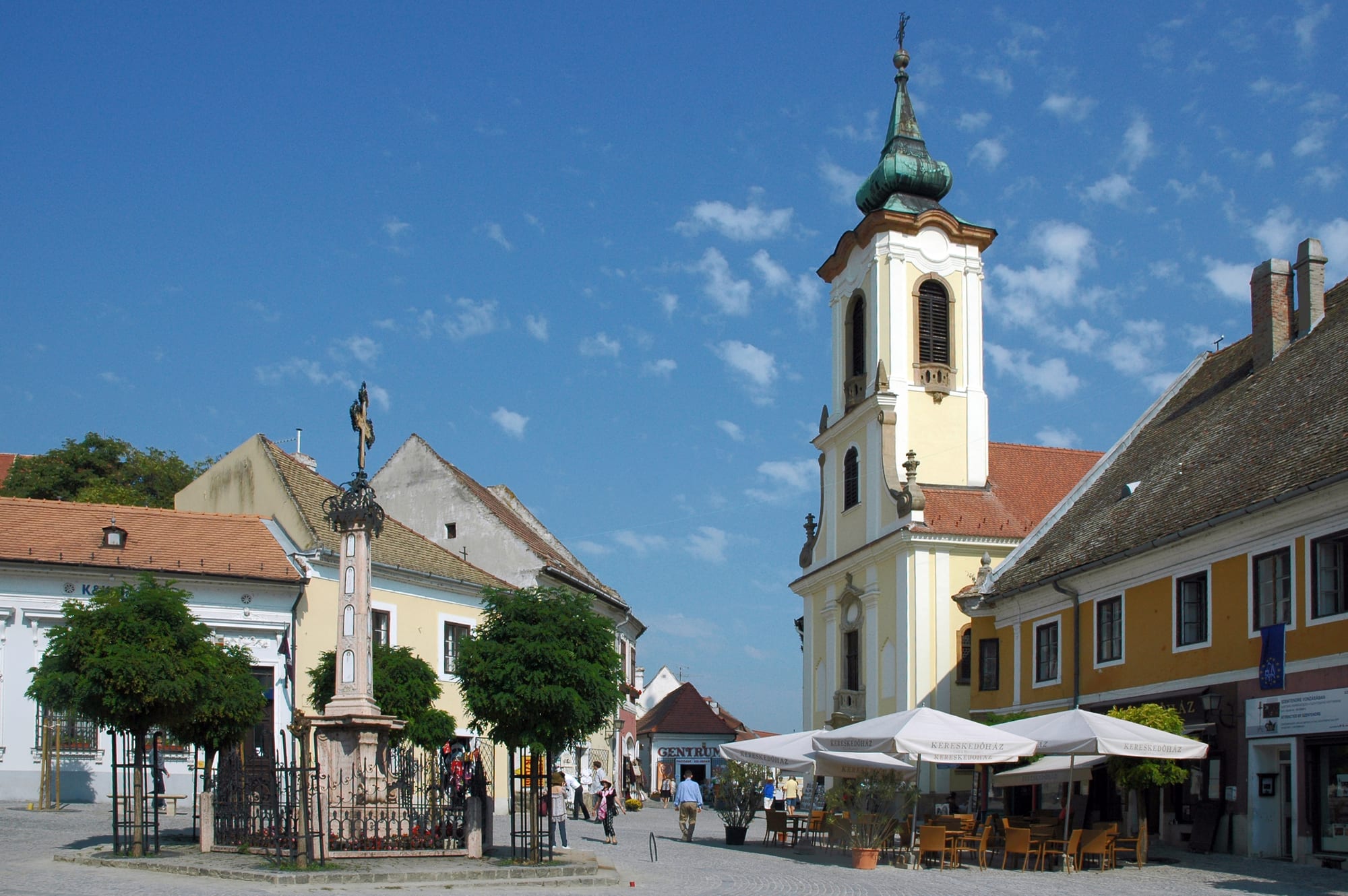
A sunny cobbled square with low baroque houses, a tall stone cross behind railings and a yellow church tower with a green spire

Budapest & Central Hungary, Hungary

Szentendre

Fő tér, the main square of Szentendre, with the memorial cross and the tower of the Annunciation Church. (DimiTalen / Wikimedia Commons · CC0)

A riverside town on the west bank of the Danube just north of Budapest, rebuilt by Serbian refugees after the Ottoman wars and later adopted by Hungarian painters. Its baroque houses, Orthodox church towers and cobbled lanes now draw day visitors to galleries, small museums and the large Hungarian Open-air Museum on the edge of town.

Neighbourhoods

  • Old town and Fő tér
    • First-time visitors
    • Historic district
    • Museums

    The compact historic centre around Fő tér, the main square with its memorial cross, rising to Church Hill above it. Narrow cobbled lanes of baroque houses hold most of the museums, the Orthodox churches, galleries and souvenir shops, and it is busy with day visitors from Budapest.

    Open in Maps
  • Danube promenade
    • Riverside walks
    • Boats
    • Cafés

    The riverside promenade, the Duna korzó, along the edge of the old town. The boat station for the Budapest and Visegrád excursion boats is here, along with restaurants and a quieter walk away from the crowds of the centre.

    Open in Maps
  • The north end and the artists' quarter
    • Art and galleries
    • Quiet and residential

    The northern part of town, where the artists' colony worked from the 1920s, with quieter streets of houses and the Gallery of the Artists' Colony on Bogdányi utca. More than two hundred artists still live in the town.

    Open in Maps

Things to do

Churches and landmarks

  • Belgrade Cathedrallandmark

    The largest of the town's Serbian Orthodox churches, built in baroque style in 1756–63 by settlers from Belgrade, whose 48-metre bell tower is the tallest in Szentendre.

    Open in Maps
  • Annunciation Churchlandmark

    A baroque and rococo Serbian Orthodox church on Fő tér with an iconostasis painted in 1802–04, now used mostly as a museum.

    Open in Maps
  • Fő térlandmark

    The main square, lined with former merchants' houses and centred on a memorial cross, at the heart of the old town.

    Open in Maps

Museums

  • Hungarian Open-air Museummuseum

    Hungary's largest outdoor ethnographic collection, founded in 1967, with authentic buildings moved from different regions and precise replicas of folk architecture on a 63-hectare site north-west of town.

    Open in Maps
  • Margit Kovács Ceramics Museummuseum

    One of the town's most popular museums, opened in 1973, devoted to the work of the ceramic artist Margit Kovács.

    Open in Maps
  • Czóbel Museummuseum

    A museum on Church Hill devoted to the painter Béla Czóbel, a member of The Eight, who settled in Szentendre in 1940; the museum opened in his lifetime, in 1975.

    Open in Maps
  • Serbian Orthodox Ecclesiastical Art Collectionmuseum

    Icons, prayer books and gospels, goldsmiths' work, textiles and wood carvings of the Orthodox Church in Hungary, in a museum beside the Belgrade Cathedral.

    Open in Maps
  • Marzipan Museummuseum

    A colourful exhibition of figures and scenes made entirely of marzipan, on Dumtsa Jenő utca.

    Open in Maps

Short trips from the town

  • Danube-Ipoly National Parkpark

    One of the most diverse national parks in Hungary, formed in 1997 from the Pilis and Börzsöny national parks; marked hiking trails start at the HÉV terminus, and a bike path runs up the Bükkös creek valley.

    Open in Maps
  • Visegrádattraction

    A town upriver on the Danube Bend, with a ruined royal palace and a hilltop citadel, about 45 minutes away by bus or reached by the summer excursion boats.

    Open in Maps

Seasonal events

  • Summer festivalsJune to August

    A season of summer festivals and concerts in the town, including concerts of the summer academy of early music in August.

  • Serbian church festival19 August

    The Szerb búcsú, the town's Serbian church festival.

Eat and drink

Long-standing places and food districts in Szentendre. Hours, ratings and directions come from your maps app, always current.

Szentendre classics

  • Restaurants around Fő térneighborhood

    The terraces of the main square and the lanes around it serve Hungarian cooking to day visitors, with tables out on the cobbles in the warmer months.

    Open in Maps
  • Szabó Marzipan Museum and Confectionerycafe

    A confectionery with a museum of figures and scenes made entirely of marzipan.

    Open in Maps
  • National Wine Museumrestaurant

    An exhibition of Hungary's wine regions and winemaking tools on Bogdányi utca, with wine tastings and the Labirintus restaurant.

    Open in Maps

Experience Szentendre

History

The first well-known settlement here was Ulcisia Castra, a Roman fortress on the Danube frontier. After the Magyar conquest a settlement grew up on the remains of the Roman buildings, and the name Sanctus Andreas — Saint Andrew, Szentendre in Hungarian — first appears in a will of 1146 confirmed by King Géza II. The Ottoman wars almost emptied the town: a 17th-century record found only one family and its servants living here.

During the Great Turkish War Serbs were invited to move to Hungary away from the Ottoman Empire, and in 1690 a mass migration of Serbs reached the Szentendre area. Dalmatian families settled too, on the slope where Dalmát Street still recalls them. The newcomers prospered as merchants, and their wealth paid for the baroque houses, the Orthodox churches, among them the cathedral the settlers from Belgrade built in 1756–63, and the narrow alleys that give the town its character. In the 18th century Serbs were the majority; in the 19th century their numbers declined, and Hungarians became the largest group.

Szentendre stayed a small town of three to four thousand people into the 1870s. The railway from Budapest, opened in 1888, brought it closer to the capital, and from the early 20th century its calm provincial life drew painters; an artists' colony worked in the north of the town from the 1920s, and the Szentendre Artists' Colony was formally founded in 1929. Suburban growth after the 1970s filled the surrounding hillsides with houses, and the town has become one of the best-known day trips from Budapest.

Culture & Customs

Art is the town's identity. Generations of Hungarian painters have lived here since the early 20th century, and more than two hundred artists, writers, musicians and actors still do. Museums are devoted to individual artists who worked in the town — the painter Béla Czóbel, a member of the avant-garde group The Eight, the ceramic artist Margit Kovács, Károly Ferenczy, the founder of Hungarian modernism, and the couple Imre Ámos and Margit Anna — and the Ferenczy Museum Center runs many of them together. Galleries of contemporary work fill the old houses of the centre.

The Serbian heritage is the other strand. The town keeps several Serbian Orthodox churches, the Belgrade Cathedral being the largest, under the Eparchy of Buda of the Serbian Orthodox Church, and a museum of Serbian church art beside it. The community that built them is now small, but the church towers dominate the skyline and the Serbian church festival is held each August.

Summer brings festivals and concerts to the town. The Hungarian Open-air Museum on the edge of town, the country's largest collection of rebuilt rural buildings, shows folk architecture from the mid-18th to the mid-20th century, and its grounds stood in for a village in the Netflix series The Witcher.

Daily Life

About 28,000 people lived in Szentendre in 2021, a big change from the small town of three to four thousand people that it remained until the 1870s. Large areas around the old centre were added to the town in the late 1970s, and by the early 21st century they had filled with family houses climbing into the surrounding hills.

Szentendre lies within the Budapest agglomeration, linked to the capital by the HÉV railway, and suburban growth has made it in part a green suburb of the capital. Tourism shapes the centre: souvenir shops, restaurants, galleries and museums occupy much of the old town, and summer weekends bring crowds of day visitors. Away from the historic core, life is quieter, in residential streets spreading up hills such as Szarvashegy, where some people live in weekend houses year-round.

The rhythm of the town follows the visitors in the centre and the commuter timetable elsewhere. Growth has strained local infrastructure, which has been slow to keep up with the rising population.

Food

Szentendre's restaurants mostly serve standard Hungarian cooking, and the terraces around Fő tér and the lanes leading off it are where most visitors eat, with the busiest tables on summer weekends when day visitors arrive from Budapest. Lángos, the deep-fried flatbread sold at stalls across Hungary, is the classic snack for day trippers and cyclists arriving along the river from Budapest. It was once made from the last bits of bread dough, baked at the front of a brick or clay oven and eaten hot for breakfast on baking day.

Marzipan has its own museum here: the Szabó marzipan museum and confectionery shows scenes and figures made entirely of marzipan. Pastry shops and cafés around the main square serve cakes in the Hungarian coffee-house tradition.

Wine is the other draw. The National Wine Museum on Bogdányi utca presents the wine regions of Hungary and winemaking tools and offers tastings, and in winter cheap hot wine is sold in the centre.

Planning tools

Budget

Restaurants and shops on and around Fő tér are priced for visitors. Most people come as a day trip from the capital, so the main costs are museum tickets and a meal; the Ferenczy Museum Center offers a combined ticket for many of the town's museums.

Daily Budget Midrange
USD 100–190 (guesthouse or small hotel, restaurant meals, museum entries, a river boat)
Daily Budget Shoestring
USD 45–75 (guesthouse room or a day trip on the HÉV, lángos and bakery food)

The combined ticket for the Ferenczy Museum Center's museums costs little more than a single entry.

Best Time to Visit

Late spring to early autumn, when the excursion boats run on the Danube and the summer festival fills the main square. Summer weekends bring large crowds from Budapest. Autumn is quieter, and in winter the town is calm, with mulled wine sold in the centre and some museums on shorter hours.

Suggested Number of Days

Most visitors come for a single day from Budapest, which is enough for the old town and a museum or two. Staying two or three nights allows time for the open-air museum, the hills behind the town and the other towns of the Danube Bend.

First Visit
1 day
With Surroundings
2–3 days

Transportation

The old town is small and best seen on foot. The HÉV suburban railway and bus station stand side by side about ten minutes' walk from Fő tér, and local buses run to the open-air museum. Buses also link the other Danube Bend towns, and a riverside cycle path runs from Budapest.

Comfortable shoes are worth wearing: the lanes of the old town are cobbled and Church Hill is steep.

Airport & Station Connections

Szentendre is about 19 km north of Budapest, reached by Line 5 of the HÉV suburban railway, which has run since 1888, and by bus. In the warmer months excursion boats on the Budapest–Szentendre–Visegrád line call at the town's boat station. The nearest airport is Budapest's Ferenc Liszt International Airport, on the far side of the capital.

Walkability

Very walkable: the old town, Church Hill and the Danube promenade are all within a few minutes of each other. The streets are cobbled and some are steep. The open-air museum lies about 2 km north-west of the centre, a bus ride or a long walk away.

Safety

Hungary is a safe country with low levels of violent crime. Szentendre is a small town, and the main care needed is with belongings in the crowded lanes on summer weekends.

Keep bags closed in the crowds around Fő tér and wear sturdy shoes on the steep cobbled lanes. Check current official travel advice before travelling.

Climate

Much like the capital just to the south, a climate between humid temperate and humid continental, with warm to hot summers and chilly winters in which snow is fairly frequent.

Summer
warm — in nearby Budapest July, the warmest month, averages close to 21°C
Winter
cold — in nearby Budapest January averages about -1.6°C

Local Customs

Tips are customary in restaurants and cafés. The Serbian Orthodox churches are places of worship and part of a living community: quiet behaviour and modest dress are expected inside. Many artists live in the town, and galleries are working businesses rather than museums.

Check the bill for a service charge of about 10 per cent before adding a tip.

Common Payment Methods

The currency is the Hungarian forint (HUF). Cards are widely accepted in restaurants, shops and museums, but small stalls, lángos sellers and some galleries prefer cash; there are ATMs in the town centre.